
Work Letter: Common Types and Ready-to-Use Templates
Work letter guide with common types and ready-to-use templates for requests, resignations, negotiations, and HR issues. Copy, customize, send fast.
A clear work letter can do two things at once: communicate professionally and create a written record. Whether you are applying for a role, requesting a change at work, or documenting an issue, having the right format and a strong starting template saves time and reduces stress.
Below you will find the most common types of work letter, what each one is for, and copy-ready templates you can adapt in minutes.
What counts as a “work letter” (and when it beats a quick email)
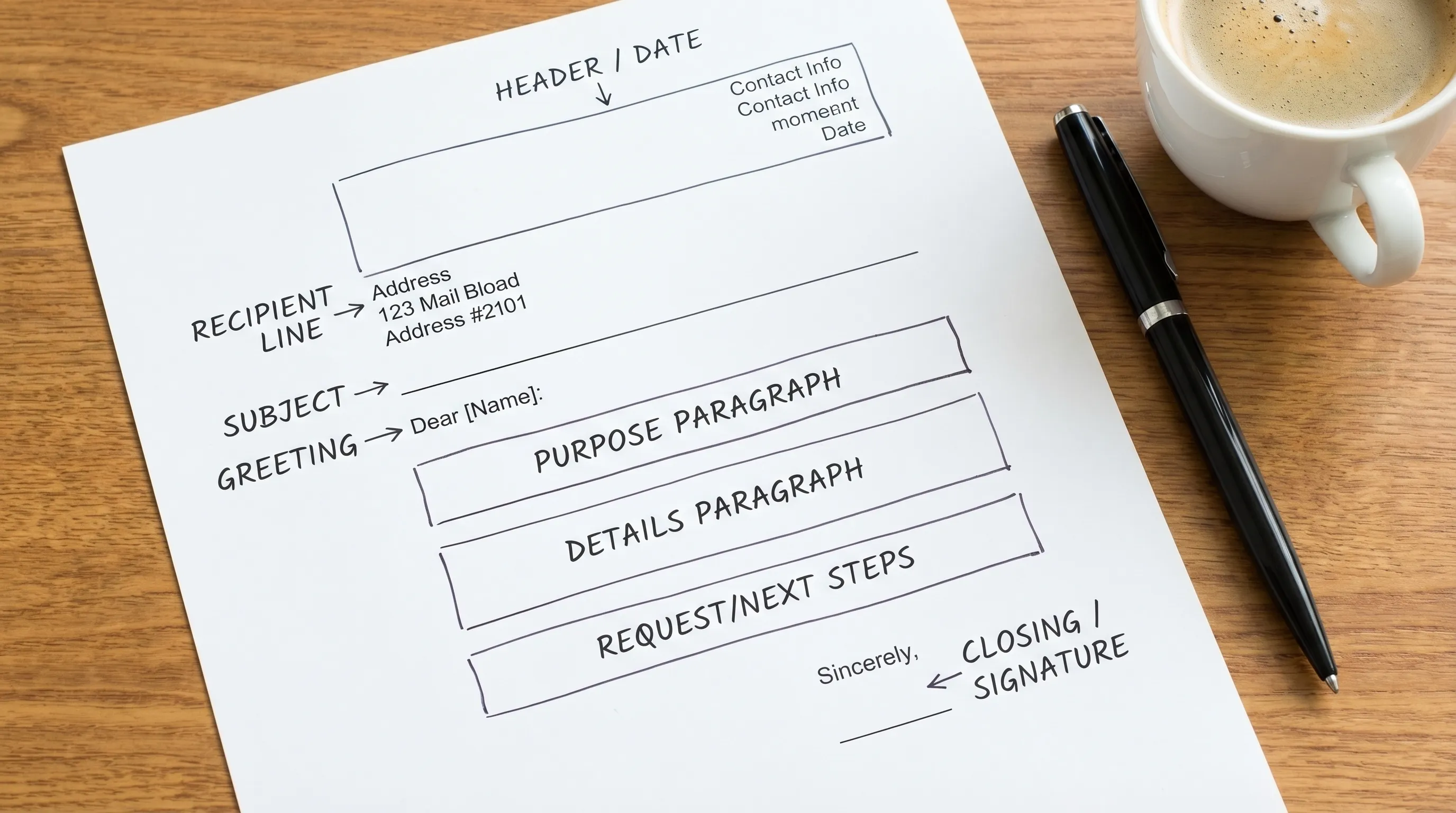
A work letter is a structured, professional message used in workplace situations where clarity, tone, and documentation matter. Many work letters are sent as emails today, but they still follow letter conventions: a specific subject, a direct purpose statement, and a polite close.
Use a work letter (instead of an informal message) when:
- You need approval or a decision (leave, schedule changes, budget, promotion).
- You are negotiating terms (salary, offer details, role scope).
- You are creating a record for HR or compliance (complaints, policy issues).
- You want to protect relationships with a measured, professional tone (resignations, apologies).
Quick formatting rules (US-friendly)
Most workplace letters work best in a simple block format:
- Left-aligned text
- Single spacing with a blank line between paragraphs
- 10 to 12 pt readable font
- Short paragraphs (2 to 4 lines whenever possible)
If you are attaching a PDF, include a subject line and a clean filename (example: Leave_Request_Jordan_Lee_2026-04-14.pdf). For a refresher on standard business letter conventions, Purdue OWL’s business letter guide is a reliable reference: Purdue OWL: Business Letters.
Common work letter types (with ready-to-use templates)
Here is a quick map of the most common workplace letters and how they are typically used.
| Work letter type | Best for | Typical tone | Typical length |
|---|---|---|---|
| Job application letter | Applying when a formal letter is requested | Confident, specific | 200 to 400 words |
| Offer acceptance letter | Accepting and confirming details | Positive, clear | 120 to 250 words |
| Resignation letter | Leaving professionally | Brief, respectful | 80 to 180 words |
| Salary negotiation letter | Countering an offer or requesting adjustment | Firm, collaborative | 200 to 350 words |
| Promotion request letter | Asking for a new title/level | Evidence-based | 250 to 450 words |
| Leave request letter | PTO, medical, personal leave | Practical, polite | 150 to 300 words |
| Remote work request letter | WFH or hybrid arrangement | Business-focused | 250 to 450 words |
| Complaint letter to HR | Reporting misconduct, harassment, policy concerns | Factual, documented | 300 to 600 words |
| Reference request letter | Asking someone to recommend you | Appreciative, easy-to-act-on | 150 to 300 words |
| Performance review response letter | Following up after a review | Constructive, accountable | 200 to 400 words |
1) Job application letter (formal alternative to a cover letter)
Use this when a posting asks for an “application letter,” when applying to government roles, or when submitting through email and you want a more formal style.
Subject: Application for [Job Title] – [Your Name]

Dear [Hiring Manager Name],

I am applying for the [Job Title] role at [Company]. In my current/most recent role as [Current Title] at [Company], I [one measurable outcome or achievement]. I am interested in [Company] because [specific reason tied to the role, product, mission, or team].

In the last [time period], I delivered results such as:
- [Achievement #1 with metric, scope, or outcome]
- [Achievement #2 with metric, scope, or outcome]

I would welcome the opportunity to discuss how my experience in [relevant skill/area] can help your team [desired outcome from the job description]. Thank you for your time and consideration.

Sincerely,
[Your Full Name]
[Phone] | [Email] | [LinkedIn/Portfolio]
Tip: If you want a more modern, shorter structure, you may also like a three-paragraph approach (hook, proof, close) used in many current hiring processes.
2) Offer acceptance letter (confirm the basics in writing)
This letter is useful even if you already accepted verbally, it prevents confusion about start dates, compensation, and next steps.
Subject: Offer Acceptance – [Job Title] – [Your Name]

Dear [Name],

Thank you for the offer to join [Company] as a [Job Title]. I am happy to accept and look forward to starting on [Start Date].

As discussed, my starting compensation will be [Salary/Hourly Rate], with [bonus/equity details if applicable], and I will report to [Manager Name].

Please let me know the next steps for onboarding and any paperwork you would like me to complete before my start date.

Sincerely,
[Your Full Name]
[Phone] | [Email]
3) Resignation letter (professional and brief)
A resignation letter should be clear about the decision and the last day. Keep emotion out of the text and handle details in conversation.
Subject: Resignation – [Your Name]

Dear [Manager Name],

Please accept this letter as my formal resignation from my position as [Job Title] at [Company]. My last day of work will be [Last Working Day].

Thank you for the opportunities and support during my time here. I will do everything I can to help ensure a smooth transition, including documenting my current responsibilities and supporting knowledge transfer.

Sincerely,
[Your Full Name]
4) Salary negotiation letter (counter an offer or request an adjustment)
Use this after receiving an offer (or after you have new scope and results) and you want to make a specific, justified ask.
Subject: Compensation Discussion – [Job Title] – [Your Name]

Dear [Name],

Thank you again for the offer to join [Company] as a [Job Title]. I am excited about the role and confident I can make an impact in [area tied to role].

Based on my experience in [skill/area] and my track record of [1–2 proof points], I would like to discuss adjusting the base salary to [Target Number]. This figure reflects the scope of the role as described and the market range for similar positions in [Location/Remote].

If helpful, I am happy to share additional context on my results in [metric area] and align on the overall package (base, bonus, equity).

Thank you for considering, and I look forward to your thoughts.

Sincerely,
[Your Full Name]
5) Promotion request letter (make it easy to say yes)
Promotions are approved when you show you are already operating at the next level. This letter works best after you have a documented wins list.
Subject: Promotion Consideration – [Your Name]

Dear [Manager Name],

I would like to request consideration for a promotion to [Target Title/Level]. Over the past [time period], I have taken on responsibilities aligned with that level and delivered outcomes including:

- [Outcome #1 with measurable impact]
- [Outcome #2 with measurable impact]
- [Outcome #3 with measurable impact]

In addition, I have expanded my scope by [cross-functional work, leadership, ownership]. I would appreciate time to discuss expectations for [Target Title] and the steps required to formalize the promotion.

Thank you for your guidance and support.

Sincerely,
[Your Full Name]
6) Leave request letter (PTO, medical, personal)
The goal is clarity: dates, coverage plan, and what you need approved.
Subject: Leave Request – [Dates] – [Your Name]

Dear [Manager/HR Name],

I am requesting leave from [Start Date] through [End Date], returning on [Return Date]. The reason is [brief reason, optional depending on context].

To support coverage, I will [handoff plan, documentation, point of contact]. I will be available for urgent questions at [limited contact method/time window] if needed.

Please confirm if this leave is approved and whether you need any additional information.

Sincerely,
[Your Full Name]
7) Remote work request letter (WFH or hybrid)
Strong remote work requests read like a business case, not a preference statement.
Subject: Remote Work Request – Proposed Schedule and Trial – [Your Name]

Dear [Manager Name],

I would like to request a [remote/hybrid] work arrangement starting [Date]. My proposed schedule is [days remote / days in office].

I believe this arrangement will support team outcomes by [2–3 business reasons: focus time, fewer commute disruptions, extended coverage hours, etc.]. To ensure performance remains strong, I propose a [trial period length] trial with clear metrics such as [output measures, response times, project milestones].

I will maintain availability during core hours of [hours], attend required in-person meetings, and provide weekly updates on [workstream].

If you are open to it, I would appreciate 15 minutes this week to discuss and adjust the plan.

Sincerely,
[Your Full Name]
8) Complaint letter to HR (factual, documented, specific)
If you are reporting discrimination, harassment, retaliation, or policy violations, be careful to stick to observable facts and include dates, locations, and witnesses. If you want to understand protected classes and basic EEOC concepts in the US, the EEOC overview is a good starting point.
Subject: Formal Complaint – [Topic] – [Your Name]

Dear [HR Contact Name],

I am writing to file a formal complaint regarding [issue type: harassment, discrimination, retaliation, policy violation]. The concern involves [person/department], and the incidents occurred on or around the following dates:

- [Date]: [What happened, where, who was present]
- [Date]: [What happened, where, who was present]

This behavior has impacted my work by [specific impact]. I have kept supporting information including [emails, messages, screenshots, notes] and can provide it upon request.

I am requesting that HR [investigate, document, take corrective action, clarify policy, implement separation plan]. Please confirm receipt of this complaint and the next steps in the process.

Sincerely,
[Your Full Name]
[Job Title] | [Department]
[Phone] | [Email]
9) Reference request letter (make it easy for them to help)
A good reference request includes context, what you are applying for, and a few bullet-ready highlights.
Subject: Reference Request – [Role/Company] – [Your Name]

Hi [Name],

I hope you’re doing well. I’m applying for [Role] at [Company], and I wanted to ask if you would be comfortable serving as a reference.

If helpful, here are a few points I hope the reference can highlight:
- [Strength or accomplishment #1]
- [Strength or accomplishment #2]
- [How you worked together and timeframe]

The reference would be due by [Date], and it may be [phone call / email / form]. I completely understand if your schedule does not allow.

Thank you,
[Your Full Name]
10) Performance review response letter (follow-up, align, and improve)
Use this after a review when you want to document agreement on goals or respond professionally to feedback.
Subject: Follow-Up on Performance Review – [Your Name]

Dear [Manager Name],

Thank you for the feedback in my performance review on [Date]. I appreciate the clarity on what is going well and where I can improve.

To confirm my understanding, my key goals for the next [time period] are:
1) [Goal #1]
2) [Goal #2]
3) [Goal #3]

To address the improvement area of [area], my plan is to [specific actions, check-ins, training, timeline]. I would also welcome your guidance on how success will be measured.

Thank you again. I’m committed to making measurable progress.

Sincerely,
[Your Full Name]
How to customize any work letter without sounding generic
Most templates fail because they stay vague. Before you send, add:
- One specific detail that proves context (project name, policy name, customer segment, quarter).
- One measurable result (time saved, revenue, quality metric, SLA improvement, volume).
- One clear ask (approve by date, confirm next steps, schedule a meeting).
If you are writing letters at scale inside an organization, standardization plus automation can reduce back-and-forth. Some mid-market companies handle process improvements through partners focused on AI automation and systems integration, such as AI & NetSuite consulting teams that run structured delivery cycles.
Frequently Asked Questions
What is a work letter? A work letter is a professional, structured message used for workplace situations like requests, resignations, negotiations, and HR documentation.
How long should a work letter be? Most work letters are strongest at 120 to 400 words. Complaint letters to HR can be longer if needed for dates and documentation.
Should I attach my letter as a PDF or send it in the email body? For most internal requests, the email body is enough. For formal resignations, HR complaints, or anything you may need to archive, a PDF attachment can be useful.
Can I use AI to write a work letter? Yes, AI is a good way to get a clean first draft. You should still personalize it with real details, verify names and dates, and edit for your natural voice.
What tone should I use in a letter to my manager or HR? Aim for calm, direct, and respectful. Avoid emotional language, threats, or sarcasm, especially in letters that may be forwarded.
Draft your work letter in 30 seconds (then personalize)
If you want to go from a blank page to a polished draft fast, try CraftMyLetter. Choose from 65+ letter types, add a few details, pick a tone, and generate a ready-to-send letter in under 30 seconds. You can copy to clipboard, export as PDF, and keep a history of your letters. No credit card required to try it.