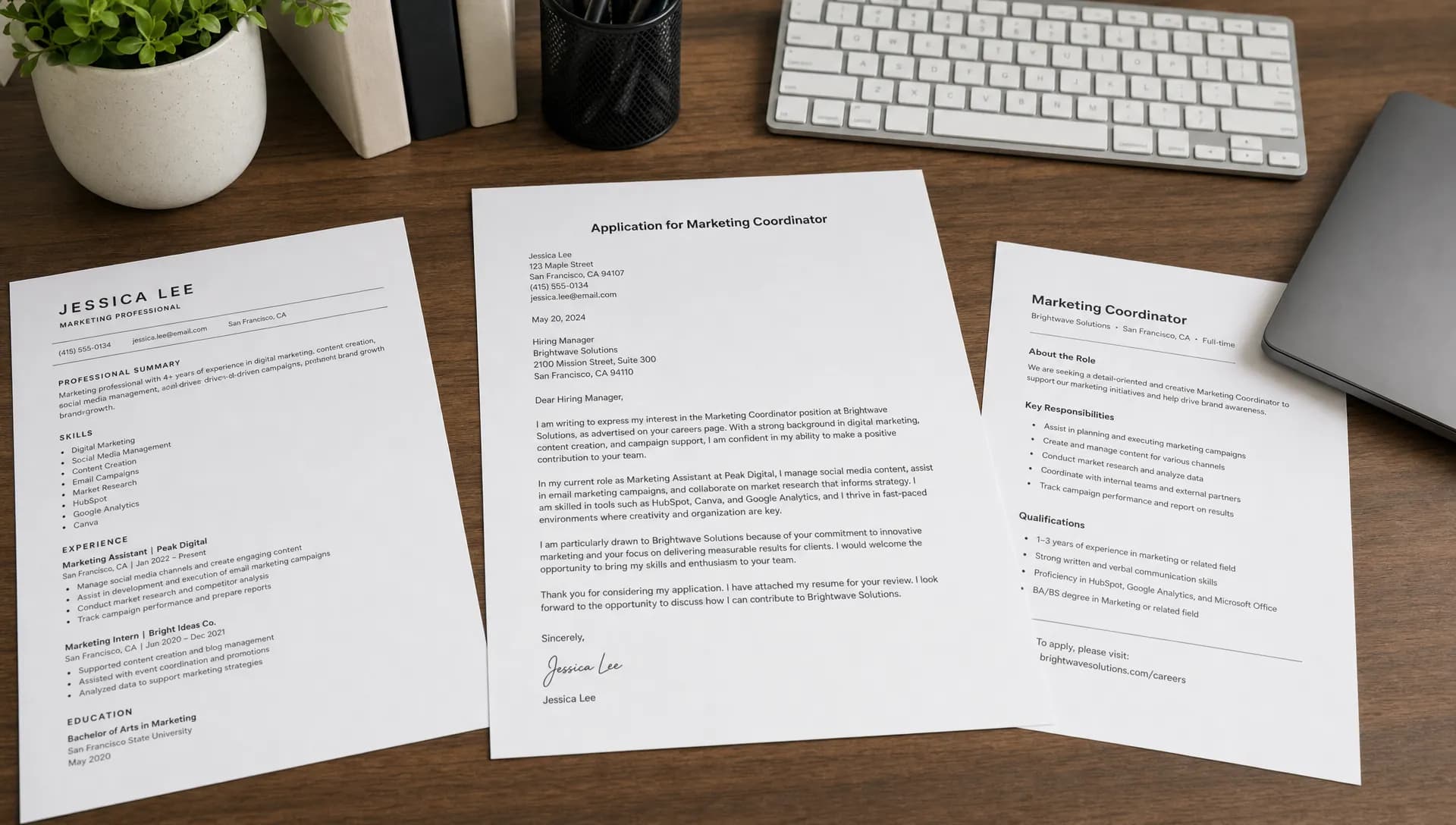
Job Application Letter Format Hiring Managers Expect
Learn the job application letter format hiring managers expect, with layout rules, section order, a copyable template, and mistakes to avoid.
Write your job application — not a blank template
Generate a finished job application with your details, tone, and language in ~30 seconds. Free first letter, no credit card — beats copy-pasting and filling the blanks yourself.
A job application letter does not need a clever design, a dramatic opening, or a page full of buzzwords. Hiring managers usually expect something much simpler: a clean business-letter format, a clear reason for writing, proof that you match the role, and a professional close.
That may sound basic, but format matters because it affects how quickly your letter can be understood. A well-formatted application letter helps the reader find the role you are applying for, see your strongest qualifications, and decide whether your resume deserves closer attention.
Below is the practical job application letter format hiring managers expect, including the order of sections, layout rules, a copyable template, and the mistakes that make otherwise qualified applicants look careless.
What hiring managers mean by “format”
When people ask about job application letter format, they often think only about margins, fonts, and spacing. Those details matter, but format is bigger than appearance.
A strong format answers three questions fast:
- Who are you and how can the employer contact you?
- Which position are you applying for?
- Why are you a credible fit for this specific job?
In other words, the format should guide the hiring manager through your message without making them work. The best application letters are easy to scan, specific to the role, and short enough to read in one sitting.
For most roles, the safest choice is a traditional business letter layout. Purdue OWL’s guidance on basic business letters also emphasizes clear sender information, recipient information, a salutation, organized body paragraphs, and a professional closing, which is exactly the structure employers are used to seeing.
The job application letter format in one view
Use this order when submitting a formal application letter as a document attachment or printed letter.
| Section | What to include | Hiring manager expectation |
|---|---|---|
| Header | Your name, phone, email, city and state, LinkedIn or portfolio if relevant | Clear contact details without clutter |
| Date | Month day, year | A current, professional business-letter detail |
| Recipient details | Hiring manager name, title, company, company address if known | Shows care and proper business format |
| Salutation | “Dear Hiring Manager,” or “Dear Ms./Mr./Dr. Last Name,” | Professional greeting, no guessing if name is unknown |
| Opening paragraph | Role title, where you found it, and your strongest fit | Immediate context and relevance |
| Proof paragraph | 1 to 2 accomplishments tied to job requirements | Evidence, not repetition of your resume |
| Fit paragraph | Why this company, team, or role interests you | Shows you did not send a generic letter |
| Closing paragraph | Appreciation, next step, and contact invitation | Polite confidence and clear finish |
| Signature | “Sincerely,” plus your full name | Standard professional close |
This format works because it matches how hiring teams read. They do not want to hunt for the role, infer your qualifications, or decode a creative layout. They want a concise, relevant letter that makes the next step obvious.
If you want a deeper walkthrough of each section, this related guide on job application cover letter format breaks down the structure in more detail.
The layout rules that make your letter look professional
Your application letter should look like a polished business document, not a flyer, personal essay, or resume redesign.
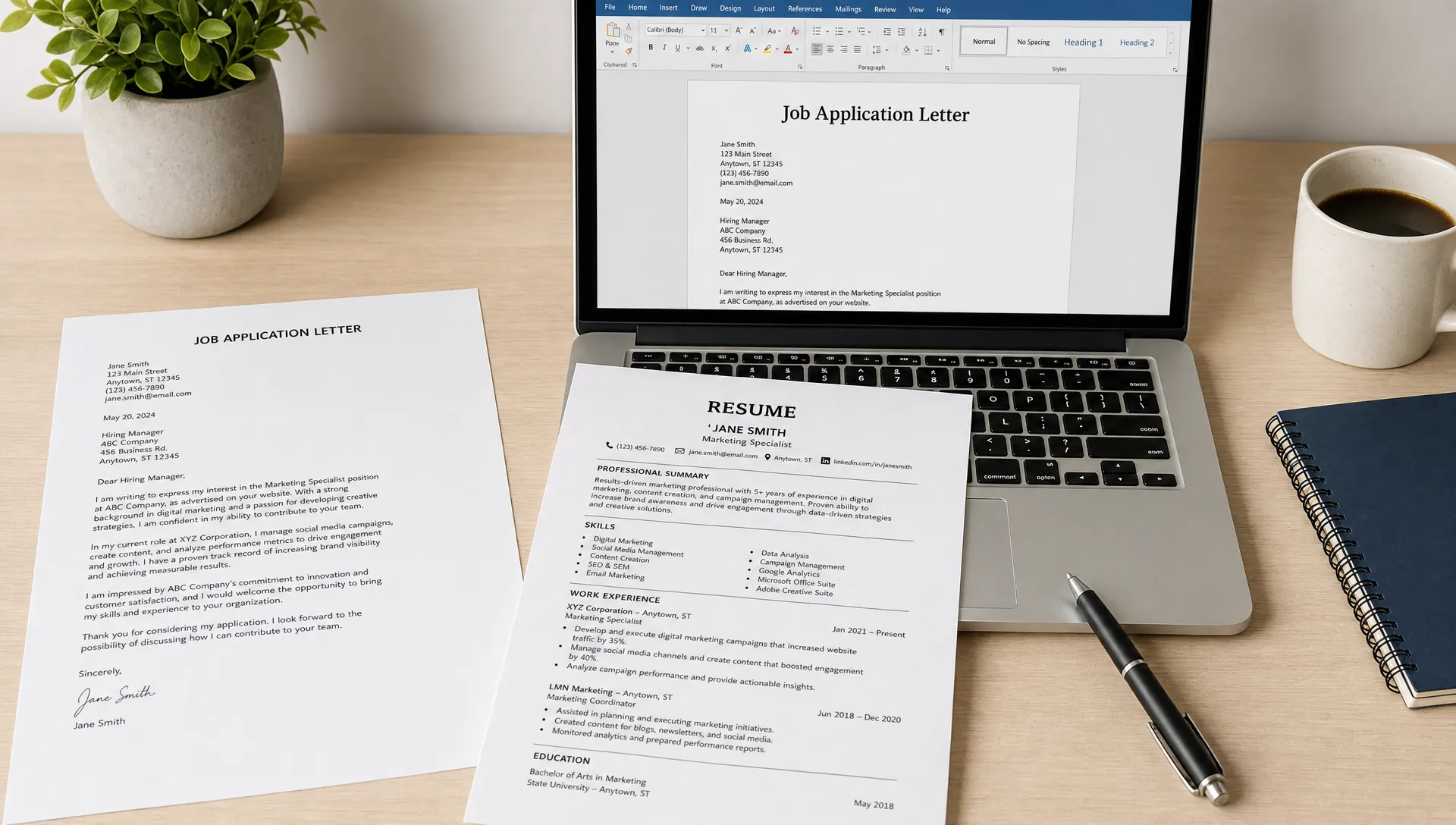
Use a simple, left-aligned block format. Keep the entire letter to one page, usually 250 to 400 words. Choose a readable font such as Arial, Calibri, Times New Roman, or Georgia in 10 to 12 point size. Use standard margins, usually around one inch, and leave a blank line between sections and paragraphs.
Avoid columns, graphics, icons, decorative borders, and unusual colors. If you are applying for a design role, your portfolio can show creativity. Your application letter should still be easy to read and compatible with common hiring workflows.
A good rule is this: if the format draws attention away from the message, simplify it.
Section by section: what to write and why it belongs there
Header
Your header should include the contact information an employer needs to reach you quickly. At minimum, include your full name, phone number, professional email address, and city and state.
You can also include a LinkedIn profile, portfolio, personal website, GitHub, or online writing portfolio if it directly supports your application. Do not add unnecessary personal details such as marital status, age, full home address, or a photo unless the employer specifically requests something and it is appropriate in your location and industry.
A clean header might look like this:
Jordan Lee
Chicago, IL
(312) 555-0148
jordan.lee@email.com
linkedin.com/in/jordanlee
Date and recipient information
For a formal document, include the date below your header. Then add the recipient’s name, title, company, and address if available.
If you do not know the hiring manager’s name, do not spend hours searching or use a name you are unsure about. It is better to write “Dear Hiring Manager,” than to address the wrong person.
This part may feel old-fashioned, especially if you are applying online. Still, it signals that you understand professional correspondence and can follow business communication norms.
Salutation
The safest salutations are simple and respectful. Use “Dear Hiring Manager,” when the name is unknown. If you know the person’s name and title, use it accurately.
Avoid casual greetings such as “Hey,” “Hi there,” or “To whom it may concern” if you can. “To whom it may concern” is not incorrect, but it can feel impersonal. “Dear Hiring Manager,” is usually warmer and more direct.
Opening paragraph
Your opening paragraph should immediately explain why you are writing. Mention the exact job title and, if useful, where you found the posting. Then add one sentence that previews your strongest qualification.
Weak opening:
I am writing to apply for the position at your company. I believe I would be a good fit.
Stronger opening:
I am applying for the Customer Success Associate position at Northline Software. With three years of experience resolving client issues in SaaS support and a track record of improving response times, I am excited to bring practical customer support skills to your team.
The stronger version works because it gives the role, the background, the value, and the reason to keep reading.
Proof paragraph
The middle of your letter should prove fit, not repeat your resume line by line. Choose one or two requirements from the job posting and connect them to specific experience.
For example, if the posting asks for project coordination, stakeholder communication, and reporting, do not say, “I have strong coordination and communication skills.” Show it.
A better paragraph might say:
In my current administrative coordinator role, I manage weekly project updates for a 12-person operations team, prepare status reports for leadership, and track deadlines across three departments. This experience has helped me communicate clearly, anticipate delays, and keep projects moving without adding unnecessary meetings.
Notice that the paragraph is specific but not overloaded. It gives enough evidence to make the resume more believable.
Company fit paragraph
Hiring managers can tell when a letter could be sent to any company. A short company fit paragraph helps your application feel intentional.
You do not need flattery or a long explanation. One or two specific details are enough. Mention the company’s mission, product, industry, team focus, or challenge if it genuinely connects to your experience.
For example:
I am especially interested in this role because your team focuses on making financial tools easier for small business owners. In my previous role, I supported independent retailers and learned how important clear onboarding and responsive service are for customers who do not have extra time to troubleshoot software.
This type of paragraph shows that you understand the employer’s context and can connect your background to their needs.
Closing paragraph
Your closing should be confident, polite, and brief. Thank the reader, restate your interest, and invite the next step.
A strong closing might look like this:
Thank you for considering my application. I would welcome the opportunity to discuss how my customer support experience and process improvement skills can contribute to your team. I can be reached at (312) 555-0148 or jordan.lee@email.com.
Do not end with pressure, apology, or uncertainty. Avoid phrases like “I know I may not be the most qualified candidate” or “Please give me a chance.” Your letter should close with professional confidence.
Copyable job application letter format template
Use this template as a starting point. Replace every bracketed section with details from your own experience and the job posting.
[Your Full Name]
[City, State]
[Phone Number]
[Professional Email]
[LinkedIn, Portfolio, or Website if relevant]

[Month Day, Year]

[Hiring Manager Name]
[Hiring Manager Title]
[Company Name]
[Company Address if available]

Dear [Hiring Manager Name or Hiring Manager],

I am applying for the [Job Title] position at [Company Name]. With experience in [relevant skill or field] and a background in [specific achievement, responsibility, or industry], I am excited about the opportunity to contribute to your team.

In my previous role as [Your Role] at [Company or Organization], I [describe a relevant responsibility or accomplishment]. This helped me develop [skill tied to job posting], and it directly connects to your need for someone who can [job requirement or business need].

I am particularly interested in [Company Name] because [specific reason related to the company, role, product, mission, or industry]. I believe my experience with [relevant experience] would allow me to add value by [specific contribution].

Thank you for considering my application. I would welcome the opportunity to discuss how my background and skills align with the [Job Title] role. I can be reached at [phone number] or [email address].

Sincerely,

[Your Full Name]
The template gives you the correct structure, but the details are what make it work. Before sending, compare each paragraph with the job posting. If a sentence does not support your fit for that specific role, revise it or remove it.
For more help turning the format into a letter that gets attention, see this guide on how to write a letter to apply for a job that gets read.
Email job application letter format
If the employer asks you to apply by email, your format changes slightly. You usually do not need the full business-letter header inside the email body because your email account already shows sender details, and your signature can include contact information.
Use a clear subject line, such as:
Application for Marketing Coordinator - Jordan Lee
Then write the letter in the body of the email using the same paragraph structure: greeting, opening, proof, company fit, closing, and signature. Keep it concise. If you attach your resume and application letter as files, mention the attachments in the final paragraph.
A simple email signature can include your full name, phone number, email, city and state, and relevant portfolio link. Do not overload your signature with quotes, images, banners, or multiple social media links.
If the job posting gives specific instructions, follow them exactly. If it asks for a PDF, send a PDF. If it asks for a Word document, send a Word document. If it asks you to paste the letter into a form field, paste it there instead of trying to attach a separate file.
What hiring managers do not want to see
A strong format can be weakened by careless choices. These are some of the most common issues that make application letters less effective.
| Mistake | Why it hurts your application | Better approach |
|---|---|---|
| Writing more than one page | Makes the letter harder to scan | Keep it to 3 or 4 focused paragraphs |
| Using a generic greeting and message | Suggests a mass application | Mention the role and company specifically |
| Repeating the resume | Wastes the reader’s time | Highlight 1 or 2 relevant proof points |
| Using decorative formatting | Can look unprofessional or distract from content | Use a clean business-letter layout |
| Forgetting contact details | Creates friction for follow-up | Include phone and professional email |
| Ignoring instructions | Signals poor attention to detail | Match the employer’s requested file type and process |
The biggest mistake is treating the letter as a formality. Hiring managers may not read every word of every letter, but when they do, they are looking for relevance, judgment, and communication ability. A clear format helps all three come through.
Quick formatting checklist before you send
Before submitting your application, review the letter one final time for structure and clarity.
- The letter fits on one page.
- Your contact information is accurate and easy to find.
- The job title and company name are correct.
- The greeting is professional.
- The opening paragraph states the role and your strongest fit.
- The middle paragraph includes specific evidence.
- The letter explains why this employer or role interests you.
- The closing includes a polite next step.
- The file name is professional, such as “Jordan-Lee-Application-Letter.pdf.”
- The letter has been proofread for names, dates, grammar, and formatting.
This checklist may seem simple, but it catches the details that hiring teams notice. A typo in the company name or an outdated phone number can undo an otherwise strong application.
Frequently Asked Questions
What is the best format for a job application letter? The best format is a one-page, left-aligned business letter with your header, date, recipient details, salutation, 3 to 4 concise paragraphs, professional closing, and signature.
How long should a job application letter be? Most job application letters should be 250 to 400 words. The goal is to make a focused case for your fit, not repeat your entire resume.
Is a job application letter the same as a cover letter? In many U.S. job searches, the terms are used similarly. A job application letter is often a formal letter submitted with your resume, while a cover letter may be slightly broader, but the expected structure is usually the same.
Should I include my full address in an application letter? In most modern U.S. applications, your city and state are enough unless the employer specifically requests a full mailing address. Always include a professional email address and phone number.
What file format should I use for a job application letter? Use the file format requested in the job posting. If no format is specified, PDF is often a good choice because it preserves layout, but some application systems may prefer Word documents.
Create a polished application letter faster
The format is only the starting point. The best job application letters combine the expected structure with details that match the role, company, and tone of the opportunity.
If you want help turning your experience into a ready-to-send letter, LetterCraft AI can generate professional, personalized letters for job applications and 65+ other scenarios in under 30 seconds. You can choose tone options, copy your letter, export it as a PDF, and try it without a credit card.
Write your job application — not a blank template
Generate a finished job application with your details, tone, and language in ~30 seconds. Free first letter, no credit card — beats copy-pasting and filling the blanks yourself.