How to Write a Letter to Apply for a Job That Gets Read
Learn how to write a letter to apply for a job that hiring teams actually read, with structure, examples, templates, and a checklist.
A hiring manager rarely reads a job application letter from top to bottom on the first pass. They scan it for a reason to keep reading. Your job is to make that reason obvious within the first few lines.
A strong letter to apply for a job does not repeat your resume, summarize your entire career, or use generic lines like “I am writing to express my interest.” It connects three things quickly: what the employer needs, what you have done, and why the conversation should continue.
This guide shows you how to write a job application letter that feels specific, professional, and easy to read, even when the person reviewing it has limited time.
What a Job Application Letter Must Do
A job application letter, often used similarly to a cover letter, is a short professional message that supports your resume and explains why you are a strong fit for a specific role. If you are unsure which document you need, read this guide on the difference between an application letter and a cover letter.
The best letters answer the reader’s silent questions before they have to ask them.
| Hiring team question | What your letter should show |
|---|---|
| Which job are you applying for? | The exact role title and, if relevant, where you found it. |
| Can you do the work? | One or two relevant achievements tied to the job description. |
| Why this employer? | A specific reason that goes beyond flattery. |
| Are you easy to evaluate? | Clear formatting, concise paragraphs, and direct language. |
| What should happen next? | A confident closing that invites an interview or follow-up. |
Think of the letter as a bridge between your resume and the role. Your resume lists evidence. Your letter explains why that evidence matters for this job.
Start With the Job Posting, Not a Blank Page
Before writing, study the job posting like a checklist. Employers often signal their priorities through repeated phrases, required skills, and the first few responsibilities listed. The more closely your letter responds to those priorities, the more relevant it feels.
The U.S. Department of Labor’s CareerOneStop recommends using cover letters to explain why you are a good match and to highlight information that may not be obvious from your resume. That means your letter should not be a generic introduction. It should be built from the employer’s actual needs.
Before you draft, gather these five inputs:
- The exact job title and company name.
- The top three responsibilities from the posting.
- Two achievements from your background that match those responsibilities.
- One specific reason you want this role or company.
- Any important context, such as relocation, career change, referral, or availability.
If the posting is vague, use a trusted role database like O*NET Online to understand common responsibilities and skills for that occupation. This can help you choose stronger proof points without guessing.
Use a Simple Structure That Can Be Read in 30 Seconds
A letter that gets read is usually easy to scan. Most job application letters should be about 250 to 400 words, with short paragraphs and a clear point in every section. If you need detailed layout rules, see this guide to the cover letter format hiring managers expect.
Here is a practical structure that works for most job applications.
| Section | Purpose | Ideal length |
|---|---|---|
| Header or email subject | Identify you and the role. | 1 to 4 lines |
| Greeting | Address the reader professionally. | 1 line |
| Opening paragraph | State the role and give a strong reason to keep reading. | 2 to 3 sentences |
| Proof paragraph | Connect your experience to the employer’s needs. | 4 to 6 sentences |
| Fit paragraph | Show motivation, values fit, or context. | 2 to 4 sentences |
| Closing | Request the next step politely and confidently. | 2 to 3 sentences |
This structure keeps the letter focused. It also prevents the two most common problems: writing too much about yourself without connecting to the role, or sounding enthusiastic without offering proof.
Write an Opening That Earns Attention
The opening paragraph decides whether the rest of the letter gets a serious look. Avoid starting with a sentence the hiring manager has seen hundreds of times.
A weak opening says you are interested. A strong opening shows why your interest is relevant.
| Weak opening | Stronger opening | Why it works |
|---|---|---|
| I am writing to apply for the Marketing Coordinator position. | I am applying for the Marketing Coordinator role because your team needs someone who can turn campaign ideas into measurable pipeline growth, which is exactly what I did during my internship at BrightWave. | It connects the role to a relevant result. |
| Please accept my application for the Customer Support Representative position. | After resolving 40+ customer tickets per day while maintaining a 96% satisfaction score, I am excited to apply for your Customer Support Representative role. | It leads with evidence, not formality. |
| I believe I would be a great fit for your company. | Your focus on faster onboarding caught my attention because I recently helped reduce new-user setup questions by rewriting support documentation. | It shows company-specific relevance. |
A good opening can follow this simple formula:
I am applying for [role] because [specific employer need] matches my experience in [relevant proof].
This does not need to sound robotic. The point is to make your relevance obvious immediately.
Turn Your Experience Into Proof, Not Claims
The middle of the letter is where many applicants lose the reader. They write things like “I am organized, motivated, and a strong communicator.” Those qualities may be true, but they are hard to evaluate without evidence.
Instead, use a simple proof pattern: situation, action, result.
For example, instead of writing:
I have strong communication skills and work well with customers.
Write:
In my current retail role, I handle customer concerns during peak weekend hours, explain return policies clearly, and regularly de-escalate issues before they require manager involvement. That experience would help me support your customer service team with patience, accuracy, and professionalism.
The second version gives the reader something concrete to imagine. It also ties the proof back to the employer’s need.
If you have measurable results, use them. Numbers make claims easier to trust. You do not need dramatic metrics. Even modest specifics help:
- Trained 6 new team members.
- Managed 25 client accounts.
- Reduced response time from 48 hours to 24 hours.
- Supported events with 200+ attendees.
- Processed invoices with fewer errors after creating a checklist.
If you do not have numbers, use scope, frequency, tools, or outcomes. For example, mention the type of customers you served, the software you used, the deadlines you met, or the kind of problems you solved.
Show Company Fit Without Overdoing Praise
Employers can spot generic praise quickly. Lines like “Your company is a leader in the industry” or “I have always admired your organization” usually do not add much unless they are backed by a specific reason.
A better approach is to connect one company detail to one part of your experience or motivation.
For example:
I was especially interested in your focus on expanding support for small business clients. In my previous role, I worked closely with local business owners and learned how much they value clear communication, fast follow-through, and practical guidance.
This works because it is not empty admiration. It shows that you understand something about the employer and can connect it to how you work.
Good company-fit details can come from:
- The job posting.
- The company website.
- A recent product launch or initiative.
- A value mentioned in the company’s career page.
- A conversation with an employee or recruiter.
- A specific challenge the team appears to be hiring for.
Keep this section brief. One specific sentence is usually more effective than a long paragraph of praise.
Template: Letter to Apply for a Job
Use this template as a starting point, then customize it with real details from the job posting and your background.
[Your Name]
[Your Phone Number]
[Your Email Address]
[City, State]
[Date]

[Hiring Manager Name]
[Company Name]
[Company Address, if sending as a formal letter]

Dear [Hiring Manager Name],

I am applying for the [Job Title] position at [Company Name]. Your need for someone who can [key responsibility from job posting] stood out to me because my experience in [relevant skill or role] has prepared me to contribute quickly.

In my previous role as [Your Role], I [describe a relevant action or responsibility]. This helped [result, improvement, customer outcome, team benefit, or measurable achievement]. I also gained experience with [tool, process, or skill from the posting], which would allow me to support your team’s work in [specific responsibility or goal].

I am especially interested in [Company Name] because [specific reason related to the company, role, product, mission, or team]. I would bring [two or three strengths] and a practical understanding of [important job requirement].

Thank you for considering my application. I would welcome the opportunity to discuss how my experience can support [Company Name] in the [Job Title] role. I look forward to hearing from you.

Sincerely,
[Your Name]
This template gives you structure, but it should not stay generic. Replace every bracket with information that only makes sense for that job.
Example of a Job Application Letter That Gets Read
Here is a complete example for a customer success role.
Jordan Lee
jordan.lee@email.com
Denver, CO
June 13, 2026

Dear Ms. Ramirez,

I am applying for the Customer Success Associate position at Northstar Software. Your need for someone who can improve onboarding and support long-term client satisfaction stood out to me because I have spent the past two years helping customers adopt new tools with less confusion and faster follow-through.

In my current role at a scheduling software company, I support small business clients through setup, troubleshooting, and renewal questions. I created a simple onboarding checklist that reduced repeat setup questions and helped new customers understand the product before their first support call. I also work daily in Zendesk and HubSpot, which matches the tools listed in your posting.

I am especially interested in Northstar Software because your product focuses on helping operations teams save time. I enjoy roles where clear communication directly improves a customer’s day, and I would bring patience, product curiosity, and a strong sense of ownership to your customer success team.

Thank you for considering my application. I would welcome the opportunity to discuss how my support experience can help Northstar Software create a smoother onboarding experience for new customers.

Sincerely,
Jordan Lee
Notice what this letter does well. It names the role, identifies a likely employer need, gives relevant proof, mentions tools from the posting, and explains motivation without becoming too long.
How to Adapt the Letter for Different Situations
Not every applicant has the same background. The structure stays similar, but the emphasis changes depending on your situation.
| Situation | What to emphasize | Example line |
|---|---|---|
| Entry-level applicant | Coursework, internships, projects, volunteer work, reliability, and learning speed. | My class project in data visualization gave me hands-on experience turning raw survey results into clear recommendations. |
| Career changer | Transferable skills and the reason your past experience helps in the new role. | My background in hospitality has trained me to solve customer problems quickly, stay calm under pressure, and communicate clearly across teams. |
| Employment gap | Current readiness and relevant activity, not a long explanation. | During my career break, I completed a project management certificate and am now ready to bring my operations experience back into a full-time role. |
| Referral | The connection, then your fit. | After speaking with Maya Chen about your team’s growth, I was excited to apply because the role matches my experience in client onboarding. |
| Internal application | Knowledge of the company plus readiness for broader responsibility. | My experience supporting the sales team over the past year has given me a strong understanding of our customers and the internal processes this role depends on. |
If you are applying after a layoff, you usually do not need to explain it unless it helps clarify a gap or transition. If you do mention it, keep it neutral and move quickly back to your qualifications.
Make the Letter Easy to Read in Any Format
A good letter can be weakened by poor formatting. Use a clean, traditional layout that works as a PDF, email, or portal attachment. Purdue OWL’s guidance on basic business letters is a useful reference if you are sending a formal printed or attached letter.
For most applications, follow these rules:
- Use a simple font such as Arial, Calibri, or Times New Roman.
- Keep the font size between 10.5 and 12 points.
- Use short paragraphs with white space between them.
- Save formal attachments as a PDF unless the employer requests another format.
- Name your file clearly, such as
Jordan-Lee-Customer-Success-Letter.pdf. - If sending by email, use a direct subject line like
Application for Customer Success Associate, Jordan Lee.
Applicant tracking systems and hiring platforms vary, so avoid unusual formatting, text boxes, graphics, or complex designs. Your letter should look polished, but the content matters more than decoration.
Common Mistakes That Make Employers Stop Reading
Most weak job application letters fail for predictable reasons. The good news is that these mistakes are easy to fix.
| Mistake | Why it hurts | Better approach |
|---|---|---|
| Using the same letter for every job | It sounds generic and ignores the employer’s needs. | Customize the opening and proof paragraph for each role. |
| Repeating your resume | The reader learns nothing new. | Explain why one or two resume points matter for this job. |
| Writing too much | Long letters are harder to scan. | Aim for 250 to 400 words in most cases. |
| Leading with what you want | Employers care first about the problem they need solved. | Start with the role, employer need, and your relevant proof. |
| Overusing buzzwords | Words like passionate and hard-working are vague without evidence. | Show those traits through examples. |
| Sounding too casual | Informal language can weaken credibility. | Use warm, professional language. |
| Forgetting the next step | The letter ends without direction. | Close by welcoming an interview or conversation. |
A simple test: if you could send the same letter to ten companies without changing anything, it is not specific enough.
The 10-Minute Final Checklist
Before sending your letter, review it like a hiring manager would. Do not only proofread for typos. Check whether the letter is doing its job.
- Does the first paragraph name the role and show relevant fit?
- Does the letter include at least one concrete proof point?
- Is there a company-specific detail that feels genuine?
- Are the paragraphs short enough to scan quickly?
- Have you removed generic phrases that could apply to anyone?
- Does the tone sound professional, confident, and human?
- Is the file name, subject line, and contact information correct?
- Did you match the employer’s requested format and submission instructions?
If the answer is yes to each question, your letter is much more likely to be read with interest.
When to Use AI to Draft Your Job Application Letter
AI can be helpful when you know what you want to say but do not want to start from a blank page. The key is to give the tool real information: the job title, company, responsibilities, your achievements, tone preference, and any context the employer should know.
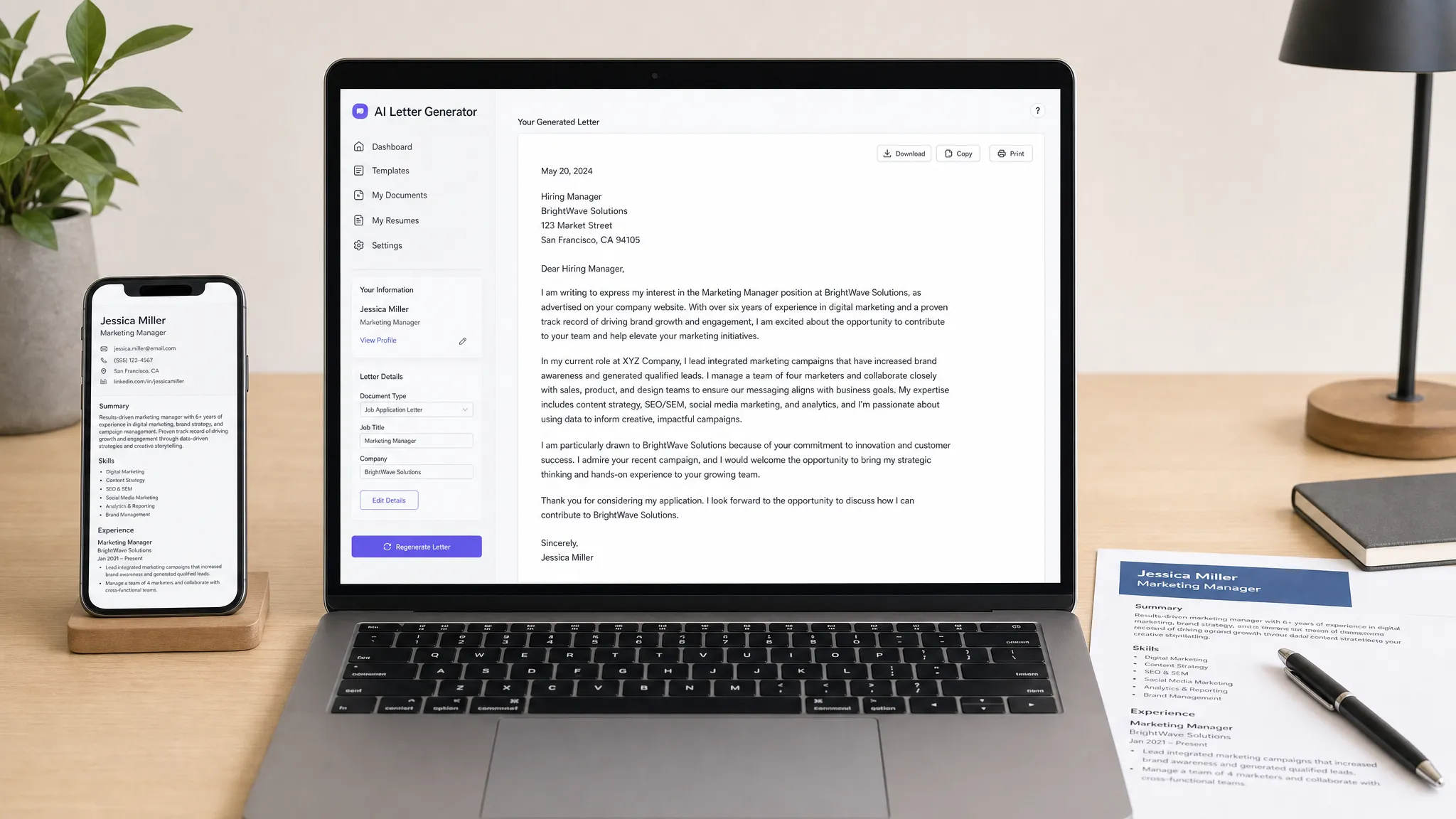
LetterCraft AI is built specifically for professional letters, including job application letters, cover letters, resignation letters, complaint letters, and many other scenarios. You can enter a few details, choose a tone, and generate a personalized draft in under 30 seconds. From there, you can revise the wording, copy it, or export it as a PDF.
AI should not replace your judgment. It should help you get to a strong first draft faster. The final letter should still include your real experience, your voice, and details that match the specific role.
Frequently Asked Questions
What is the difference between a letter to apply for a job and a cover letter? In many job searches, the terms overlap. A cover letter usually accompanies a resume for a specific job opening. A job application letter can be similar, but it may also be used as a more formal standalone letter, especially when applying by email, through a portal, or in response to a direct request.
How long should a job application letter be? Most should be 250 to 400 words. Shorter is acceptable for email applications, especially if your resume is attached. Longer letters are only useful when the employer specifically asks for detailed selection criteria or a formal statement.
Should I mention salary expectations in my application letter? Only mention salary expectations if the employer asks for them. Otherwise, use the letter to focus on fit, proof, and motivation. Salary is usually better discussed later in the hiring process.
What if I do not know the hiring manager’s name? Use a professional greeting such as “Dear Hiring Manager” or “Dear [Department] Team.” Avoid outdated greetings like “To Whom It May Concern” unless the application is extremely formal and no team information is available.
Can I use the same letter for multiple jobs? You can reuse the structure, but you should customize the opening, proof points, and company-fit sentence for every role. A letter that feels written for one specific job is much stronger than a broad template.
Write a Job Application Letter Faster
If you want a polished first draft without staring at a blank page, try LetterCraft AI. Choose the letter type, add your job details, select the tone you want, and generate a personalized letter in under 30 seconds.
You can use it for 65+ professional letter types, export your draft as a PDF, copy it to your clipboard, and keep track of letter history. No credit card is required to try it, and the pricing is simple with no subscriptions.