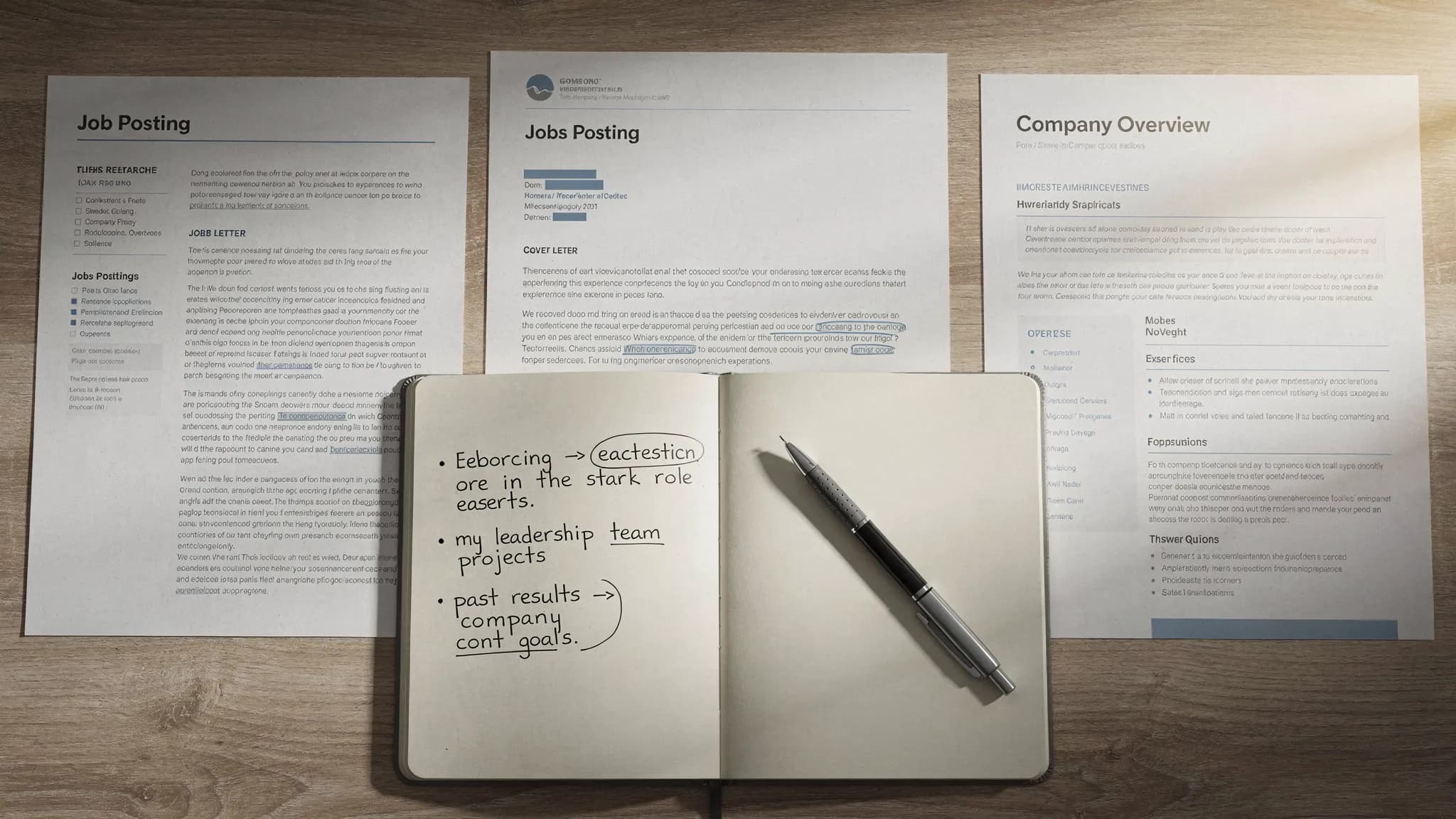
How to Write a Cover Letter for Companies
Learn how to write a cover letter for companies with a clear structure, research tips, examples, and a template you can customize fast.
Write your cover letter — not a blank template
Generate a finished cover letter with your details, tone, and language in ~30 seconds. Free first letter, no credit card — beats copy-pasting and filling the blanks yourself.
Most cover letters fail for a simple reason: they are written for any employer, not for a specific company. A hiring manager can spot this immediately. The letter mentions passion, teamwork, and experience, but it never explains why this company, why this role, and why the applicant is a credible match.
Writing a cover letter for companies means building a letter around the employer’s needs, priorities, and context. Your resume shows what you have done. Your cover letter should connect that experience to what the company is trying to accomplish next.
The goal is not to flatter the company. The goal is to make the reader think, this person understands what we need and can help.
What a company-focused cover letter should do
A strong cover letter answers three questions quickly: why you are interested in the company, how your experience matches the role, and what evidence proves you can contribute. According to CareerOneStop’s cover letter guidance, cover letters should be customized to the job and employer rather than sent as generic introductions.
That advice matters even more in 2026, when many applicants use templates or AI tools to send high volumes of applications. A company-specific letter stands out because it feels intentional.
| What the company wants to know | What your cover letter should show |
|---|---|
| Do you understand the role? | Mention one or two responsibilities from the job posting and connect them to your experience. |
| Do you understand the company? | Reference a relevant product, market, mission, customer segment, or recent initiative. |
| Can you produce results? | Use one or two proof points, ideally with numbers, scope, or outcomes. |
| Are you professional and concise? | Keep the letter focused, polished, and easy to scan. |
Research the company before you write
You do not need hours of research. You need enough detail to avoid sounding interchangeable. Spend 10 to 15 minutes gathering facts that help you explain why the company is a good fit for your skills.
Start with the job description, then check the company’s website, careers page, LinkedIn page, recent announcements, product pages, and customer stories if available. Look for repeated themes. Are they scaling operations? Improving customer experience? Launching in a new market? Hiring for compliance, automation, growth, or retention?
| Research source | What to look for | How to use it in your letter |
|---|---|---|
| Job posting | Required skills, repeated keywords, major responsibilities | Match your proof points to the role’s most important needs. |
| Company website | Products, services, audience, mission | Show you understand what the company actually does. |
| Careers page | Values, culture, team language | Mirror the company’s tone without copying phrases word for word. |
| Recent news or blog posts | Expansions, launches, partnerships, funding, initiatives | Mention one relevant detail if it connects to your experience. |
| LinkedIn or employee posts | Team growth, department priorities, hiring focus | Add context about why the timing of your application makes sense. |

The key is relevance. Do not mention a company award or mission statement just to prove you looked them up. Mention details that help explain why you can help.
The best structure for a cover letter to a company
A company-focused cover letter should usually be 250 to 400 words. If you are applying through a portal, one page is enough. If you are sending the letter in an email body, keep it even tighter.
Use this structure:
- Opening paragraph: Name the role and company, then lead with a specific reason you are interested or a relevant achievement.
- Evidence paragraph: Connect your experience to the company’s needs using one or two concrete proof points.
- Company fit paragraph: Explain why this company’s work, customers, product, or direction aligns with your background.
- Closing paragraph: Reaffirm your interest, thank the reader, and invite the next step.
This structure works because it avoids the two most common problems: repeating your resume and writing a vague admiration letter. If you need help with layout, use this guide to the cover letter format hiring managers expect.
Write an opening that names the company for a real reason
Your opening should not begin with a generic line like, I am writing to apply for the position. That is technically correct, but it wastes the most valuable sentence in the letter.
A better opening connects the company, role, and your relevant value in one or two sentences.
| Weak opening | Stronger company-focused opening |
|---|---|
| I am excited to apply for this position at your company. | I am excited to apply for the Marketing Manager role at Greenpoint Health because your focus on patient education matches the kind of content strategy I have built for healthcare audiences. |
| I believe I would be a great fit for your team. | In my last role, I helped reduce customer onboarding time by 28 percent, which is directly relevant to your Customer Success team’s focus on faster product adoption. |
| Your company seems like a great place to work. | After reading about your expansion into mid-market accounts, I was drawn to this role because I have spent the past three years helping B2B teams support that exact customer segment. |
The strongest openings are specific without being overly long. If your first sentence could be sent to 50 companies with only the company name changed, revise it.
Connect your skills to the company’s priorities
A cover letter is persuasive when it turns your experience into business value. Instead of listing skills, show how those skills solve the employer’s likely problem.
For example, do not write only that you have project management experience. Explain that you coordinated a cross-functional launch, reduced delays, improved reporting, or helped a team deliver under pressure. Companies hire outcomes, not adjectives.
A simple formula works well:
Company need + your relevant experience + evidence of impact = strong cover letter proof.
For example:
I noticed the role emphasizes improving support workflows across multiple teams. In my current position, I rebuilt our escalation process between support, engineering, and account management, reducing unresolved high-priority tickets by 22 percent in one quarter.
That sentence works because it shows the applicant read the posting, understands the company’s need, and has already solved a similar problem.
Adjust your tone for different types of companies
Not every company wants the same style. A startup may appreciate direct ownership and adaptability. A large enterprise may value process, risk management, and cross-functional collaboration. A nonprofit may care deeply about mission alignment and community impact.
| Company type | What to emphasize | Tone to use |
|---|---|---|
| Startup | Ownership, speed, flexibility, building from scratch | Direct, energetic, practical |
| Large corporation | Scale, process, collaboration, stakeholder management | Polished, structured, professional |
| Nonprofit | Mission alignment, service, measurable community impact | Warm, sincere, evidence-based |
| Tech company | Product understanding, user impact, data, experimentation | Clear, outcome-focused, specific |
| Local business | Customer relationships, reliability, community knowledge | Personal, grounded, respectful |
| Regulated industry | Accuracy, compliance, documentation, judgment | Careful, precise, credible |
Tone does not mean pretending to be someone else. It means choosing the version of your professional voice that fits the employer’s environment.
Cover letter template for companies
Use this template as a starting point, then replace every placeholder with company-specific detail.
Dear [Hiring Manager Name],

I am excited to apply for the [Job Title] role at [Company Name]. I was drawn to [specific company detail] because it connects closely with my experience in [relevant skill, industry, or function]. In my recent work as [Current or Previous Role], I have focused on [main area of impact], which aligns with the priorities described in your posting.

In my role at [Previous Company], I [describe relevant responsibility or project]. This led to [specific result, metric, or outcome]. I also [second relevant proof point], giving me experience with [tool, process, customer type, or challenge] that would help me contribute to [Company Name] quickly.

What stands out to me about [Company Name] is [company-specific reason tied to product, mission, customers, growth, or team]. I would welcome the opportunity to bring my background in [skill 1] and [skill 2] to support your team’s goals.

Thank you for your time and consideration. I would be glad to discuss how my experience can contribute to [Company Name] in this role.

Sincerely,
[Your Name]
If you want a faster starting point, you can also use this customizable cover letter template and add the company-specific details from your research.
Example of a company-focused cover letter
Here is a fictional example for a Customer Success Manager role at a B2B software company.
Dear Hiring Team,

I am excited to apply for the Customer Success Manager role at Brightline Analytics. I was especially interested in your focus on helping mid-market teams turn complex data into practical decisions, because my recent work has centered on improving product adoption for non-technical users.

In my current role at a SaaS analytics company, I manage a portfolio of 42 customer accounts across healthcare, retail, and professional services. Last year, I redesigned our onboarding checklist and created a simple usage review process for new customers, which helped increase 90-day activation from 64 percent to 81 percent. I also partnered with product and support teams to identify recurring training gaps, reducing repeated onboarding tickets by 18 percent over two quarters.

What stands out to me about Brightline Analytics is your emphasis on customer education rather than simply selling software access. That approach matches how I work with clients: translate product features into clear workflows, identify adoption blockers early, and build trust through consistent follow-through.

Thank you for your time and consideration. I would welcome the opportunity to discuss how my customer success experience can support Brightline Analytics as your client base continues to grow.

Sincerely,
Jordan Lee
Notice that the letter does not try to cover everything in the resume. It chooses the most relevant evidence and ties it to the company’s likely priorities.
What if there is no open position?
If you are writing to a company without a posted job, you are closer to writing a letter of intent or letter of interest. The structure is similar, but the purpose changes. Instead of proving fit for a specific role, you are introducing your value and asking to be considered for future or unadvertised opportunities.
In that case, be clear about the function you are targeting. Do not simply ask for any job. Say you are interested in roles related to operations, customer success, product marketing, finance, engineering, or another specific area. Then explain why your background is relevant to the company.
For a no-posting situation, this guide to a job letter of intent may be a better fit than a traditional cover letter.
How to customize one letter for multiple companies
You do not need to rewrite your entire letter from scratch for every application. A smart approach is to keep your strongest proof paragraph and customize the company-facing sections.
Your reusable paragraph should contain a high-value achievement that applies across similar roles. Your customized sections should include the opening, one company-specific sentence in the middle, and the closing reference to the role or team.
Before sending, ask yourself: if I removed the company name, would the letter still clearly point to this employer? If the answer is no, add one more specific detail.
Common mistakes to avoid
| Mistake | Why it hurts | Better approach |
|---|---|---|
| Swapping only the company name | It feels mass-produced and careless. | Add one detail about the company’s work, customers, or priorities. |
| Praising the company too much | Admiration does not prove you can do the job. | Use company research to introduce your relevant value. |
| Repeating your resume | The reader already has your resume. | Choose one or two achievements and explain why they matter for this role. |
| Using vague claims | Words like hardworking and passionate are not enough. | Show results, scope, tools, customers, or measurable impact. |
| Writing too much | Long letters are harder to scan. | Keep it concise, usually 250 to 400 words. |
| Ignoring the job posting | You may miss the employer’s real priorities. | Match your examples to the top responsibilities in the posting. |
A 15-minute process for writing your letter
Use this quick workflow when you need a polished letter without spending hours on each application.
- Read the job posting for 3 minutes: Highlight the top three responsibilities and any repeated skills.
- Research the company for 5 minutes: Find one useful detail about its product, customers, mission, growth, or team.
- Choose your best proof point for 3 minutes: Pick one achievement that matches the company’s needs.
- Draft the opening for 2 minutes: Name the company, role, and your most relevant connection.
- Write the evidence paragraph for 2 minutes: Explain what you did, how you did it, and what changed as a result.
- Review before sending: Check names, role title, formatting, tone, and whether the letter sounds like it was written for this company specifically.
This process keeps you focused on what matters: relevance, proof, and clarity.
Final checklist before you send
| Question | Why it matters |
|---|---|
| Did I name the correct company and role? | Small errors can immediately damage credibility. |
| Is my opening specific to this company? | The first sentence sets the tone for the whole letter. |
| Did I include proof of results? | Evidence is stronger than self-description. |
| Did I connect my background to the company’s priorities? | This is what makes the letter persuasive. |
| Is the letter concise and easy to scan? | Busy hiring teams often review applications quickly. |
| Did I proofread names, dates, and formatting? | A polished letter signals professionalism. |
Frequently Asked Questions
How long should a cover letter for a company be? Most cover letters should be 250 to 400 words. If you are sending it as an email, aim for the shorter end and focus on one strong achievement.
Should I write a different cover letter for every company? Yes, but you do not need to start from zero every time. Reuse your strongest relevant proof points, then customize the opening, company-specific detail, and closing.
What should I say if I admire the company but do not have direct industry experience? Connect your transferable skills to the company’s needs. For example, customer communication, operations improvement, data analysis, project coordination, and sales experience can apply across many industries when explained clearly.
Can I send a cover letter to a company that is not hiring? Yes, but it should be framed more like a letter of interest or letter of intent. Be specific about the type of role or department you are targeting and explain the value you could bring.
Is it okay to use AI to write a company cover letter? Yes, as long as you personalize and review the final version. AI can help structure the draft, but you should add real company research, accurate achievements, and your own voice before sending.
Create a company-specific cover letter faster
If you are staring at a blank page, LetterCraft AI can help you create a polished first draft in under 30 seconds. Choose the cover letter type, add the company name, role, achievements, and preferred tone, then generate a personalized letter you can edit, copy, or export as a PDF.
LetterCraft AI supports 65+ letter types, multiple tone options, letter history tracking, and five languages. You can try it with no credit card required, and the pricing is simple with one-time options instead of subscriptions.
Start your next application with a stronger draft at LetterCraft AI.
Write your cover letter — not a blank template
Generate a finished cover letter with your details, tone, and language in ~30 seconds. Free first letter, no credit card — beats copy-pasting and filling the blanks yourself.