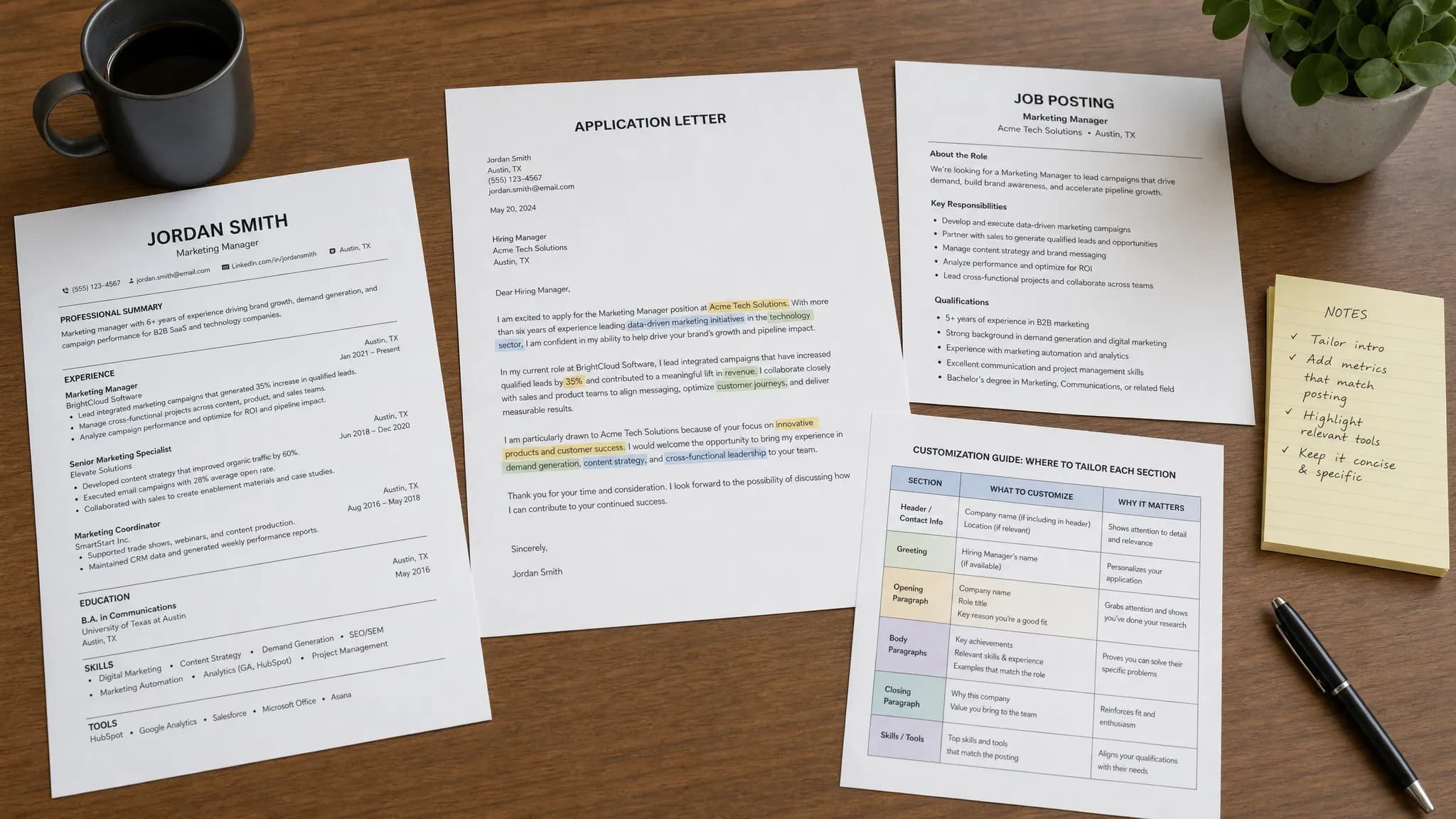
Letter of Intent Template for Job Applications
Use this letter of intent template for job applications, with copy-ready sections, examples, formatting tips, and mistakes to avoid.
Write your job application — not a blank template
Generate a finished job application with your details, tone, and language in ~30 seconds. Free first letter, no credit card — beats copy-pasting and filling the blanks yourself.
Most job seekers treat a letter of intent as a vague note of interest. Hiring teams usually need something sharper: a short business letter that states what kind of opportunity you want, why the company is a strong match, and what evidence proves you can contribute.
The letter of intent template for job applications below is built for that purpose. You can copy it, personalize the placeholders, and adapt it for a posted role, a future opening, an internal position, or a company you admire but that has not advertised the right job yet.
What a letter of intent should accomplish
A job application letter of intent, often called an LOI, introduces your professional background and expresses your intention to be considered for a role or category of roles. Unlike a resume, it explains fit in plain language. Unlike a casual networking message, it is formatted and written like a formal business letter.
A strong LOI should do three things quickly:
- Identify the opportunity, department, company, or type of position you are targeting.
- Show specific proof that your background matches the employer's needs.
- End with a clear next step, usually a request to discuss your qualifications or be considered for current and upcoming openings.
If you are still deciding whether this format is right for your situation, our guide to writing a letter of intent for a job explains how LOIs differ from cover letters and letters of interest. If a job posting specifically asks for a cover letter instead, use a more direct application letter for job template.
When to use this job application LOI template
Use a letter of intent when you need a professional introduction but do not want to simply repeat your resume. It works best when the employer needs to understand your direction, motivation, and transferable value.
| Situation | Is an LOI a good fit? | Why |
|---|---|---|
| Applying for a posted role that requests an LOI | Yes | The employer wants a formal statement of intent and fit. |
| Reaching out to a company without a posted role | Yes | You can express interest in future opportunities and explain your value. |
| Applying internally for a promotion or transfer | Yes | The format helps connect your current work to the target position. |
| Applying for a role that asks for a cover letter | Sometimes | Use a cover letter if the job ad clearly requests one. |
| Sending a quick networking note | Usually no | A short email may be more natural than a formal letter. |
The key is intent. If your goal is to be considered seriously for a professional opportunity, use an LOI. If your goal is only to ask for advice, schedule coffee, or reconnect with a contact, keep it shorter and less formal.
Copy-ready letter of intent template for job applications
Use the template below as a starting point. Keep the final version between 250 and 400 words unless the employer gives a specific length requirement.
[Your Name]
[Your Address]
[City, State ZIP]
[Email Address]
[Phone Number]
[Date]

[Hiring Manager Name]
[Company Name]
[Company Address]
[City, State ZIP]

Dear [Hiring Manager Name],

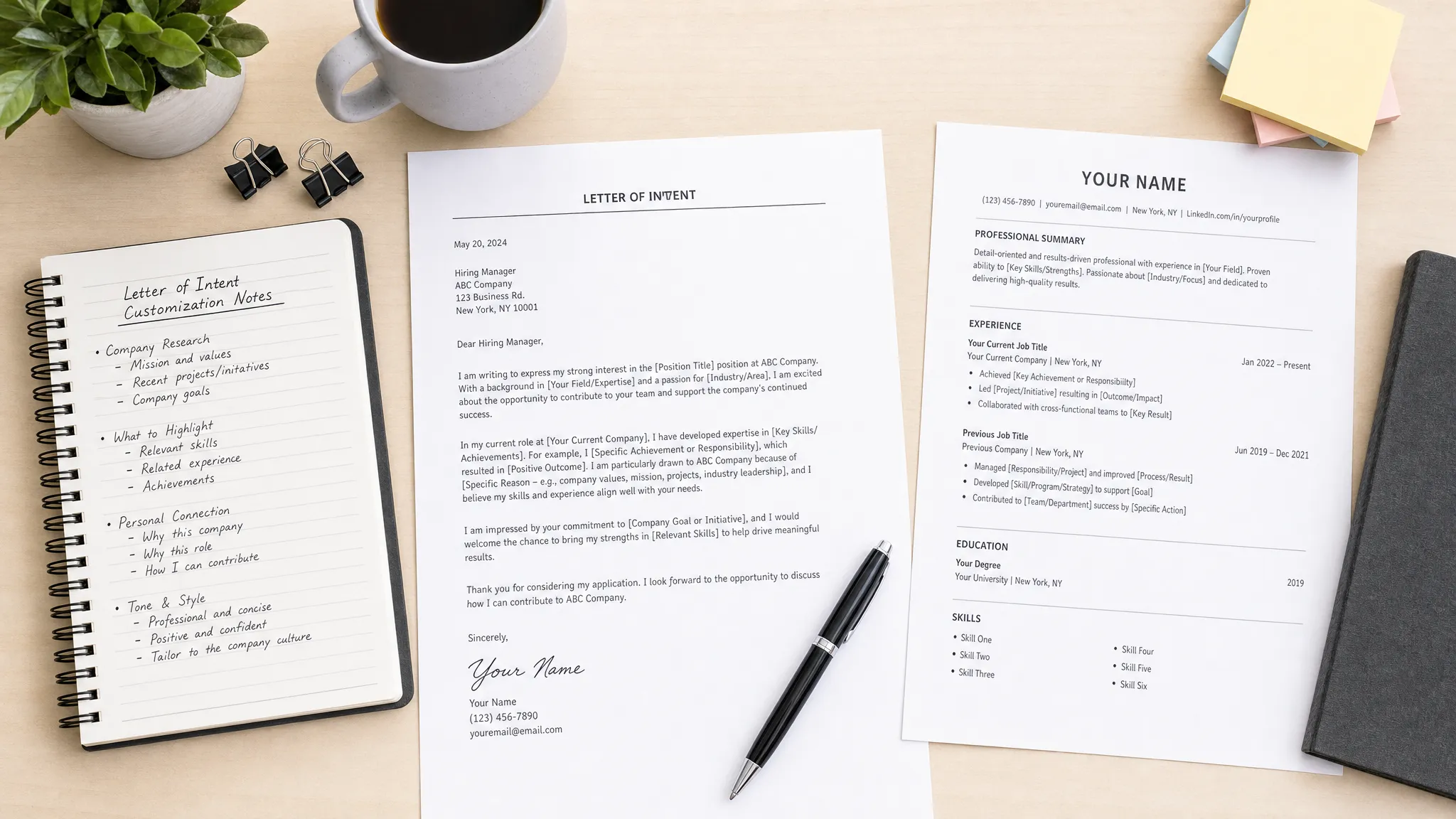
I am writing to express my intent to be considered for [role, department, or type of opportunity] at [Company Name]. With experience in [your field or specialty] and a background in [relevant skill, industry, or achievement area], I am interested in contributing to [company goal, team need, or business priority].

In my current or previous role as [job title] at [organization], I [describe a specific accomplishment, project, or responsibility]. This experience strengthened my ability to [skill 1], [skill 2], and [skill 3], which align closely with the needs of [team, department, or company]. I am especially drawn to [Company Name] because of [specific reason related to mission, product, culture, growth, clients, or industry reputation].

I believe my combination of [strength 1], [strength 2], and [strength 3] would allow me to make a meaningful contribution to your team. I have attached my resume for your review and would welcome the opportunity to discuss how my background may support current or future openings at [Company Name].

Thank you for your time and consideration. I look forward to the possibility of speaking with you.

Sincerely,

[Your Name]
How to fill in each part of the template
The template only works if you replace general phrases with evidence. A hiring manager should be able to understand why you are writing, what you bring, and why the company is not receiving a generic letter.
Start with the target opportunity. If there is a posted job title, name it exactly. If there is no posting, describe the function clearly, such as marketing operations roles, entry-level data analyst opportunities, or future project management openings.
Next, add one strong proof point. This can be a measurable achievement, a project result, a responsibility that matches the target role, or a relevant credential. Metrics help when you have them, but they are not required. A specific example is usually stronger than a broad claim.
Then, explain company fit. This should not be flattery. Reference something concrete, such as the employer's product, market, values, public initiatives, client base, or growth area. The goal is to show that your interest is informed.
Finally, keep the closing simple. Ask to discuss your fit, be considered for openings, or have your resume reviewed. Do not pressure the reader or overstate your availability.
Example wording for common job application scenarios
The easiest way to improve a letter of intent is to adapt the language to the reason you are applying. Here are practical lines you can use inside the template.
| Scenario | Strong line to adapt |
|---|---|
| Posted job opening | I am writing to express my intent to be considered for the [Job Title] position, where my background in [skill or field] aligns closely with your team's needs. |
| No current opening | I am reaching out to express my interest in future opportunities within [department or function] at [Company Name]. |
| Internal transfer | After contributing to [current team or project], I am interested in applying my knowledge of [company process, clients, or systems] to the [target team] role. |
| Career change | My experience in [previous field] has built strong skills in [transferable skill], which I am eager to apply in a [target role] environment. |
| Recent graduate | Through my coursework, internships, and projects in [field], I have developed a foundation in [skill 1] and [skill 2] that I am ready to apply professionally. |
| Senior-level role | I am interested in contributing my experience leading [teams, programs, operations, or strategy] to help [Company Name] achieve [business outcome]. |
Notice that each line connects intent with relevance. The best letters do not simply say you are interested. They explain why your interest makes sense.
Formatting rules recruiters expect
A letter of intent should look professional before anyone reads the first sentence. For traditional business-letter conventions, the Purdue OWL guide to basic business letters is a useful reference. The same principles apply to a job application LOI: clear contact details, formal greeting, concise paragraphs, and a professional closing.
| Element | Recommended format |
|---|---|
| Length | 250 to 400 words for most job applications |
| Paragraphs | 3 to 5 short paragraphs |
| Font | Simple professional font, 10 to 12 pt |
| Margins | About 1 inch on all sides |
| File type | PDF unless the employer requests another format |
| File name | Firstname-Lastname-Letter-of-Intent.pdf |
| Greeting | Dear [Name] if known, or Dear Hiring Manager |
| Tone | Professional, confident, and specific |
If you paste the letter into an email body, you can remove the physical address blocks. If you attach it as a document, keep the full business-letter format unless the application portal asks for a different style.
Mistakes that make a letter of intent feel generic
A weak LOI is usually not weak because the applicant lacks experience. It is weak because the letter could be sent to any company. Before sending yours, check for these common problems:
- Opening with a vague phrase such as I am interested in working for your company without naming the role or function.
- Repeating resume bullets without explaining why they matter for the target employer.
- Using broad adjectives such as hardworking, passionate, or motivated without evidence.
- Writing more about what you want than what you can contribute.
- Forgetting to attach or mention your resume.
- Sending the same letter to multiple companies without tailoring the company-fit paragraph.
The fix is simple: add specificity. One relevant achievement, one company-specific reason, and one clear next step can make the entire letter stronger.
Email version of the template
If you are sending the LOI by email instead of uploading it as a document, use a shorter format. Keep the subject line clear and include your resume as an attachment.
Subject: Letter of Intent - [Your Name] - [Target Role or Department]

Dear [Hiring Manager Name],

I am writing to express my intent to be considered for [role, department, or type of opportunity] at [Company Name]. My background in [field or specialty] includes experience with [skill or achievement], and I am interested in contributing to [company goal or team need].

In my role as [job title] at [organization], I [specific accomplishment or responsibility]. This experience has prepared me to support [relevant outcome], and I am particularly interested in [Company Name] because of [specific reason].

I have attached my resume for your review and would welcome the opportunity to discuss how my background could support current or future openings on your team.

Thank you for your time and consideration.

Sincerely,
[Your Name]
[Phone Number]
[LinkedIn URL or Portfolio URL, if relevant]
For email, shorter is better. The hiring manager should be able to understand the purpose in the first few lines and scan your fit quickly.
Final editing checklist before you send
Use this checklist after you customize the template. It helps catch the issues that make otherwise strong applications look rushed.
| Question | What to check |
|---|---|
| Is the target clear? | The first paragraph names the role, department, or opportunity type. |
| Is the proof specific? | At least one sentence describes a concrete accomplishment or relevant project. |
| Is the company fit real? | The letter includes a reason that applies to this employer, not every employer. |
| Is the tone professional? | The language is confident without sounding exaggerated. |
| Is the next step clear? | The closing asks for consideration, a conversation, or review of your resume. |
| Is it easy to read? | Paragraphs are short, formatting is clean, and the letter fits on one page. |
| Is it error-free? | Names, titles, company details, dates, and attachments are correct. |
A final proofread matters. Read the letter aloud once before sending it. Awkward sentences, repeated words, and missing context are easier to catch when you hear them.
Frequently Asked Questions
Is a letter of intent the same as a cover letter? No. A cover letter usually responds to a specific job posting and explains why you match that role. A letter of intent can be broader and may express interest in a company, department, internal move, or future opportunity.
How long should a letter of intent for a job application be? Most job application LOIs should be 250 to 400 words. That is long enough to show intent, fit, and proof, but short enough for a hiring manager to scan quickly.
Can I use a letter of intent when there is no job opening? Yes. That is one of the best uses of an LOI. Make the target area clear, explain why the company interests you, and ask to be considered for future openings that match your background.
Should I include salary expectations in a letter of intent? Usually no, unless the employer specifically asks. The LOI should focus on fit, contribution, and interest. Salary discussions typically happen later in the hiring process.
Should I attach my resume to a letter of intent? Yes, in most job application contexts. Mention that your resume is attached so the reader knows where to find your detailed work history, education, and credentials.
What is the best subject line for an email letter of intent? Use a clear subject line such as Letter of Intent - [Your Name] - [Target Role]. If you are applying to a specific posting, include the job title or reference number if available.
Create your job application letter faster
A template gives you a strong structure, but the best letter is still tailored to your background and the opportunity in front of you. If you want a polished draft without starting from a blank page, LetterCraft AI can generate professional, personalized letters for 65+ scenarios in under 30 seconds.
You can choose your details and tone, copy the result, export it to PDF, and keep track of past letters. It is free to try, does not require a credit card, and helps you turn a basic template into a ready-to-send job application letter with less stress.
Write your job application — not a blank template
Generate a finished job application with your details, tone, and language in ~30 seconds. Free first letter, no credit card — beats copy-pasting and filling the blanks yourself.