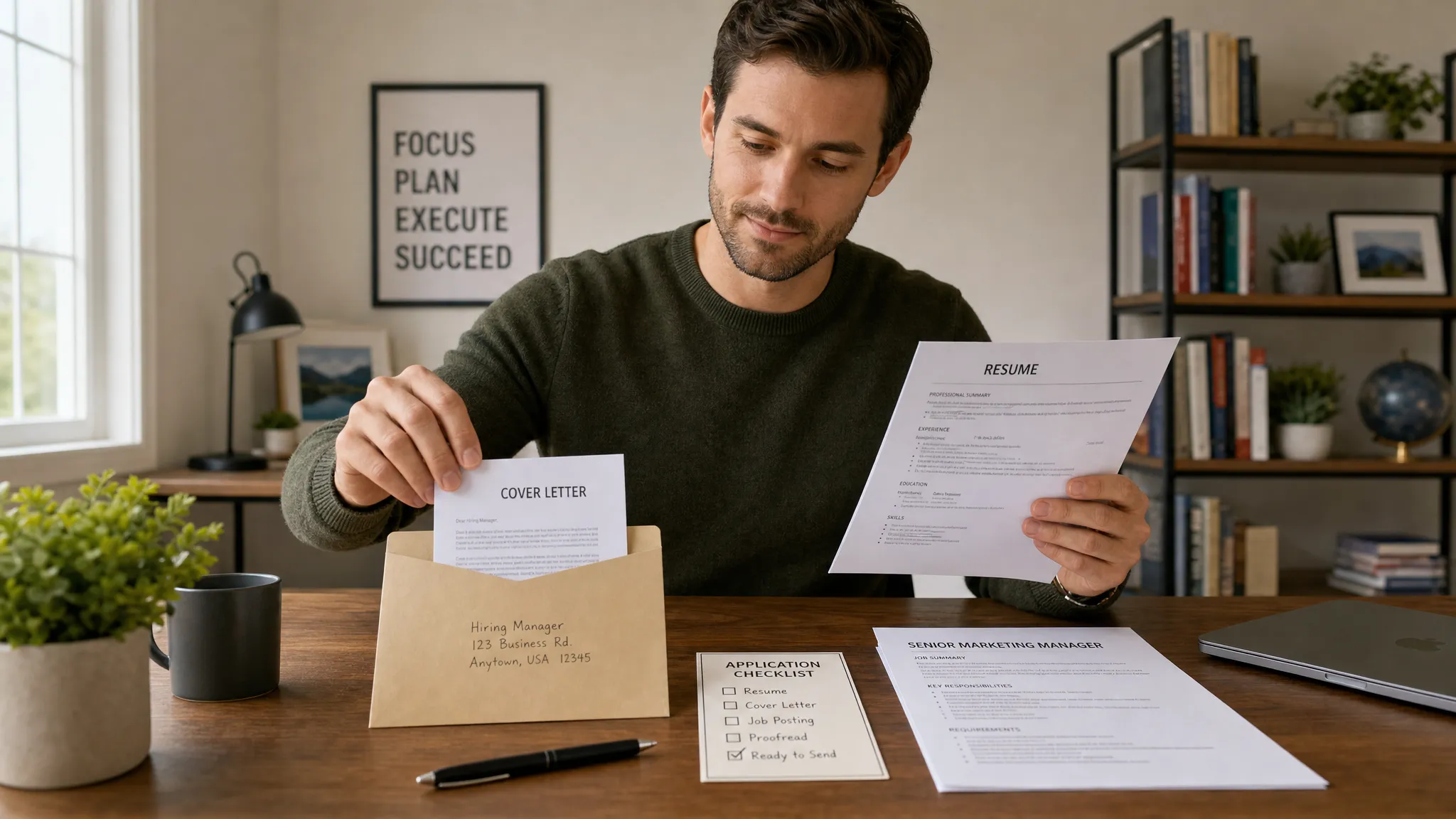
Help Writing a Cover Letter? Start With This Checklist
Need help writing a cover letter? Use this practical checklist to tailor your opening, proof points, format, tone, and final review.
Write your cover letter — not a blank template
Generate a finished cover letter with your details, tone, and language in ~30 seconds. Free first letter, no credit card — beats copy-pasting and filling the blanks yourself.
If you need help writing a cover letter, start by lowering the stakes. A cover letter is not your life story, and it is not a longer version of your resume. It is a short, targeted note that answers one question for the hiring team: “Why should we pay attention to this applicant for this role?”
That becomes much easier when you use a checklist. Instead of staring at a blank page, you can confirm that your letter has the right inputs, structure, proof, tone, and formatting before you send it.
Use the checklist below whether you are writing from scratch, editing a template, or polishing an AI-generated draft.
What a strong cover letter should do
A strong cover letter gives context your resume cannot fully explain. It connects your experience to the job posting, shows why this specific company interests you, and highlights one or two proof points that make your fit obvious.
CareerOneStop, sponsored by the U.S. Department of Labor, describes cover letters as a way to introduce yourself, explain why you are interested, and show how your skills match the employer’s needs. That is the right mindset: your cover letter should be useful to the reader, not just expressive for you.
Think of it as a relevance filter. If your resume lists everything you have done, your cover letter points to the few things that matter most for this job.
Before you write: gather these five inputs
The biggest reason cover letters sound generic is that the writer starts before collecting details. Spend five minutes gathering the information below, and your draft will immediately become sharper.
| Input | Why it matters | Quick prompt |
|---|---|---|
| Exact job title and company | Keeps the letter targeted | What role am I applying for, and where? |
| Top 2 to 3 job requirements | Shows you understand the role | Which responsibilities appear most important? |
| One or two proof points | Prevents vague claims | What result, project, metric, or story proves I can do this? |
| Company-specific reason | Shows genuine interest | What about this team, product, mission, customer base, or challenge interests me? |
| Recipient and format details | Avoids careless mistakes | Should this be an email, attachment, portal text box, or PDF? |
If you cannot find a hiring manager’s name, use a neutral greeting such as “Dear Hiring Team” or “Dear [Department] Team.” Avoid guessing a name or using an outdated generic greeting if you have a better option.
The cover letter checklist
1. Is your letter written for one specific job?
A cover letter that could be sent to ten companies usually persuades none of them. Before you write full paragraphs, check whether your target is clear.
Your letter should name the role, reflect the job posting, and emphasize the skills that matter most for that position. If the posting focuses on client communication, your cover letter should not spend most of its space on unrelated coursework or internal projects.
Quick check:
- I named the exact role and company.
- I mentioned at least one responsibility or priority from the job posting.
- I removed details that are impressive but not relevant to this role.
A focused cover letter does not need to include everything. It needs to make the reader think, “This person understands what we need.”
2. Does the opening get to relevance quickly?
Many cover letters begin with a sentence like “I am writing to apply for the position of...” That is not wrong, but it wastes the most valuable line of the letter.
A stronger opening connects the role to your most relevant value.
| Generic opening | Stronger opening |
|---|---|
| I am writing to apply for the Marketing Coordinator position. | I am excited to apply for the Marketing Coordinator role at BrightWave because my experience growing email engagement and coordinating campaign calendars aligns closely with your need for a detail-oriented marketing teammate. |
| Please accept my application for the Customer Support Representative role. | With three years of customer support experience and a track record of resolving high-volume tickets with strong satisfaction scores, I would be glad to support your customer experience team. |
By the end of the first paragraph, the hiring team should know what you are applying for, why you fit, and why the letter is not copied from another application.
3. Did you prove your fit instead of just describing yourself?
Hiring managers see phrases like “hardworking,” “passionate,” “detail-oriented,” and “team player” constantly. Those words only matter when they are supported by evidence.
Instead of saying you are organized, mention a project you coordinated. Instead of saying you are analytical, mention a report, system, or decision your analysis improved. Instead of saying you communicate well, mention the audience, situation, and result.
A useful proof sentence often follows this pattern:
“While working on [project or responsibility], I [action you took], which led to [result or outcome].”
For example:
“While coordinating onboarding for a 12-person support team, I created a shared training tracker that reduced missed onboarding tasks and helped new hires reach independent ticket handling faster.”
The result does not always need to be a perfect metric. A clear outcome, scope, or before-and-after detail can still make your claim credible.
4. Is there a real reason you want this employer?
A cover letter should answer “Why this company?” without sounding like flattery. You do not need a dramatic personal story. You do need one specific connection.
Good company-specific details can include a product you have used, a customer group you care about, a recent initiative, a company value that matches your work style, or a challenge the team appears to be solving.
Weak motivation sounds like this:
“I have always admired your successful company and would love to be part of it.”
Stronger motivation sounds like this:
“I am especially interested in your focus on simplifying financial tools for first-time business owners, because much of my recent support work has involved helping non-technical customers understand complex account issues clearly.”
Specificity is what makes the difference. One thoughtful sentence is better than a paragraph of praise.
5. Does every paragraph answer a hiring question?
A cover letter usually works best when each paragraph has a job. If a paragraph does not answer a hiring question, it probably needs to be cut or rewritten.
| Paragraph | Hiring question it should answer | What to include |
|---|---|---|
| Opening | Why are you relevant to this role? | Role, company, strongest fit |
| Middle | What evidence shows you can do the work? | One or two proof points tied to the job |
| Motivation | Why this company or team? | Specific company connection |
| Closing | What should happen next? | Appreciation, confidence, interview interest |
You do not always need four long paragraphs. In many cases, three concise paragraphs are enough: opening, proof, close. If you want a deeper structure, read this guide to cover letter structure.
6. Is the letter short enough to be read?
A cover letter should be easy to skim. For most job applications, aim for about 250 to 400 words and keep it to one page. If you are past 500 words, you are probably explaining too much or repeating your resume.
Short does not mean shallow. It means each sentence has a purpose. Remove long background stories, repeated skills, and phrases that do not add new information.
A good test is to read only the first sentence of each paragraph. If those sentences alone do not communicate your fit, the structure needs work.
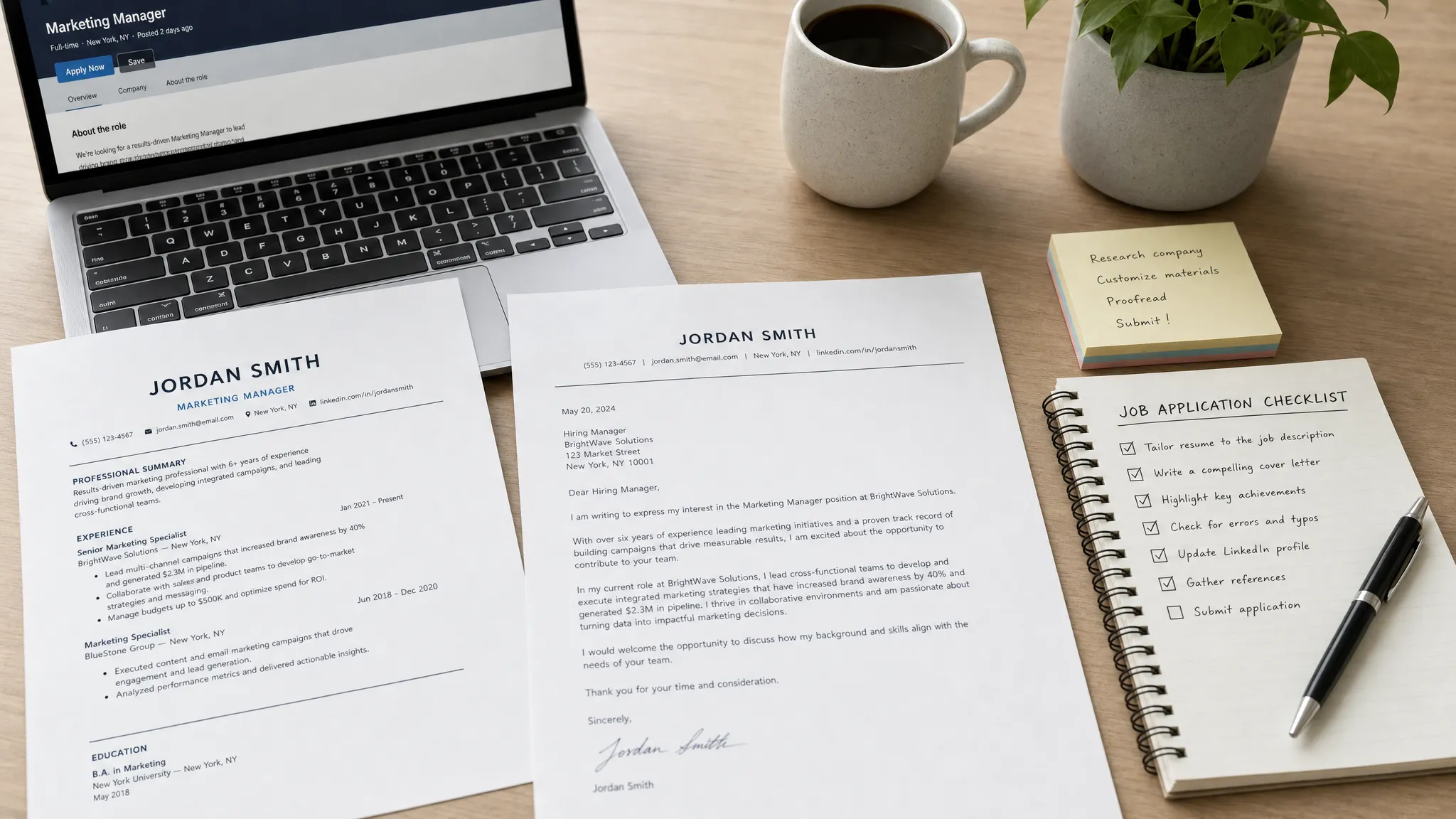
7. Is the format simple and professional?
Even a strong letter can lose credibility if it looks cluttered. Use a clean layout, standard font, consistent spacing, and a file name that makes sense. If you are attaching a PDF, use a name like “FirstName-LastName-Cover-Letter.pdf.”
For a traditional letter, use left-aligned business formatting with your contact information, the date, recipient information if available, a greeting, the body, and a professional closing. For email applications, you can usually place the letter directly in the email body and keep the formatting simpler.
If you want exact spacing and layout guidance, use this cover letter format guide.
8. Did you handle special situations briefly and confidently?
If you are changing careers, returning after a gap, applying with limited experience, or recovering from a layoff, your cover letter can give helpful context. The key is to be brief, neutral, and forward-looking.
| Situation | What to do | What to avoid |
|---|---|---|
| Career change | Connect transferable skills to the new role | Apologizing for not having a traditional background |
| Employment gap | Mention it only if helpful, then pivot to readiness | Overexplaining personal details |
| Recent graduate | Highlight projects, internships, coursework, or volunteer work | Saying you have no experience |
| Layoff | Use one neutral sentence if needed | Blaming your previous employer |
| Overqualified candidate | Explain why this role is a deliberate fit | Sounding like the role is a temporary backup plan |
For example, a career changer might write:
“After five years managing client relationships in hospitality, I am now applying that same communication, problem-solving, and service recovery experience to customer success roles in SaaS.”
That sentence gives context without sounding defensive.
9. Does the tone sound like a professional human?
The best cover letters sound polished but natural. They are confident without being arrogant, warm without being casual, and specific without sounding forced.
Watch for phrases that make your letter feel robotic or inflated, such as “esteemed organization,” “dynamic team player,” “I am uniquely qualified,” or “I would be an invaluable asset.” These phrases are common, but they rarely add meaning.
A better tone is direct:
“I would welcome the opportunity to discuss how my experience improving customer response workflows could support your team’s service goals.”
If you used AI to help writing a cover letter, read the draft aloud. Your ear will catch sentences that sound too generic, too formal, or unlike you.
10. Did you complete a final accuracy check?
Small mistakes can create doubt, especially in a document meant to prove your professionalism. Before sending, review the details that are easiest to overlook.
Final check:
- The company name is correct everywhere.
- The job title matches the posting.
- The recipient name is spelled correctly, if used.
- The letter does not repeat large sections of the resume.
- The strongest proof point appears in the first half of the letter.
- The tone is confident, not desperate.
- The file name is professional.
- The PDF or email preview displays correctly.
If you answer “no” to any item, fix that issue before sending. A few extra minutes can prevent an avoidable rejection.
Copy-ready cover letter checklist
Use this as your final review before every application:
- I tailored the letter to one job, not a general job search.
- I used the exact company name and role title.
- My opening explains why I am relevant quickly.
- I included one or two concrete proof points.
- I connected my experience to the employer’s needs.
- I included a specific reason I am interested in this company.
- I kept the letter to one page.
- I used simple formatting and a readable font.
- I avoided clichés and vague personality claims.
- I handled any special situation briefly and positively.
- I proofread names, dates, titles, and attachments.
- I ended with a clear, professional closing.
This checklist works because it forces your letter to stay reader-focused. Instead of asking “Does this sound impressive?” you are asking “Does this help the hiring team understand my fit?”
A faster workflow if you are stuck
If you are still stuck, do not start with a blank page. Start with inputs.
Write down the job title, company name, two requirements from the posting, one relevant achievement, and one reason the company interests you. Then turn those notes into a short draft. You can also use a customizable template if you prefer a structured starting point, such as this cover letter template you can edit in minutes.
AI can also help, especially when you know what details to provide. The quality of the output depends on the specificity of your inputs. A vague prompt creates a vague letter. A prompt with the role, company, achievements, preferred tone, and situation creates a much stronger first draft.
Frequently Asked Questions
What is the best way to get help writing a cover letter? The best help starts with structure. Gather the job details, choose one or two proof points, write a targeted opening, and use a checklist to edit for relevance, tone, and formatting.
How long should a cover letter be? For most applications, keep it to one page and roughly 250 to 400 words. Senior roles or specialized applications may need slightly more detail, but clarity matters more than length.
Should I write a cover letter if it is optional? Usually, yes, if you can make it specific. An optional cover letter is useful when it explains fit, motivation, a career change, a gap, or a strong achievement that your resume alone may not highlight.
Can I use the same cover letter for multiple jobs? You can reuse the structure, but not the exact letter. At minimum, customize the role title, company name, opening, proof points, and company-specific reason.
Is it okay to use AI for a cover letter? Yes, as long as you personalize and review the result. AI is useful for creating a first draft quickly, but you should add real achievements, company details, and your natural voice before sending.
Turn your checklist into a ready-to-send cover letter
Need help writing a cover letter without spending an hour on the first draft? LetterCraft AI helps you generate professional, personalized letters in under 30 seconds.
Choose the letter type, add a few details, select the tone you want, and get a polished draft you can copy, edit, or export as a PDF. LetterCraft AI supports 65+ letter types, including cover letters, resignation letters, complaint letters, and more. It is free to try, with no credit card required.
Start with the checklist above, then use LetterCraft AI to turn your details into a clean, confident cover letter faster.
Write your cover letter — not a blank template
Generate a finished cover letter with your details, tone, and language in ~30 seconds. Free first letter, no credit card — beats copy-pasting and filling the blanks yourself.