
Cover Letter Structure: A 3-Paragraph Framework That Works
Cover letter structure made simple: a 3-paragraph framework with examples and a fill-in template to write a tailored cover letter fast.
Write your cover letter — not a blank template
Generate a finished cover letter with your details, tone, and language in ~30 seconds. Free first letter, no credit card — beats copy-pasting and filling the blanks yourself.
Hiring managers don’t reject most cover letters because they’re “bad writers.” They reject them because the letter is hard to scan, too generic, or never connects the candidate’s proof to the role.
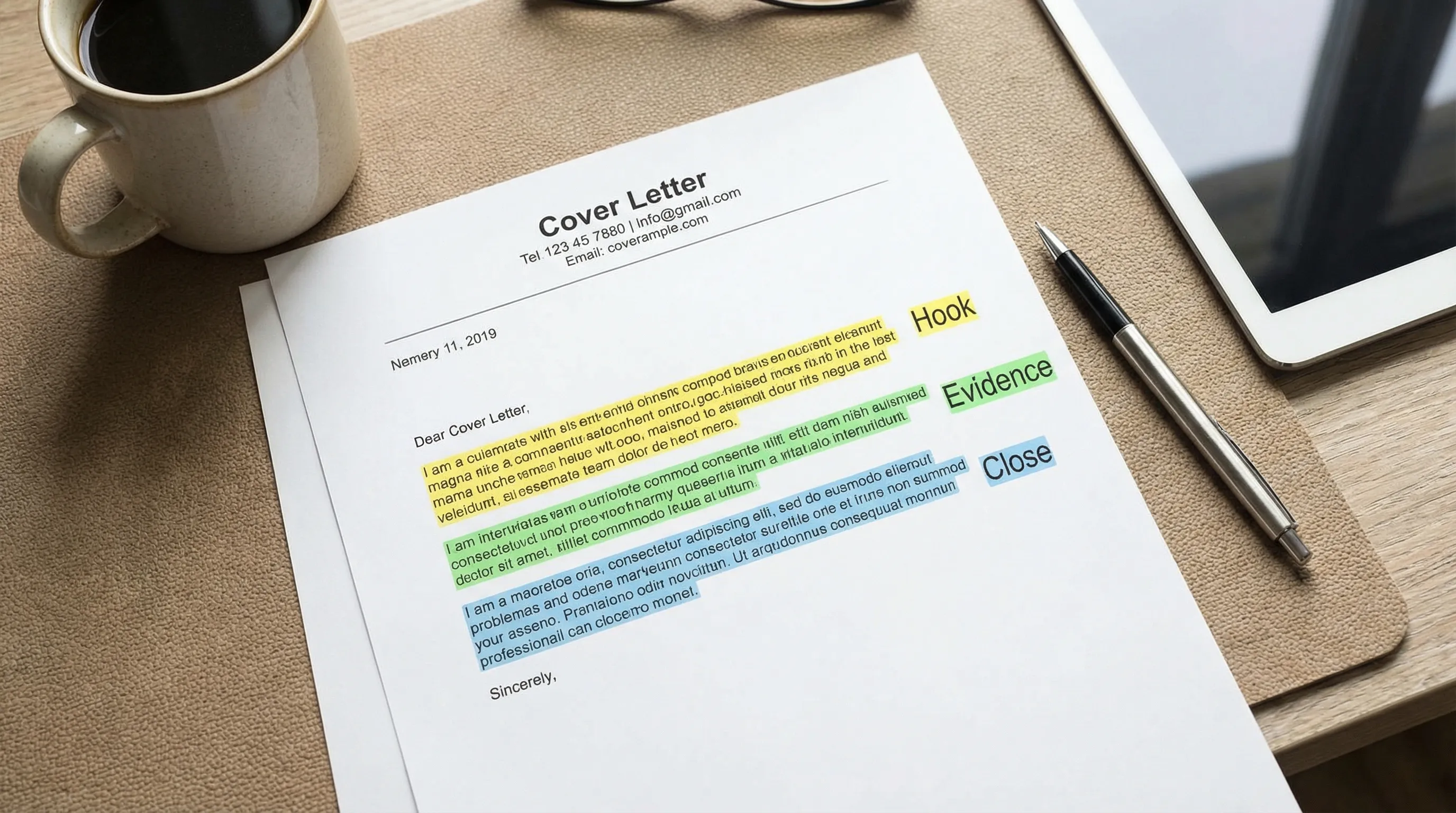
A strong cover letter structure fixes all three problems. And the simplest structure that consistently works is a tight 3-paragraph framework: Hook, Evidence, Close.
Below is a practical breakdown of what to write in each paragraph, what to avoid, plus a fill-in template you can use for almost any job.
Why a 3-paragraph cover letter structure works
Most recruiters and hiring managers read cover letters quickly (often after scanning your resume). Your structure needs to help them answer three questions fast:
- Why this role/company?
- Can you do the work (with proof)?
- Are you a low-risk, high-signal candidate worth interviewing?
A three-paragraph framework maps perfectly to those questions:
- Paragraph 1: Targeted reason you’re applying (and a hook).
- Paragraph 2: Proof you can deliver (measurable or specific results).
- Paragraph 3: Clear close (value recap + call to action).
If you want a deeper guide on what to say (not just how to structure it), you can also read: How to Write a Cover Letter That Gets Interviews in 2026.
The ideal cover letter length (so your structure stays sharp)
A 3-paragraph cover letter is usually strongest when it’s short enough to read in one pass.
As a practical range:
- 150 to 300 words works well for most roles.
- Up to 400 words can work for senior roles if every sentence earns its place.
Many career centers give similar guidance. For example, see Harvard’s resume and cover letter guidance for formatting and concision standards.
Cover letter structure at a glance
Use this table as your “what goes where” cheat sheet.
| Paragraph | Goal | What to include | What to avoid |
|---|---|---|---|
| 1. Hook | Make it clear this letter is for this job | Role + company + specific reason + 1 signature strength | “I’m applying for…” with no details, passion-only claims |
| 2. Evidence | Prove you can do the job | 1 to 2 relevant achievements + scope + outcome + tools/skills | Repeating your resume, long life story, buzzwords |
| 3. Close | Make the next step easy | Value recap + enthusiasm + interview ask + thanks | Desperation, vague endings, overconfident demands |
Paragraph 1: The hook (4 to 6 lines)
Your opening paragraph should do two jobs:
- Signal fit quickly (role, company, and your most relevant positioning).
- Show this is not generic (a detail that proves intent).
What to write
A reliable structure:
- Sentence 1: State the role and your value theme.
- Sentence 2: Add a company-specific reason (product, mission, team, recent news, or the job’s core problem).
- Sentence 3 (optional): Preview the proof you’ll share.
Example hook (strong)
I’m applying for the Customer Success Manager role at Northwind because you’re scaling a mid-market onboarding motion, and that’s where I’ve produced my strongest results. In my last role, I reduced time-to-first-value by 22% by rebuilding onboarding workflows and customer education.
Common hook mistakes
- Starting with a generic line that could fit any job.
- Saying you’re “passionate” without evidence.
- Writing a summary of your entire background (save proof for paragraph 2).
Paragraph 2: The evidence (6 to 10 lines)
This is the most important paragraph. The goal is not to list everything you’ve done, it’s to prove you can solve the employer’s problem.
What to include (pick one path)
Choose the path that best matches your situation:
Path A: The achievement proof (best for most candidates)
- A relevant accomplishment
- The scope (team size, budget, volume, users, revenue, deadlines)
- What you did (actions)
- The outcome (results)
Path B: The skills-to-problem proof (best for career changers)
- A core responsibility from the job posting
- A transferable example that demonstrates the same skill
- A short link back to the role (“This is how I’d approach X at your company.”)
A simple “proof sentence” formula
Use this to stay concrete:
I achieved [result] by doing [action], using [skill/tools], which matters because [job need].
Example evidence paragraph (achievement-driven)
At Beacon Labs, I owned lifecycle email and landing page optimization for two product lines. By rewriting onboarding sequences, improving segmentation, and partnering with product on activation nudges, I increased trial-to-paid conversion from 8.4% to 11.1% in one quarter. I also built a lightweight reporting cadence that helped our team prioritize experiments based on retention impact, not just clicks.
What to avoid in paragraph 2
- A dense list of tools with no outcomes.
- Copying bullet points from your resume.
- Three or more different stories. One strong story beats three weak ones.
Paragraph 3: The close (3 to 6 lines)
Your closing paragraph should feel confident and easy to act on.
What to write
- Re-anchor your fit in one sentence.
- Express interest in an interview.
- Add a courteous thank you.
Example close
I’d welcome the chance to discuss how my lifecycle and activation experience can help improve retention and conversion at Northwind as you scale. Thank you for your time and consideration, and I’m happy to share examples of past experiments and results.
One line that helps (but most people skip)
If appropriate, add a low-friction “proof offer,” such as:
- “I can share a portfolio.”
- “I can walk through a recent project.”
- “I can provide a brief 30-60-90 day plan.”
This signals preparedness without sounding arrogant.
A fill-in-the-blank 3-paragraph cover letter template
Use this as a starting point, then personalize it.
Paragraph 1 (Hook)
I’m applying for the [Job Title] role at [Company] because [specific reason tied to the company or team’s work]. I bring [1-2 strengths tied to the role], and in my recent work I’ve delivered [headline result or impact].
Paragraph 2 (Evidence)
In my role as [Current/Recent Title] at [Company/Context], I [action you took] to solve [problem]. This resulted in [measurable outcome]. I’m confident this experience translates to [responsibility from job description], especially as you focus on [initiative/challenge the company likely has].
Paragraph 3 (Close)
I’d appreciate the opportunity to discuss how I can contribute to [team/goal] at [Company]. Thank you for your time, and I look forward to the possibility of an interview.
How to customize the structure for common situations
The framework stays the same, but what you emphasize shifts.
If you’re changing careers
- In paragraph 1, lead with the new role’s core skill, not your old title.
- In paragraph 2, use one transferable story with strong outcomes.
- In paragraph 3, ask for a conversation and keep tone grounded.
For more examples across scenarios, you may also like: 10 Cover Letter Examples That Got Real Interviews (2026).
If you have an employment gap
You usually don’t need to explain it unless it’s essential for context. If you do, keep it to one neutral sentence in paragraph 2, then pivot back to proof.
If you were laid off
A layoff is not a character flaw, but it can become a distraction if you over-explain it. If you mention it, do it briefly and neutrally, then refocus on results.
(There’s a dedicated guide for this scenario here: Laid Off in 2026? How to Write a Cover Letter That Still Gets You Hired.)
Quick pre-send checklist (structure-focused)
Before you hit submit, confirm these three things:
- Paragraph 1 contains at least one specific company detail (not just the company name).
- Paragraph 2 includes proof (numbers, scope, outcomes, or a concrete project).
- Paragraph 3 clearly asks for the interview and ends professionally.
Frequently Asked Questions
What is the best cover letter structure in 2026? A short, targeted 3-paragraph structure works best for most applicants: a tailored hook, evidence with measurable proof, and a clear close requesting an interview.
How many paragraphs should a cover letter be? Three paragraphs is a strong default because it’s easy to scan and forces clarity. A fourth short paragraph can work for senior roles, but only if it adds new proof.
How long should each paragraph be in a cover letter? Aim for roughly 4 to 6 lines for the hook, 6 to 10 lines for evidence, and 3 to 6 lines for the close. Keep the whole letter around 150 to 300 words when possible.
Should I repeat my resume in my cover letter? No. Your cover letter should add context and proof: pick 1 to 2 achievements that match the role and explain the impact, instead of listing job duties.
Can I use AI to write my cover letter? Yes, but you should always personalize it with role-specific details, your real achievements, and a quick edit for tone. The goal is help with structure and drafting, not sending generic text.
Write a structured cover letter in 30 seconds with CraftMyLetter
If you like this 3-paragraph framework but don’t want to start from a blank page, you can use CraftMyLetter to generate a personalized cover letter for your role in under 30 seconds. Choose the letter type, fill in a few details, pick a tone, then copy, export to PDF, or save it to your letter history. No credit card is required to try it.
Write your cover letter — not a blank template
Generate a finished cover letter with your details, tone, and language in ~30 seconds. Free first letter, no credit card — beats copy-pasting and filling the blanks yourself.