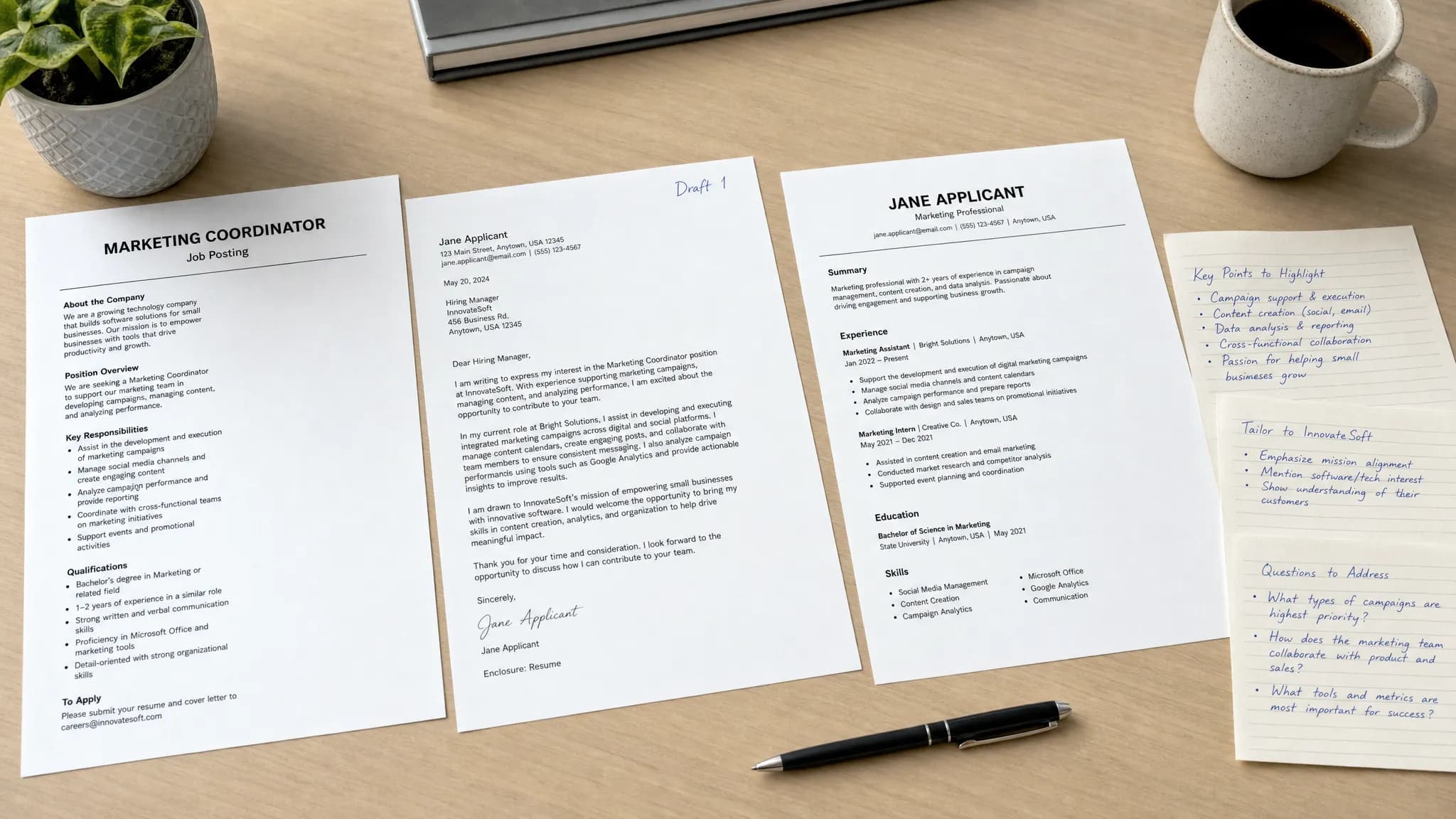
Writing a Great Cover Letter in 5 Practical Steps
Writing a great cover letter is easier with this 5-step guide. Learn how to tailor, prove fit, and close confidently.
Write your cover letter — not a blank template
Generate a finished cover letter with your details, tone, and language in ~30 seconds. Free first letter, no credit card — beats copy-pasting and filling the blanks yourself.
Writing a great cover letter is easier when you stop treating it like a mini autobiography. A hiring manager already has your resume. Your letter should make one thing obvious: why your experience, motivation, and timing make sense for this specific role.
That means the best cover letters are not the longest, cleverest, or most formal. They are focused. They connect the job posting to your strongest proof. They sound like a real person wrote them. And they give the reader a reason to move your application forward.
Use the five practical steps below to go from a blank page to a strong, tailored draft without overthinking every sentence.
Step 1: Decode the job post before you write
Before writing a single line, read the job description like a hiring manager. Most applicants skim it for keywords. Strong applicants look for the employer's actual problem.
Start by identifying the role's core mission. Is the company trying to increase sales, improve customer retention, ship product faster, reduce errors, support a growing team, or bring structure to a messy process? Your cover letter should respond to that mission.
Use this quick relevance map:
| Job post clue | What it tells you | How to use it in your cover letter |
|---|---|---|
| Responsibilities listed first | The work that matters most | Lead with proof that you can do this work |
| Repeated skills or tools | Likely screening priorities | Mention only the ones you have used meaningfully |
| Words like fast-growing, scaling, transformation, or high-volume | The work environment | Show experience with pace, change, or complexity |
| Nice-to-have qualifications | Differentiators | Use them if they strengthen your angle, but do not force them |
| Company mission or product focus | Motivation signals | Explain why this company or customer problem interests you |
Do not try to address everything in the posting. A great cover letter usually focuses on two or three high-value matches. If you include every requirement, the letter becomes a crowded checklist instead of a persuasive argument.
A simple pre-writing note can be enough:
- The role needs someone who can manage client onboarding and reduce churn.
- My best proof is improving onboarding completion by 22 percent in my last role.
- My company-specific reason is that their product serves small businesses, which I have supported for three years.
Once you have that, the letter has direction.
Step 2: Choose one clear message
The biggest mistake applicants make is trying to sound impressive in every possible way. They mention leadership, communication, teamwork, creativity, analytics, passion, adaptability, and five tools in the same paragraph. The result feels generic because there is no central point.
Instead, choose one message you want the reader to remember.
Use this sentence before drafting:
My strongest fit for this role is my ability to [main contribution], proven by [specific evidence], and I am interested because [company-specific reason].
Here is how that can look in different situations:
| Situation | Strong cover letter angle | What to avoid |
|---|---|---|
| Recent graduate | Relevant coursework, internship, project, or leadership experience tied to the job | Apologizing for limited experience |
| Career changer | Transferable skill plus proof from a previous industry | Overexplaining your entire career history |
| Experienced professional | A measurable result that matches the role's biggest priority | Repeating every senior responsibility from your resume |
| Returning after a gap | Current readiness plus recent learning, freelance work, or relevant past results | Making the gap the main story |
This one-message approach keeps your writing sharp. It also helps you decide what to leave out, which is often harder than deciding what to include.
For example, if you are applying for a marketing coordinator role focused on email campaigns, your angle might be campaign execution and performance tracking. You do not need to spend half the letter describing unrelated event planning experience unless it supports that angle.
Step 3: Open with relevance, not a generic introduction
Many cover letters start with a sentence like: I am writing to apply for the position of Marketing Associate. It is polite, but it wastes the most valuable line of the letter.
Your opening should quickly show the role, your fit, and a reason to keep reading. You can still be professional without sounding stiff.
Compare these openings:
| Weak opening | Stronger opening |
|---|---|
| I am excited to apply for the Customer Success Manager position. | I am applying for the Customer Success Manager role because my last three years have focused on improving onboarding, reducing support friction, and helping small business clients adopt software faster. |
| Please accept my application for the Data Analyst role. | Your Data Analyst role stood out because it combines dashboard building with operational decision-making, the same mix I used to help a logistics team cut weekly reporting time by 35 percent. |
| I believe I would be a great fit for your company. | After supporting high-volume retail customers through peak-season escalations, I am interested in bringing that same calm, structured service approach to your support team. |
A strong opening does not need to be dramatic. It needs to be specific.
If you have a referral, mention it early. If you have a standout achievement, lead with it. If you are changing careers, name the bridge between your past work and the new role. The reader should understand your angle within the first three sentences.
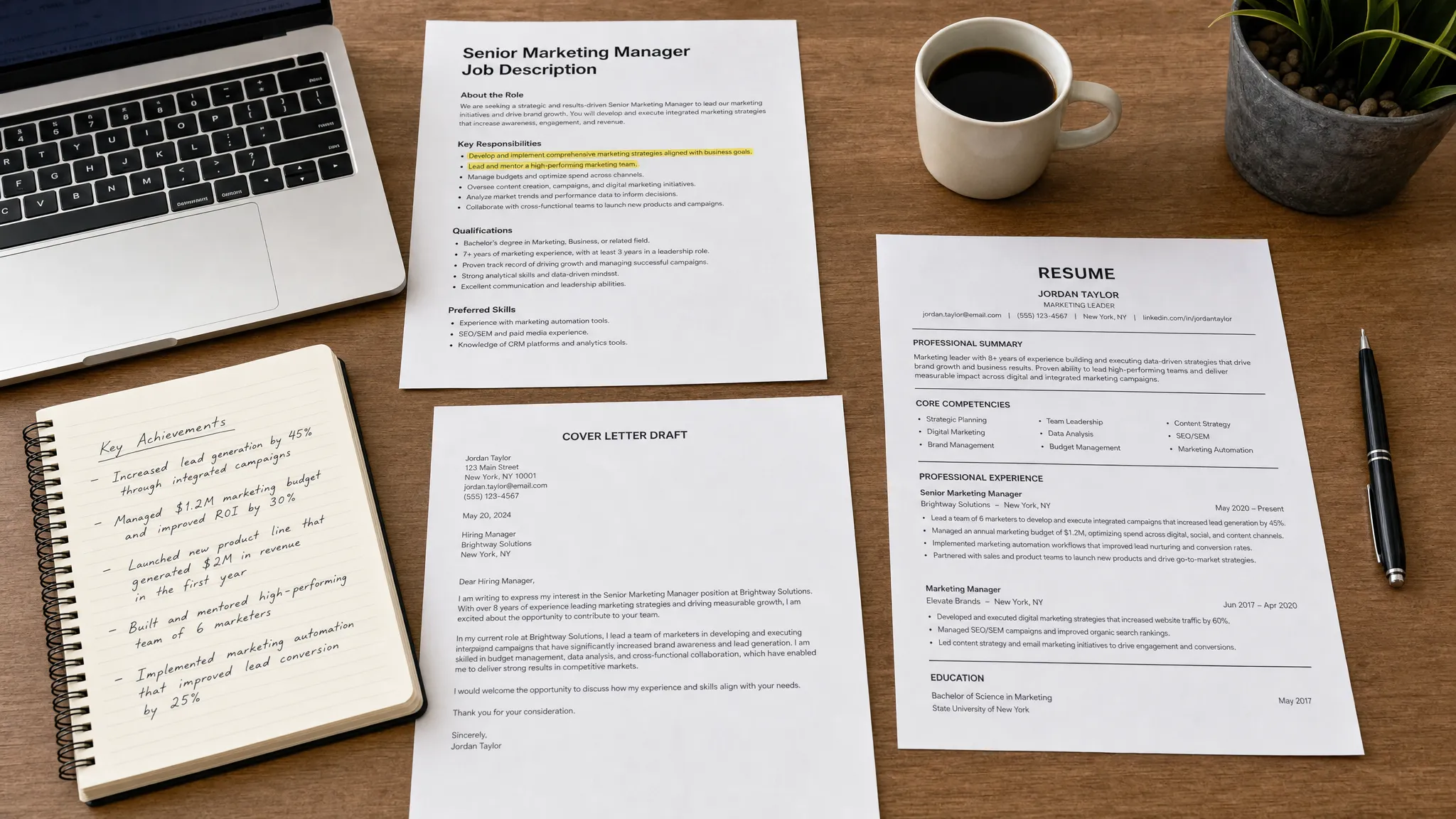
Step 4: Prove your fit with one or two focused examples
The middle of your cover letter is where you earn credibility. This section should not repeat your resume line by line. Instead, pick one or two examples that show how you think, solve problems, and create value.
A useful structure is:
Claim, evidence, connection.
The claim says what you are good at. The evidence proves it. The connection explains why it matters for the job.
Here is a simple example:
In my current role, I have become the person managers rely on when customer issues need quick, organized follow-up. Last quarter, I helped redesign our escalation tracker, which reduced unresolved tickets older than seven days by 28 percent. Because your posting emphasizes cross-functional customer support, I would bring both the service mindset and process discipline needed to keep clients moving forward.
Notice what this paragraph does well. It does not just say the applicant is organized. It shows organization through a result. It also connects the achievement directly to the employer's needs.
If you do not have obvious metrics, you can still provide proof. Use context instead of vague adjectives. Mention the size of the team, number of customers, frequency of work, difficulty of the situation, tools used, deadlines met, or feedback received.
For example:
-
Instead of: I have strong communication skills.
-
Write: I wrote weekly project updates for a 12-person product team, translating technical delays into clear next steps for sales and support.
-
Instead of: I am a fast learner.
-
Write: When our team adopted a new CRM, I completed training early, built a short internal guide, and helped three colleagues migrate their client notes without losing follow-up history.
-
Instead of: I am passionate about healthcare.
-
Write: My volunteer work at a community clinic showed me how much clear scheduling and patient communication affect trust, which is why your patient coordinator role is especially meaningful to me.
The goal is not to prove you are perfect. It is to prove you understand the work and can contribute in a way that feels real.
If you need inspiration for role-specific language, browse cover letter examples that got interviews or adapt one of these free cover letter templates by industry. Just remember to replace template language with your own evidence.
Step 5: Close with confidence and clean formatting
Your closing paragraph should be short. Reaffirm your interest, connect your value to the role, and invite the next step. Avoid sounding desperate, overly casual, or passive.
A strong closing can be as simple as:
I would welcome the opportunity to discuss how my experience improving onboarding workflows and supporting small business clients could help your customer success team deliver a smoother first 90 days for new accounts. Thank you for your time and consideration.
That works because it is specific. It names the value again, keeps the tone professional, and ends cleanly.
Before sending, make the letter easy to read. Hiring teams often review applications quickly, so formatting matters more than many applicants realize.
Use these final formatting rules:
- Keep the letter around 250 to 400 words unless the employer requests something different.
- Use three to four short paragraphs with clear spacing.
- Address the hiring manager by name if you can find it, otherwise use a professional greeting such as Dear Hiring Manager.
- Match the company and job title exactly as listed in the posting.
- Save as a PDF when uploading, unless the application system requests another format.
- Name the file clearly, such as Firstname-Lastname-Cover-Letter.pdf.
If you want a deeper layout guide, read Cover Letter Format: The Simple Layout Hiring Managers Expect.
Put the five steps together: a short example
Here is how the five-step process becomes a finished draft. This example is for a Customer Success Specialist role at a software company serving small businesses.
Dear Hiring Manager,
I am applying for the Customer Success Specialist role because my recent work has focused on helping small business clients adopt software with less confusion and faster follow-through. In my current support role, I have handled onboarding questions, account setup issues, and renewal conversations for customers who often need clear, patient guidance.
One contribution I am especially proud of was improving our onboarding follow-up process. After noticing that new customers were repeating the same setup questions, I created a simple email sequence and internal checklist for our team. Within two months, we reduced duplicate onboarding tickets and gave customers clearer next steps after their first call. That experience matches your focus on helping users get value quickly after signing up.
I am also drawn to your company because your product supports independent business owners, a customer group I have worked with closely for the past three years. I understand how important it is to make software feel practical, not overwhelming, for busy teams.
I would welcome the opportunity to discuss how my customer support experience, onboarding mindset, and small business background could help your team improve early customer engagement. Thank you for your time and consideration.
This letter works because it is not trying to cover everything. It has a clear angle, relevant proof, company-specific motivation, and a confident close.
A quick self-edit before you send
After drafting, read the letter once as the employer. Ask whether every paragraph helps answer one of these questions: Can this person do the job? Do they understand what we need? Are they genuinely interested in this role?
Then read it out loud. This catches stiff phrasing, repeated words, and sentences that sound like they were copied from a template. Replace broad claims with concrete details wherever possible.
A good cover letter should sound polished, but not robotic. If a sentence could appear in any applicant's letter, make it more specific or cut it.
Frequently Asked Questions
What makes a cover letter great? A great cover letter is specific to the job, focused on the employer's needs, and supported by real evidence. It should not simply repeat your resume. It should explain why your background makes sense for this role at this company.
How long should a cover letter be? Most cover letters should be 250 to 400 words. Shorter is fine if the letter is specific and complete. Longer letters are usually harder to scan and often include details better left for the resume or interview.
Should I write a new cover letter for every job? You do not need to start from zero every time, but you should customize the opening, proof points, and company-specific reason for each serious application. A lightly edited template is better than a generic letter, but a targeted letter is stronger.
Can I use AI when writing a great cover letter? Yes, as long as you personalize the result. AI can help you create a structured first draft quickly, but you should add your real achievements, adjust the tone, and confirm that the letter accurately reflects your experience.
What if I do not have much experience? Focus on transferable proof. Use class projects, internships, volunteer work, part-time jobs, certifications, or personal projects. The key is to show relevant behavior, such as solving problems, learning quickly, communicating clearly, or handling responsibility.
Create a polished cover letter faster
If you want a strong first draft without staring at a blank page, try LetterCraft AI. Add a few details about the job, your experience, and your preferred tone, and generate a personalized cover letter in under 30 seconds.
LetterCraft AI supports 65+ letter types, multiple tone options, PDF export, copy to clipboard, letter history tracking, and 5 languages. It is free to try, requires no credit card, and uses simple one-time pricing instead of subscriptions. Use it to draft faster, then apply the five steps above to make your letter truly yours.
Write your cover letter — not a blank template
Generate a finished cover letter with your details, tone, and language in ~30 seconds. Free first letter, no credit card — beats copy-pasting and filling the blanks yourself.