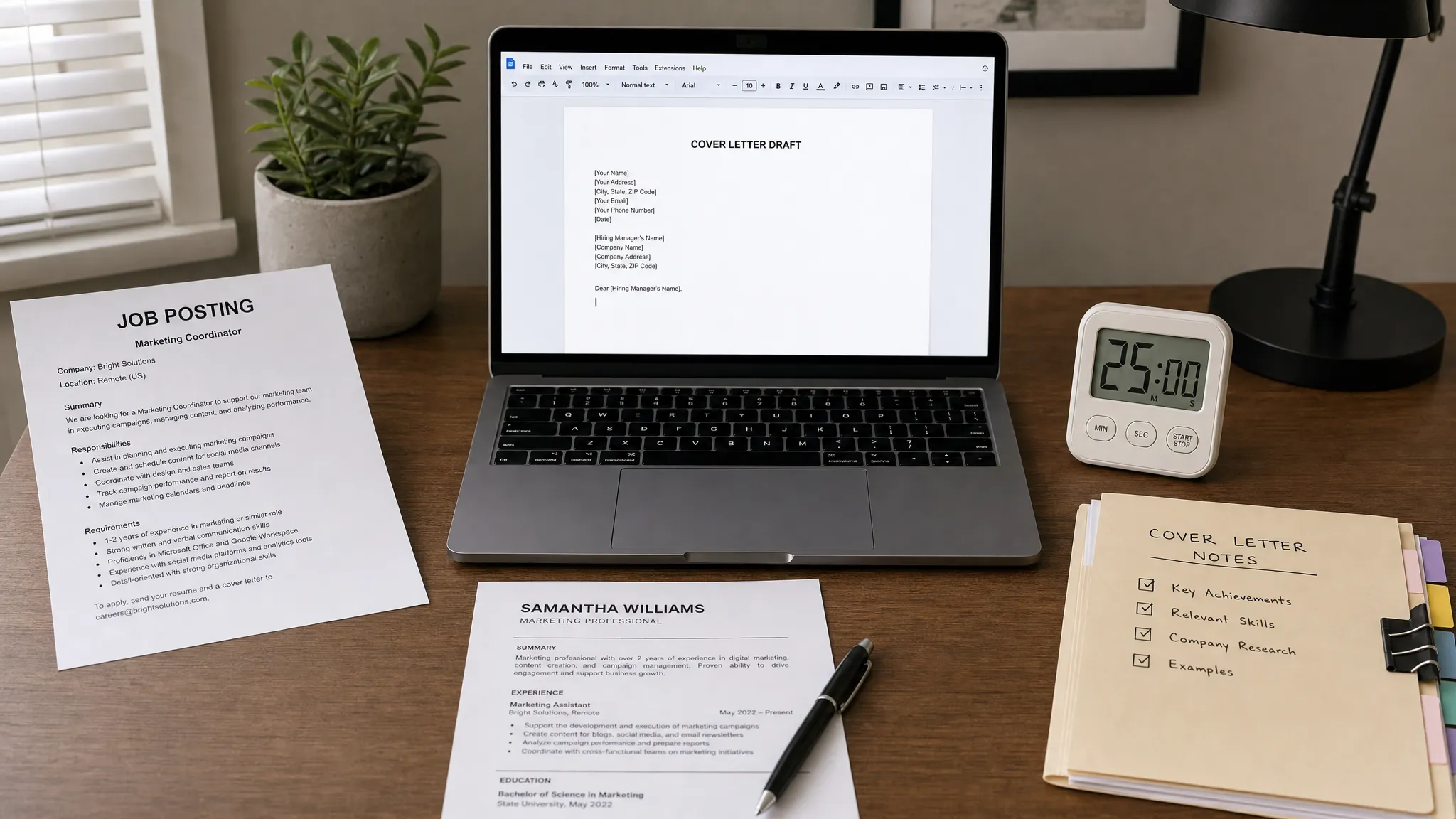
Writing a Good Cover Letter When You Have Little Time
Writing a good cover letter in a rush? Use this fast workflow, template, and checklist to create a polished, targeted letter in minutes.
Write your cover letter — not a blank template
Generate a finished cover letter with your details, tone, and language in ~30 seconds. Free first letter, no credit card — beats copy-pasting and filling the blanks yourself.
When a job posting closes tonight or you are applying between meetings, the goal is not to write the most beautiful cover letter of your life. The goal is to write a clear, specific, credible letter that gives the hiring team a reason to keep reading your resume.
The good news: writing a good cover letter does not require hours of drafting. If you focus on the few details that matter most, you can create a strong letter in 10 to 30 minutes without sounding generic.
This guide gives you a fast workflow, a copy-ready template, and a final checklist so you can send a polished cover letter even when time is tight.
What a cover letter must do when you have little time
A rushed cover letter fails when it tries to do too much. You do not need to summarize your entire career, explain every job change, or repeat your resume line by line.
A good short cover letter should answer three questions:
- Why are you applying for this specific role?
- What proof do you have that you can do the work?
- Why should the hiring manager feel confident moving you forward?
That is it. If your letter answers those questions in 250 to 350 words, it is usually enough for most job applications.
Think of your cover letter as a bridge between the job posting and your resume. The resume shows your history. The cover letter explains the match.
The 5-minute prep: gather only what you need
Before writing, resist the urge to open a blank document and start guessing. Spend five minutes collecting the minimum useful information. This makes the letter faster and much more specific.
| Detail to gather | Where to find it | How to use it in the letter |
|---|---|---|
| Exact job title | Job posting | Mention it in the opening sentence |
| Company name | Job posting or company site | Personalize the letter immediately |
| Top 2 requirements | Responsibilities section | Choose your strongest matching proof |
| One relevant achievement | Resume, portfolio, LinkedIn | Use it as your main evidence |
| One reason you want the role | Company page, product, mission, team | Add a human, non-generic motivation |
This is the fastest way to avoid a bland letter. Even one company-specific detail can make your application feel intentional.
If you have more time later, you can refine. But if you only have a few minutes, these five inputs are enough to produce a useful first draft.
Choose the right cover letter based on your time limit
Not every application deserves the same amount of time. If you are applying to a dream job, spend longer. If you are sending several applications in one sitting, use a leaner version.
| Time available | Best approach | What to prioritize |
|---|---|---|
| 10 minutes | Short targeted letter | One strong achievement and one company detail |
| 20 minutes | Standard 3-paragraph letter | Clear opening, evidence paragraph, confident close |
| 30 minutes | Polished tailored letter | Better wording, stronger metrics, final proofreading |
The mistake many applicants make is spending 45 minutes on formatting and only 2 minutes on relevance. Hiring teams notice relevance first. A simple, well-targeted letter is better than a fancy generic one.
The fastest structure for writing a good cover letter
When you have little time, use a three-part structure: opening, proof, close. This keeps the letter focused and prevents rambling.
For a deeper breakdown of this format, you can also read our guide to the 3-paragraph cover letter structure.
Paragraph 1: Open with the match
Your opening should not say, “I am writing to apply for…” and stop there. That is technically correct, but it wastes your most valuable sentence.
Instead, combine the role, your fit, and a quick reason for interest.
Weak opening:
I am writing to apply for the Marketing Coordinator position at your company. I believe I would be a good fit.
Stronger opening:
I am excited to apply for the Marketing Coordinator role at BrightPath because your focus on customer-led growth matches my experience creating email campaigns that increased trial signups by 18%.
The stronger version works because it is specific. It names the role, connects to the company, and gives proof immediately.
Paragraph 2: Prove one or two things, not everything
Your middle paragraph should focus on the most relevant evidence. Do not list every skill you have. Pick the one or two that matter most for this job.
A useful formula is:
In my recent role, I did X, which led to Y. This connects to your need for Z.
For example:
In my previous customer support role, I handled 40 to 60 tickets per day while maintaining a 96% customer satisfaction score. I also helped rewrite five help center articles that reduced repeat questions from new users. Your posting emphasizes fast, empathetic support, and that is exactly the environment where I have done my best work.
Notice that the paragraph does not repeat the resume. It interprets the resume for the hiring manager.
Paragraph 3: Close with confidence and next steps
The close should be short, professional, and forward-looking. Avoid sounding desperate or overly formal.
Strong close:
I would welcome the opportunity to discuss how my experience in customer support and process improvement could help your team deliver a better user experience. Thank you for your time and consideration.
You do not need to say you are “perfect” for the role. Confidence works better when it is calm and specific.
A copy-ready cover letter template for when you are in a rush
Use this template when you need a solid draft quickly. Replace the brackets with real details from the job posting and your experience.
Dear [Hiring Manager Name or Hiring Team],

I am excited to apply for the [Job Title] role at [Company Name]. Your need for someone who can [top requirement from job posting] stood out to me because my experience in [relevant skill or field] has prepared me to contribute quickly.

In my recent role as [Current or Previous Role], I [specific achievement or responsibility], which resulted in [measurable result or clear outcome]. I also have experience with [second relevant skill, tool, or responsibility], and I understand how important [company priority or role priority] is for this position.

I would welcome the opportunity to discuss how my background in [relevant area] can support [Company Name]’s goals. Thank you for your time and consideration.

Sincerely,
[Your Name]
If you do not have numbers, use a concrete outcome instead. “Trained three new team members,” “improved response time,” “supported a product launch,” or “managed scheduling for a 12-person team” is still stronger than “I am hardworking.”
The 15-minute cover letter workflow
If you have only 15 minutes, follow this order. Do not perfect each sentence as you go. Build the letter first, then edit.
Minutes 0 to 3: Highlight the job posting
Find the two most important requirements. These are usually repeated in the responsibilities, qualifications, or “what you’ll do” sections.
Look for words like “manage,” “analyze,” “communicate,” “support,” “sell,” “coordinate,” “build,” or “lead.” These action words tell you what the employer actually needs.
Minutes 3 to 6: Pick your best proof
Choose one achievement that matches those requirements. If possible, use a number. If not, use scope.
Good proof sounds like this:
- Increased monthly sales by 12%
- Managed calendars for 4 executives
- Resolved 50+ support tickets per week
- Helped onboard 18 new employees
- Wrote reports used by senior leadership
The proof does not need to be dramatic. It needs to be relevant.
Minutes 6 to 10: Draft using the three paragraphs
Write quickly using the opening, proof, close structure. Keep your sentences simple. If a sentence takes too long to write, it is probably trying to say too much.
At this stage, do not worry about perfect phrasing. Aim for clarity.
Minutes 10 to 13: Add one company-specific detail
This is where a rushed letter becomes a targeted letter. Add one sentence showing that you know where you are applying.
Examples:
- “I was drawn to your focus on small business customers.”
- “Your recent expansion into telehealth stood out to me.”
- “I appreciate that your team emphasizes practical, accessible financial education.”
- “The role’s focus on improving onboarding is especially interesting to me.”
Do not overdo it. One accurate detail is enough.
Minutes 13 to 15: Proofread for obvious issues
Read the letter out loud once. Check the company name, job title, spelling, and whether the first paragraph could apply to any company. If it could, make it more specific.
How to use AI when you are short on time
AI can be extremely helpful when the hard part is getting from a blank page to a workable draft. The key is to give the tool real details and then review the output before sending.
With LetterCraft AI, you can generate a personalized cover letter in under 30 seconds by filling in a few details. The tool supports 65+ letter types, multiple tone options, PDF export, copy to clipboard, letter history tracking, and support for 5 languages. It is free to try and does not require a credit card.
AI works best when you provide specific inputs, such as the job title, company name, your most relevant achievement, and the tone you want. A generic input usually creates a generic letter. A specific input gives you a much stronger starting point.
A good AI-assisted workflow looks like this:
- Generate the first draft with your role, company, and achievement details.
- Replace any sentence that sounds too broad or exaggerated.
- Add one detail that only applies to this company.
- Read the final version out loud before sending.
This keeps the speed advantage of AI while making sure the final letter still sounds like you.
What to cut when you are running out of time
When the clock is ticking, editing is mostly about removing anything that does not help your case. A shorter letter with strong details is better than a long letter full of filler.
| Cut this | Use this instead |
|---|---|
| “I am a highly motivated self-starter” | A specific example of work you completed |
| “I believe I am the perfect candidate” | A calm sentence connecting your experience to the role |
| Long career history | One relevant achievement |
| Generic praise for the company | One specific company detail |
| Repeating your resume | Explaining why your experience matters for this job |
The fastest way to improve a cover letter is to replace adjectives with evidence. “Detail-oriented” is fine, but “managed weekly reports with zero missed deadlines for six months” is stronger.
Quick examples: rushed vs. effective wording
Small changes can make a rushed letter sound much more professional.
| Rushed wording | Better wording |
|---|---|
| “I have many skills that would help your company.” | “My experience coordinating vendor timelines would help your team manage multi-step client projects.” |
| “I really need this opportunity.” | “I am interested in this role because it combines customer communication with process improvement.” |
| “I am good at leadership.” | “I led a team of five part-time staff during peak season and improved shift coverage.” |
| “Your company seems great.” | “Your focus on accessible financial tools stood out because I have supported customers learning complex products.” |
These edits work because they move from vague claims to job-relevant proof.
The 60-second pre-send checklist
Before you submit, check the letter for the mistakes that rushed applicants make most often.
- The company name is correct.
- The job title matches the posting.
- The first paragraph is specific to this role.
- The middle paragraph includes proof, not just personality traits.
- The letter is around 250 to 350 words.
- The tone is professional, warm, and not desperate.
- There are no spelling errors in names, tools, or certifications.
- The file name is professional if you are uploading a document.
If you want more examples before sending, review these cover letter examples that got interviews or use a customizable cover letter template to compare your structure.
Frequently Asked Questions
Can I write a good cover letter in 10 minutes? Yes, if you keep it short and specific. Focus on the exact role, one relevant achievement, and one company-specific reason for applying. A concise targeted letter is better than a long generic one.
How long should a rushed cover letter be? Aim for 250 to 350 words. If you are applying by email, a shorter version of 150 to 250 words can work as long as it includes a clear match and proof.
What if I do not know the hiring manager’s name? Use “Dear Hiring Manager” or “Dear [Company Name] Hiring Team.” Do not spend too much time searching unless the name is easy to find.
Should I use the same cover letter for every job? You can reuse the same structure, but you should change the opening, proof points, and company detail for each application. Those edits usually take only a few minutes.
Is it okay to use AI for a cover letter? Yes, as long as you review and personalize the draft. AI is useful for speed and structure, but the final letter should include your real experience and details from the job posting.
Create a polished cover letter faster
If you are short on time, you do not have to choose between speed and quality. Start with the job posting, choose one strong achievement, use a simple three-paragraph structure, and edit for specificity.
Need a first draft now? Try LetterCraft AI to generate a personalized cover letter in under 30 seconds, then make the final edits with the checklist above before you send it.
Write your cover letter — not a blank template
Generate a finished cover letter with your details, tone, and language in ~30 seconds. Free first letter, no credit card — beats copy-pasting and filling the blanks yourself.