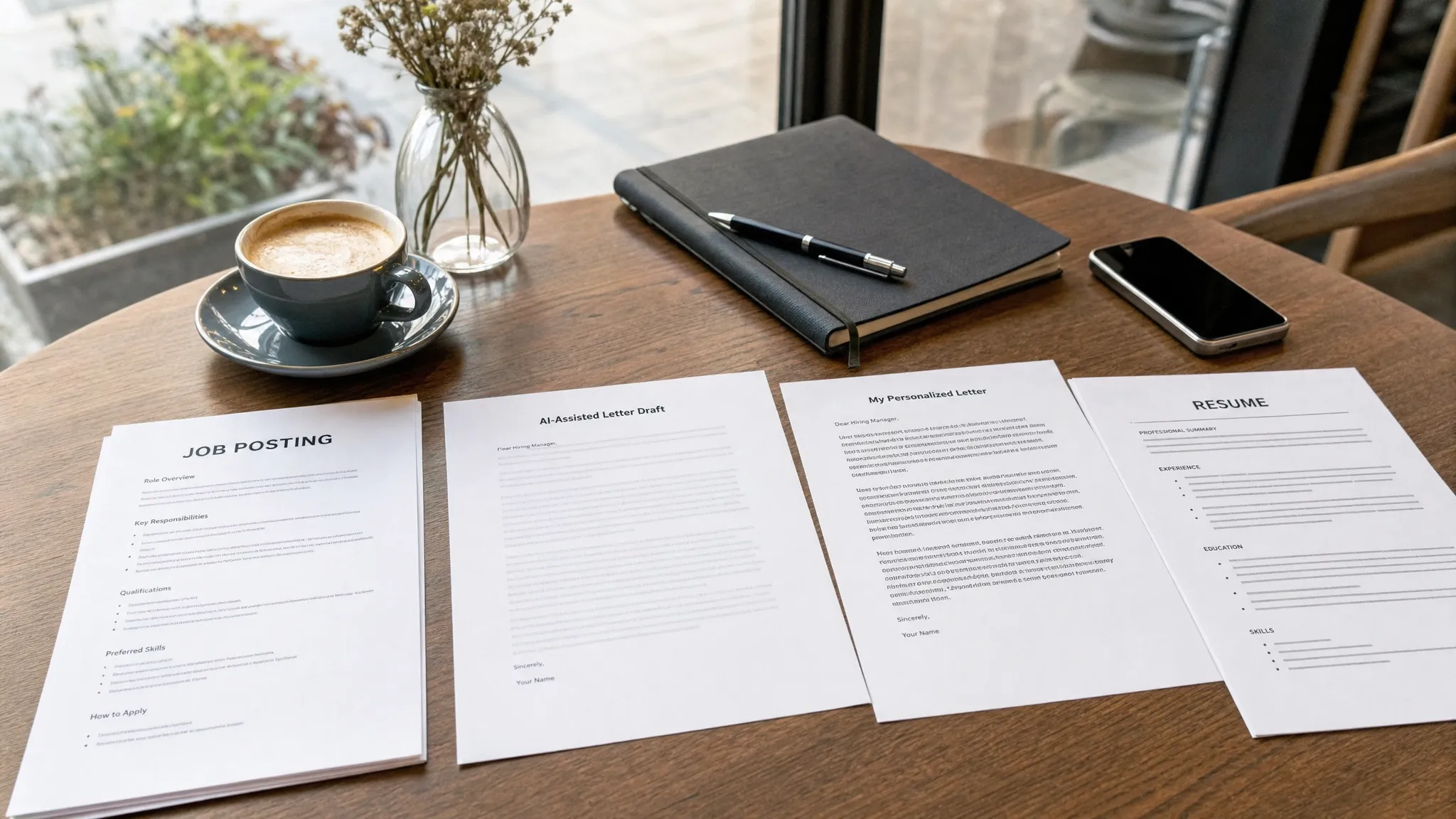
Using AI to Write an Application Letter That Sounds Human
Use AI to write an application letter that sounds human, with prompts, examples, tone tips, and a final edit checklist.
Write your job application — not a blank template
Generate a finished job application with your details, tone, and language in ~30 seconds. Free first letter, no credit card — beats copy-pasting and filling the blanks yourself.
AI can help you write faster, but speed is not the same as credibility. A strong application letter still needs to sound like a real person applying for a real role at a real company.
That is where many AI drafts fall short. They are usually grammatically clean, but they can feel too broad, too polished, or too similar to every other letter in the hiring manager’s inbox. The good news is that you can use AI to write an application letter without losing your voice. You just need to treat AI as a skilled drafting assistant, not as the final author.
This guide shows you how to get an application letter that feels specific, honest, and human, while still taking advantage of AI’s speed.
Why AI application letters often sound artificial
Most weak AI-written application letters have the same problem: they are built from general patterns instead of personal evidence.
An AI tool can easily produce sentences like, “I am excited to apply for this position because I am passionate about your company’s mission.” That sentence is not necessarily wrong, but it could apply to almost anyone. It does not prove that you understand the role, remember a relevant experience, or have a real reason for applying.
Human-sounding letters usually include small but meaningful details. They mention the exact problem the role solves, a specific project from your background, or a genuine connection between your experience and the company’s work. Those details are what make the letter believable.
There is also a tone issue. AI often defaults to language that is formal, enthusiastic, and safe. That can be useful for a first draft, but if every sentence sounds like a corporate announcement, the letter loses warmth. Hiring managers are not looking for a perfect essay. They are looking for signs of judgment, relevance, and fit.
What a human-sounding application letter actually does
A good application letter is not a longer version of your resume. It should make a focused case for why you are worth interviewing.
At a basic level, your letter should answer four questions:
- Why are you applying for this specific role?
- What experience makes you credible?
- What proof can you share without exaggerating?
- Why would your working style fit the team or organization?
The Purdue OWL guidance on job search writing emphasizes the importance of tailoring career documents to the specific employer and position. That advice matters even more when AI is involved, because generic inputs usually create generic output.
Here is the practical difference between an AI-ish letter and a human one:
| AI-ish application letter | Human-sounding application letter |
|---|---|
| Uses broad claims like “I am a strong communicator” | Connects communication skills to a real example |
| Praises the company in vague terms | Mentions a specific product, team, value, or challenge |
| Repeats the resume in paragraph form | Selects one or two achievements that match the job |
| Sounds overly formal from start to finish | Uses professional language with natural rhythm |
| Claims passion without context | Explains why the role genuinely makes sense now |
The goal is not to hide that AI helped you. The goal is to make sure the final letter is accurate, specific, and recognizably yours.
Start with better raw material, not a better prompt
Many applicants try to fix weak AI drafts by writing more complicated prompts. Prompts help, but the information you provide matters more.
Before using AI to write an application letter, gather the details a human career coach would ask for. You do not need a long document. A few precise notes are enough.
Prepare these inputs before generating your draft:
- The job title and company name
- The top three responsibilities from the job posting
- Two skills or experiences you want to highlight
- One measurable result, project, or concrete example
- One honest reason you are interested in this organization
- Your preferred tone, such as warm, confident, concise, or formal
- Any constraints, such as word count, email format, or one-page limit
For example, “I improved customer response time” is better than “I have strong customer service skills.” Even better would be, “I helped reduce average customer response time from two days to under six hours by reorganizing our support inbox.” Specific details give AI something real to work with.
If you are still unsure about the basic structure, it can help to first review a clear job application letter template before asking AI to draft. Structure and personalization work best together.
Use a prompt that sets the right boundaries
A useful prompt does three things. It gives AI context, defines the outcome, and tells it what to avoid.
You can adapt this prompt:
Write a concise application letter for the role of [job title] at [company]. Use a professional but natural tone. Do not sound overly formal, exaggerated, or generic.

Here is my background: [brief summary].

The most relevant parts of the job are: [responsibilities or requirements].

Please highlight these proof points: [specific examples or achievements].

My reason for applying is: [honest reason connected to company or role].

Keep the letter to [word count] and make it sound like a real person wrote it. Avoid clichés such as “I am writing to express my sincere interest” and “I am a perfect fit.”
Notice the last line. It matters. AI often reaches for common phrases because they are statistically safe. Asking it to avoid clichés nudges the draft toward fresher language.
You can also ask for multiple versions. For instance, request one version that is direct, one that is warmer, and one that is more formal. Then combine the best parts. If you want a deeper walkthrough, this guide on getting better output from an AI cover letter generator explains how better inputs lead to more credible drafts.
Edit the opening so it sounds like you
The opening paragraph is where AI drafts often feel most robotic. Many begin with a predictable formula, then spend several lines saying very little.
A human opening does not need to be clever. It needs to be specific.
Weak AI-style opening:
I am writing to express my strong interest in the Marketing Coordinator position at your esteemed company. With my passion for marketing and excellent communication skills, I believe I would be a valuable addition to your team.
More human opening:
I am applying for the Marketing Coordinator role because it matches the work I have enjoyed most in my current position: turning campaign ideas into organized launch plans, tracking results, and keeping several teams aligned under deadline.
The second version works because it tells the reader what kind of work the applicant actually does. It does not rely on big claims. It creates a clear connection between the role and the candidate’s experience.
When editing your AI draft, look for the first sentence that could be sent by thousands of applicants. Replace it with something only you could reasonably say.
Add proof without turning the letter into a resume
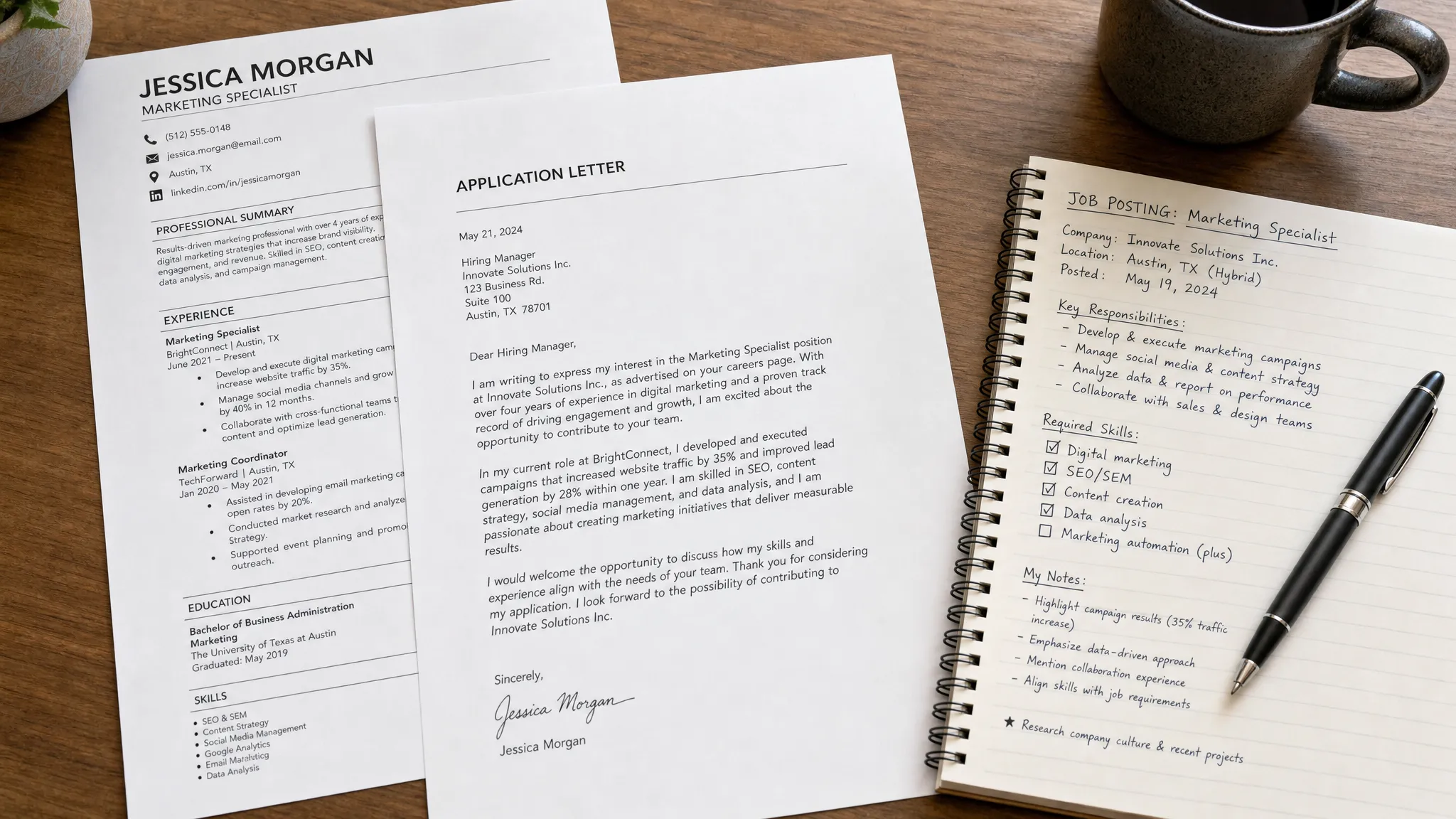
A common mistake is asking AI to include every qualification. That usually creates a dense, unfocused letter. Instead, choose one or two proof points that directly support the role.
Think of each proof point as a small story with three parts: what was happening, what you did, and what changed because of it.
For example:
| Weak claim | Stronger proof |
|---|---|
| I have leadership experience. | I trained three new team members during our busiest quarter and created a checklist that reduced onboarding questions. |
| I am detail-oriented. | I reviewed weekly client reports and caught several billing errors before they reached customers. |
| I work well under pressure. | I helped coordinate a same-day schedule change for 40 attendees after a venue issue, while keeping clients updated. |
| I am interested in the company. | Your focus on accessible financial tools stands out to me because my recent work has centered on making complex information easier for customers to use. |
The proof does not always need a number. Metrics are helpful when you have them, but a concrete situation can be persuasive too. The key is to avoid unsupported adjectives. Do not just say you are adaptable, organized, or collaborative. Show the reader where that quality appeared in your work.
This also protects you from one of the biggest AI risks: exaggeration. AI may make your experience sound larger than it is if you provide vague inputs. Your final letter should never imply responsibilities, results, or credentials you cannot defend in an interview.
Make the tone professional, not overly polished
Many people assume “professional” means stiff. It does not. A professional application letter can be clear, warm, and direct.
To make an AI draft sound more natural, read it out loud. If you would feel strange saying a sentence in an interview, rewrite it. This simple test catches phrases like “dynamic environment,” “esteemed organization,” and “unwavering commitment to excellence.”
You can also ask AI to revise the draft with a tone instruction like this:
Revise this application letter so it sounds professional, clear, and human. Keep the meaning the same. Remove inflated language, repeated phrases, and anything that sounds like a template.
Then review the result manually. AI can improve rhythm, but you should decide what sounds like you.
A practical rule: use fewer adjectives and more nouns and verbs. Instead of “I am an extremely dedicated and highly motivated professional,” write, “I have managed weekly reporting, client follow-ups, and deadline changes without missing a delivery date.” The second sentence gives the hiring manager something to evaluate.
Keep the letter short enough to respect the reader
AI can generate long letters quickly, but longer is not usually better. Most application letters should fit on one page. If the letter is in an email, it may need to be even shorter.
A simple three-part structure works well:
- First paragraph: Name the role and create a specific connection.
- Second paragraph: Show one or two relevant proof points.
- Third paragraph: Reinforce fit, thank the reader, and invite next steps.
This structure keeps the letter focused. It also prevents the AI from wandering into generic background information. If a sentence does not help the reader understand why you fit this role, cut it.
Use AI for review, not just drafting
One of the best uses of AI is not writing the first draft. It is reviewing the draft after you have personalized it.
Ask AI questions like:
- Which sentences sound generic?
- Where does this letter repeat my resume instead of adding context?
- Does the tone sound confident without sounding exaggerated?
- What details would make this more specific to the job posting?
- Is there any claim here that sounds unsupported?
These questions turn AI into an editor. That is often more valuable than letting it write the whole letter from scratch.
If you are concerned about whether employers can tell a letter involved AI, focus less on “beating” detection tools and more on making the content truthful and specific. AI detectors are imperfect, and the stronger issue is quality. Still, if this is on your mind, you can read more about whether an AI cover letter may get flagged and what actually makes writing feel human.
A simple workflow for using LetterCraft AI
If you want the speed of AI without starting from a blank page, LetterCraft AI can help you generate a polished first draft quickly. The tool supports 65+ professional letter types, including job-related letters, and lets you personalize the output with details and tone options.
A practical workflow looks like this:
- Enter the role, company, and the most relevant details from your background.
- Choose a tone that fits the situation, such as professional, warm, or concise.
- Generate the letter, then review it for accuracy and specificity.
- Replace any generic phrases with real examples from your experience.
- Copy the final text or export it as a PDF if that format is needed.
Because LetterCraft AI also offers letter history tracking, you can keep versions organized as you apply to different roles. That is useful because every application letter should be adjusted for the job, not reused word for word.
Example: turning a generic AI paragraph into a human one
Here is a typical AI-generated paragraph:
My background in administration has provided me with the skills necessary to succeed in this role. I am highly organized, detail-oriented, and able to manage multiple tasks in a fast-paced environment. I am confident that my experience would make me a strong asset to your team.
This is clean, but it is too general. It tells the employer almost nothing about the applicant.
Here is a more human version:
In my current administrative role, I manage calendar changes, vendor emails, and weekly document preparation for a team of nine. The part of the job I do best is keeping small details from becoming larger problems, whether that means catching missing invoice information or reorganizing meeting notes so the team can act on them quickly.
The revised version is stronger because it gives the reader a picture of the work. It still sounds professional, but it is not inflated. It feels like a person with actual experience.
Final checklist before you send
Before sending your AI-assisted application letter, do one last pass with this checklist:
- The company name, role title, and recipient details are correct.
- The first paragraph is specific to this job.
- The letter includes at least one concrete example.
- The tone sounds like something you would say in an interview.
- There are no exaggerated claims or invented results.
- The letter does not repeat your resume line by line.
- Generic phrases and clichés have been removed.
- The length is appropriate for the application format.
- The final version has been proofread by you, not only by AI.
That last point matters. AI can help you draft, revise, and polish, but you are still responsible for the message. Your letter should represent your experience accurately.
Frequently Asked Questions
Can I use AI to write an application letter? Yes. Using AI to write an application letter is acceptable as long as the final version is truthful, personalized, and reviewed by you. Treat AI as a drafting and editing tool, not a replacement for your own judgment.
How do I make an AI application letter sound less robotic? Add specific details from the job posting, include one or two real examples from your experience, remove inflated language, and rewrite any sentence you would not naturally say in an interview.
Should I mention that I used AI to write my application letter? Usually, you do not need to mention the tool you used to draft your letter. What matters is that the final content is accurate, ethical, and genuinely reflects your experience.
What should I avoid when using AI for job applications? Avoid copying the first draft without edits, inventing achievements, using vague praise for the company, and sending the same letter to every employer. These mistakes make the letter feel generic and reduce trust.
Is an application letter the same as a cover letter? The terms are often used similarly, but an application letter can be slightly broader. In practice, both should introduce you, connect your experience to the role, and encourage the employer to review your resume or invite you to interview.
Create a better first draft in less time
You do not need to choose between a slow manual process and a generic AI letter. The best approach is to let AI handle the blank page, then add the details only you know.
With LetterCraft AI, you can generate a professional application letter in under 30 seconds, choose the tone that fits your situation, and refine the result into a version that sounds polished, personal, and ready to send.
Write your job application — not a blank template
Generate a finished job application with your details, tone, and language in ~30 seconds. Free first letter, no credit card — beats copy-pasting and filling the blanks yourself.