
Tips for Writing Cover Letters That Sound Human
Use these tips for writing cover letters that sound human, not generic, with examples, rewrite tricks, and AI editing advice.
A cover letter can be grammatically perfect and still feel forgettable. That is the problem many job seekers face in 2026: their letters are polished, keyword-rich, and technically correct, but they sound like they could have been written for anyone.
A human-sounding cover letter does something different. It makes a hiring manager feel that a real person understood the role, chose relevant evidence, and wrote with judgment. These tips for writing cover letters will help you keep the professionalism while removing the generic, overproduced tone that makes applications blend together.
What makes a cover letter sound human?
A human cover letter is not casual, emotional, or overly personal. It is specific. It explains why this role makes sense, why your background matters, and why you are interested enough to write something tailored.
Good cover letters usually answer three questions quickly: why this job, why you, and why now. That aligns with long-standing career writing guidance from sources like Purdue OWL’s job search writing resources, which emphasize purpose, audience, and clarity.
The opposite of human is not “AI-written.” The opposite of human is vague. A letter can be written from scratch and still sound robotic if it relies on phrases like “I am a results-driven professional” or “I am excited to leverage my skills.” A letter can also start with AI and still sound natural if you add real context, relevant examples, and your own voice.
| Robotic signal | Human alternative |
|---|---|
| “I am writing to express my interest in the position.” | “I was drawn to this role because it combines customer research, product storytelling, and fast-moving campaign execution.” |
| “I have excellent communication skills.” | “In my last role, I turned technical product updates into weekly customer emails that reduced support questions.” |
| “I am passionate about your company.” | “Your recent expansion into small business lending caught my attention because I have spent three years supporting SMB finance teams.” |
| “My background makes me an ideal candidate.” | “My experience training new account managers maps closely to your need for someone who can improve onboarding.” |
1. Start with a real reason, not a stock opening
The first sentence sets the tone. If it sounds copied, the rest of the letter has to work harder.
A weak opening usually announces the obvious: you are applying, you saw the role, you are excited. A stronger opening connects your background to something specific in the role.
Generic: I am excited to apply for the Marketing Coordinator position at your company.
Human: I was drawn to the Marketing Coordinator role because it asks for the same mix of campaign tracking, content scheduling, and cross-team communication that I used to support three product launches last year.
Notice that the better version is not more dramatic. It is more useful. It tells the reader why the match is worth considering.
2. Write to the job description, not to every possible employer
One of the simplest ways to sound human is to respond to the actual job posting. Hiring managers can tell when your letter was built around a general profile instead of the role in front of you.
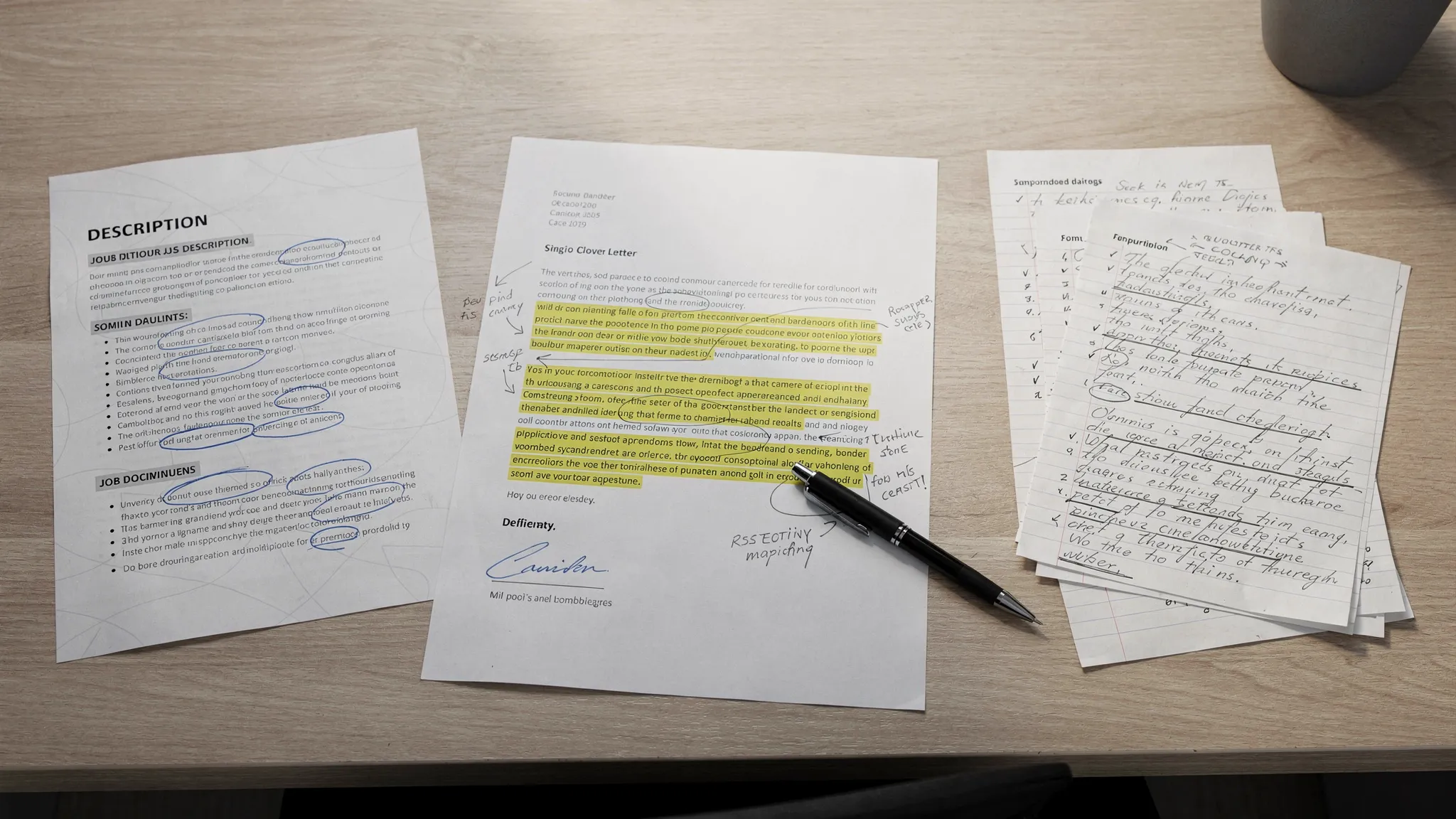
Before writing, identify the two or three responsibilities that matter most. Then choose proof from your experience that connects directly to those responsibilities. You do not need to mention every requirement. In fact, trying to cover everything usually makes the letter feel mechanical.
If the posting emphasizes stakeholder management, talk about a time you worked across departments. If it emphasizes accuracy, mention a process you improved or errors you reduced. If it emphasizes growth, show that you have built something, learned quickly, or adapted under pressure.
This is where a clear structure helps. If you tend to ramble, use a focused framework like our 3-paragraph cover letter structure: opening, evidence, close.
3. Use one small story instead of a list of traits
Human writing often includes context. Not a long personal story, just enough detail to make your claim believable.
Instead of saying you are organized, describe what you organized. Instead of saying you are collaborative, explain who you worked with and what changed because of it. Instead of saying you thrive in fast-paced environments, show a moment when priorities changed and you still delivered.
A useful mini-story has three parts: the situation, the action you took, and the result. You can fit all three into two sentences.
Example: When our support team saw a spike in billing questions after a pricing update, I created a shared response guide and worked with product marketing to clarify the help center copy. Within two weeks, repeat billing tickets dropped and new agents had a clearer script to follow.
That sounds more human than “I am a proactive problem solver” because it gives the reader something concrete to picture.
4. Replace adjectives with evidence
Most cover letters use too many adjectives and not enough proof. Words like motivated, detail-oriented, strategic, dynamic, and hardworking are not bad, but they are weak without evidence.
A good rule: if you make a claim about yourself, attach a detail to it.
| Instead of writing | Try writing |
|---|---|
| “I am detail-oriented.” | “I managed weekly QA checks for 120 customer records and caught inconsistencies before reports went to leadership.” |
| “I am a strong leader.” | “I trained four new team members and created a handoff checklist that shortened onboarding time.” |
| “I am creative.” | “I tested three subject line styles and found that customer story-led emails performed best with our audience.” |
| “I work well under pressure.” | “During a system outage, I coordinated updates between support, engineering, and customers until service was restored.” |
If you do not have numbers, use scale, frequency, audience, stakes, or outcome. “Presented weekly updates to a five-person leadership team” is still more credible than “excellent presenter.”
5. Let your motivation be specific, not exaggerated
Hiring managers do not need you to declare lifelong passion for every company. They need to see that you understand what the role involves and that your interest is grounded in something real.
A human motivation statement might mention a product, customer base, company stage, industry problem, team focus, or role responsibility. It should not sound like praise copied from the company’s homepage.
Too broad: I have always admired your innovative company culture and would be honored to contribute.
Better: I am especially interested in this role because your team is expanding self-service tools for small business customers, a group I supported closely in my last customer success role.
This version shows research, but it does not overdo flattery. It connects the company to the candidate’s experience.
6. Write like a professional person, not a corporate brochure
Many cover letters sound unnatural because they are packed with business clichés. People rarely speak in phrases like “cross-functional synergies,” “proven track record of excellence,” or “leveraging my robust skill set.”
Professional writing can still be plain. In fact, plain language often sounds more confident.
Try these swaps:
| Corporate phrase | More natural wording |
|---|---|
| Utilize | Use |
| Leverage my experience | Apply my experience |
| Proven track record | Experience doing this successfully |
| Results-driven professional | Someone who focuses on measurable outcomes |
| Dynamic fast-paced environment | A team where priorities move quickly |
| I am uniquely qualified | My background fits this role because |
A helpful test is to read your letter out loud. If a sentence feels strange to say, it will probably feel strange to read.
7. Be confident without sounding inflated
A human cover letter has a balanced tone. It should not beg for a chance, but it also should not sound like the company would be lucky to have you.
The strongest tone is clear, specific, and calm.
| Tone problem | Example | Better version |
|---|---|---|
| Too timid | “I hope I might be considered if you think I could possibly be a fit.” | “I would welcome the opportunity to discuss how my experience could support your team.” |
| Too inflated | “I am the perfect candidate for this position.” | “My background in client onboarding and process improvement closely matches the role’s priorities.” |
| Too generic | “I believe I would be a valuable asset.” | “I can help your team improve onboarding documentation while maintaining a high-touch customer experience.” |
Confidence sounds human when it is backed by evidence. Arrogance sounds hollow because it asks the reader to believe a conclusion you have not proven.
8. Do not repeat your resume, interpret it
Your resume already lists roles, dates, tools, and achievements. Your cover letter should explain why those details matter for this job.
Think of your resume as the record and your cover letter as the argument. The letter should guide the reader toward the most relevant parts of your background.
For example, if your resume says you “managed email campaigns,” your cover letter can explain that you learned how to segment audiences, coordinate with sales, and improve messaging based on performance data. If your resume says you “worked in retail,” your cover letter can explain how that experience strengthened your ability to handle customer objections, prioritize under pressure, and communicate clearly.
This is especially useful for career changers, recent graduates, and applicants with non-linear experience. You are not asking the hiring manager to connect the dots. You are connecting them.
9. Keep some natural rhythm in your sentences
Over-polished writing often has the same sentence length, the same formal transitions, and the same predictable structure. Human writing has rhythm.
That does not mean adding slang or jokes. It means varying sentence length and using direct wording. A short sentence can add clarity. A slightly longer sentence can add context. Together, they make the letter easier to read.
Compare these two versions:
Flat: I have experience in project coordination, stakeholder communication, process documentation, and deadline management, and I believe these skills would allow me to contribute to your organization’s continued success.
More human: I have coordinated projects where timelines changed quickly and several teams needed the same information at once. That experience would help me support your operations team as it improves internal handoffs and documentation.
The second version is not less professional. It simply sounds like a person explaining relevant experience.
10. Use AI for the draft, then add the human layer
AI can help you avoid the blank page, organize your thoughts, and create a polished first draft. The mistake is sending that first draft unchanged.
If you use an AI cover letter tool, treat the output as a structured starting point. Then add details only you know: the reason this company interests you, the specific project that proves your fit, the challenge you solved, or the pattern in your career that makes the move logical.
A good AI-assisted workflow looks like this: generate a draft, replace generic claims with real examples, adjust the tone, read it aloud, and cut anything that could apply to hundreds of other applicants.
LetterCraft AI is built for this kind of workflow. You can generate a personalized cover letter in under 30 seconds, choose from multiple tone options, copy the result, export it as a PDF, and keep track of previous letters. The goal is not to remove your voice. It is to give you a strong structure so you can spend your time adding the details that make the letter sound like you.
A quick humanizing checklist before you send
Before submitting your cover letter, scan it for sentences that feel too broad. If a sentence could be sent to any company for any role, revise it.
Use this checklist as a final pass:
- Does the first paragraph mention the specific role or responsibility that drew you in?
- Does the letter include at least one concrete example from your experience?
- Does every self-description have evidence behind it?
- Does your motivation sound real rather than flattering?
- Have you removed phrases you would never say in a professional conversation?
- Is the letter focused on how you can help the employer, not only on what you want?
- Can the whole letter be read in about one minute?
If you want a deeper formatting and structure check, use our cover letter format guide or start from a customizable cover letter template.
Example: turning a generic paragraph into a human one
Here is a common cover letter paragraph:
I am a dedicated and results-oriented professional with strong communication and organizational skills. I have experience working in fast-paced environments and collaborating with cross-functional teams. I believe my background would make me a strong fit for your company.
This is not terrible, but it is forgettable. It makes claims without giving the reader a reason to believe them.
Here is a more human version:
In my current operations role, I coordinate weekly updates between customer support, finance, and product teams so that billing issues are resolved before they affect renewal conversations. That experience matches your need for someone who can improve internal handoffs while keeping customer impact in view.
The improved version works because it is specific. It names the context, the teams involved, the problem, and the connection to the new role. It also sounds like something a real candidate would write, not a template trying to sound impressive.
What “human” does not mean
Sounding human does not mean ignoring professional boundaries. Some applicants go too far in the other direction and make the letter overly personal, funny, apologetic, or emotional.
Avoid these mistakes:
| Mistake | Why it hurts |
|---|---|
| Sharing too much personal history | The letter loses focus on the role and your qualifications. |
| Making jokes that may not land | Humor is hard to judge without knowing the reader. |
| Apologizing for your background | It frames your experience as a problem before the employer does. |
| Overexplaining a layoff or gap | A brief, neutral sentence is usually enough if you need to address it. |
| Writing like a fan | Employers want interest, not excessive praise. |
Human means relevant, grounded, and clear. It means your letter helps the reader understand the person behind the resume without making them work for the point.
Frequently Asked Questions
How do I make my cover letter sound less generic? Replace broad claims with specific proof. Mention the role, one relevant responsibility, one concrete achievement, and one real reason you are interested in the company or team.
Is it okay to use AI to write a cover letter? Yes, as long as you review and personalize the draft. AI is useful for structure and speed, but the final letter should include details from your actual experience and the specific job posting.
Should a cover letter sound conversational? It can sound natural, but it should still be professional. Aim for the tone of a thoughtful email to a hiring manager, not a text message or a formal legal document.
Is “I am excited to apply” a bad opening? It is not wrong, but it is overused. A stronger opening explains why the role fits your experience or why a specific part of the job caught your attention.
How long should a human-sounding cover letter be? Most cover letters should be around 250 to 400 words. Shorter is fine if it is specific and complete. Longer letters often lose impact unless the role requires detailed selection criteria.
Can I use contractions in a cover letter? Sometimes. Contractions like “I’m” or “I’ve” can sound natural in modern companies, but use your judgment. For conservative industries, a slightly more formal tone may be safer.
Create a cover letter that sounds like you
If you know what you want to say but keep getting stuck on phrasing, LetterCraft AI can help you turn your details into a polished draft fast. Choose the cover letter type, add the role and your background, select the tone, and generate a ready-to-edit letter in under 30 seconds.
You can then personalize the draft with your own examples, copy it to your application, or export it as a PDF. Try LetterCraft AI to create a professional cover letter that is structured, specific, and still sounds human.