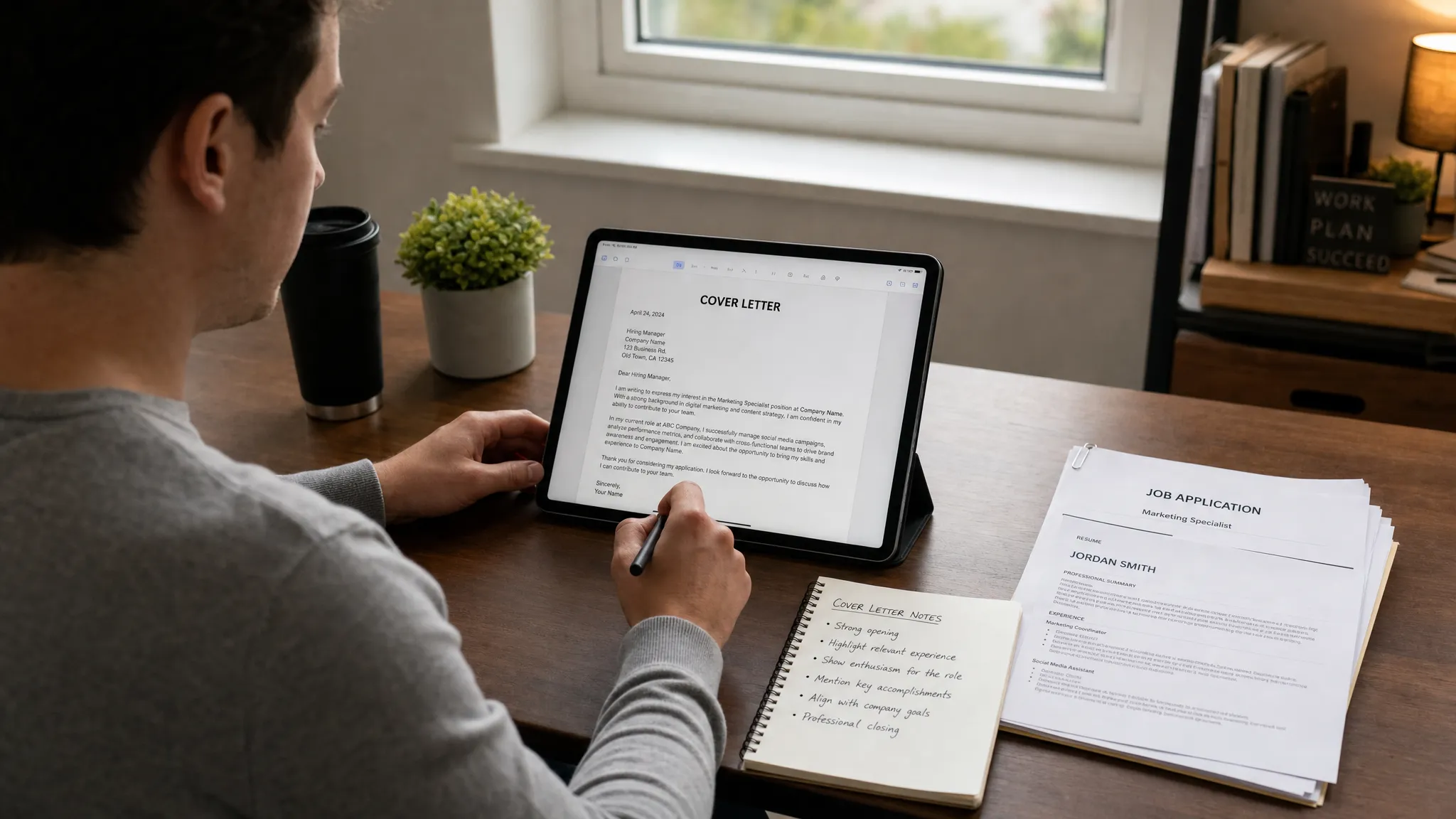
Starting a Cover Letter Without Sounding Generic
Starting a cover letter? Use proven opening formulas and examples to avoid generic lines, show fit fast, and make recruiters keep reading.
Write your cover letter — not a blank template
Generate a finished cover letter with your details, tone, and language in ~30 seconds. Free first letter, no credit card — beats copy-pasting and filling the blanks yourself.
A generic cover letter opening is easy to recognize because it could belong to anyone: “I am writing to apply for the position of…” or “Please accept my application for…” These lines are not wrong, but they waste the most valuable part of your letter: the first few seconds of attention.
Starting a cover letter well does not mean being flashy, clever, or overly personal. It means giving the hiring manager a quick reason to keep reading. The strongest openings usually do three things at once: identify the role, connect your background to the employer’s need, and show a detail that proves this letter was written for this opportunity.
Below is a practical way to start a cover letter without sounding generic, including formulas, examples, phrases to avoid, and quick edits you can make before sending.
Why Generic Cover Letter Openings Fail
Hiring teams often read applications quickly, especially when a role attracts dozens or hundreds of candidates. If your first sentence sounds like a template, the reader may assume the rest of the letter is also copied, even if your experience is strong.
Generic openings fail because they usually focus on the act of applying rather than the value you bring. The employer already knows you are applying. What they do not know yet is why you are relevant, why this role interests you, and what makes you different from another qualified candidate.
A weak opening says, “Here is my application.” A strong opening says, “Here is why my experience matters for this exact role.”
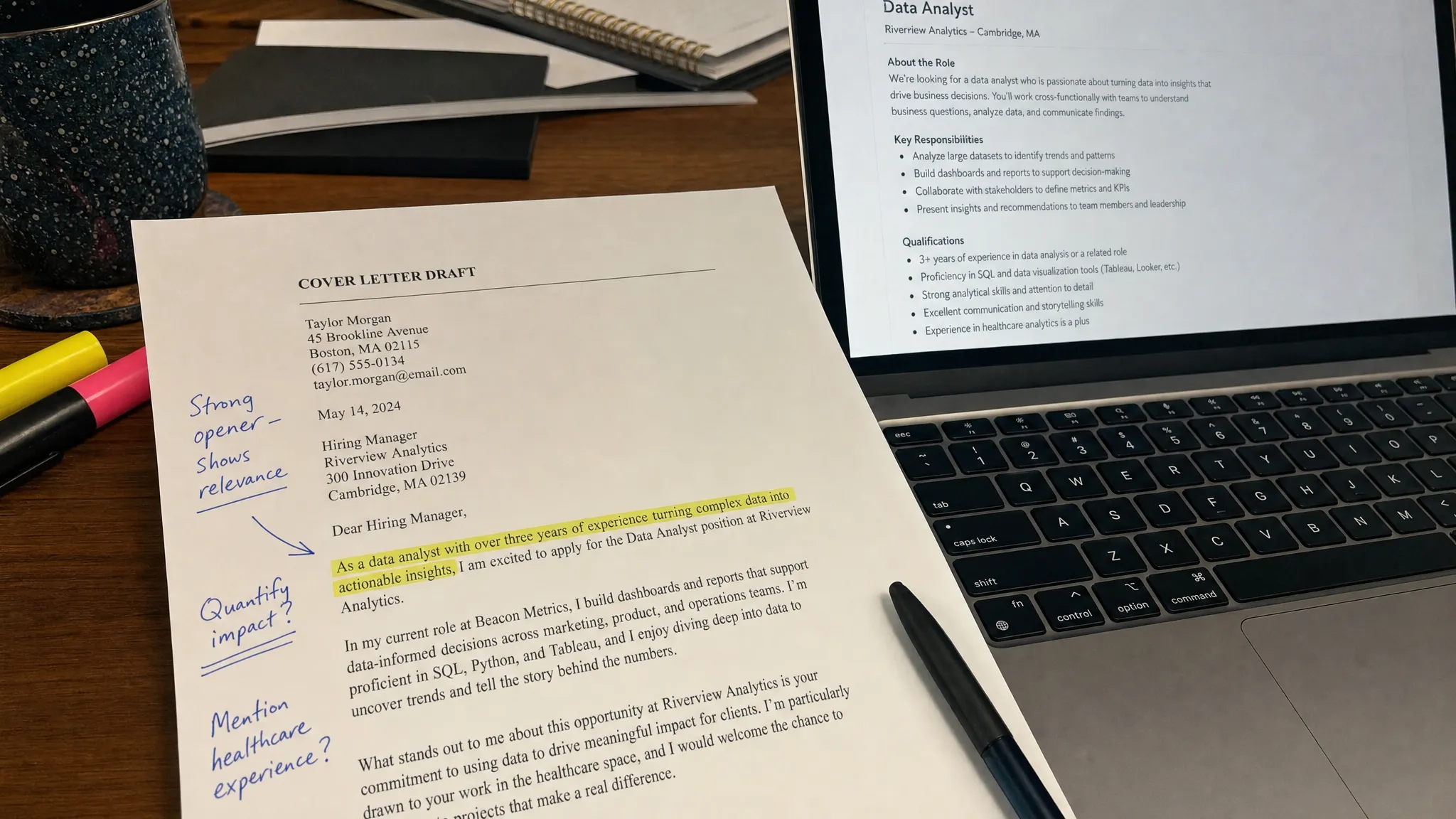
What a Strong Cover Letter Opening Should Do
The first paragraph does not need to summarize your whole career. In fact, trying to say too much can make the opening feel unfocused. Instead, aim for one clear, specific reason the hiring manager should continue.
A strong opening should answer at least two of these questions:
- What role are you applying for?
- What relevant strength, result, or experience do you bring?
- Why does this company, team, or mission interest you?
- What problem can you help solve?
- What context makes your application credible, such as a referral, career pivot, or recent project?
Here is the difference in practice:
| Generic opening | Stronger opening | Why it works |
|---|---|---|
| I am writing to apply for the Marketing Manager position. | I was excited to see your Marketing Manager opening because it combines the two areas where I have delivered my strongest results: lifecycle campaigns and conversion-focused content. | It names the role, shows fit, and introduces proof. |
| I believe I would be a good fit for your company. | After helping a B2B SaaS team increase demo requests by 34%, I am interested in bringing the same data-driven approach to your demand generation team. | It leads with a measurable result. |
| Please accept my application for the Customer Support role. | Your posting emphasizes de-escalation, speed, and product knowledge, which closely matches my experience resolving 60+ customer tickets per day while maintaining a 96% satisfaction rating. | It mirrors the job posting and proves relevance. |
Five Better Ways to Start a Cover Letter
There is no single perfect first sentence. The best opening depends on your experience, the job, and what you want the employer to notice first. Use one of these approaches when starting a cover letter and adapt it to your situation.
Lead With a Relevant Achievement
This is one of the strongest openings if you have measurable results. Instead of introducing yourself by job title alone, introduce yourself through proof.
Example: In my current operations role, I reduced order processing errors by 28% by redesigning our quality-check workflow, and I am excited to bring that same process-improvement mindset to the Operations Coordinator role at Brightline Logistics.
This works because it gives the employer evidence immediately. You are not saying you are detail-oriented, you are showing it.
If you do not have exact metrics, use concrete scope instead. For example, mention the size of a team, number of clients, type of project, or frequency of work.
Lead With the Employer’s Need
A company-centered opening shows that you read the job description and understand what the team is trying to accomplish.
Example: Your job posting makes it clear that this role needs someone who can turn complex product information into clear customer education, which is exactly the work I have been doing for the past three years in technical content and onboarding.
This approach is especially useful when the job description is detailed. Look for repeated themes such as growth, compliance, customer retention, reporting, process improvement, or cross-functional communication.
Lead With a Specific Company Detail
Personalization does not mean flattery. Avoid vague lines like “I admire your company’s success.” Instead, mention something specific: a product launch, market expansion, mission, customer base, or business model.
Example: I was drawn to Northstar Health’s focus on expanding virtual care access for rural patients, and my background coordinating patient onboarding for telehealth programs would allow me to contribute quickly to that mission.
The key is to connect the company detail to your experience. A company-specific sentence without a career connection can sound forced.
Research does not have to be deep. If you are applying for a business development or operations role in corporate services, for instance, reviewing a provider such as Alldren’s UAE company formation and corporate structuring services can help you understand the language of the industry, including compliance, structuring, and client advisory needs.
Lead With a Referral or Connection
If someone referred you, mention it early. A referral gives context and can help the reader understand why your application deserves attention.
Example: After speaking with Maya Chen about the Product Analyst opening, I was excited by how closely the role matches my experience translating customer behavior data into roadmap recommendations.
Keep the referral line short. The focus should still move quickly to your fit for the role.
Lead With a Career Pivot, But Make the Transfer Clear
Career changers often start too apologetically. You do not need to open by saying, “Although I do not have direct experience…” Instead, lead with the connection between your previous work and the new role.
Example: My five years in classroom teaching have been built around explaining complex ideas clearly, adapting to different learning styles, and measuring progress, which is why I am excited to apply for the Customer Education Specialist role.
This framing helps the hiring manager see transferable value before they notice the nontraditional path.
Cover Letter Opening Formulas You Can Adapt
If you are staring at a blank page, formulas can help. The goal is not to copy them word for word. Use them as a starting point, then add your real details.
| Situation | Opening formula | Example |
|---|---|---|
| You have measurable results | After achieving [result] in [context], I am excited to apply for [role] at [company]. | After increasing renewal revenue by 18% in my current account management role, I am excited to apply for the Customer Success Manager position at ElevateCRM. |
| You match a core requirement | Your posting emphasizes [requirement], and my experience in [related work] directly aligns with that need. | Your posting emphasizes fast, empathetic support, and my experience managing high-volume customer inquiries directly aligns with that need. |
| You admire a specific company direction | I was drawn to [company initiative], especially because my background in [skill] has prepared me to support [goal]. | I was drawn to your expansion into small-business banking, especially because my background in onboarding local business clients has prepared me to support that growth. |
| You are changing careers | My background in [previous field] has strengthened [transferable skill], which is central to success in [target role]. | My background in hospitality has strengthened my ability to manage customer expectations under pressure, which is central to success in account coordination. |
| You are a recent graduate | Through [project, internship, or coursework], I developed [skill] that matches the needs of your [role]. | Through my senior analytics project, I developed dashboarding and data-cleaning skills that match the needs of your Junior Data Analyst role. |
Phrases That Make Your Opening Sound Generic
Some phrases are common because they are safe, but safe can sound forgettable. You do not always need to delete them, but you should avoid relying on them as your entire opening.
Common phrases to rewrite include:
- I am writing to apply for...
- Please accept my application for...
- I believe I am the perfect candidate...
- Ever since I was young...
- I have always been passionate about...
- I am a hard-working, motivated professional...
- Your company is a leader in the industry...
The problem is not that these phrases are grammatically incorrect. The problem is that they do not give evidence. If you use one, follow it immediately with a specific reason.
For example, “I am writing to apply for the Project Coordinator role” becomes much stronger when followed by: “because your focus on cross-functional execution matches my experience coordinating launch timelines across product, design, and customer success teams.”
Before-and-After Examples
Sometimes the fastest way to improve your opening is to rewrite a generic first sentence into something more specific. Here are a few transformations you can model.
Example 1: Entry-Level Applicant
Generic: I am writing to apply for the Entry-Level Financial Analyst position at your company.
Better: After building a financial model for a campus investment fund and completing an internship focused on variance analysis, I am excited to apply for the Entry-Level Financial Analyst position at Meridian Capital.
Why it works: The second version gives evidence of relevant exposure, even without years of full-time experience.
Example 2: Customer Service Role
Generic: I am confident I would be a great fit for your customer service team.
Better: Your support role calls for someone who can stay calm with frustrated customers, solve problems quickly, and document issues clearly, which reflects my experience handling 50+ daily support interactions in a retail banking environment.
Why it works: It echoes the employer’s needs and includes concrete volume.
Example 3: Manager Role
Generic: I have extensive management experience and would like to join your organization.
Better: In my last role, I led a team of 12 through a scheduling redesign that reduced overtime costs by 16%, and I am interested in bringing that practical, people-centered management style to your Store Manager opening.
Why it works: It shows leadership through a specific outcome.
Example 4: Career Change
Generic: Although my background is in education, I am interested in moving into HR.
Better: My teaching background has given me five years of hands-on experience coaching performance, resolving conflict, and communicating policies clearly, which are the same strengths I would bring to your HR Coordinator role.
Why it works: It removes apology and replaces it with transferable value.
A Quick 10-Minute Process for Starting a Cover Letter
If you are applying to multiple roles, you need a repeatable process. This short workflow helps you avoid generic openings without spending an hour on every application.
- Highlight three job requirements: Choose the requirements that appear most central to the role, not every skill listed.
- Pick one proof point: Select a result, project, responsibility, or story that connects to one of those requirements.
- Find one company detail: Use the company website, job posting, recent news, or product page to identify a specific reason for interest.
- Write one sentence connecting them: Combine the role, proof point, and company need in plain language.
- Read it aloud: If it sounds like something any applicant could send, add a sharper detail.
A good opening is rarely the most poetic sentence. It is the most relevant one.
If you want a full structure after you finish the opening, read our guide on how to write a cover letter that gets interviews in 2026. For inspiration across roles, you can also review these cover letter examples that got interviews.
How to Use AI Without Sounding Like Everyone Else
AI can help you get past the blank page, but it can also produce openings that sound polished and generic if you provide only generic inputs. The quality of the opening depends on the details you give it.
Instead of asking AI to “write a cover letter for a marketing job,” provide details like:
- The exact job title and company name
- Two or three responsibilities from the job posting
- One measurable achievement from your background
- One reason you are interested in the company
- The tone you want, such as confident, warm, concise, or formal
LetterCraft AI is built specifically for professional letters, including cover letters, and can generate a personalized draft in under 30 seconds. You can choose tone options, create polished letters for 65+ scenarios, copy the text, export to PDF, and keep track of past letters. The best workflow is simple: generate a strong draft, then add one or two details only you would know.
If you are worried about your letter sounding AI-written, focus on specificity. A sentence with your real project, real result, and real reason for applying will almost always sound more human than a vague “I am passionate about your mission.” You can also read our guide on making AI-assisted cover letters sound authentic.
Final Checklist for a Non-Generic Opening
Before sending your cover letter, check the first paragraph against this quick list:
- Does it name the role or clearly imply the role?
- Does it include a specific skill, result, project, or background detail?
- Does it connect to the company’s actual needs?
- Could the same sentence be sent to 20 other employers without changes?
- Does it avoid empty adjectives like passionate, motivated, and hard-working unless supported by evidence?
- Is it concise enough to lead naturally into the rest of the letter?
If your opening passes those checks, you are already ahead of most applicants. You do not need a dramatic hook. You need a relevant one.
Frequently Asked Questions
Is it bad to start a cover letter with “I am writing to apply”? It is not bad, but it is usually weak by itself. If you use that phrase, add a specific reason immediately, such as a relevant achievement, company detail, or job requirement you match.
How long should the first paragraph of a cover letter be? Aim for two to four sentences. The opening should be long enough to establish fit, but short enough to keep the hiring manager moving into your evidence.
Should I mention the company name in the first sentence? Yes, if it feels natural. Mentioning the company name can help personalize the opening, but it works best when paired with a specific detail about the role, team, product, mission, or market.
What if I do not have measurable achievements? Use concrete scope instead. Mention projects completed, customers supported, tools used, coursework, internships, team size, processes improved, or responsibilities that match the job posting.
Can I start a cover letter with a story? You can, but keep it brief and professional. A story should quickly connect to the role. Avoid long personal background unless it directly explains your motivation or qualifications.
Start Strong, Then Build the Rest Faster
A strong cover letter opening is not about sounding impressive. It is about sounding relevant. Replace generic first lines with proof, company context, and a clear connection to the job, and your letter immediately becomes more useful to the reader.
Need a polished starting point? Try LetterCraft AI to generate a personalized cover letter in seconds, then customize the opening with your strongest achievement and company-specific detail before you send.
Write your cover letter — not a blank template
Generate a finished cover letter with your details, tone, and language in ~30 seconds. Free first letter, no credit card — beats copy-pasting and filling the blanks yourself.