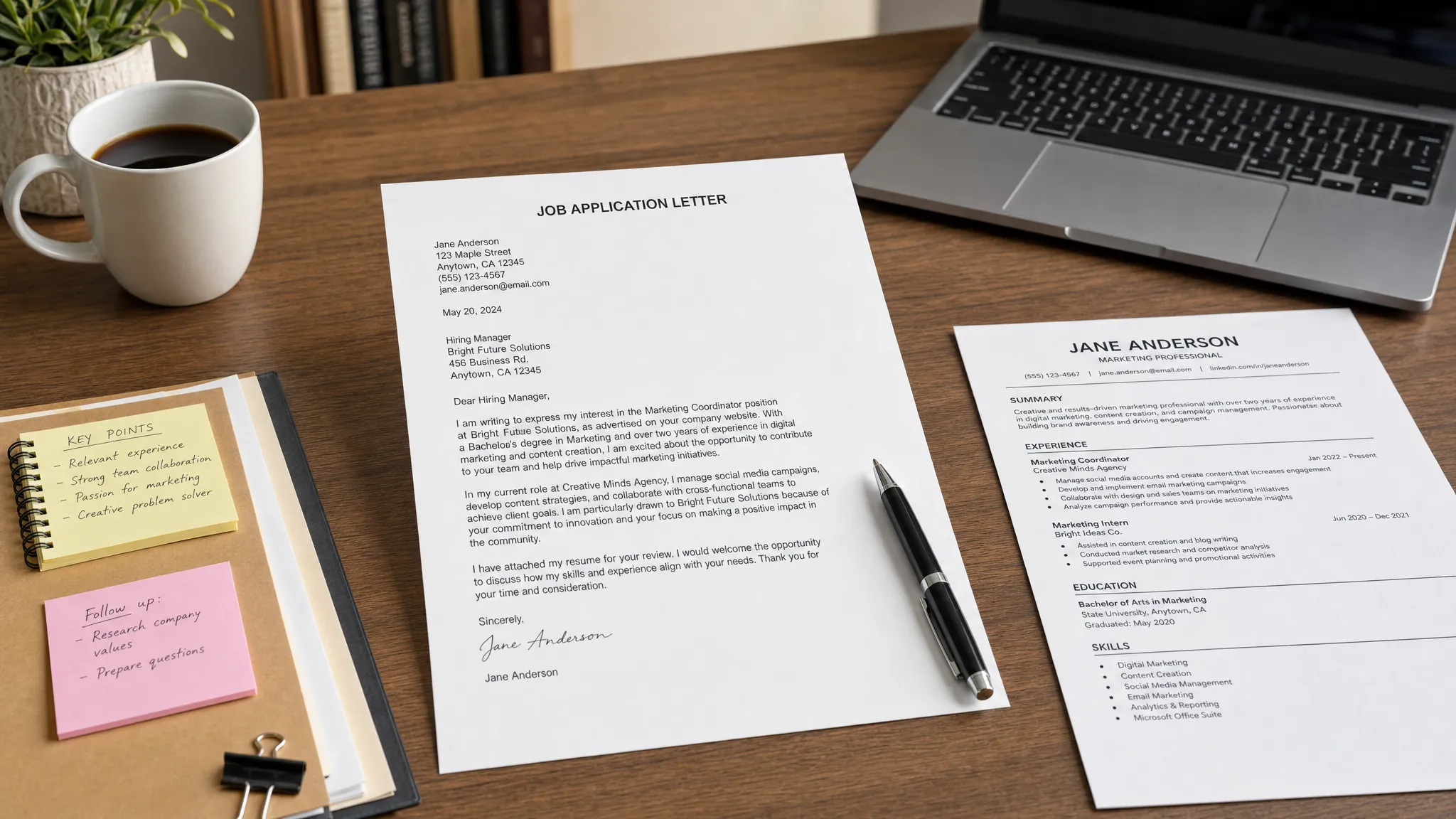
How to Write a Job Formal Letter Without Sounding Stiff
Learn how to write a job formal letter that sounds professional, confident, and natural, with examples, tone swaps, and a simple template.
A job formal letter has to do two things at once: show respect for the hiring process and sound like it was written by a real person. That balance can feel tricky. If you are too casual, your letter may seem careless. If you are too formal, it can read like a template from 1998.
The good news is that a polished letter does not need heavy phrases, outdated wording, or a painfully serious tone. The best job letters are clear, specific, and courteous. They sound professional because they are easy to understand, not because they are full of complicated language.
This guide will show you how to write a job formal letter that feels confident, warm, and appropriate without sounding stiff.
What a job formal letter actually needs to do
A formal job letter is any professional letter connected to employment. It might be a job application letter, cover letter, letter of interest, follow-up letter, acceptance letter, resignation letter, or request for a reference.
Although the purpose changes, the standard remains the same. Your letter should help the reader quickly understand:
- Who you are
- Why you are writing
- What information matters most
- What you would like to happen next
According to Purdue OWL's guidance on business letters, effective professional letters should be clear, concise, and considerate of the reader. That is also the key to sounding natural. Stiff writing usually happens when people try to sound impressive instead of useful.
A strong job letter is not about showing off vocabulary. It is about making the hiring manager's job easier.
Why formal job letters often sound stiff
Most stiff job letters have the same problem: they use formal language as a substitute for substance.
You have probably seen lines like these:
- I hereby submit my application for your kind consideration.
- I humbly request that you peruse my enclosed credentials.
- I believe I am the ideal candidate due to my unparalleled dedication.
- Kindly do the needful at your earliest convenience.
These phrases sound formal, but they create distance. They also make the letter feel generic because they could be sent to any employer, for any role, by any applicant.
A natural formal letter uses simpler language, but keeps the tone respectful. For example:
| Stiff phrase | Natural professional version |
|---|---|
| I hereby submit my application | I am writing to apply for the role |
| I humbly request your consideration | I would appreciate the opportunity to be considered |
| I possess excellent communication abilities | I have experience communicating with clients, managers, and cross-functional teams |
| Please do the needful | Please let me know if you need any additional information |
| I am the perfect candidate | My background in this area aligns well with the role |
The second column is not casual. It is still professional. The difference is that it sounds like a capable person speaking clearly.
Aim for respectful, direct, and human
The best tone for a job formal letter is not cold or overly friendly. It sits in the middle: respectful, direct, and human.
Respectful means you use proper greetings, complete sentences, and polite phrasing. Direct means you get to the point without long introductions. Human means you include enough personality and specificity to show that this letter was written for a real opportunity.
Compare these two openings:
Stiff: I am writing this letter with immense honor and humility to express my sincere intent to apply for the position recently advertised by your esteemed organization.
Natural: I am writing to apply for the Marketing Coordinator position at Brightline Media. My experience creating campaign reports and coordinating content calendars matches the needs described in the job posting.
The natural version still sounds formal, but it is easier to read. It names the role, names the company, and gives a relevant reason to keep reading.
If you are writing specifically to apply for a role, the same principle applies to your full letter structure. This guide on how to write a letter to apply for a job that gets read goes deeper into building an application letter around proof rather than generic claims.
Use a clean structure before worrying about wording
A stiff letter often starts with stiff structure. If the letter feels crowded, vague, or overly ceremonial, even good sentences can seem awkward.
Use this simple structure for most formal job letters:
- Greeting: Address the hiring manager by name if you have it. If not, use a professional general greeting such as Dear Hiring Manager.
- Purpose: State why you are writing in the first sentence or two.
- Relevant context: Add the most important background, experience, or reason for your message.
- Specific request or next step: Explain what you would like the reader to do or consider.
- Professional close: Thank the reader and end with a standard sign-off.
This structure works because it respects the reader's time. It also prevents you from adding unnecessary formal padding just to make the letter feel complete.
For letters beyond job applications, such as requests, confirmations, or professional notices, you can also use a general formal format. This guide to writing a simple letter that still feels professional is helpful if you want a clean base structure.
Write an opening that sounds confident, not robotic
Your opening sets the tone for the entire letter. The most common mistake is using a long first sentence that tries too hard to sound official.
A good opening should answer two questions quickly: why are you writing, and why should the reader care?
Here are a few polished opening examples:
| Situation | Natural formal opening |
|---|---|
| Job application | I am writing to apply for the Project Assistant role at Northview Consulting. My background in scheduling, document preparation, and client coordination aligns closely with the position. |
| Cover letter | I was excited to see the Customer Success Associate opening at LaneTech because the role combines client communication with process improvement, two areas I have focused on in my recent work. |
| Follow-up after interview | Thank you for taking the time to speak with me about the Operations Coordinator role. I enjoyed learning more about the team and wanted to reiterate my interest in the position. |
| Letter of interest | I am reaching out to express my interest in future administrative roles with your organization. I have followed your work in community services and would welcome the opportunity to contribute. |
| Reference request | I hope you are doing well. I am applying for a new role and would be grateful if you would consider serving as a professional reference. |
Notice that none of these openings use exaggerated language. They are formal because they are specific and appropriate.
Replace vague qualities with proof
A job formal letter becomes stiff when it relies too heavily on adjectives. Words like hardworking, passionate, dedicated, motivated, and detail-oriented are not wrong, but they are weak if they stand alone.
Instead of saying you are detail-oriented, show where that quality appears in your work. Instead of saying you are a strong communicator, mention the type of communication you have handled.
Here is the difference:
Stiff: I am a highly motivated and detail-oriented individual with excellent interpersonal skills.
Natural: In my previous role, I coordinated weekly client updates, prepared meeting notes, and tracked project deadlines for a team of eight.
The second version feels more natural because it gives the reader something concrete. It also sounds more credible.
When writing the middle of your letter, try this formula:
- Name one relevant responsibility or achievement
- Connect it to the job or situation
- Keep the sentence plain and specific
For example: In my current administrative role, I manage appointment scheduling, prepare internal reports, and respond to customer inquiries. These responsibilities have helped me build the organization and communication skills needed for this position.
That is formal, but not stiff. It respects the reader and gives them useful evidence.
Choose plain words over inflated words
Many writers make formal letters harder than they need to be. They replace simple words with longer ones because they assume longer means more professional. Usually, it does not.
In a job formal letter, plain language is often stronger.
| Instead of | Use |
|---|---|
| Utilize | Use |
| Facilitate communication | Communicate or coordinate |
| Demonstrate a capacity for | Show or have experience in |
| In the event that | If |
| At this point in time | Now or currently |
| With regard to | About or regarding |
| I am desirous of | I would like to |
Plain words do not make your letter casual. They make your message easier to trust. Hiring managers and recruiters read quickly, so clear writing helps your letter work harder.
A useful test is to read your sentence out loud. If you would never say it in a respectful conversation with a manager, rewrite it.
Keep warmth in the details, not in slang
Sounding natural does not mean using slang, jokes, emojis, or overly familiar phrasing. A job formal letter still needs boundaries.
Warmth comes from showing genuine interest and writing with care. For example, a company-specific sentence can make your letter feel more personal without becoming casual.
Stiff: Your esteemed organization is known for excellence, and I would be honored to join it.
Natural: I am especially interested in your company because of its focus on accessible financial education, which connects closely with my experience supporting customer onboarding.
The natural version is warmer because it is specific. It shows that you understand something about the employer and can connect it to your own background.
This is especially important for cover letters. If that is the letter you are working on, you may find this guide on writing a cover letter without stress useful because it focuses on a simple, low-pressure structure.
Use professional closings that do not feel wooden
Closings often become stiff because writers try to sound overly grateful or dramatic. You do not need to beg for consideration. You simply need to thank the reader and make the next step clear.
Here are a few strong closing examples:
| Situation | Natural formal closing |
|---|---|
| Job application | Thank you for considering my application. I would welcome the opportunity to discuss how my experience aligns with the role. |
| Follow-up letter | Thank you again for your time. I remain very interested in the opportunity and would be happy to provide any additional information. |
| Reference request | I understand if your schedule does not allow it, but I would be grateful for your support if you are comfortable providing a reference. |
| Resignation letter | Thank you for the opportunities I have had during my time with the company. I will do my best to support a smooth transition. |
For your sign-off, keep it simple. Sincerely, Best regards, and Kind regards are all safe choices. Avoid overly casual closings like Cheers unless you already have an informal relationship with the recipient.
A copy-ready job formal letter template
Use this template as a starting point. It is formal enough for a professional setting, but simple enough to sound natural.
Dear [Hiring Manager's Name],

I am writing to apply for the [Job Title] position at [Company Name]. My experience in [relevant skill or field] and my background in [specific responsibility] align well with the needs described in the job posting.

In my previous role at [Company or Organization], I [describe one relevant responsibility, project, or achievement]. This helped me develop [skill or strength] that I believe would be valuable in this position.

I am especially interested in [Company Name] because [specific reason connected to the company, role, or industry]. I would appreciate the opportunity to discuss how my experience could support your team.

Thank you for your time and consideration.

Sincerely,

[Your Name]
To make it sound less like a template, replace every bracket with a real detail. The more specific your details are, the less stiff the letter will feel.
For example, do not write: My experience in business and my background in many tasks align well with the job.
Write: My experience in customer service and my background handling appointment scheduling, account updates, and email inquiries align well with the role.
The second version is still concise, but it gives the reader a clearer picture of your fit.
Quick editing checklist before you send
Before sending your letter, review it for tone, clarity, and usefulness. A few small edits can make a big difference.
Use this checklist:
- Does the first paragraph clearly explain why you are writing?
- Did you name the role, company, or purpose of the letter?
- Have you replaced vague claims with specific examples?
- Does every sentence sound like something a professional person might actually say?
- Have you removed outdated phrases such as hereby, esteemed organization, or do the needful?
- Is the letter short enough to read quickly?
- Did you proofread names, dates, job titles, and contact details?
A good job formal letter should usually fit on one page. If it is an email, it should be even tighter. Respecting the reader's time is one of the easiest ways to sound professional.
Common mistakes that make a formal letter sound stiff
The most common mistake is overexplaining. You do not need three sentences of appreciation before you state your purpose. You also do not need to repeat the same idea in different words.
Another mistake is copying a template without adapting it. Templates are useful for structure, but they become obvious when the details are too broad. If your letter could apply to any company, it is not specific enough.
A third mistake is confusing confidence with exaggeration. You can express interest without saying the company is your dream employer. You can describe your strengths without claiming to be the perfect candidate.
Finally, many writers forget the reader's perspective. The hiring manager is not looking for ceremonial language. They are looking for relevance, clarity, and signs that you understand the role.
Frequently Asked Questions
How formal should a job formal letter be? It should be respectful, clear, and well structured. Use a proper greeting, complete sentences, and a professional close, but avoid outdated or overly ceremonial phrases.
Can I use I in a formal job letter? Yes. Since you are explaining your experience, interest, or request, using I is normal. The key is to avoid starting every sentence with I and to connect your experience to the reader's needs.
Is Dear Hiring Manager acceptable? Yes, if you do not know the recipient's name. If the job posting includes a specific name, use it. Avoid To Whom It May Concern unless there is truly no better option.
How long should a formal letter for a job be? Most job-related letters should be one page or shorter. For emails, three to five short paragraphs is usually enough.
How do I make a formal letter sound less generic? Add specific details: the job title, company name, one relevant achievement, and one reason you are interested in the organization or role.
Write a polished job letter faster
If you know what you want to say but struggle to make it sound professional, LetterCraft AI can help you create a ready-to-send draft in under 30 seconds. You can generate personalized letters for 65+ scenarios, choose from multiple tone options, copy your text, and export to PDF.
Try LetterCraft AI to draft a job formal letter that sounds polished, clear, and human without starting from a blank page.