How to Match Your Cover Letter and Resume the Right Way
Learn how to match your cover letter and resume with aligned skills, achievements, keywords, and formatting so your application feels focused.
Write your cover letter — not a blank template
Generate a finished cover letter with your details, tone, and language in ~30 seconds. Free first letter, no credit card — beats copy-pasting and filling the blanks yourself.
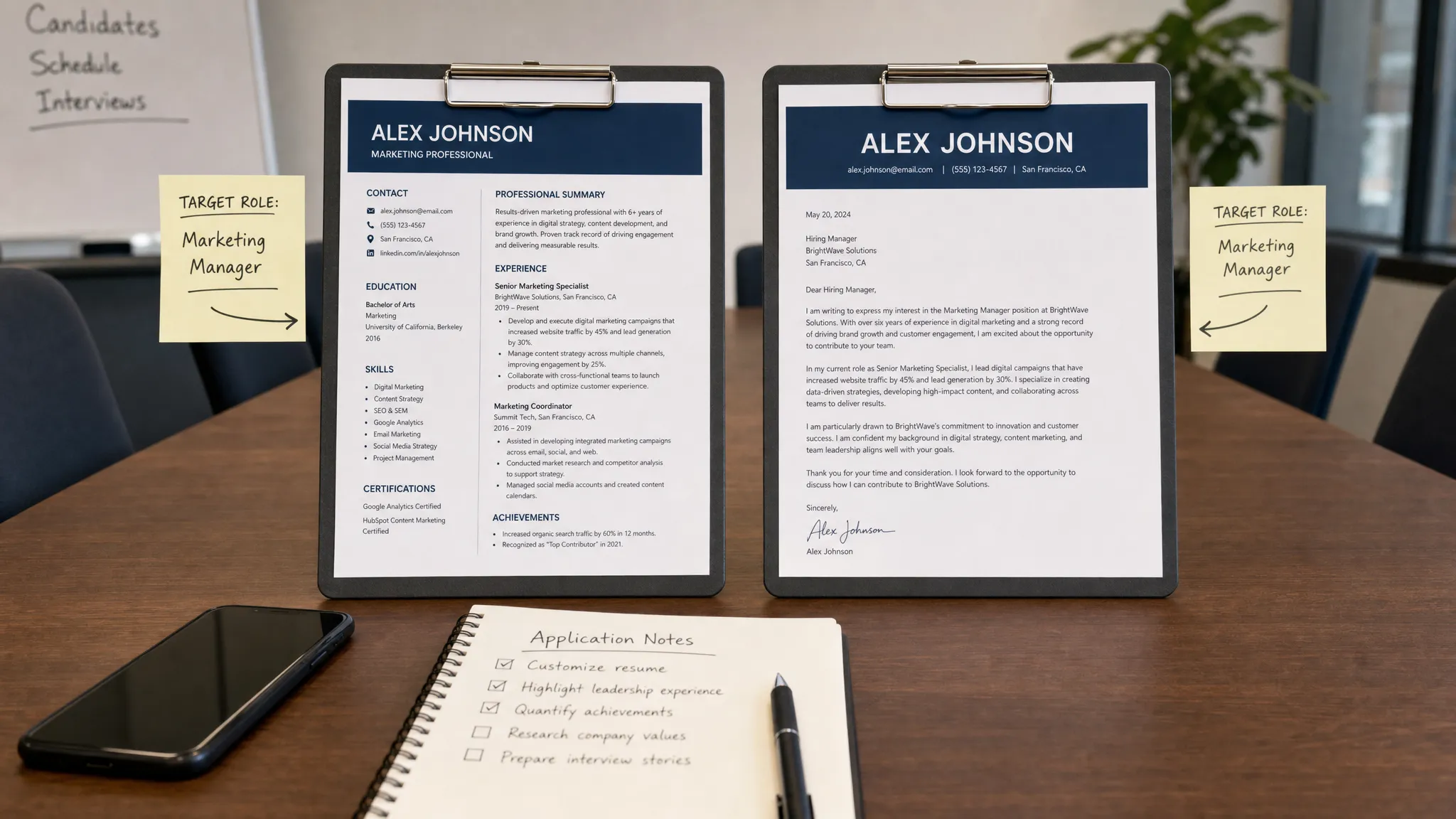
A strong job application feels like one clear story told in two different formats. Your resume shows the evidence, your cover letter explains why that evidence matters for this specific job.
When the two documents do not match, hiring teams notice. A resume that emphasizes project management paired with a cover letter about customer service can feel unfocused. A cover letter that claims leadership experience, but a resume that never shows it, raises doubts. Matching your cover letter and resume the right way helps recruiters understand your fit faster.
The goal is not to copy your resume into paragraph form. The goal is alignment. Your resume and cover letter should highlight the same target role, the same strongest qualifications, and the same overall career message, while each document does a different job.
What it really means to match your cover letter and resume
Matching your cover letter and resume means creating consistency across your application materials. The hiring manager should be able to read your cover letter, glance at your resume, and immediately see the connection.
Think of your resume as the proof file. It lists your experience, skills, education, certifications, tools, and measurable results. Your cover letter is the explanation. It connects selected proof points to the employer’s needs and shows motivation, judgment, and communication style.
| Application element | Resume’s job | Cover letter’s job | How they should match |
|---|---|---|---|
| Target role | Shows relevant titles, skills, and experience | States why you are applying for this role | Use similar role language and priorities |
| Skills | Lists keywords, tools, and capabilities | Explains how you used the most important skills | Focus on the same top 3 to 5 skills |
| Achievements | Provides concise metrics and outcomes | Adds context around one or two major wins | Use the same strongest results, not new claims |
| Career story | Shows timeline and progression | Explains transitions, motivation, or fit | Make your narrative consistent with your work history |
| Formatting | Presents scannable information | Presents a polished business letter | Use consistent name, contact details, and style |
For job seekers, this matters because recruiters often scan quickly. According to CareerOneStop, tailoring your resume and cover letter to the job is a core part of a strong application. Matching both documents helps you look intentional, not generic.
Start with one application message
Before editing either document, define the single message you want the employer to remember. This is your application thesis.
A simple version looks like this:
I am a [target role] with experience in [core skill 1], [core skill 2], and [core result], and I am a strong fit for this role because [company or role-specific reason].
For example:
I am a customer success specialist with experience reducing churn, onboarding SaaS clients, and improving support workflows, and I am a strong fit for this role because your team is scaling post-sale customer operations.
Once you have this message, your resume and cover letter should both support it. Your resume might include churn reduction metrics, onboarding experience, CRM tools, and customer support achievements. Your cover letter might expand on one customer onboarding success story and explain why the company’s growth stage interests you.
This step prevents the most common mistake: sending a resume for one story and a cover letter for another.
Match the job title and professional positioning
Your resume headline, summary, and cover letter opening should point toward the same role. They do not have to use the exact same wording, but they should not create confusion.
If the job posting is for a “Marketing Operations Manager,” your resume should not lead with “Creative Brand Strategist” unless that is truly the angle you want to emphasize. You can still show creative experience, but your positioning should make the operations fit obvious.
A matched version might look like this:
| Resume section | Strong aligned example |
|---|---|
| Resume headline | Marketing Operations Manager with 6 years in campaign automation and reporting |
| Resume summary | Experienced in CRM workflows, lifecycle campaigns, and cross-functional marketing analytics |
| Cover letter opening | I’m excited to apply for the Marketing Operations Manager role because my background in campaign automation and reporting aligns closely with your need for scalable marketing systems. |
A mismatched version might say “brand storyteller” in the resume, “growth marketer” in the cover letter, and “content strategist” in the email subject line. Even if all three are true, the employer may not know which role you are really targeting.
Align your skills with the job posting
The best cover letter and resume pair starts with the job description. Read the posting and identify the skills that appear most central to the role. These are usually found in the responsibilities section, required qualifications, and repeated phrases.
You do not need to mirror every word. You do need to show that your application responds to the actual job.
For example, if the posting emphasizes “stakeholder communication,” “data analysis,” and “process improvement,” your resume should include those ideas where truthful. Your cover letter should then choose one or two of them and demonstrate impact.
A strong alignment might look like this:
| Job posting priority | Resume proof | Cover letter expansion |
|---|---|---|
| Stakeholder communication | Coordinated weekly updates across sales, product, and support teams | I regularly translated product updates into clear action steps for sales and support teams, which helped reduce confusion during launches. |
| Data analysis | Built weekly dashboard tracking conversion rates and retention trends | My reporting work helped managers identify where prospects dropped off and prioritize fixes to the onboarding flow. |
| Process improvement | Reduced manual reporting time by 35% through template automation | One of my strongest contributions has been simplifying recurring workflows so teams can spend more time on customer-facing work. |
This approach keeps both documents focused. Your resume gives the facts. Your cover letter explains why those facts are relevant.
Use the same strongest achievements, but add context
Your cover letter should not introduce a completely different set of accomplishments from your resume. If a cover letter says you “increased revenue by 22%,” the resume should support that achievement somewhere.
That does not mean the wording must be identical. In fact, it is better if the cover letter adds context instead of repeating the bullet word for word.
Resume bullet:
Increased inbound demo bookings by 31% in six months by redesigning landing page copy and launching segmented email follow-ups.
Cover letter version:
In my current marketing role, I helped increase inbound demo bookings by 31% in six months by improving landing page messaging and building segmented follow-up emails. That experience matches your focus on converting high-intent traffic into qualified pipeline.
Notice the difference. The resume bullet is compact. The cover letter version explains the relevance to the new employer.
If you need more help building an evidence-driven letter, see this guide on how to write a cover letter that gets interviews.
Keep your timeline and details consistent
Small inconsistencies can create unnecessary doubt. Before submitting your application, check that names, dates, titles, locations, and credentials match exactly.
Common mismatches include slightly different job titles, outdated company names, different graduation dates, inconsistent certification names, or a cover letter mentioning a skill that is missing from the resume.
Some variation is normal. For example, your official title might be “Client Services Associate II,” while your resume headline says “Customer Success Professional.” That is fine if your work history still lists the official title clearly. Problems arise when the cover letter describes you as a manager, but the resume shows no management role or leadership evidence.
If you are changing careers, matching is even more important. Your resume may show a different industry, so the cover letter must bridge the gap clearly. It should explain which skills transfer and point the reader back to resume proof.
For instance, a teacher applying for a training specialist role might match the documents this way:
| Resume proof | Cover letter bridge |
|---|---|
| Designed curriculum for 120 students across multiple learning levels | My teaching background has given me direct experience designing structured learning materials for diverse audiences. |
| Led parent conferences and student progress reviews | I am comfortable explaining complex information clearly and adapting my communication to different stakeholders. |
| Trained new teachers on classroom technology | That experience connects directly to your need for someone who can support employee learning and tool adoption. |
The cover letter does not hide the career change. It makes the resume make sense.
Match tone, formality, and confidence level
Your resume and cover letter should sound like they came from the same professional. If your resume is concise and metrics-focused but your cover letter is overly casual, the application can feel uneven. If your resume is entry-level but your cover letter uses exaggerated executive language, it may sound inflated.
Aim for a tone that is professional, specific, and natural. You can show personality, but keep it relevant to the role.
A resume phrase like “Managed customer escalations in a high-volume support environment” might become this cover letter sentence:
I’m comfortable handling high-pressure customer situations and have managed escalations in a high-volume support environment where clear communication and follow-through were essential.
That sounds aligned. It uses the same experience, but gives the reader a better sense of your working style.
The NACE career readiness competencies are a useful reminder that employers often look beyond technical skills. Communication, professionalism, teamwork, leadership, and critical thinking can appear on your resume as evidence and in your cover letter as short examples.
Coordinate formatting without overdesigning
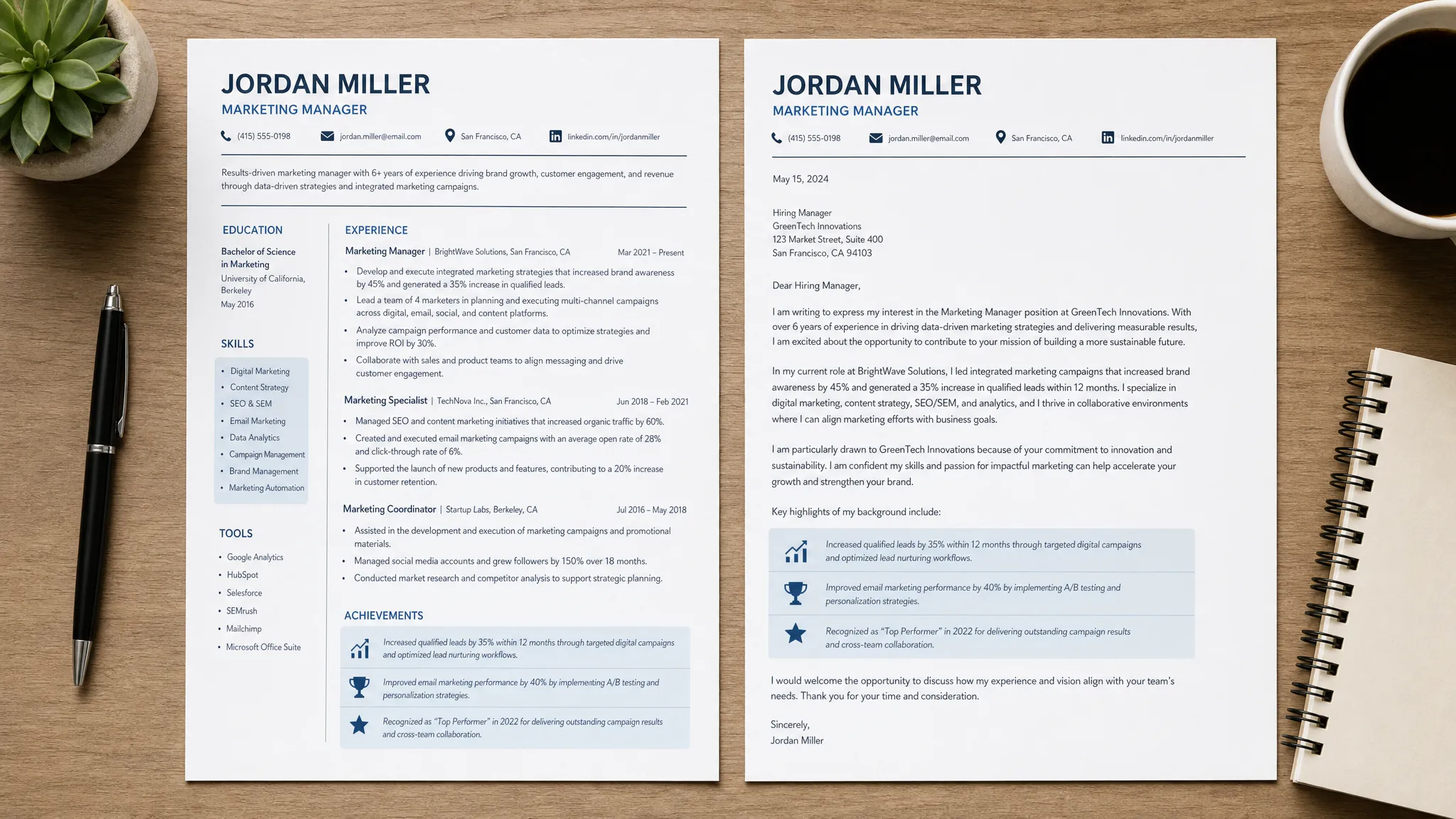
Your cover letter and resume do not need to be visually identical, but they should look like a set. Use the same name, email, phone number, LinkedIn URL, and location format. If you use a simple header on the resume, consider using the same header on the cover letter.
Formatting alignment is especially important when you submit both as PDF attachments. A hiring manager may open them together, and consistent formatting makes the package feel polished.
Keep these basics consistent:
- Name and contact information
- Font style or at least a similar professional font family
- Margins and spacing
- File naming convention
- Date format and location format
- LinkedIn, portfolio, or website links
A clean file naming pattern can also help:
| Document | Good file name |
|---|---|
| Resume | Jordan-Lee-Resume-Product-Manager.pdf |
| Cover letter | Jordan-Lee-Cover-Letter-Product-Manager.pdf |
Avoid highly designed layouts that make one document look modern and the other look outdated. Also avoid graphics, icons, or unusual formatting that distracts from the content. If you want a simple layout, this guide to cover letter format explains the structure hiring managers expect.
Do not turn your cover letter into a resume summary
Matching does not mean repeating. If your cover letter simply restates every resume section, it wastes the reader’s time.
A weak cover letter says:
I have experience in sales, account management, CRM software, reporting, and customer communication. In my last role, I managed accounts, created reports, used CRM software, and communicated with customers.
A stronger matched cover letter says:
Your posting emphasizes account growth and customer retention. In my last role, I managed a portfolio of 45 accounts and helped increase renewal revenue by 18% by identifying expansion opportunities early. I would bring the same structured, relationship-focused approach to your customer success team.
The second version still matches the resume, but it selects the most relevant evidence and connects it to the employer’s needs.
Build a simple cover letter and resume matching workflow
If you are applying to multiple jobs, alignment can feel time-consuming. Use a repeatable process instead of rewriting from scratch every time.
- Save the job posting before you apply.
- Highlight the top 3 to 5 requirements.
- Update your resume summary, skills, and most relevant bullets to reflect those priorities truthfully.
- Choose one or two resume achievements to expand in the cover letter.
- Write a cover letter opening that names the role and your main fit.
- Add a company-specific reason that does not appear on your resume.
- Check both documents for consistent titles, dates, keywords, and contact details.
This is also where AI can help. A tool can create a structured first draft quickly, but you should still verify that every claim matches your resume and the job posting. If you use LetterCraft AI, paste accurate details from your resume and the job description so the generated letter reflects your real background.
Free cover letter and resume matching checklist
Use this free cover letter and resume checklist before you submit your next application.
- The resume headline or summary matches the role you mention in the cover letter.
- The top skills in the job posting appear in both documents when they truthfully apply.
- The cover letter expands on achievements that are visible in the resume.
- Dates, job titles, company names, degrees, and certifications are consistent.
- The cover letter explains motivation or fit, not just qualifications.
- The resume remains scannable and does not become overloaded with keywords.
- The cover letter is specific to the company and role.
- Both documents use matching contact information and a professional format.
- File names are clear and role-specific.
- Every claim in the cover letter can be supported if asked in an interview.
If you cannot check most of these boxes, revise before sending.
Examples of good matching by situation
Different job seekers need different types of alignment. A recent graduate, a career changer, and a senior professional should not use the same strategy.
| Situation | Resume focus | Cover letter focus |
|---|---|---|
| Recent graduate | Coursework, internships, projects, tools, academic achievements | Why the role fits your training and which project proves readiness |
| Career changer | Transferable skills, relevant projects, certifications, results from past roles | A clear bridge between past experience and the new role |
| Laid-off applicant | Recent achievements, current skills, impact in previous role | Forward-looking fit, not a long explanation of the layoff |
| Senior candidate | Leadership scope, business outcomes, team size, strategy | Strategic value and why this specific organization is a strong match |
| Remote applicant | Remote tools, async communication, independent work results | Evidence that you can communicate, prioritize, and deliver without close supervision |
For more examples of strong letters, you can review these cover letter examples that got real interviews. Use them for structure, but always align your own letter with your own resume.
Common mismatches to fix before applying
Some application mistakes are easy to miss because each document looks fine on its own. The problem only appears when they are read together.
| Mismatch | Why it hurts | Quick fix |
|---|---|---|
| Cover letter mentions a major achievement not found on resume | It may seem exaggerated or unsupported | Add the achievement to the resume or choose another example |
| Resume targets one role, cover letter targets another | The application feels unfocused | Rewrite the headline, summary, or opening around one role |
| Skills list is packed with keywords not discussed anywhere else | It looks like keyword stuffing | Keep only skills you can support with experience |
| Cover letter explains a career change, but resume does not show transferable skills | The bridge feels incomplete | Reorder bullets to emphasize relevant skills |
| Formatting and contact details differ | It looks careless | Use one header and verify all details |
| Cover letter is much more senior than the resume | It can sound inflated | Match confidence level to actual evidence |
The best fix is usually not a full rewrite. Often, you only need to adjust the resume summary, reorder a few bullets, and rewrite the cover letter opening.
How to use AI without creating a mismatch
AI can speed up cover letter writing, especially when you are applying to several roles. The risk is that a generic AI draft may add claims, skills, or motivations that do not match your resume.
To avoid that, give the AI specific inputs: the job title, company name, job description, your resume highlights, your preferred tone, and any details you want included or avoided. Then review the output carefully.
A good AI-assisted workflow looks like this:
- Choose the resume bullets you want the letter to emphasize.
- Generate a cover letter draft using those bullets and the job posting.
- Remove any claim that is not supported by your resume.
- Add one specific reason you are interested in the company.
- Read the final version aloud to make sure it sounds like you.
If you want a starting point, you can also use a basic cover letter template and customize it manually.
Frequently Asked Questions
Should my cover letter repeat my resume? No. Your cover letter should match your resume, but it should not repeat it line by line. Use the letter to expand on one or two relevant achievements and explain why they matter for the role.
Can I mention something in my cover letter that is not on my resume? Yes, but be careful. It is fine to mention motivation, company interest, or a brief story that does not fit on the resume. However, major skills, credentials, and achievements should usually be supported by the resume.
Do my cover letter and resume need the same design? They should look related, but they do not need to be identical. Use consistent contact information, simple formatting, and similar professional styling.
How do I match my cover letter and resume for a career change? Focus on transferable skills. Your resume should highlight relevant accomplishments from your previous field, while your cover letter explains the connection between that experience and the new role.
Should I customize both documents for every job? Ideally, yes. You do not need to rewrite everything, but you should adjust the resume summary, top skills, selected bullets, and cover letter so they reflect the job posting.
Can LetterCraft AI help me match my cover letter to my resume? Yes. LetterCraft AI can help generate a personalized cover letter draft when you provide accurate resume details and the job description. You should still review the draft to confirm every claim is true and aligned.
Create a cover letter that fits your resume
Your resume and cover letter should work together, not compete for attention. The resume proves your qualifications. The cover letter turns that proof into a clear case for why you fit this specific job.
If you want to save time, try LetterCraft AI to generate a professional, personalized cover letter in under 30 seconds. Add details from your resume, choose the tone that fits your situation, and get a polished draft you can copy, export, and refine before applying. No credit card is required to try it.
Write your cover letter — not a blank template
Generate a finished cover letter with your details, tone, and language in ~30 seconds. Free first letter, no credit card — beats copy-pasting and filling the blanks yourself.