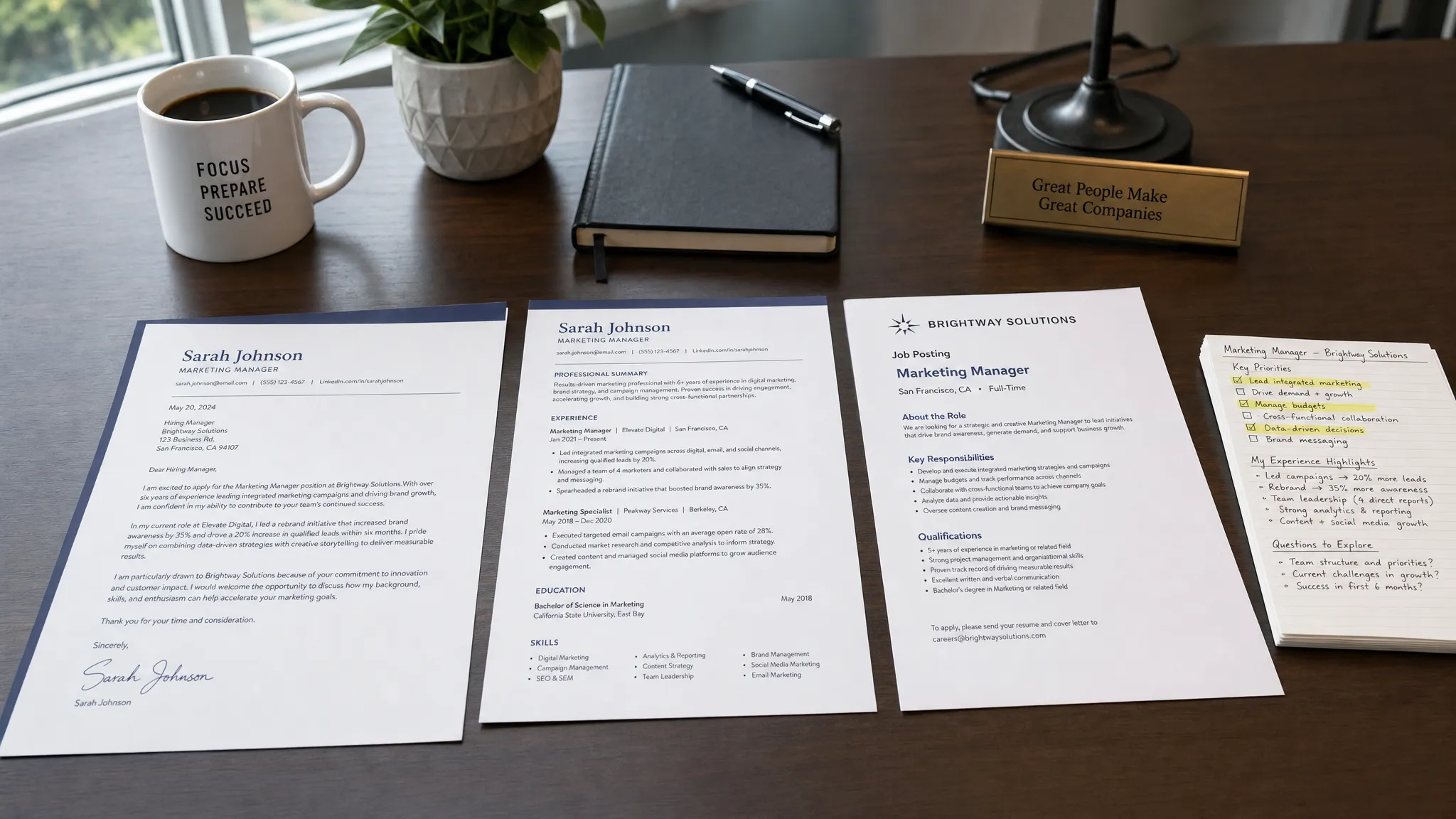
Cover Letter Tips for Interview Applications
Cover letter tips for interview applications: learn how to write concise, specific letters that prove fit and help you get noticed.
Write your cover letter — not a blank template
Generate a finished cover letter with your details, tone, and language in ~30 seconds. Free first letter, no credit card — beats copy-pasting and filling the blanks yourself.
A cover letter is not just a formality. When written well, it acts as a short, persuasive case for why a recruiter should move your resume into the interview pile.
The challenge is that most applicants write cover letters that sound polite but generic. They summarize their resume, repeat obvious details, and end with a hopeful line about being considered. That rarely helps because hiring teams are not looking for a biography. They are looking for evidence of fit, motivation, and low hiring risk.
If your goal is to write a stronger cover letter for interview application success, the tips below will help you focus on what actually moves a hiring manager toward one decision: inviting you to talk.
Start with the interview goal, not the letter itself
Before you write, clarify what the cover letter is supposed to do. It does not need to explain every job you have held. It does not need to prove you are perfect. It needs to make the reader curious enough to review your resume seriously and schedule a conversation.
That means every paragraph should answer one of these questions:
- Why this role?
- Why this company or team?
- Why are you likely to succeed?
- Why should the employer speak with you now?
If a sentence does not support one of those answers, cut it. A shorter letter with clear proof is usually stronger than a longer letter full of general enthusiasm.
For a full writing sequence, you can also use LetterCraft AI's step-by-step cover letter guide, but this article focuses specifically on interview-winning refinements.
Open with your strongest fit in the first three lines
Recruiters skim. Your first paragraph should quickly connect the job opening to your most relevant experience, skill, or result. Avoid opening with a sentence that could appear in thousands of applications.
Weak opening:
'I am writing to apply for the Marketing Coordinator position at your company. I believe I would be a great fit for this role.'
Stronger opening:
'I am applying for the Marketing Coordinator role because your team needs someone who can support campaign execution, content coordination, and performance reporting. In my last role, I helped manage weekly email campaigns and improved average click-through rate by 18% over two quarters.'
The stronger version does three things immediately. It names the role, reflects the employer's needs, and gives a measurable reason to keep reading.
If you do not have a metric, use a concrete responsibility or outcome instead. For example, mention the type of customers you supported, the tools you used, the size of the team you worked with, or the kind of projects you completed.
Mirror the job description without copying it
A hiring manager should feel that your letter was written for this role, not pasted into every application. One of the easiest ways to do that is to identify the employer's top three needs from the job description.
Look for repeated themes such as customer service, project ownership, data analysis, stakeholder communication, writing ability, compliance, sales targets, or technical troubleshooting. Then choose one or two examples from your background that prove you can meet those needs.
Do not copy full phrases mechanically. Instead, translate the requirements into natural language.
| Job description says | Your cover letter could say |
|---|---|
| Manage multiple deadlines in a fast-paced environment | I regularly coordinated overlapping client requests while keeping project updates organized and on schedule. |
| Strong written and verbal communication skills | My role required clear status updates for customers, managers, and cross-functional partners. |
| Experience with reporting and analysis | I built weekly performance summaries that helped the team identify trends and adjust priorities. |
| Ability to work independently | I was trusted to own recurring tasks from planning through completion with minimal supervision. |
This approach makes your cover letter feel relevant while still sounding like a real person wrote it.
Use proof points instead of personality claims
Many applicants rely on adjectives: hardworking, passionate, detail-oriented, motivated, reliable. These qualities matter, but they are weak unless supported by evidence.
A useful rule is to turn every major claim into a proof point. If you say you are organized, show what you organized. If you say you communicate well, show who you communicated with and what improved because of it.
For example:
- Instead of 'I am highly organized,' write 'I maintained a shared project tracker for five active client accounts and helped reduce missed follow-ups.'
- Instead of 'I am passionate about customer service,' write 'I handled 40+ customer inquiries per day while maintaining positive satisfaction feedback.'
- Instead of 'I am a fast learner,' write 'I learned the team's CRM within two weeks and began preparing weekly pipeline updates for managers.'
Proof does not always require impressive numbers. Specificity is proof. A concrete example tells the employer you have actually done the work.
Connect your motivation to the employer's real work
A common cover letter mistake is writing, 'I have always admired your company.' That line is not harmful, but it is usually too vague to help.
Better motivation is specific. Mention something relevant about the company's product, mission, customer base, industry position, recent initiative, or the type of work the role supports. Keep it brief and professional.
Good motivation sounds like this:
'I am especially interested in this role because your team focuses on helping small businesses simplify their operations. My experience supporting business owners in a client-facing role has shown me how valuable clear communication and practical problem solving can be.'
This works because it connects the company to the candidate's experience. It is not flattery. It is alignment.
Keep the structure simple and skimmable
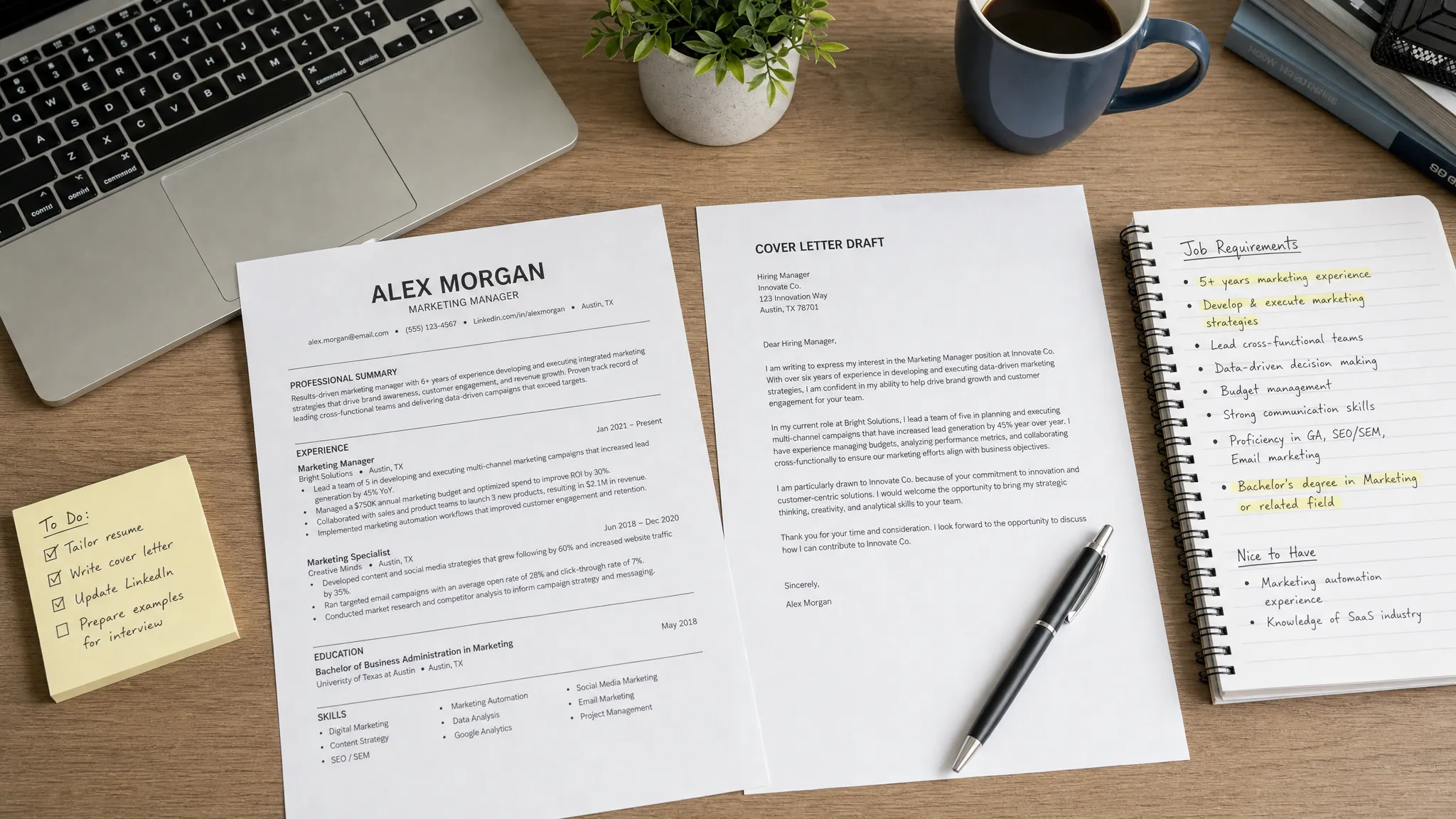
A strong cover letter for an interview application usually fits into three or four short paragraphs. Aim for about 250 to 400 words unless the employer requests something different.
A practical structure is:
- Paragraph 1: Role, interest, and strongest fit.
- Paragraph 2: One or two examples that prove relevant skills.
- Paragraph 3: Why this company or role makes sense for you.
- Closing: Confident, polite invitation to discuss your fit.
This structure respects the reader's time. It also prevents you from drifting into unrelated background details.
If you prefer to start from a ready-made structure, this cover letter for job application template can help you avoid the blank page while still giving you room to personalize.
Match the tone to the role and company
Your tone should be professional, but not stiff. A cover letter for a law firm, healthcare administrator, or finance role may need a more formal tone. A letter for a startup, design agency, or customer success position can be slightly warmer and more conversational.
The safest tone is clear, confident, and specific. Avoid exaggerated phrases such as 'dream job,' 'perfect candidate,' or 'I will be an incredible asset' unless you have the evidence to support that level of confidence.
A balanced closing might read:
'I would welcome the opportunity to discuss how my experience in account coordination and client communication could support your team. Thank you for your time and consideration.'
That sounds professional without being overly passive or overly aggressive.
Address potential concerns briefly, if needed
Sometimes your application has an obvious question mark. You may be changing careers, returning after a gap, relocating, or applying without every listed qualification. A cover letter can help, but only if you address the concern strategically.
Do not apologize. Do not spend half the letter explaining the issue. Instead, reframe it around transferable value.
Career change example:
'Although my background is in hospitality, the core of my work has been customer communication, issue resolution, and fast decision-making. Those strengths are directly relevant to the Client Support Associate role.'
Employment gap example:
'After a planned career break, I am now ready to return to full-time work and bring my project coordination experience to a team that values accuracy and follow-through.'
The goal is to remove doubt, not invite more of it.
Make the resume and cover letter work together
Your cover letter should not repeat your resume line by line. Instead, it should create context for the most relevant parts of your resume.
Think of your resume as evidence and your cover letter as the argument. The resume shows what you have done. The letter explains why that background matters for this exact role.
For example, if your resume lists 'managed inventory reports,' your cover letter can explain the value behind that task: 'By maintaining accurate inventory reports, I helped the team identify shortages earlier and reduce last-minute purchasing issues.'
That kind of context is often what turns a basic qualification into a reason to interview you.
Customize the final 20%, not the whole letter every time
You do not need to rewrite from scratch for every application. That is exhausting and often unnecessary. Instead, build a strong base letter, then customize the parts that hiring teams notice most.
Focus your customization on:
- The opening sentence.
- The top skills or requirements from the job posting.
- One proof point that best matches the role.
- The company-specific motivation sentence.
- The job title and company name.
This keeps your application efficient while avoiding the generic feel that hurts many cover letters.
Proofread for trust, not just grammar
Typos matter because they create doubt. A hiring manager may wonder whether the same lack of care will show up in your work. But proofreading is not only about spelling. It is also about checking clarity, accuracy, and tone.
Before sending, ask yourself:
- Did I name the correct company and role?
- Does the first paragraph give a real reason to keep reading?
- Have I included at least one specific example?
- Is the letter short enough to skim comfortably?
- Does the tone sound like me on a good professional day?
Reading the letter aloud is one of the fastest ways to catch awkward phrasing. If you stumble over a sentence, simplify it.
Common mistakes that cost interview opportunities
Even qualified candidates can weaken their applications with small mistakes. The most common ones are easy to fix once you know what to look for.
Avoid sending a letter that is too broad. If it could be used for any company in any industry, it is not specific enough. Avoid overexplaining your life story. The employer needs the most relevant context, not every detail. Avoid focusing only on what you want from the job. Show what you can contribute. Avoid repeating your resume without interpretation. Add meaning, motivation, and proof.
Finally, avoid sounding desperate. It is fine to be enthusiastic, but your letter should communicate confidence and fit rather than urgency or need.
A quick before-and-after example
Here is how a generic paragraph can become more interview-focused.
Before:
'I have excellent communication skills and experience working with customers. I am a quick learner and believe I would do well in this position.'
After:
'In my retail associate role, I supported customers with product questions, returns, and order issues in a busy store environment. That experience strengthened my ability to listen carefully, explain options clearly, and stay calm when solving problems, which matches the customer support focus of this role.'
The second version is not longer because it adds fluff. It is stronger because it adds context, proof, and relevance.
Frequently Asked Questions
How long should a cover letter for an interview application be? Aim for 250 to 400 words in most cases. The letter should be long enough to show fit and proof, but short enough for a recruiter to skim quickly.
Should I mention the interview directly in my cover letter? You can mention that you would welcome the opportunity to discuss your fit, but avoid sounding demanding. A confident closing is better than asking too aggressively for an interview.
What is the best opening line for a cover letter? The best opening line connects the role to your strongest relevant qualification. Name the position, reflect a key employer need, and include a specific skill or result when possible.
Can I use the same cover letter for multiple applications? You can use the same base structure, but you should customize the opening, proof points, company motivation, and role details for each application.
What if I do not have much experience? Focus on transferable skills, coursework, volunteer work, internships, part-time jobs, or projects. Students can also review this application letter sample for students for examples of how to present early experience professionally.
Turn your notes into a polished cover letter faster
A strong cover letter does not need to be complicated. It needs to be specific, concise, and clearly connected to the role you want.
If you want help turning your experience into a ready-to-send letter, LetterCraft AI can generate personalized professional letters in under 30 seconds. You can choose from 65+ letter types, adjust the tone, copy your result, export to PDF, and try it without a credit card.
Use the tips above to gather your strongest details, then create a cover letter that gives hiring managers a clear reason to invite you to the interview.
Write your cover letter — not a blank template
Generate a finished cover letter with your details, tone, and language in ~30 seconds. Free first letter, no credit card — beats copy-pasting and filling the blanks yourself.