
Cover Letter for Job Application: A Step-by-Step Guide
Write a cover letter for job application step by step with a proven structure, examples, a copy-ready template, and an edit checklist to stand out.
Write your cover letter — not a blank template
Generate a finished cover letter with your details, tone, and language in ~30 seconds. Free first letter, no credit card — beats copy-pasting and filling the blanks yourself.
A great cover letter for job application does one job: it makes a hiring manager think, “This person understands what we need, and they’ve done it before.”
Not “I’m hardworking.” Not a repeat of your resume. A short, tailored letter that connects the dots between the role’s requirements and your proof.
This guide walks you through a step-by-step process you can reuse for almost any role, plus a copy-ready template and examples of strong lines.
What a cover letter needs to accomplish (in 30 seconds)
Most cover letters are scanned, not read line-by-line. Your goal is to make the “scan” irresistible.
A strong cover letter should:
- Clarify fit (why you match this job)
- Add proof (2 to 3 results that back up your claims)
- Show intent (why this company, why this team, why now)
- Reduce risk (you can do the work, communicate well, and ramp fast)
As a practical target, aim for 250 to 400 words (roughly three to four short paragraphs).
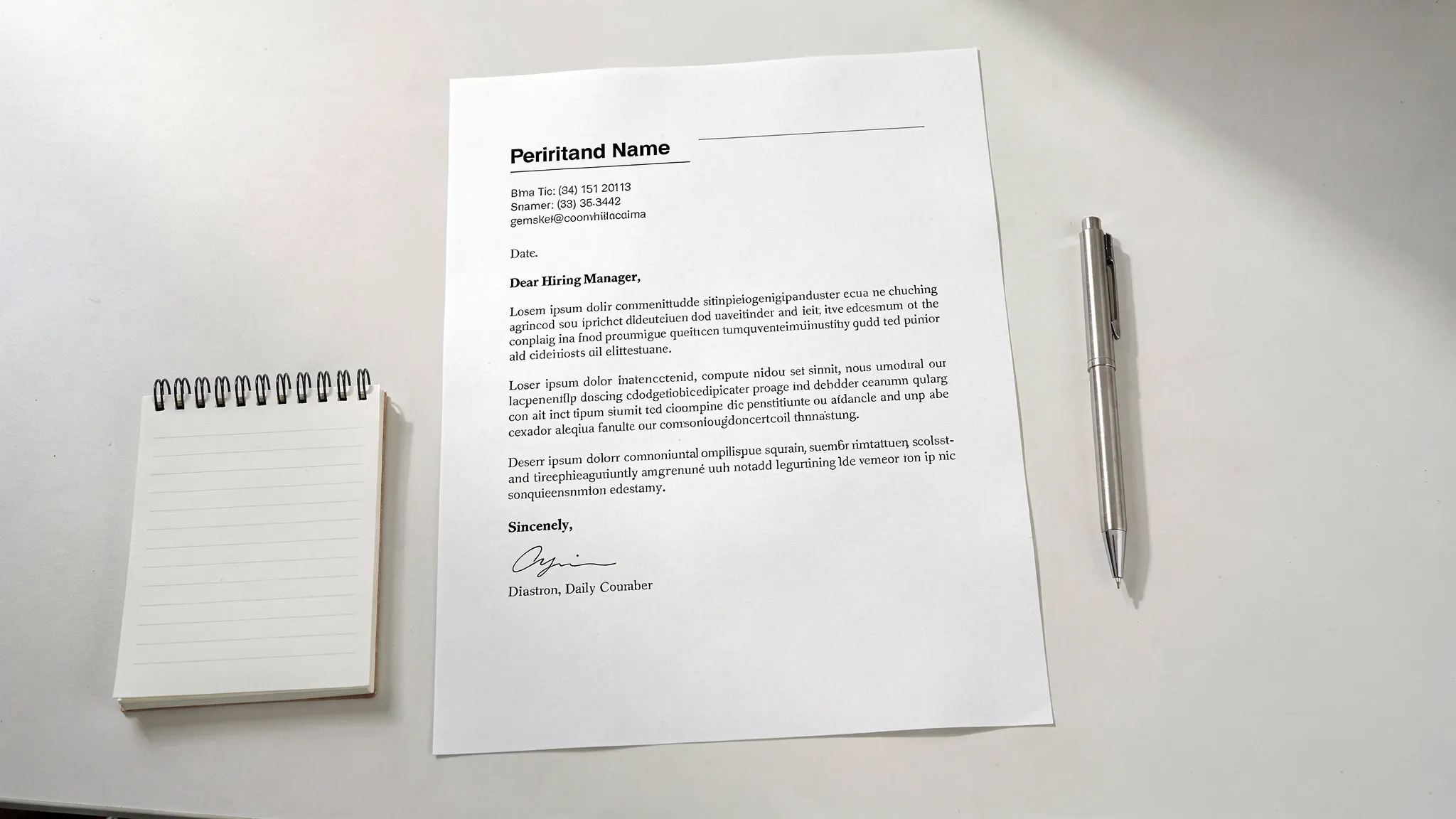
Step 1: Extract the job’s “must-prove” requirements
Before you write anything, turn the job description into a short list of things you must prove.
Look for:
- Repeated themes (stakeholder management, pipeline creation, incident response)
- Outcome language (increase, reduce, improve, own, deliver)
- Tools or domain cues (Salesforce, HIPAA, SOC 2, GA4)
Then select two core requirements you will prove in your letter. You can mention more, but your strongest proof should cluster around two.
Here’s a simple “relevance map” you can build in 5 minutes:
| Job requirement (from posting) | Your matching experience | Proof (numbers, scope, outcome) | Cover letter line idea |
|---|---|---|---|
| “Improve onboarding and retention” | Built onboarding for SMB customers | Reduced time-to-value by 20%, raised activation 12% | “I redesigned onboarding to cut time-to-value by 20%…” |
| “Partner with Product and Sales” | Led cross-functional launches | Shipped 3 launches, improved win rate 8% | “I’ve partnered with Product and Sales to…” |
If you cannot add proof (numbers, scope, specific outcome), the requirement should not be one of your “headline” points.
Step 2: Research the company just enough to be specific
You do not need an essay on the company’s mission. You need one or two details that prove you did your homework.
Good sources for quick specificity:
- The company website (product pages, customer stories)
- The team’s page (role expectations, what they ship)
- A recent announcement or update (a new feature, expansion, partnership)
Pick one detail you can tie to your experience.
Examples of useful details:
- “You’re expanding into mid-market healthcare”
- “Your product just launched X integration”
- “This role owns implementation for enterprise customers”
Avoid vague lines like “I love your mission” unless you immediately anchor them to something concrete.
Step 3: Choose your “thesis sentence” (your angle)
A thesis sentence keeps your letter focused.
Use this formula:
I help [team/company] achieve [relevant outcome] by [your most credible strength], proven by [result].
Examples:
- “I help customer success teams reduce churn by tightening onboarding and building scalable playbooks, most recently improving retention by 9% across a 120-account book.”
- “I help marketing teams increase qualified pipeline through performance + landing page experimentation, including a 28% lift in MQL-to-SQL conversion.”
You will reuse this angle in your opening and reinforce it with proof in the body.
Step 4: Set the right structure and formatting
You can write great content and still lose points with messy formatting.
Keep it simple:
- Left-aligned, readable font (no tiny text)
- Clear paragraphs with white space
- No tables inside the letter itself (tables are great for drafting, not for submission)
A standard cover letter layout includes:
| Section | What it’s for | Keep it to |
|---|---|---|
| Greeting | Professional opener | 1 line |
| Opening paragraph | Role + specific interest + thesis | 2 to 4 sentences |
| Body paragraph(s) | 2 proof blocks tied to job needs | 6 to 10 sentences total |
| Closing paragraph | Ask for interview + logistics + thanks | 2 to 4 sentences |
Step 5: Write an opening that earns the next 10 seconds
Your opening should do three things quickly:
- Name the role
- Show a specific reason you want it (company detail)
- Lead with your strongest fit (your thesis)
Strong opening examples (you can adapt):
- “I’m applying for the Customer Success Manager role at [Company]. Your focus on [specific initiative] caught my attention because I’ve led similar work, including [proof].”
- “When I saw you’re hiring a [Role] to [key outcome from posting], I recognized a direct match with my experience in [skill] and [skill], most recently [result].”
What to avoid in your first line:
- “To whom it may concern” (feels dated)
- “I’m excited to apply” with no substance
- An autobiography (“I graduated in…”) unless you are entry-level and it’s relevant
Step 6: Build the middle around two “evidence blocks”
Think of your body as two proof blocks, each tied to a requirement.
Each block should include:
- The situation or goal
- What you did (your decisions, not your job description)
- The result (metric, timeline, scope)
- The skill the result proves
Here are two quick patterns you can copy:
Evidence block pattern A (achievement-driven)
“In my current role at [Company], I [action] to solve [problem]. This led to [measurable result]. The same approach would translate to [job requirement] at [Target Company].”
Evidence block pattern B (stakeholder-driven)
“I regularly partner with [teams] to [outcome]. For example, I [specific example], resulting in [metric]. This experience matches your need for [requirement].”
If you are struggling to add metrics, use “credible scope” instead:
- Volume (tickets/week, accounts, monthly traffic)
- Budget (managed a $X budget)
- Team scope (cross-functional group of X)
- Time (delivered in X weeks)
Step 7: Close with confidence (and make the next step easy)
Your closing is not the place to be timid. You are not begging, you are guiding.
A strong close:
- Re-states the match in one line
- Asks for the interview
- Adds a practical detail if helpful (availability, portfolio link, work authorization, location)
- Thanks them
Example closing:
“Based on my experience improving [outcome] and partnering across [teams], I’m confident I can help [Company] achieve [goal]. I’d welcome the chance to discuss how I’d approach the first 60 days in this role. Thank you for your time and consideration.”
Step 8: Edit like a hiring manager (fast scan, low risk)
Before you send, do a final pass with the reader’s mindset.
Use this checklist:
- Does the first paragraph mention something specific about the company or role?
- Can I highlight two lines that prove impact (numbers or scope)?
- Did I remove generic phrases (“hardworking,” “team player”)?
- Did I keep it under one page with short paragraphs?
- Are the keywords natural (not stuffed), matching the job post?
- Did I proofread names, titles, and company spelling?
- Does it sound like me (simple language, real details, no corporate filler)?
A copy-and-paste cover letter template (fill-in)
Use this template as a starting point, then replace every bracket with something real.
Subject (if email): Application for [Role] | [Your Name]
Dear [Hiring Manager Name] (or Dear [Team] Hiring Team),
I’m applying for the [Role] position at [Company]. I’m particularly interested in this role because [specific company detail tied to role]. I bring [X years / type of experience] in [relevant area], including [1 strong proof], and I’m confident I can help your team [key outcome from posting].
In my recent work at [Company], I [action you took] to address [problem or goal]. As a result, I achieved [metric/scope outcome]. This aligns with your need for [requirement #1], especially as you [company context].
Additionally, I’ve [second action/strength], partnering with [teams/stakeholders] to deliver [outcome]. For example, I [specific example], resulting in [metric]. This directly matches your focus on [requirement #2].
I’d welcome the opportunity to discuss how my experience in [2 strengths] can support [Company] as you [near-term goal]. Thank you for your time and consideration.
Sincerely, [Your Name] [Phone] | [Email] | [LinkedIn/Portfolio]
Example: A short cover letter for job application (complete sample)
Dear Product Operations Hiring Team,
I’m applying for the Product Operations Specialist role at BrightNote. Your focus on improving cross-functional execution across Product, Support, and Sales stood out to me because I’ve built the systems that keep teams aligned, including a workflow overhaul that reduced launch delays by 30%.
In my current role at a B2B SaaS company, I owned the release process from intake through post-launch review. I introduced a lightweight launch brief, standardized risk checks, and a single source of truth in our project tracker. Within two quarters, we cut missed handoffs and reduced average launch slippage by 30%, while increasing stakeholder satisfaction (measured via internal surveys).
I also partner closely with Support and Success to turn customer pain into prioritized product work. For example, I led a monthly “top issues” review tied to ticket volume and revenue risk, helping the team resolve two high-impact workflow bugs that were driving repeat contacts.
I’d love to discuss how I can help BrightNote tighten execution and make launches more predictable. Thank you for your time and consideration.
Sincerely, Jordan Lee
Common cover letter mistakes (and quick fixes)
Repeating your resume
If a line could be copied from your resume verbatim, rewrite it to add context.
Fix: add the “why it mattered” and the outcome.
Writing too much about you, not enough about the job
Cover letters are not personal essays.
Fix: for every “I” sentence, make sure it connects to a requirement or business outcome.
Being “enthusiastic” but vague
Energy is good, but only after specificity.
Fix: replace “excited” with a concrete reason (a product, a metric, a challenge).
Overexplaining gaps or sensitive topics
If you must address something (gap, relocation), do it in one neutral sentence, then pivot to proof.
Fix: one line, no drama, no blame.
Generic AI tone
Hiring managers can sense copy-paste.
Fix: add one real detail from your experience, and one real detail about the company.
Special situations: what to say (in one line)
Keep these situations brief, then move on.
- Career change: “I’m pivoting from [field] to [field], and I’ve already built experience in [relevant skill] through [project/results].”
- Entry-level: “While I’m early in my career, I’ve demonstrated [skill] through [internship/project], delivering [result].”
- Referral: “[Name] suggested I reach out after we worked together on [context], and I’m excited to apply because [fit + proof].”
- Relocation: “I’m relocating to [city] on [date] and am available for interviews immediately.”
If you are making a job move as part of a bigger money plan (higher savings rate, relocation, or a path to FIRE), you might also enjoy the practical guidance on the FIYR personal finance blog.
How to create a polished letter faster with CraftMyLetter
If writing from a blank page slows you down, an AI draft can help, as long as you personalize it.
With CraftMyLetter, you can:
- Choose a cover letter type and provide a few details to generate a draft in under 30 seconds
- Pick a tone (for example, confident, formal, friendly)
- Export to PDF, copy to clipboard, and keep versions in your letter history
To get better output, paste in:
- The job description (or the top requirements)
- 2 to 3 quantified achievements you want featured
- One company-specific detail you plan to mention
Then do a human edit pass to add your voice and remove anything that sounds generic.
Frequently Asked Questions
How long should a cover letter for job application be? Aim for 250 to 400 words, or about three to four short paragraphs. One page is the practical maximum.
Should I write a cover letter if it’s optional? If you can tailor it quickly with real proof (and the role is competitive, senior, or a career change), a good cover letter can help you stand out.
What if I don’t know the hiring manager’s name? Use “Dear Hiring Manager” or “Dear [Team] Hiring Team.” It’s normal in modern applications.
Should I mention salary expectations in a cover letter? Only if the posting specifically asks. Otherwise, save compensation for the recruiter screen or negotiation stage.
Is it okay to use AI to write my cover letter? Yes, as a draft. The risk is sending generic text. Add role-specific proof, company details, and your real voice before submitting.
Do I need a different cover letter for every job? You can reuse a base structure, but you should tailor the opening and the two evidence blocks for each role.
Create a tailored cover letter in 30 seconds
If you want a fast, professional starting draft without overthinking structure, try CraftMyLetter. It generates personalized cover letters (and 65+ other letter types) in under 30 seconds, with multiple tone options, PDF export, and no credit card required to try.
Write your cover letter — not a blank template
Generate a finished cover letter with your details, tone, and language in ~30 seconds. Free first letter, no credit card — beats copy-pasting and filling the blanks yourself.