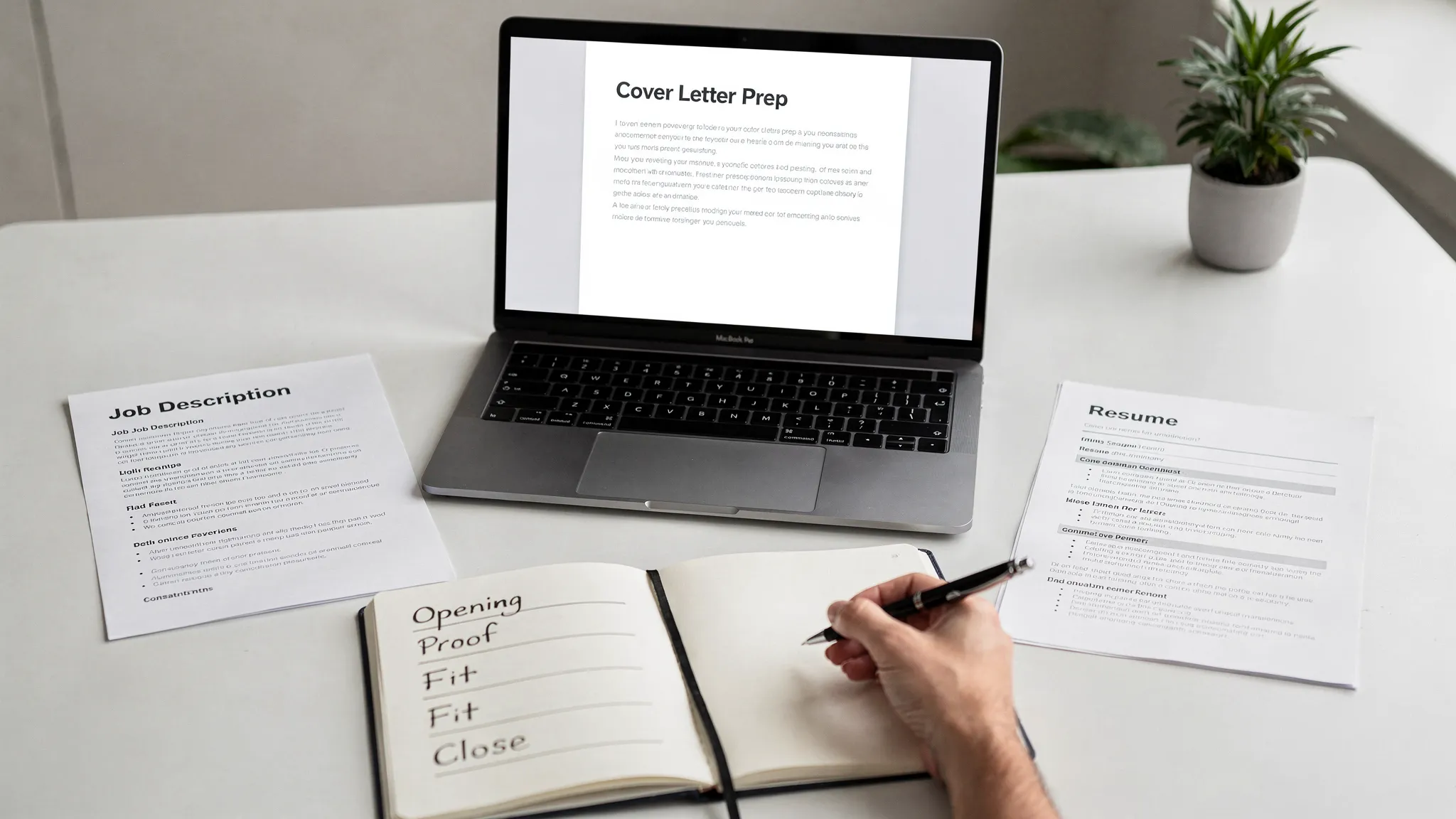
Cover Letter Outlines That Keep You Focused
Use focused cover letter outlines to plan a clear hook, proof, and close for any job, with examples, templates, and quick drafting tips.
Write your cover letter — not a blank template
Generate a finished cover letter with your details, tone, and language in ~30 seconds. Free first letter, no credit card — beats copy-pasting and filling the blanks yourself.
The fastest way to write a better cover letter is not to start writing immediately. It is to outline first.
Without an outline, most applicants drift into the same problems: repeating their resume, explaining too much background, using generic compliments about the company, or ending without a clear reason to interview them. A focused outline prevents that. It tells you what each paragraph must accomplish before you spend time polishing sentences.
Strong cover letter outlines do not make your letter robotic. They make it intentional. They help you choose the one message the hiring manager should remember, the evidence that supports it, and the closing that moves the application forward.
What a cover letter outline is supposed to do
A cover letter outline is a planning framework for your letter. It is not the same as a finished template, and it is not just a list of sections like “opening, body, closing.” A useful outline answers a sharper question: what should this letter prove?
According to CareerOneStop, a cover letter should explain why you are qualified for the position and encourage the employer to review your resume. That means the letter needs focus. It should not tell your whole career story. It should make one persuasive case for one role.
A good outline helps you:
- Match your experience to the job posting before drafting.
- Pick the strongest one or two proof points.
- Avoid copying your resume in paragraph form.
- Keep the final letter short enough to be read quickly.
- Adjust your tone for different roles, industries, and situations.
Think of the outline as a filter. If a sentence does not support your main claim, it probably does not belong in the letter.
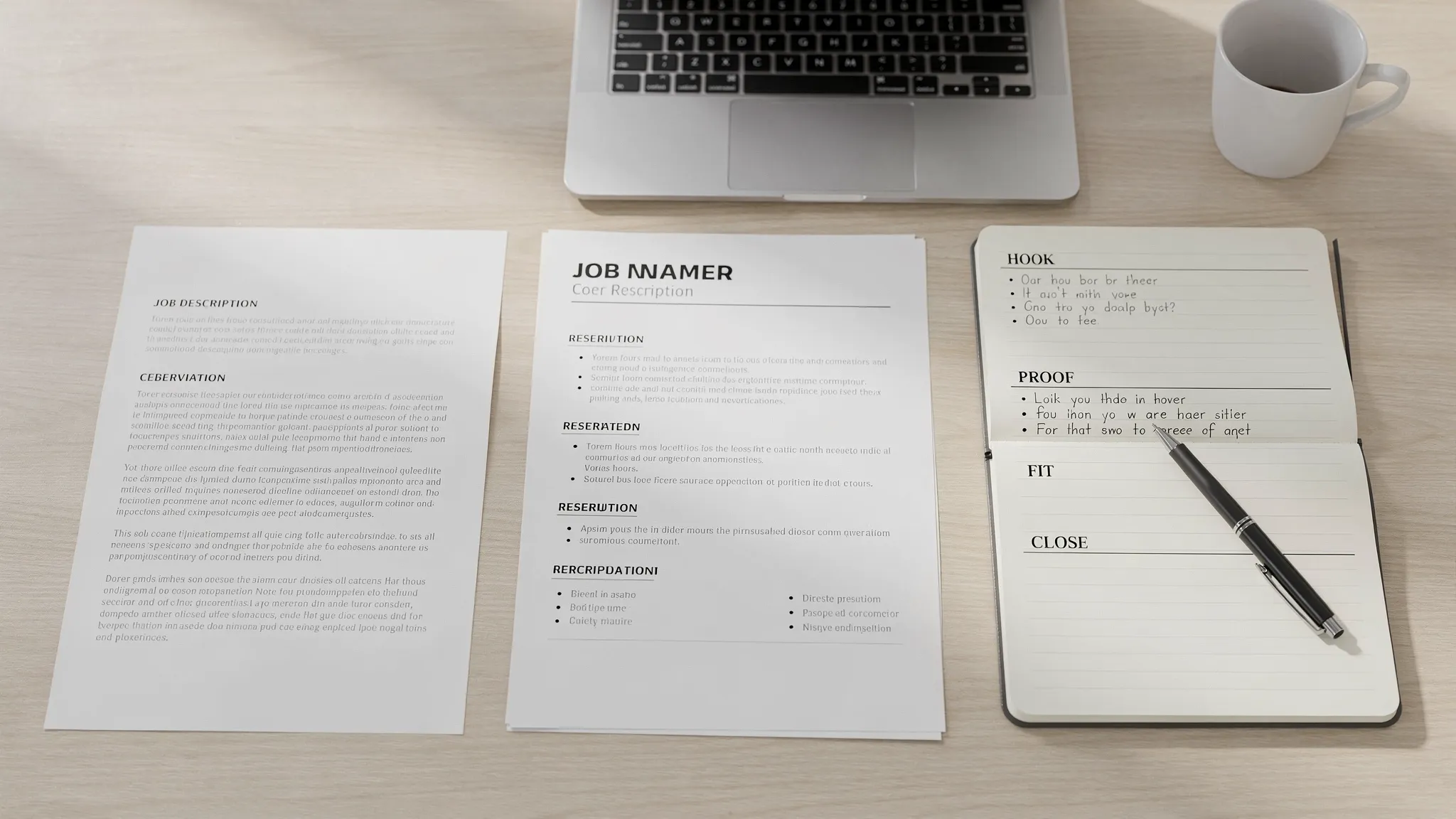
The focus rule: one job, one claim, two proof points
Before choosing an outline, write one sentence that defines the purpose of the letter:
I can help [company/team] achieve [role priority] because I have [specific evidence].
For example:
I can help your customer success team improve retention because I have reduced churn risk through onboarding improvements and proactive account reviews.
That sentence may never appear in the final letter, but it keeps the draft from wandering. Every paragraph should connect back to it.
Most cover letters become unfocused because the applicant tries to prove too many things at once. They want to show leadership, communication, technical ability, passion, resilience, industry knowledge, and personality in one page. The result is often vague. A hiring manager does not need every reason you are qualified. They need the most relevant reason to keep reading.
The core outline for a focused cover letter
Use this outline when you want a simple, flexible structure that works for most job applications.
| Section | Purpose | What to include | What to avoid |
|---|---|---|---|
| Opening | Show relevance immediately | Job title, company name, and your strongest match | “I am writing to apply” with no specific hook |
| Proof | Demonstrate ability | One or two achievements, metrics, projects, or responsibilities tied to the role | A full resume summary |
| Fit | Explain why this role makes sense | Company, team, product, mission, or job-specific motivation | Generic praise like “your company is innovative” |
| Close | Make the next step easy | Appreciation, confidence, interview interest, contact readiness | Overly formal or desperate language |
This outline usually becomes three or four short paragraphs. For most applications, aim for 250 to 400 words. If you are sending the cover letter in the body of an email, shorter is often better, around 150 to 250 words.
If you need help with the visual layout after outlining, see this guide to the cover letter format hiring managers expect.
Cover letter outlines you can copy
Different situations need different emphasis. A recent graduate should not use the same outline as a career changer, and a referred candidate should not bury the referral in the second paragraph. Use the outline that matches the reason your application needs context.
1. The standard role-fit outline
Use this when your experience clearly matches the job posting.
Opening: Name the role and lead with your most relevant qualification or recent achievement.

Proof paragraph: Connect 1-2 job requirements to specific examples from your work.

Company fit paragraph: Mention one real reason this company or team interests you.

Close: Reaffirm your fit, thank the reader, and express interest in discussing the role.
This outline works because it follows the hiring manager's likely thought process: What role is this for? Is this person qualified? Do they understand our needs? Should I interview them?
A focused opening might look like this:
I am excited to apply for the Operations Coordinator role at Brightline Health because my background in scheduling, vendor communication, and process documentation matches the coordination support your growing clinical team needs.
Notice that the sentence is not flashy. It is specific. That is the point.
2. The achievement-led outline
Use this when you have a strong metric or accomplishment that directly relates to the role.
Opening: Start with the achievement most relevant to the employer's problem.

Context: Briefly explain the situation, team, or challenge behind the achievement.

Transfer: Show how that experience connects to the job posting.

Close: Invite a conversation about how you can create similar results for the employer.
This outline is especially useful in sales, marketing, operations, customer success, project management, recruiting, finance, and other roles where outcomes matter.
For example:
In my current customer support role, I helped reduce first-response time by 32% by rewriting our triage process and creating clearer escalation rules. I am applying for the Customer Experience Specialist position at Northstar because your posting emphasizes faster resolution times and scalable support systems.
The achievement creates instant focus. Instead of saying “I am a strong communicator,” you show what your communication improved.
3. The career-change outline
Use this when your past job title does not obviously match the role you want next.
Opening: Acknowledge the transition briefly and name the transferable strength.

Bridge paragraph: Connect your past experience to the new role's core responsibilities.

Proof paragraph: Use one example that shows relevant skills in action.

Close: Reinforce your motivation for the new path and your readiness to contribute.
The mistake career changers often make is overexplaining the change. You do not need a long personal history. You need a bridge.
A focused bridge might say:
Although my background is in classroom teaching, the work that energized me most was designing learning materials, analyzing student progress, and simplifying complex information. Those same strengths align closely with the Instructional Designer role at your organization.
This keeps the focus on relevance, not apology. If you need a more complete framework for this type of letter, you can also review the 3-paragraph cover letter structure.
4. The recent graduate or entry-level outline
Use this when you have limited full-time experience but strong academic, internship, volunteer, or project evidence.
Opening: Name the role and highlight your strongest relevant training, project, or internship.

Evidence paragraph: Connect coursework, projects, campus leadership, or part-time work to the job requirements.

Motivation paragraph: Explain why this role is a logical first step, with one company-specific detail.

Close: Emphasize eagerness to contribute and willingness to learn.
Entry-level letters should not focus on what you lack. They should focus on what you have already practiced.
Instead of writing:
I do not have much professional experience yet, but I am hardworking and willing to learn.
Try:
Through my capstone project, I analyzed survey data from 300 student respondents and presented recommendations to improve event participation. That experience strengthened the research, communication, and problem-solving skills your Program Assistant role requires.
The second version gives the hiring manager something concrete to evaluate.
5. The referral outline
Use this when someone at the company referred you or encouraged you to apply.
Opening: Mention the referral naturally and connect it to the role.

Proof paragraph: Show why you are qualified beyond the referral.

Fit paragraph: Reference what you learned from the conversation or connection.

Close: Thank the reader and express interest in continuing the conversation.
A referral can help, but it cannot replace evidence. Do not make the whole letter about who you know. Use the referral as context, then prove fit.
Example opening:
After speaking with Maya Chen about the Product Analyst opening, I was excited by the team's focus on turning customer behavior data into clearer roadmap decisions. My experience building usage dashboards and presenting insights to product managers makes this role a strong match.
This works because the referral leads into substance.
6. The short email cover letter outline
Use this when the application asks you to email your resume or when the cover letter is optional but there is space for a note.
Subject line: Include the role title and your name.

First sentence: State the role and your strongest match.

Middle 2-3 sentences: Give one proof point and one reason for interest.

Final sentence: Mention the attached resume and thank the reader.
Email cover letters should be direct. The reader is already in their inbox, so long paragraphs feel heavier than they would in an attachment.
Example:
I am applying for the Marketing Coordinator role and believe my experience supporting email campaigns, social content calendars, and performance reporting aligns well with your team's needs. In my internship at Luma Studio, I helped organize a campaign that increased newsletter click-through rate by 18%. I am especially interested in your focus on community-driven brand growth. My resume is attached, and I would appreciate the opportunity to discuss how I can contribute.
How to choose the right outline
If you are not sure which outline fits your situation, start with the reason your application might need explanation or emphasis.
| Your situation | Best outline | Main focus |
|---|---|---|
| You meet most job requirements | Standard role-fit outline | Clear match to the posting |
| You have a standout metric | Achievement-led outline | Measurable impact |
| You are changing careers | Career-change outline | Transferable skills |
| You are a student or new graduate | Entry-level outline | Projects, coursework, internships |
| You were referred | Referral outline | Warm connection plus proof |
| You are applying by email | Short email outline | Brevity and clarity |
The outline should match your strongest argument. If your best evidence is a number, lead with achievement. If your biggest hurdle is an unconventional background, lead with a bridge. If the employer may not immediately understand why you are applying, use the outline to answer that question early.
A quick worksheet before you draft
Before turning your outline into a letter, fill in these five lines:
Target role:
Company or organization:
Top requirement from the job posting:
My strongest matching proof:
One honest reason I want this role:
Here is what that might look like:
Target role: HR Generalist
Company or organization: Westbrook Foods
Top requirement from the job posting: Employee relations and onboarding support
My strongest matching proof: Coordinated onboarding for 45 seasonal employees and reduced missing paperwork issues
One honest reason I want this role: The company is expanding its frontline workforce and needs practical people operations support
Now the letter has direction. You are not trying to sound generally impressive. You are showing why your experience matters for this role.
Common outline mistakes that make cover letters feel scattered
Even a good structure can fail if the outline is too broad. Watch for these issues before drafting.
| Mistake | Why it weakens the letter | Better approach |
|---|---|---|
| Listing every skill | The letter feels unfocused and generic | Choose the 2 skills most tied to the posting |
| Starting with your needs | The employer does not see value quickly | Start with the role's needs and your fit |
| Using vague proof | Claims sound unsupported | Add a project, metric, responsibility, or outcome |
| Overexplaining background | The key message gets buried | Use one concise context sentence |
| Saving motivation for the end | The company fit feels like an afterthought | Include one specific reason in the middle or close |
A strong outline should feel almost too simple. If it has six major ideas, cut it down. If every paragraph has the same point, combine them. If the proof does not connect to the job description, replace it.
Purdue OWL's job search writing resources emphasize that job search letters should be tailored to the position and employer. Outlining is where that tailoring begins.
From outline to finished letter: a simple process
Once the outline is clear, drafting becomes easier. Write quickly first, then edit for precision.
Start each paragraph with its job. The opening should establish relevance. The proof paragraph should show evidence. The fit paragraph should connect you to the company. The closing should make the next step easy.
After drafting, read only the first sentence of each paragraph. If those sentences do not tell a coherent story, revise the outline before polishing language. Many applicants waste time editing sentences that should be removed entirely.
Then cut filler. Phrases like “I believe I would be a great fit,” “I am passionate about this opportunity,” and “I have excellent communication skills” are not wrong, but they are weak without specifics. Replace them with evidence, context, or a clearer reason for interest.
For a final review before sending, use this practical cover letter checklist.
FAQ
What is the best outline for a cover letter? The best outline is usually a focused opening, one evidence-based paragraph, one company-fit paragraph, and a concise close. However, the right outline depends on your situation. Career changers need a bridge, recent graduates need project-based proof, and referred candidates should mention the referral early.
How detailed should a cover letter outline be? Keep it brief. A useful outline should fit on a small section of a page and include the role, your main claim, one or two proof points, one company-specific reason, and the closing message. If the outline is long, the letter will likely be long too.
Should I outline every cover letter from scratch? You can reuse the same basic structure, but you should adjust the outline for each role. At minimum, change the top requirement, proof point, and company-specific detail. Those are the parts that make the letter feel tailored.
Can I use AI after creating an outline? Yes. AI works best when you give it focused inputs. If you provide the role, company, tone, proof points, and desired structure, the draft is more likely to sound relevant and less generic.
How long should the final cover letter be? For most job applications, 250 to 400 words is a safe range. For email cover letters, 150 to 250 words often works better. The goal is not to fill a page. The goal is to make a clear case quickly.
Turn your outline into a polished cover letter faster
A focused outline gives you the strategy. A strong draft still needs the right wording, tone, and formatting.
With CraftMyLetter, you can turn your notes into a professional, personalized cover letter in under 30 seconds. Choose the cover letter type, add a few details about the role and your experience, select a tone, and generate a ready-to-edit draft. You can copy it, export it as a PDF, and keep track of your letter history.
If you are staring at a blank page, start with one of the cover letter outlines above. If you want a polished version faster, try CraftMyLetter with no credit card required.
Write your cover letter — not a blank template
Generate a finished cover letter with your details, tone, and language in ~30 seconds. Free first letter, no credit card — beats copy-pasting and filling the blanks yourself.