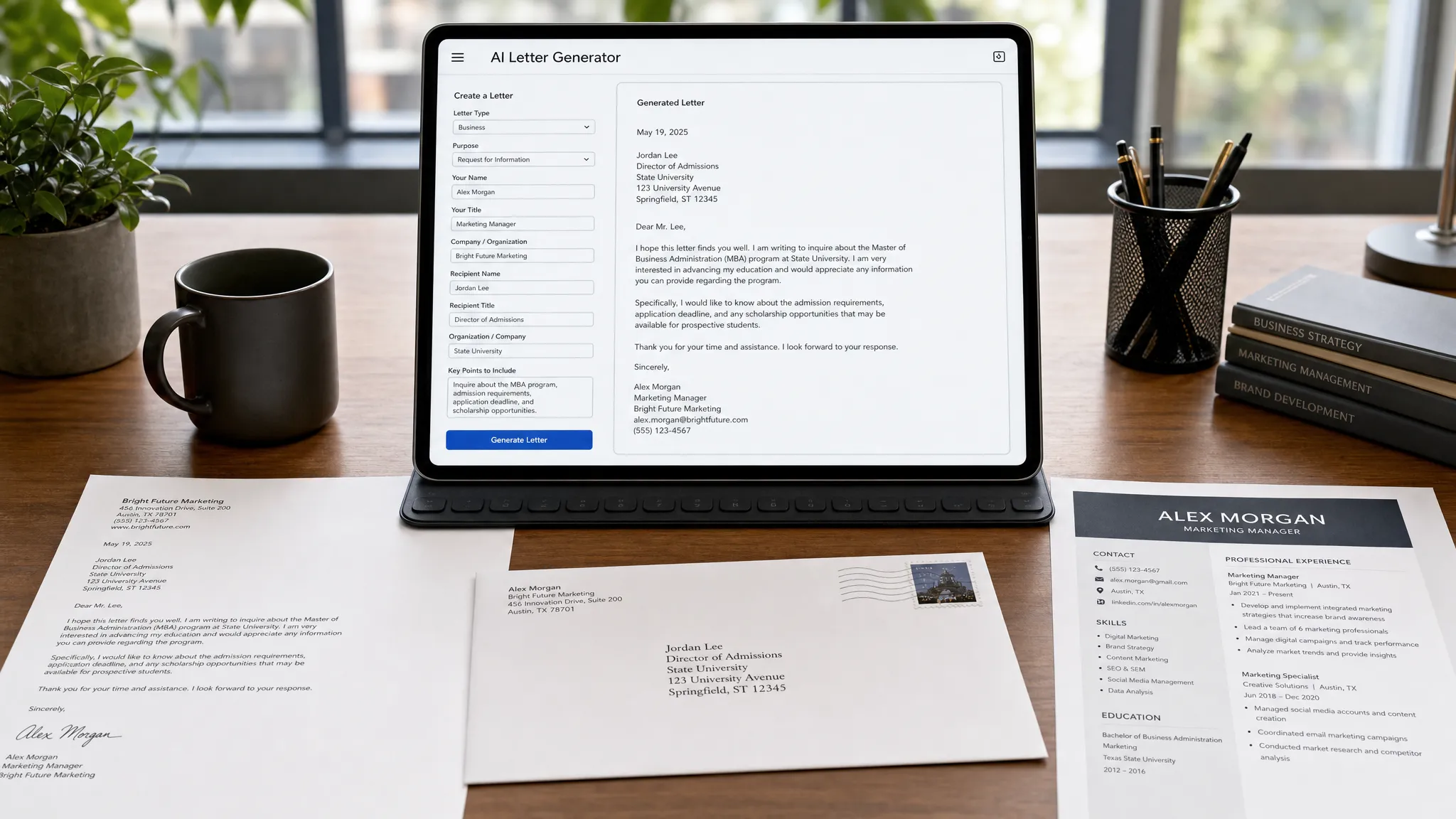
Business Letter vs Cover Letter: Key Differences
Business letter vs cover letter: learn the key differences, when to use each, and how to choose the right format for professional writing.
Write your cover letter — not a blank template
Generate a finished cover letter with your details, tone, and language in ~30 seconds. Free first letter, no credit card — beats copy-pasting and filling the blanks yourself.
At a glance, a business letter and a cover letter can look almost identical. Both may include the recipient's address, the date, a salutation, polished paragraphs, and a professional close. That shared format is why people often use the terms interchangeably.
But in practice, they solve different problems. A business letter is a broad category of formal communication used to make requests, document decisions, complain, propose, confirm, introduce, or follow up. A cover letter is a more specific document, most often used to introduce your resume and explain why you fit a role.
Understanding the difference helps you avoid the wrong tone. If you write a cover letter like a general business letter, it can feel flat. If you write a business letter like a job pitch, it can feel unfocused. The right document makes the desired next step obvious.
The short answer
A cover letter can follow business letter formatting, but not every business letter is a cover letter. Think of a business letter as the broader category of professional correspondence, and a cover letter as a specific application-focused use case inside that world.
For example, a letter requesting payment from a client is a business letter. A letter sent with your resume for a marketing manager role is a cover letter. Both are formal, but one is action-focused and transactional, while the other is persuasive and career-focused.
If you are comparing employment documents rather than broad business communication, LetterCraft AI also has a related guide on the difference between a job letter and a cover letter.
What is a business letter?
A business letter is any formal written message used in a professional context. It may be sent between companies, from a company to a customer, from an employee to an employer, or from an individual to an organization.
The main goal is usually to communicate clearly and create a record. A business letter may request action, confirm an agreement, explain a problem, respond to a complaint, introduce a service, or document a decision.
Common business letter examples include:
- Complaint letters to a company about a product or service
- Inquiry letters asking for information, pricing, or availability
- Recommendation letters supporting a person's qualifications
- Resignation letters formally ending employment
- Apology letters sent after a service issue or delay
- Proposal letters introducing a business opportunity
- Follow-up letters after a meeting, interview, or negotiation
A good business letter is concise, organized, and reader-focused. It should answer three questions quickly: why you are writing, what the recipient needs to know, and what you want to happen next.
What is a cover letter?
A cover letter is a professional introduction sent with another document, most commonly a resume. In hiring, its purpose is to connect your background to a specific role and persuade the reader to consider you for an interview.
A strong cover letter does not simply repeat your resume. Instead, it highlights the most relevant parts of your experience, explains your interest in the organization, and shows how you can solve the employer's problem.
Cover letters can also appear outside job applications, such as with proposals, manuscripts, grant applications, or business submissions. Still, when most people search for cover letter, they usually mean the job application document.
In a job search, the cover letter should be targeted. A generic letter that could go to any company rarely performs well. The better approach is to mention the role, reflect the employer's priorities, and give one or two specific reasons you are a strong match.
Business letter vs cover letter: key differences
| Difference | Business letter | Cover letter |
|---|---|---|
| Main purpose | Communicates a professional message, request, decision, or record | Introduces you and supports an application or submission |
| Typical audience | Client, vendor, employer, employee, agency, customer, or organization | Hiring manager, recruiter, admissions reviewer, editor, or selection committee |
| Content focus | Facts, context, issue, request, decision, or next step | Skills, experience, motivation, fit, and value |
| Tone | Formal, clear, direct, and often neutral | Professional, persuasive, confident, and personalized |
| Length | Varies by situation, often one page | Usually one page, often 3 to 5 paragraphs |
| Desired outcome | A response, approval, confirmation, correction, payment, meeting, or written record | An interview, review, shortlist decision, or deeper consideration |
Purpose: communication vs persuasion
The biggest difference is purpose. A business letter is usually designed to complete a communication task. It may ask for information, make a complaint, confirm a policy, or place a formal request on record. Success means the recipient understands the message and knows what to do next.
A cover letter is designed to persuade. It still needs to be clear, but clarity alone is not enough. The writer must make a case for why they are relevant, credible, and worth considering.
That distinction changes the writing. A business letter might begin with a direct statement such as:
I am writing to request confirmation of the revised delivery date for our June order.
A cover letter might begin with a targeted statement such as:
I am excited to apply for the account manager role because my client retention experience closely matches your team's growth priorities.
Both openings are professional. The first is about a transaction. The second is about fit.
Audience: organization contact vs decision maker
A business letter can be addressed to many types of recipients. You may write to a customer service department, a supplier, a landlord, a government office, a business partner, or an internal manager. The relationship may be ongoing, unfamiliar, or purely administrative.
A cover letter is usually addressed to someone evaluating you. That reader is comparing you with other candidates or applicants. They want to know whether you understand the opportunity, meet the requirements, and can communicate professionally.
Because the cover letter reader is making a selection decision, personalization matters more. Whenever possible, the letter should reflect the company, role, department, or project. A business letter can also be personalized, but it often prioritizes accuracy and completeness over personality.
Content: facts and action vs fit and value
A business letter should include the essential facts. Depending on the situation, that may mean dates, reference numbers, account details, meeting summaries, policy points, requested deadlines, or supporting evidence.
A cover letter should include proof of fit. That proof might be a relevant achievement, a specific skill, a career transition explanation, or a short story showing why your experience matters.
Here is a simple way to decide what belongs in each document:
- Use a business letter when the reader needs information, documentation, clarification, a request, or a decision.
- Use a cover letter when the reader needs to understand why you or your attached material deserves serious consideration.
- Use both formal formatting and focused content when a job application, proposal, or submission requires a polished introduction.
Structure: similar layout, different emphasis
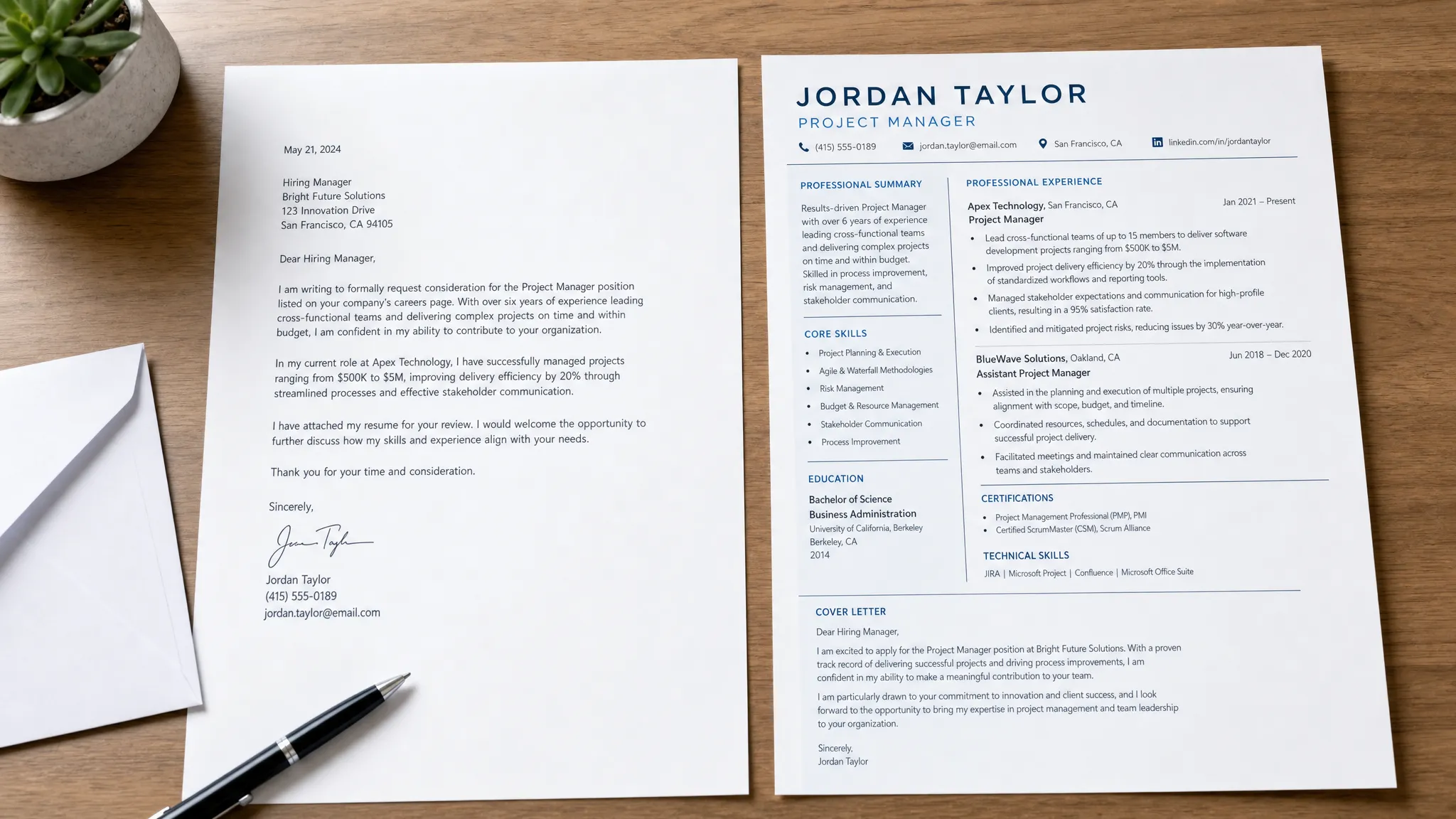
This is where the confusion usually starts. Many cover letters use standard business letter format, especially when submitted as a PDF or printed document. That means they may include the date, recipient information, salutation, body paragraphs, closing, and signature.
A business letter structure typically looks like this:
- Sender information and date
- Recipient information
- Salutation
- Clear opening explaining the reason for writing
- Body with relevant facts, context, or details
- Closing paragraph with the requested action or next step
- Professional sign-off and name
A cover letter structure usually puts more emphasis on the candidate's value:
- Contact information and date, if using formal letter format
- Hiring manager or organization details, if available
- Opening that names the role or opportunity
- Body paragraph connecting experience to the employer's needs
- Additional proof, motivation, or alignment with the organization
- Closing with interest in an interview or further discussion
- Professional sign-off and name
If you need a deeper walkthrough of layout, spacing, and section order, this guide on how to format a cover business letter correctly explains the mechanics in more detail.
Tone: neutral authority vs confident interest
Business letters are often most effective when they are calm and direct. Even complaint letters should avoid emotional language. The goal is to sound credible, reasonable, and specific.
Cover letters can be warmer and more energetic, but they should not become casual or exaggerated. A good cover letter balances confidence with evidence. Instead of saying you are perfect for the job, show how your experience lines up with the job's needs.
Compare these two tones:
| Situation | Less effective | More effective |
|---|---|---|
| Business letter | I am extremely upset and need this fixed now. | I am requesting a review of this issue and a written response by July 10. |
| Cover letter | I have always dreamed of working for your company and would be amazing in this role. | My experience improving renewal rates by 18% aligns with your focus on customer retention. |
The stronger versions work because they give the reader something concrete to respond to.
When should you use a business letter?
Use a business letter when the purpose is professional communication rather than self-promotion. It is the right choice when you need to create a clear, formal message that can be filed, forwarded, approved, or answered.
Typical situations include requesting a refund, confirming a meeting outcome, sending a formal notice, asking for information, responding to a complaint, making a recommendation, or documenting a workplace matter.
A business letter is also appropriate when the relationship itself requires formality. For example, a short email may be enough for a casual check-in, but a formal letter is better for legal, financial, HR, customer service, or executive communication.
If the letter is connected to a business opportunity or formal application, you may also find these business application letter tips for clear writing useful.
When should you use a cover letter?
Use a cover letter when you are introducing yourself, your resume, or a submission for evaluation. In hiring, it is most useful when the employer asks for one, when you need to explain why you are a strong match, or when your resume alone does not tell the full story.
A cover letter can help when you are changing careers, returning to work, applying for a role with specific requirements, or trying to show enthusiasm for a company. It gives you space to connect the dots.
If an application system marks the cover letter as optional, it may still be worth including when you can make it specific and useful. But a vague, copy-paste cover letter is rarely better than no cover letter. The deciding factor is whether it adds meaningful context.
Common mistakes to avoid
One common mistake is treating every formal letter as the same document. A payment request, customer complaint, job application, and proposal introduction should not all sound alike. They may share a format, but their goals are different.
Another mistake is overloading a business letter with personal background. Unless your personal context affects the request, keep the focus on the issue, facts, and desired action.
For cover letters, the biggest mistake is summarizing the resume line by line. The reader already has your resume. Use the letter to explain relevance, motivation, and fit.
Also avoid making the letter too long. A business letter can be longer when the situation requires documentation, but most professional letters benefit from concision. A cover letter should almost always stay to one page.
Quick decision guide
If you are still unsure which document you need, start with the reader's question.
| Reader's question | Best document |
|---|---|
| What happened, what do you need, and what should I do next? | Business letter |
| Why are you a strong candidate for this role? | Cover letter |
| Can you formally confirm this request, issue, or agreement? | Business letter |
| Why should I read your resume or consider your application? | Cover letter |
| Are you submitting a proposal, manuscript, or formal application package? | Cover letter or cover-style business letter, depending on instructions |
When instructions are provided, follow them closely. If a company asks for a cover letter, send a cover letter. If an organization asks for a formal request letter, do not send a career-focused introduction. The label matters less than the reader's expected use.
Frequently Asked Questions
Is a cover letter a type of business letter? Yes, it often follows business letter format, especially in formal job applications. However, a cover letter has a specific persuasive purpose: to introduce you and support an application or submission.
Can I use the same template for a business letter and a cover letter? You can use a similar layout, but not the same content strategy. A business letter should focus on facts and action. A cover letter should focus on fit, qualifications, and motivation.
Do business letters and cover letters both need addresses? Formal versions often include addresses, dates, salutations, and sign-offs. Email versions may be shorter, but they should still include a clear greeting, organized body, and professional close.
Which is more formal, a business letter or a cover letter? A business letter is often more neutral and formal, while a cover letter is still professional but more persuasive and personalized. The right tone depends on the audience and purpose.
Should a cover letter be attached as a PDF or written in an email? Follow the application instructions. If no instructions are provided, a PDF attachment is often appropriate for formal applications, while a concise email cover note may work for direct outreach.
Create the right letter faster
Once you know whether you need a business letter or a cover letter, the next challenge is writing it clearly. LetterCraft AI helps you generate professional, personalized letters for 65+ scenarios in under 30 seconds.
You can choose from multiple tone options, copy your letter to the clipboard, export it as a PDF, and keep track of letter history. It is free to try and does not require a credit card, making it a practical way to create a polished draft without starting from a blank page.
Write your cover letter — not a blank template
Generate a finished cover letter with your details, tone, and language in ~30 seconds. Free first letter, no credit card — beats copy-pasting and filling the blanks yourself.