Application Letter: How to Write One Step by Step
Follow a 7-step writing process and a pre-send application letter checklist: structure, evidence, tone, common mistakes, and final checks before you submit.
Write your job application — not a blank template
Generate a finished job application with your details, tone, and language in ~30 seconds. Free first letter, no credit card — beats copy-pasting and filling the blanks yourself.
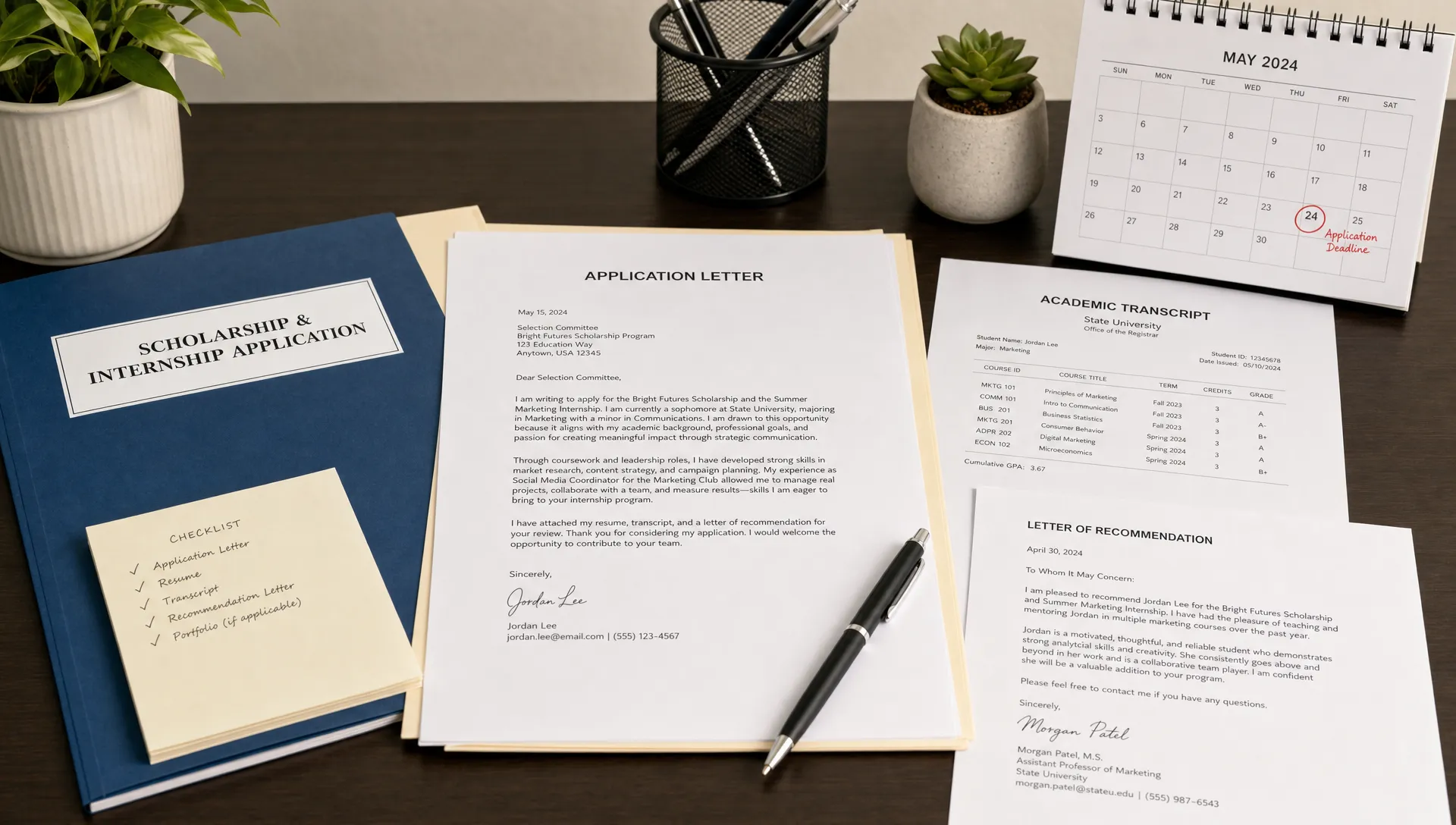
An application letter is often the first direct proof that you can communicate clearly, follow instructions, and connect your background to an opportunity. Whether you are applying for a job, internship, scholarship, training program, volunteer role, or formal request, the letter should make one thing easy for the reader: understanding why you are a strong, relevant candidate.
The challenge is that many application letters either sound too generic or repeat the resume line by line. A stronger letter is focused, specific, and written for one recipient. It explains what you are applying for, why you are qualified, why the opportunity matters to you, and what action you hope the reader will take next.
Below is a step-by-step process you can use to write an application letter that feels professional without sounding stiff.
For the full guide, see: the Application Letter Guide — meaning, format, and a complete example. This page goes deeper on the writing process itself, then hands you a pre-send checklist.
This page assumes you know the basics. If you need the fundamentals first — what an application letter is, how it differs from a cover letter, and the standard format — read the complete application letter guide and the application letter vs cover letter breakdown, then come back for the step-by-step process and checklist.
Before you write: collect the right information
A polished application letter starts before the first sentence. If you begin writing without understanding the opportunity, you are more likely to produce a generic letter that could be sent anywhere. Readers can spot that quickly.
Start by reviewing the posting, instructions, website, or program description. Look for the skills, values, requirements, deadlines, and materials requested. If the organization gives specific instructions for the letter, follow them exactly. According to Purdue OWL guidance on business letters, professional letters should be clear, courteous, and formatted for the reader, which is exactly the mindset an application letter needs.
Here is what to gather before drafting:
| Detail to collect | Why it matters |
|---|---|
| Exact opportunity name | Shows you are applying for a specific position or program |
| Recipient name and title | Makes the greeting more personal and professional |
| Top requirements | Helps you choose the most relevant evidence |
| Your strongest matching examples | Prevents vague claims and resume repetition |
| Organization details | Helps you explain genuine interest |
| Submission instructions | Reduces the risk of avoidable mistakes |
If you cannot find a recipient name, use a professional greeting such as Dear Hiring Manager, Dear Admissions Committee, or Dear Selection Committee. Avoid casual greetings unless the organization clearly uses an informal tone.
Step 1: Understand the reader’s decision
Before deciding what to write, ask what the reader is trying to decide. A hiring manager wants to know whether you can do the work, communicate well, and fit the team. A scholarship committee wants to know whether your goals and achievements match the award. A program reviewer wants evidence that you are prepared, motivated, and likely to benefit from the opportunity.
This is the foundation of a strong application letter. Do not simply ask, What do I want to say? Ask, What does this reader need to know to say yes?
A helpful way to focus your letter is to choose one central message. For example, your message might be that you are a reliable customer service professional with strong conflict-resolution experience, or a motivated student with research interests that match the program. Once you know that message, every paragraph should support it.
Step 2: Use a professional structure
A standard application letter is usually one page and follows a simple business-letter format. If you are submitting the letter by email, you can shorten the address block, but the body structure remains the same.
Use this order:
-
Sender information, if submitting as a formal document
-
Date
-
Recipient name, title, organization, and address, if available
-
Professional greeting
-
Opening paragraph with the opportunity and purpose
-
One or two body paragraphs proving fit
-
Closing paragraph with appreciation and next step
-
Formal sign-off and your name
Keep the formatting clean. Use a readable font, consistent spacing, and normal margins. If the letter is attached as a document, export it as a PDF unless the instructions ask for another format. If it is pasted into an online form, remove extra formatting so it does not display incorrectly.
Step 3: Write a clear opening paragraph
The opening paragraph should quickly answer three questions: who you are, what you are applying for, and why you are a relevant applicant. Avoid opening with a long personal story unless the application specifically asks for one.
A strong opening might follow this pattern:
I am writing to apply for the [opportunity name] at [organization]. With experience in [relevant area] and a strong background in [key skill or achievement], I am excited about the opportunity to contribute to [specific goal, team, program, or mission].
This opening works because it is direct. It does not waste space with filler such as I hope this letter finds you well, and it immediately connects your background to the opportunity.
If you are applying for an academic program or scholarship, adjust the same idea:
I am writing to apply for the [program or scholarship name]. My academic background in [field], combined with my interest in [specific focus], has prepared me to contribute meaningfully to and benefit from this opportunity.
The key is specificity. A reader should know within the first few lines that this letter was written for them.
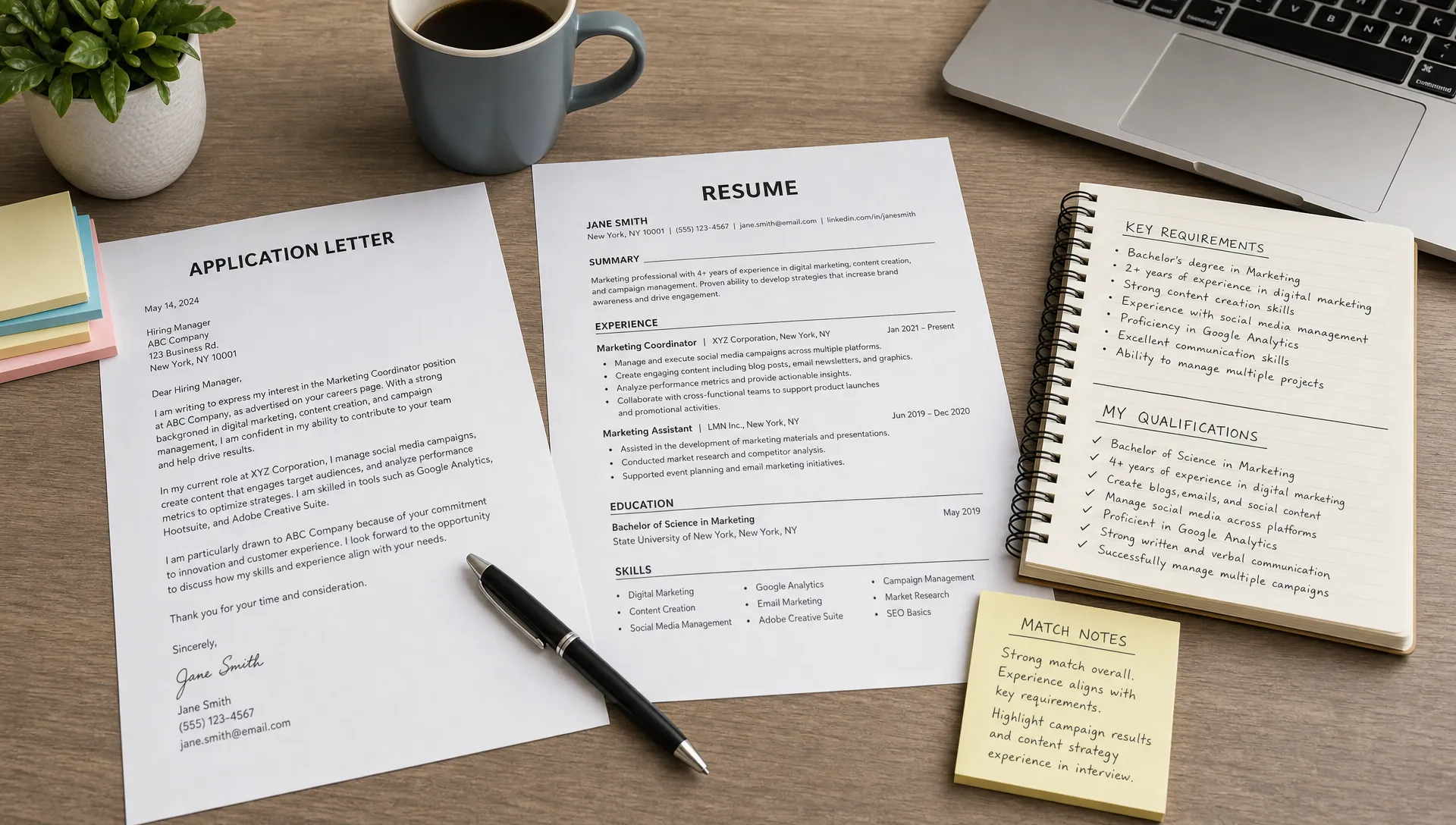
Step 4: Prove your fit with evidence
The body of the letter should not repeat everything from your resume or application form. Instead, choose the strongest evidence and explain why it matters.
For most application letters, one or two body paragraphs are enough. Each paragraph should make a point, support it with evidence, and connect it to the opportunity. You can use achievements, projects, coursework, volunteer experience, leadership examples, customer results, technical skills, or personal qualities, but the evidence should match the reader’s needs.
Weak evidence sounds like this: I am hardworking, organized, and passionate.
Stronger evidence sounds like this: In my previous administrative role, I coordinated schedules for a team of 12, prepared weekly reports, and improved document turnaround time by creating a shared tracking system.
The second version is more convincing because it shows behavior and results. Even if you do not have formal work experience, you can still use evidence from school, community work, family responsibilities, freelance projects, certifications, or personal initiatives.
Step 5: Explain why you want this opportunity
A strong application letter needs more than qualifications. It should also show motivation. This does not mean using exaggerated praise. It means explaining why this opportunity makes sense for your goals, values, or experience.
Generic motivation sounds like this: I have always wanted to work for your respected company.
Specific motivation sounds like this: I am particularly interested in this role because it combines client communication with process improvement, two areas where I have built experience and want to continue growing.
For a program or scholarship, you might connect your goals to the organization’s focus:
This program appeals to me because of its emphasis on practical research and community impact. My goal is to develop skills that allow me to apply data analysis to public health challenges, and the program’s project-based approach closely matches that direction.
The motivation paragraph should answer the reader’s quiet question: Why this opportunity, not just any opportunity?
Step 6: Close with confidence and courtesy
The closing paragraph should be short, positive, and action-oriented. Thank the reader, restate your interest, and mention your availability for the next step. Do not sound desperate, and do not apologize for gaps or weaknesses unless they truly require explanation.
A reliable closing formula is:
Thank you for considering my application. I would welcome the opportunity to discuss how my background in [relevant area] can support [organization, role, program, or goal]. I look forward to hearing from you.
Then use a professional sign-off such as Sincerely, Best regards, or Respectfully, followed by your name.
If you are submitting by email, include your contact details under your name if they are not already included elsewhere. If you are attaching files, briefly mention them in the email body, but do not over-explain.
Step 7: Edit for clarity, tone, and length
Editing is where a decent application letter becomes a strong one. Read the letter from the recipient’s point of view. Does every paragraph help them evaluate you? Is the letter specific to the opportunity? Are the examples clear? Is the tone professional but natural?
A good application letter is usually one page. If it is much longer, you may be trying to cover too much. If it is only a few sentences, it may not provide enough evidence.
As you revise, remove filler phrases such as I believe I would be a great fit without proof. Replace broad claims with concrete examples. Check names, dates, titles, and organization spelling carefully. A small typo in the recipient’s name can weaken an otherwise strong letter.
The U.S. Department of Labor’s CareerOneStop cover letter guidance also emphasizes tailoring your message to each employer. The same principle applies to any application letter: the more specific your letter is, the more useful it becomes to the reader.
A simple application letter structure you can adapt
Use this structure as a guide, not as a rigid script. The final letter should still sound like you and match the opportunity.
| Section | What to include | Writing tip |
|---|---|---|
| Greeting | Recipient name or appropriate committee | Use a real name when available |
| Opening | Opportunity name and your main reason for applying | Be direct in the first sentence |
| Body paragraph 1 | Most relevant qualifications | Match the top requirements |
| Body paragraph 2 | Evidence, motivation, or additional fit | Use specific examples |
| Closing | Thanks, interest, and next step | Keep it confident and courteous |
Here is a compact sample you can adapt:
Dear [Recipient Name],
I am writing to apply for the [opportunity name] with [organization name]. With experience in [relevant skill or field] and a strong interest in [specific area], I am excited about the opportunity to contribute to [team, program, goal, or mission].
In my previous experience as [role, student, volunteer, or relevant background], I developed [skill or strength] through [specific example]. This experience helped me [result or lesson], which closely aligns with your need for [requirement or priority]. I am also confident in my ability to [second relevant strength], as shown by [brief evidence].
I am especially interested in [organization or program name] because [specific reason]. The opportunity to [contribute, learn, serve, grow, or solve a problem] matches my background and my goals.
Thank you for considering my application. I would welcome the opportunity to discuss my qualifications further and provide any additional information you may need.
Sincerely,
[Your Name]
Common mistakes to avoid
Many application letters fail because they are unclear, not because the applicant lacks qualifications. The most common mistake is sending the same letter to every organization. A generic letter may be fast, but it rarely feels persuasive.
Another mistake is focusing too much on what the applicant wants and not enough on what the reader needs. It is fine to discuss your goals, but the letter should also show how your background benefits the employer, committee, program, or organization.
Avoid these issues before submitting:
-
Repeating your resume without adding context
-
Using a vague greeting when a recipient name is easy to find
-
Making claims without evidence
-
Writing more than one page unless instructions allow it
-
Forgetting to mention the exact opportunity name
-
Using an overly casual tone
-
Submitting without proofreading names and contact details
One useful final test is to remove the organization name from your letter. If the same letter could be sent anywhere, it needs more tailoring.
Application letter checklist
Before you send your application letter, confirm that it passes this quick review:
-
The first paragraph clearly names the opportunity
-
The letter explains why you are qualified
-
At least one example proves your skills or experience
-
The motivation feels specific, not generic
-
The tone is professional and natural
-
The letter is one page or follows the stated instructions
-
Names, titles, dates, and attachments are correct
-
The closing includes appreciation and a next step
If all of these are true, your letter is ready to submit.
Frequently Asked Questions
How long should an application letter be? Most application letters should be one page. For job applications, 250 to 400 words is often enough. Academic or scholarship applications may be longer if the instructions ask for more detail.
Is an application letter the same as a cover letter? In many job searches, yes, the terms are used similarly. However, an application letter can also apply to scholarships, internships, programs, and other formal opportunities, while a cover letter usually supports a job resume.
What should the first paragraph include? The first paragraph should state what you are applying for, introduce your most relevant qualification, and show a clear connection to the opportunity.
Should I mention weaknesses or lack of experience? Usually, no. Focus on transferable skills, relevant examples, and motivation. If a gap or missing requirement must be addressed, do it briefly and redirect attention to your strengths.
Can I use the same application letter for multiple opportunities? You can reuse the structure, but you should tailor the content every time. Change the opening, examples, motivation, and keywords to match the specific opportunity.
What is the best tone for an application letter? Aim for professional, confident, and respectful. Avoid sounding too casual, overly formal, or exaggerated. The best tone feels polished but still human.
Write your application letter faster with CraftMyLetter
If you do not want to start from a blank page, CraftMyLetter can help you generate a professional, personalized application letter in under 30 seconds. You enter a few details, choose the right tone, and receive a ready-to-send draft you can copy, export as a PDF, or save in your letter history.
CraftMyLetter supports 65+ letter types, multiple tone options, and 5 languages. It is free to try, requires no credit card, and uses simple pricing tiers with no subscriptions. Use it to create a strong first draft, then personalize the final details so your application feels specific, credible, and complete.
Write your job application — not a blank template
Generate a finished job application with your details, tone, and language in ~30 seconds. Free first letter, no credit card — beats copy-pasting and filling the blanks yourself.