Work Application Letter Example You Can Adapt Quickly
Use this work application letter example to customize a polished letter fast, with templates, wording tips, and quick edits for any job.
Write your job application — not a blank template
Generate a finished job application with your details, tone, and language in ~30 seconds. Free first letter, no credit card — beats copy-pasting and filling the blanks yourself.
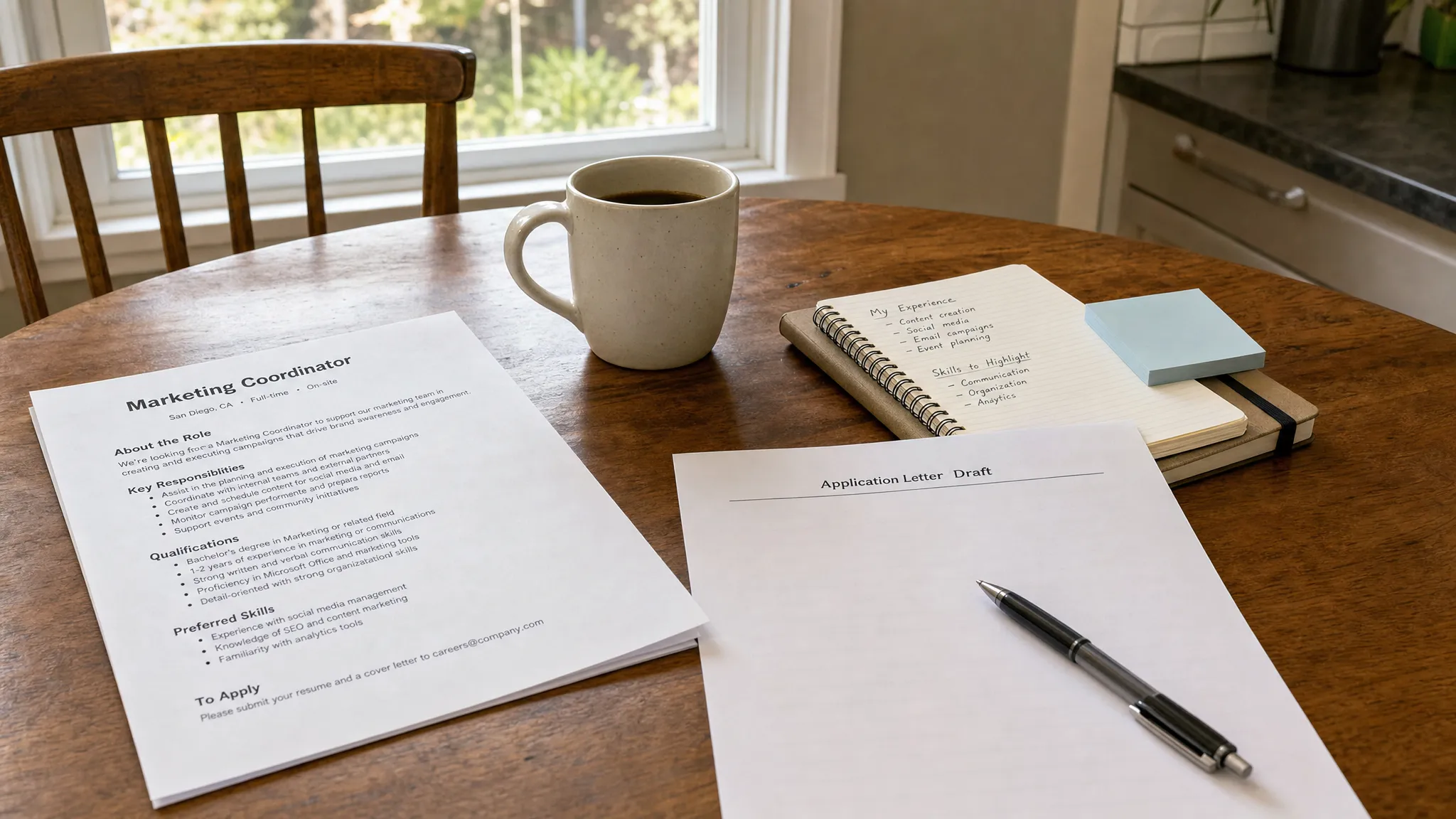
A strong application letter does one thing quickly: it shows why you are a credible fit for a specific role. If you are staring at a blank page, the easiest way forward is to start with a work application letter example, then adapt the details so it sounds like you and matches the job posting.
Below, you will find a complete example, a quick-edit template, and practical notes for changing the wording based on your experience level. Use it as a starting point, not a script. The best letter should feel personal, specific, and easy for a hiring manager to scan.
What a work application letter should include
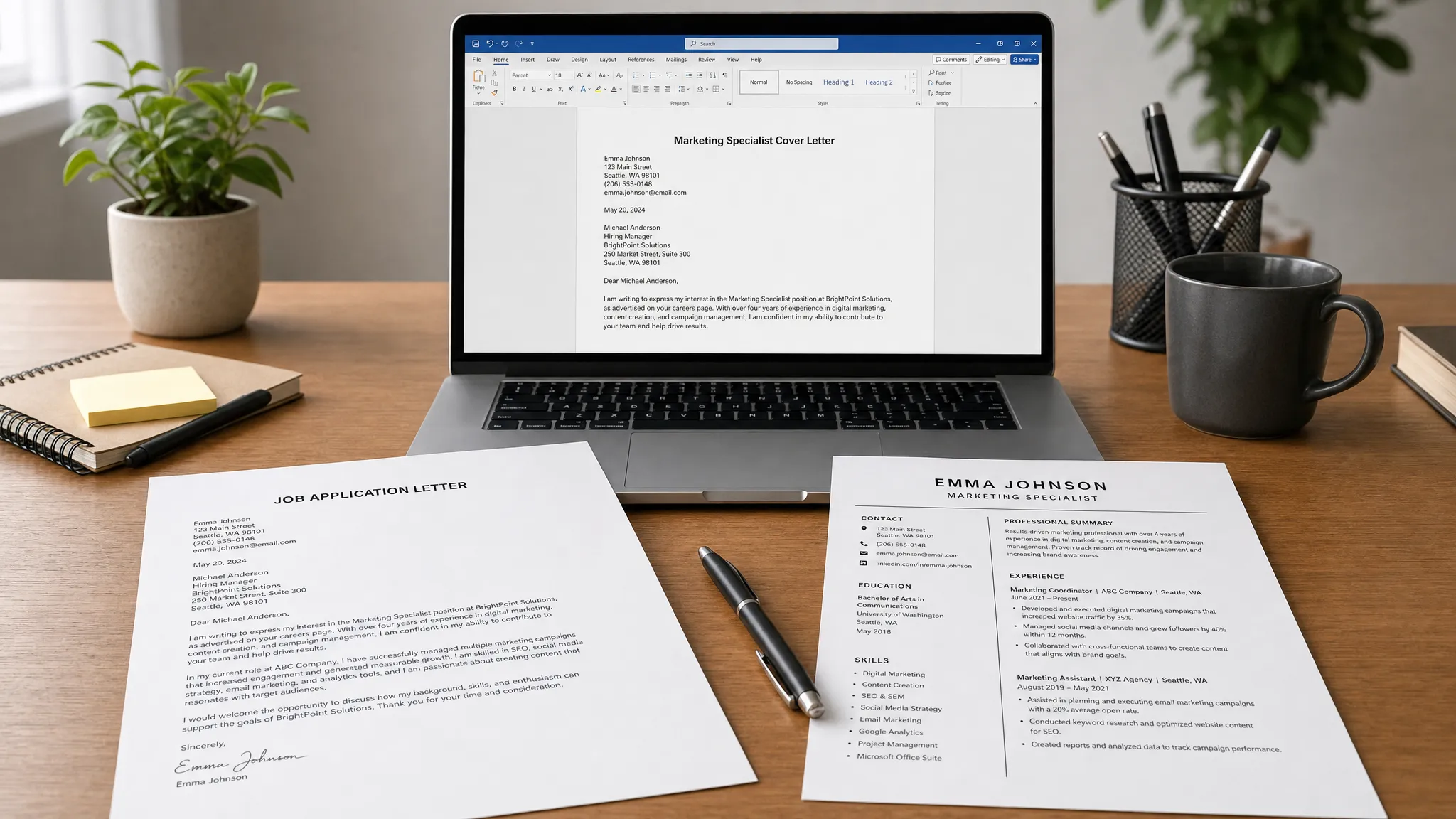
A work application letter is usually sent with your resume when applying for a job. In many cases, it works like a cover letter. It introduces you, explains your interest in the role, highlights your most relevant qualifications, and ends with a professional request for the next step.
The biggest mistake applicants make is repeating the resume line by line. Your resume lists facts. Your application letter connects those facts to the employer’s needs.
A practical structure is:
- A clear opening that names the role and shows interest
- One or two short body paragraphs that prove your fit
- A concise closing that thanks the reader and invites follow-up
If you want a broader step-by-step writing method, this guide to an application letter for employment explains how to build a fast three-part letter from scratch.
Work application letter example you can adapt
Here is a complete example for a customer service role. You can change the job title, company name, achievements, and tone to fit your own application.
[Your Name]
[Your Phone Number]
[Your Email Address]
[City, State]
[Date]

[Hiring Manager’s Name]
[Company Name]
[Company Address]

Dear [Hiring Manager’s Name],

I am writing to apply for the Customer Service Representative position at Brightline Home Services. With three years of experience supporting customers by phone, email, and live chat, I have developed strong communication skills, a calm approach to problem-solving, and a consistent focus on helping customers feel heard and supported.

In my current role at Westbrook Retail Group, I handle an average of 45 customer inquiries per day while maintaining a positive satisfaction rating. I regularly assist with order questions, billing concerns, returns, and product information. I have also helped train two new team members on our support process, which strengthened my ability to explain procedures clearly and work well with others.

I am especially interested in Brightline Home Services because of your reputation for reliable customer care and practical home solutions. I believe my experience, patience, and attention to detail would allow me to contribute quickly to your support team.

Thank you for considering my application. I would welcome the opportunity to discuss how my background and skills can support your team. I am available for an interview at your convenience and can be reached at [phone number] or [email address].

Sincerely,

[Your Name]
This example works because it is specific without being too long. It names the role, gives relevant experience, includes measurable proof, connects the applicant to the company, and ends politely.
Why this example works
The first paragraph immediately answers the hiring manager’s first question: “What role does this person want, and why might they be qualified?” There is no long personal backstory, no vague claim about being hardworking, and no unnecessary opening sentence.
The second paragraph gives evidence. The strongest detail is the average of 45 customer inquiries per day, because it helps the employer understand the applicant’s workload and experience level. If you do not have numbers, you can still use specific examples such as systems used, types of customers served, projects completed, or responsibilities handled.
The third paragraph creates a connection to the employer. This matters because hiring managers can spot a generic letter quickly. Even one sentence about the company’s work, values, products, or reputation can make the letter feel more intentional.
The closing is short and confident. It avoids sounding desperate, but it still clearly asks for an interview conversation.
Quick customization table
Use this table to adapt the example quickly without rewriting the full letter.
| Letter section | What to keep | What to customize |
|---|---|---|
| Opening | State the role and your main qualification | Job title, company name, years of experience, strongest skill |
| Body paragraph | Prove you can do the work | Metrics, responsibilities, tools, industries, achievements |
| Company connection | Show the letter is not generic | One reason you want this specific employer or role |
| Closing | Thank the reader and invite follow-up | Availability, contact details, preferred tone |
A useful rule is to customize at least five details before sending: the role, company name, one skill, one example, and one reason for applying. That is often enough to make a template feel personal while still saving time.
Fast template for any job application
If you want a more flexible version, use this template. Replace the bracketed sections with your own details.
Dear [Hiring Manager’s Name],

I am writing to apply for the [Job Title] position at [Company Name]. With [amount of experience or relevant background] in [field, task, or industry], I have developed strong skills in [skill 1], [skill 2], and [skill 3]. I am excited about the opportunity to bring these strengths to your team.

In my previous role as [Previous Role] at [Previous Company or Organization], I [describe one relevant responsibility or achievement]. I also [describe another responsibility, achievement, or strength that matches the job posting]. These experiences have prepared me to contribute to [specific need from the job description].

I am interested in [Company Name] because [specific reason related to the company, role, mission, product, service, or team]. I believe my background in [relevant area] and my ability to [important skill] would make me a strong fit for this position.

Thank you for considering my application. I would appreciate the opportunity to discuss how my experience and skills align with your needs. I can be reached at [phone number] or [email address].

Sincerely,

[Your Name]
Adapt the example for your experience level
A good application letter should reflect where you are in your career. An entry-level applicant should not pretend to have years of professional experience. A senior applicant should not waste space on basic responsibilities. The goal is to choose the strongest proof you genuinely have.
If you are applying for your first job
Focus on transferable skills, school projects, volunteer work, internships, part-time work, or personal qualities that match the job. Employers hiring for entry-level roles usually do not expect a long work history, but they do want reliability, communication, willingness to learn, and professionalism.
You might write:
Although I am at the beginning of my professional career, I have developed strong communication and organization skills through volunteer work, school projects, and part-time responsibilities. I am eager to learn, reliable with deadlines, and comfortable working with customers and team members.
If you are changing careers
Do not apologize for changing fields. Instead, connect your previous experience to the new role. Look for shared skills such as client communication, project coordination, leadership, sales, writing, technical troubleshooting, or operations.
You might write:
While my background is in hospitality, the skills I used every day, including customer communication, time management, conflict resolution, and attention to detail, align closely with the requirements of this administrative support role.
If you have several years of experience
Lead with measurable results or specialized knowledge. At this stage, your letter should show judgment, independence, and impact. Avoid listing routine duties unless they are directly tied to the role.
You might write:
Over the past six years, I have managed client accounts, improved response times, and supported cross-functional projects involving sales, operations, and customer success teams. This experience has prepared me to contribute quickly in a fast-paced account management environment.
How to make your letter sound less generic
Generic letters often fail because they could be sent to any company. To make yours stronger, borrow language from the job posting without copying full sentences. If the employer asks for “strong attention to detail,” show a situation where your attention to detail mattered. If they need someone who can “manage competing priorities,” mention a role where you handled deadlines, customers, and internal requests at the same time.
You can also improve your letter by adding context. Instead of writing “I have good communication skills,” write “I explain billing questions clearly to customers by phone and email.” Instead of “I am a team player,” write “I worked with sales and warehouse staff to resolve delayed orders before customers escalated their concerns.”
Small details create credibility. The goal is not to sound impressive in a general way. The goal is to sound relevant.
For another ready-to-use format, you can compare this example with an application letter sample for 2026 and choose the version that best fits your situation.
Common mistakes to fix before sending
Even a strong example can become weak if you send it too quickly. Before submitting your application, review the letter for simple but important issues.
Check that the company name and job title are correct. This sounds obvious, but it is one of the most common template mistakes. Also confirm that your contact information matches your resume and email signature.
Keep the letter to one page. Most application letters should be around three to five short paragraphs. If the letter feels crowded, remove repeated claims and focus on your strongest proof.
Use a professional tone. Friendly is fine, but avoid slang, jokes, exaggerated praise, or overly emotional wording. A phrase like “I would be grateful for the opportunity to discuss my application” is stronger than “This job would mean everything to me.”
Finally, proofread the letter aloud. Reading aloud helps you catch awkward sentences, missing words, and repeated phrases. If a sentence feels too long when spoken, shorten it.
A quick 10-minute adaptation process
If you need to send the letter soon, use this simple process.
First, highlight three requirements in the job posting. Choose the ones that appear most important, such as customer support, scheduling, data entry, sales calls, inventory control, or team leadership.
Second, choose one example from your experience for each requirement. The example can come from a job, internship, volunteer role, school project, or personal responsibility.
Third, edit the opening and body paragraph so those examples appear naturally. You do not need to mention everything. One strong paragraph with relevant proof is better than a long paragraph full of unrelated information.
Fourth, add one company-specific sentence. Visit the employer’s website, review the job description, or look at the company’s services. Then explain, briefly, why the role interests you.
Fifth, proofread and send the letter in the requested format. If the employer asks for a PDF, use a PDF. If the application form has a text box, paste a clean plain-text version.
Frequently Asked Questions
Is a work application letter the same as a cover letter? In many hiring situations, yes. A work application letter and a cover letter both introduce you, explain your interest in a role, and highlight relevant qualifications. Some employers use the terms differently, so always follow the wording in the job posting.
How long should a work application letter be? Aim for one page, usually three to five short paragraphs. The letter should be long enough to show fit, but short enough for a hiring manager to scan quickly.
Can I use the same application letter for every job? You can reuse the same structure, but you should customize the details for each role. At minimum, update the job title, company name, key skills, proof examples, and reason for applying.
What if I do not know the hiring manager’s name? Use a professional greeting such as “Dear Hiring Manager” or “Dear Hiring Team.” Avoid outdated greetings like “To Whom It May Concern” unless the application specifically requires a formal general salutation.
Should I mention salary in my application letter? Usually, no. Only mention salary if the employer asks you to include salary expectations. Otherwise, keep the letter focused on your fit for the role.
Create a polished letter faster
A good example can save time, but the final letter still needs to match your background and the job you want. If you want to create a tailored letter without fighting with formatting or wording, LetterCraft AI can help you generate a professional, personalized letter in under 30 seconds.
You provide the key details, choose the type of letter and tone, then copy, export, or refine the result. It is especially useful when you need a polished application letter quickly and do not want to start from a blank page.
Write your job application — not a blank template
Generate a finished job application with your details, tone, and language in ~30 seconds. Free first letter, no credit card — beats copy-pasting and filling the blanks yourself.