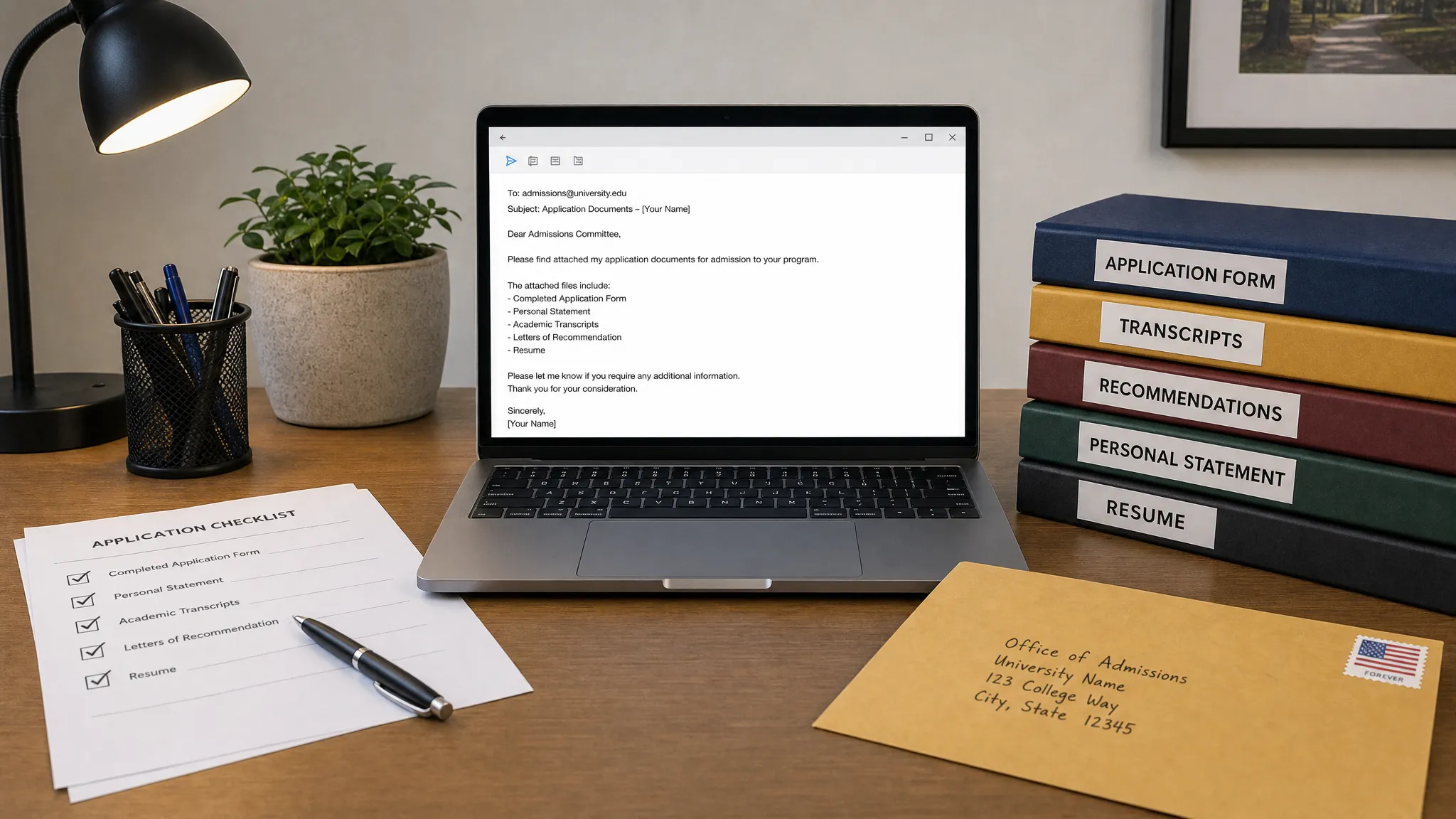
What to Put in a Covering Note for Any Application
Learn what to put in a covering note, with a simple structure, examples, and mistakes to avoid for jobs, forms, grants, and applications.
A covering note is a small piece of writing with a big job: it tells the reader what you are sending, why you are sending it, and what you want them to do next. Whether you are applying for a job, submitting scholarship documents, sending a proposal, or attaching evidence to a formal request, the right note can make your application easier to understand and harder to ignore.
The key is not to write a second full application. A good covering note is short, specific, and useful. It gives context without repeating every detail in your resume, form, statement, or supporting documents.
What is a covering note?
A covering note is a brief message that accompanies an application or set of documents. It may appear as:
- The body of an email when you attach documents
- A short message in an online application portal
- A first page before a printed application packet
- A note sent with supporting evidence, forms, or requested documents
Think of it as a guide for the person receiving your application. It should answer three questions quickly: What is this about? What is included? What should happen next?
A covering note is especially helpful when your application has multiple parts, such as a resume, cover letter, transcript, portfolio, references, proposal, or evidence file. It reduces confusion and shows that you are organized.
Covering note vs cover letter vs application letter
These terms are sometimes used interchangeably, but they are not always the same. If an employer or institution specifically asks for a cover letter, application letter, or personal statement, do not replace it with a very short covering note.
| Document type | Main purpose | Typical length | Best used for |
|---|---|---|---|
| Covering note | Introduces what you are submitting and gives brief context | 50 to 200 words | Email attachments, online portals, document submissions, formal packets |
| Cover letter | Persuades an employer that you are a strong fit for a specific role | 250 to 400 words | Job applications, internships, career changes |
| Application letter | Makes a formal request or presents your full case for an opportunity | 300 to 600 words | Jobs, scholarships, admissions, programs, formal requests |
If you are unsure which one you need, ask yourself whether the reader needs persuasion or simple orientation. If they need to understand your qualifications, write a cover letter or application letter. If they mainly need to know what you are submitting, write a covering note.
For job-specific guidance, you can also read our guide to application letters vs cover letters.
What to put in a covering note
Every strong covering note includes seven core elements. You may not need all of them every time, but this checklist works for most applications.
1. A clear subject or opening line
Start by identifying the purpose of your message. If you are sending an email, the subject line should be specific enough to locate later.
Good subject lines include:
- Application for Marketing Assistant Role, Jordan Lee
- Scholarship Application Documents, Maya Patel
- Supporting Documents for Case No. 45821
- Proposal Submission for Community Garden Grant
In the first sentence, repeat the purpose in plain language. For example: I am submitting my application for the Project Coordinator position advertised on your website.
2. The exact application, role, program, or request
Do not make the reader guess what your note relates to. Include the job title, program name, reference number, application ID, case number, deadline, or department if you have one.
This is particularly important for organizations that receive hundreds of documents. A covering note that says, I am applying for the open position, is much weaker than one that says, I am applying for the Data Analyst position, reference DA-2046, in the Product Insights team.
3. A brief reason or fit statement
A covering note is not the place for a long pitch, but one sentence of context can help. This sentence should connect your submission to the opportunity or request.
For a job, mention your most relevant strength. For a scholarship, mention your field or goal. For a formal request, mention the reason for the documents.
Example: My background in customer operations and process improvement closely matches the role's focus on service quality and team coordination.
4. A list of what is attached or included
This is one of the most practical parts of a covering note. Clearly name the documents you are sending so the recipient can confirm the application is complete.
For example: Attached are my resume, cover letter, portfolio link, and two reference letters.
If there are many documents, use a short list. For high-stakes submissions, such as immigration, insurance, academic appeals, or legal-adjacent matters, label files clearly and consider including a separate index.
5. Any important context the reader needs
Include only context that helps the reader process the application. This might include a deadline, a missing document you will send later, a name change, a corrected file, or a previous conversation.
Keep this factual and concise. Avoid long explanations unless the note is part of a formal appeal or detailed request.
6. A clear next step or request
End the body of the note by saying what you would like the reader to do. This does not need to sound demanding.
Examples include:
- Please let me know if any additional information is required.
- I would be grateful if you could confirm receipt of these documents.
- I look forward to the opportunity to discuss my application.
- Please add these documents to my existing application file.
7. Your contact details and polite closing
Even if your email signature contains your contact information, make sure the note closes professionally. Use your full name, phone number if relevant, and email address if the note may be printed or forwarded.
A simple closing works best: Sincerely, Kind regards, or Best regards.
A universal covering note template
Use this structure when you need a clean, professional note for almost any application.
Subject: [Application or document submission for: name, role, program, or reference number]

Dear [Recipient Name or Team],

I am submitting my [application/documents/supporting materials] for [specific role, program, request, case, or opportunity].

Attached are [document 1], [document 2], and [document 3]. [Optional: These materials relate to my application submitted on [date] or reference number [number].]

Please let me know if any additional information is required. Thank you for your time and consideration.

Sincerely,
[Your Full Name]
[Phone Number]
[Email Address]
For an online portal with a small text box, shorten it to this:
I am submitting my application for [specific opportunity]. I have included [key documents]. Please let me know if any additional information is needed. Thank you for your consideration.
What to include by application type
A covering note should change slightly depending on what you are applying for. The structure stays the same, but the details should match the reader's expectations.
| Application type | What to mention | What to avoid |
|---|---|---|
| Job or internship | Job title, reference number, attached resume and cover letter, one relevant strength | Repeating your entire resume |
| Scholarship or college program | Program name, applicant ID, attached essays, transcript, recommendation letters | Overexplaining your life story in the note |
| Grant or proposal | Project title, funding opportunity, attached proposal and budget | Burying the amount or purpose of the request |
| Formal request | Account number, case number, requested action, supporting documents | Emotional language that distracts from the facts |
| Immigration or visa documents | Applicant name, date of birth if required, case number, document list | Making legal claims without professional guidance |
| Internal workplace request | Department, request type, relevant dates, approval documents | Being vague about what decision is needed |
For formal requests, our free letter format template can help you structure the full letter that your covering note introduces.
Covering note examples you can adapt
Job application covering note
Subject: Application for Customer Success Manager, Elena Rivera

Dear Hiring Team,

I am submitting my application for the Customer Success Manager position listed on your careers page. My experience managing enterprise accounts and improving renewal processes aligns closely with the responsibilities described in the role.

Attached are my resume and cover letter for your review. Please let me know if you need any additional information.

Best regards,
Elena Rivera
elena.rivera@email.com
(555) 014-9821
Scholarship application covering note
Subject: Scholarship Application Documents, Daniel Brooks

Dear Scholarship Committee,

I am submitting my application materials for the 2026 Community Leadership Scholarship. I have included my completed application form, personal statement, transcript, and two recommendation letters.

Thank you for reviewing my application. I would be grateful if you could confirm receipt of the attached documents.

Sincerely,
Daniel Brooks
Formal document submission covering note
Subject: Supporting Documents for Billing Dispute, Account 78341

Dear Billing Support Team,

I am sending supporting documents for my billing dispute regarding account 78341. Attached are a copy of the disputed invoice, payment confirmation, and screenshots of the duplicate charge.

Please add these materials to my dispute file and let me know if anything else is needed to complete the review.

Kind regards,
Priya Shah
Proposal covering note
Subject: Proposal Submission, Green Streets Community Project

Dear Review Committee,

I am pleased to submit the proposal for the Green Streets Community Project for your consideration. The attached materials include the project proposal, budget summary, implementation timeline, and letters of community support.

Thank you for your time and consideration. I look forward to the opportunity to provide any additional information if needed.

Sincerely,
Marcus Hill
How long should a covering note be?
For most applications, keep your covering note between 75 and 150 words. If the application is simple, 50 words may be enough. If you are submitting a complex packet with several documents, 200 words is usually the upper limit.
A covering note should be easy to scan. Use short paragraphs, clear file names, and direct language. If you need to make a detailed argument, write a separate application letter, appeal letter, statement, or cover letter, then use the covering note to introduce it.
Common covering note mistakes
Small mistakes can make an otherwise strong application look rushed. Review your note for these issues before sending.
| Mistake | Better approach |
|---|---|
| Writing a vague subject line | Include the role, program, case number, or document type |
| Making the note too long | Keep it focused on purpose, contents, and next step |
| Forgetting attachments | Attach files before writing the final sentence or use a checklist |
| Using generic greetings only | Use a name, department, or specific team when possible |
| Sounding too casual | Keep the tone polite, clear, and professional |
| Repeating the full application | Summarize only the most relevant context |
| Sending poorly named files | Use clear names such as Resume_Jordan_Lee.pdf |
Quick pre-send checklist
Before you submit your covering note, confirm that:
- The recipient's name, department, or organization is correct
- The application, role, program, or reference number is specific
- Every document mentioned is actually attached or uploaded
- File names are clear and professional
- The note includes your full name and contact information
- The tone is polite and concise
- The final version has been proofread for typos
If the application is legally, medically, academically, or financially important, consider asking a qualified professional to review the full submission before you send it.
Can AI help write a covering note?
Yes, especially when you know what you need to say but want the wording to sound polished. The best results come from giving the AI specific details: the application type, recipient, documents included, tone, deadline, and any reference number.
LetterCraft AI can generate professional, personalized letters for 65+ scenarios in under 30 seconds. You can choose tone options, copy the result, export to PDF, track letter history, and create letters in supported languages. It is useful when you need a covering note, cover letter, resignation letter, complaint letter, request letter, or another professional draft without starting from a blank page.
You can also read our guide to using an AI letter generator for professional letters if you want a faster drafting workflow.
Frequently Asked Questions
Is a covering note the same as a cover letter? No. A covering note is usually shorter and introduces attached documents. A cover letter is more persuasive and explains why you are a strong fit for a job or opportunity.
Should I attach a covering note or put it in the email body? If you are emailing documents, the covering note usually belongs in the email body. If you are mailing or uploading a formal packet, you can include it as the first page or in the portal message field.
How long should a covering note be? Most covering notes should be 75 to 150 words. The goal is to provide context, list what is included, and make the next step clear.
Do I need a covering note for every application? Not always. If an online form already captures all information and has no message field, you may not need one. If you are emailing, mailing, or uploading multiple documents, a covering note is helpful.
What if I do not know the recipient's name? Use a specific team or department, such as Dear Hiring Team, Dear Admissions Committee, or Dear Claims Review Team. Avoid overly casual greetings.
Can I reuse the same covering note? You can reuse the structure, but update the specific application name, document list, recipient, and next step every time.
Create a polished covering note faster
A covering note does not need to be complicated, but it does need to be clear. If you want a professional draft without worrying about wording, use LetterCraft AI to create a personalized covering note or application letter in seconds. Add your details, choose the tone, review the result, and send a cleaner application with less stress.