I Need a Letter Fast: What to Include Before You Draft
Need a letter fast? Use this pre-draft checklist to gather the right details, choose tone, and create a polished letter in minutes.
If you are thinking, “I need a letter fast,” the biggest mistake is opening a blank document and trying to sound professional from the first sentence. Speed comes from preparation. When you know exactly what the letter must accomplish, who will read it, and which facts matter, the writing becomes much easier.
A rushed letter does not have to look rushed. Whether you need a cover letter, resignation letter, complaint letter, request letter, appeal, recommendation, or support letter, most professional letters rely on the same ingredients: a clear purpose, relevant context, a specific request, and a polite close.
This guide gives you a fast pre-draft checklist so you can collect what matters before writing or using an AI letter generator.
First, identify the type of letter you actually need
Before you draft, name the letter type in plain language. “I need a letter” is a starting point, but it is too broad to produce a strong result. A letter asking for a refund needs a different tone from a letter applying for a job. A resignation letter should be brief and calm. A complaint letter needs facts, dates, and a clear resolution.
Start by finishing this sentence:
“I need a letter that helps me _____.”
For example:
- “I need a letter that helps me request a refund for a delayed service.”
- “I need a letter that helps me apply for a customer support job.”
- “I need a letter that helps me resign professionally with two weeks’ notice.”
- “I need a letter that helps me explain why I am appealing a decision.”
Once the outcome is clear, the structure becomes obvious. If your situation is a formal request, you may want to start from a standard layout like this formal request letter format template, then adapt the details to your case.
Decide what the reader should do after reading
Every effective letter is written for a decision. The person reading it should know what you want them to understand, approve, fix, confirm, or answer.
Ask yourself: what is the next action I want?
That action might be:
- Approve my application
- Schedule an interview
- Accept my resignation
- Refund a payment
- Repair or replace an item
- Confirm an appointment
- Review an appeal
- Provide a document
- Support my application or request
If you cannot name the action, your letter may sound polite but vague. A fast letter should be direct without being rude. Instead of writing, “I hope you can help me with this matter,” write, “I am requesting a refund of $85 for the service appointment that was cancelled on May 14.”
Specificity saves time for both you and the reader.
Gather the details before you draft
Most delays happen because the writer stops every few sentences to search for dates, names, account numbers, job titles, receipts, or old emails. Collect those details first.
Use this quick table before writing:
| Detail to collect | Why it matters | Example |
|---|---|---|
| Recipient name and role | Helps the letter feel targeted and professional | “Ms. Jordan Lee, Hiring Manager” |
| Your relationship to the recipient | Explains why you are writing to them | “Customer since March 2024” |
| Main purpose | Keeps the letter focused | “Requesting a refund” |
| Key dates | Creates a clear timeline | “Order placed June 2, delivered June 9” |
| Evidence or proof | Supports your request | “Invoice #44821, attached receipt” |
| Desired outcome | Tells the reader what to do next | “Please confirm cancellation in writing” |
| Deadline or urgency | Encourages a timely response | “By Friday, June 26” |
| Preferred contact method | Makes replying easier | “Email is best for written confirmation” |
You do not need every field for every letter. A simple thank-you letter may not need evidence or a deadline. A complaint, appeal, or service request almost always does.
Choose the right tone before you write
Tone is one of the fastest ways to make a letter feel appropriate or inappropriate. A letter can be professional, warm, firm, apologetic, grateful, persuasive, or neutral. The best tone depends on your goal.
For employment letters, you usually want confident and concise. For a complaint letter, firm and factual is better than emotional. For a resignation letter, respectful and brief works best. For a personal recommendation request, warm and appreciative may be appropriate.
A useful rule is this: match the seriousness of the situation, not your stress level. If you are upset about a service issue, the letter should still focus on facts and the remedy you want. If you are under pressure to apply for a job quickly, the letter should still sound intentional and tailored.
The Purdue Online Writing Lab’s business letter guidance emphasizes clarity, professionalism, and proper structure in formal correspondence. That advice is especially useful when you are writing quickly because a clear structure prevents overexplaining.
Know what to include in the opening paragraph
The opening paragraph should answer three questions quickly:
Who are you? Why are you writing? What is the main point?
For a job application, that might mean naming the role and why you are a strong fit. If your urgent letter is employment-related, this guide on writing a good cover letter when you have little time gives a focused process for that specific situation.
For a complaint, the opening should identify the product, service, account, or incident. For a resignation, it should state that you are resigning and include your final working date. For a request, it should clearly state what you are asking for.
Here are a few fast opening examples:
| Letter type | Strong opening |
|---|---|
| Complaint letter | “I am writing to request a refund for order #2187, which arrived damaged on June 10.” |
| Cover letter | “I am applying for the Administrative Assistant position at BrightPath Health and would like to highlight my scheduling and client service experience.” |
| Resignation letter | “Please accept this letter as formal notice of my resignation from my position as Sales Associate, effective July 5.” |
| Request letter | “I am writing to request written confirmation of my enrollment status for the Fall 2026 semester.” |
| Appeal letter | “I am writing to appeal the decision regarding my financial aid application and to provide additional documentation for review.” |
Notice that each opening avoids long background. The context can come after the purpose.
Add only the context the reader needs
When you are in a hurry, it is tempting to include everything. That usually makes the letter weaker. The reader does not need your entire history. They need the facts that support the request.
A good context paragraph usually includes:
- The relevant timeline
- The most important facts
- Any previous attempts to resolve the issue
- One or two proof points that support your request
- Any attached or available documentation
For example, a service issue letter might say:
“On May 30, I scheduled a repair appointment for June 4 and paid the $60 service fee in advance. The technician did not arrive during the confirmed appointment window, and I did not receive a cancellation notice. I contacted customer support on June 5 and was told I would receive a follow-up within 48 hours, but I have not received an update.”
That paragraph is specific, factual, and useful. It avoids emotional exaggeration while still making the problem clear. If your letter is about getting a company or provider to act, you can also use the structure in this guide to writing a service request letter that gets faster replies.
Make the request unmistakable
A fast letter should not make the reader guess what you want. Use one clear sentence that starts with an action word.
Good request phrases include:
- “I am requesting…”
- “Please confirm…”
- “I would appreciate your review of…”
- “I am asking that…”
- “Please provide…”
- “I would like to schedule…”
- “Please consider…”
The more specific the request, the easier it is to answer. Compare these two sentences:
“I hope this can be fixed soon.”
“Please refund the $60 service fee to my original payment method by June 28 or provide a written explanation of the next steps.”
The second version gives the reader a clear path to resolution.
Include a deadline only when it is reasonable
Deadlines can help, but they should be realistic and polite. A same-day deadline may be appropriate for a time-sensitive workplace document, but it may sound unreasonable for a formal complaint that requires investigation.
Use deadlines when:
- You have an application cutoff
- A meeting, appointment, or hearing is approaching
- A billing issue needs correction before the next charge
- You need written confirmation before making another decision
- A company policy or official timeline requires a response
Phrase the deadline professionally. Instead of “I need this immediately,” try “Because the application deadline is June 30, I would appreciate a response by June 27 if possible.”
Prepare attachments and proof before sending
Attachments often make a letter more credible. They also reduce back-and-forth because the recipient does not have to ask for basic documentation.
Common attachments include receipts, invoices, order confirmations, screenshots, photos, previous email exchanges, job descriptions, resumes, certificates, forms, IDs, or official notices.
Only attach what is relevant. If a document contains sensitive information, remove or redact anything unnecessary before sending. For consumer complaints in the United States, agencies such as the Consumer Financial Protection Bureau often encourage clear documentation when submitting a complaint or explaining an issue.
In the letter, mention attachments briefly:
“I have attached the receipt, order confirmation, and photos of the damaged item for your review.”
That sentence tells the reader what to look for without turning the letter into a document inventory.
Use a simple structure when you need the letter fast
If you have the details ready, use this universal structure:
- Opening: State who you are and why you are writing.
- Context: Give the key facts, dates, and background the reader needs.
- Request: Explain what you want the reader to do.
- Close: Thank them, give your contact information, and mention any deadline.
This structure works for most professional letters because it respects the reader’s time. It also keeps you from rambling when you are stressed.
Here is a simple draft starter you can adapt:
Dear [Recipient Name],

I am writing to [state the purpose of the letter]. My name is [your name], and [briefly explain your connection to the recipient or situation].

On [date or timeframe], [explain the key facts in chronological order]. I have [included, attached, or referenced] [evidence or documents], which provide additional context.

I am requesting [specific action or outcome]. If possible, please [respond, confirm, process, review, schedule, or provide] by [deadline].

Thank you for your time and attention. I can be reached at [email or phone number] if you need any additional information.

Sincerely,
[Your Name]
You can make it warmer, firmer, shorter, or more detailed depending on the situation.
What to leave out of a fast professional letter
Knowing what not to include is just as important as knowing what to include. A rushed letter often becomes too long because the writer includes emotion, repetition, or unrelated history.
Leave out:
- Insults, threats, or sarcasm
- Unverified claims
- Long personal background that does not affect the request
- Multiple unrelated requests in one letter
- Excessive apologies if you are not at fault
- Vague language such as “as soon as possible” when a date would be clearer
- Sensitive personal information unless it is required
Professional does not mean cold. It means the letter is easy to understand, appropriate for the situation, and focused on the outcome.
How AI can help when you already have the right inputs
AI is most useful when you give it strong details. If you only type “write me a complaint letter,” the result may sound generic. If you provide the recipient, issue, dates, desired outcome, tone, and attachments, the draft will be much closer to ready.
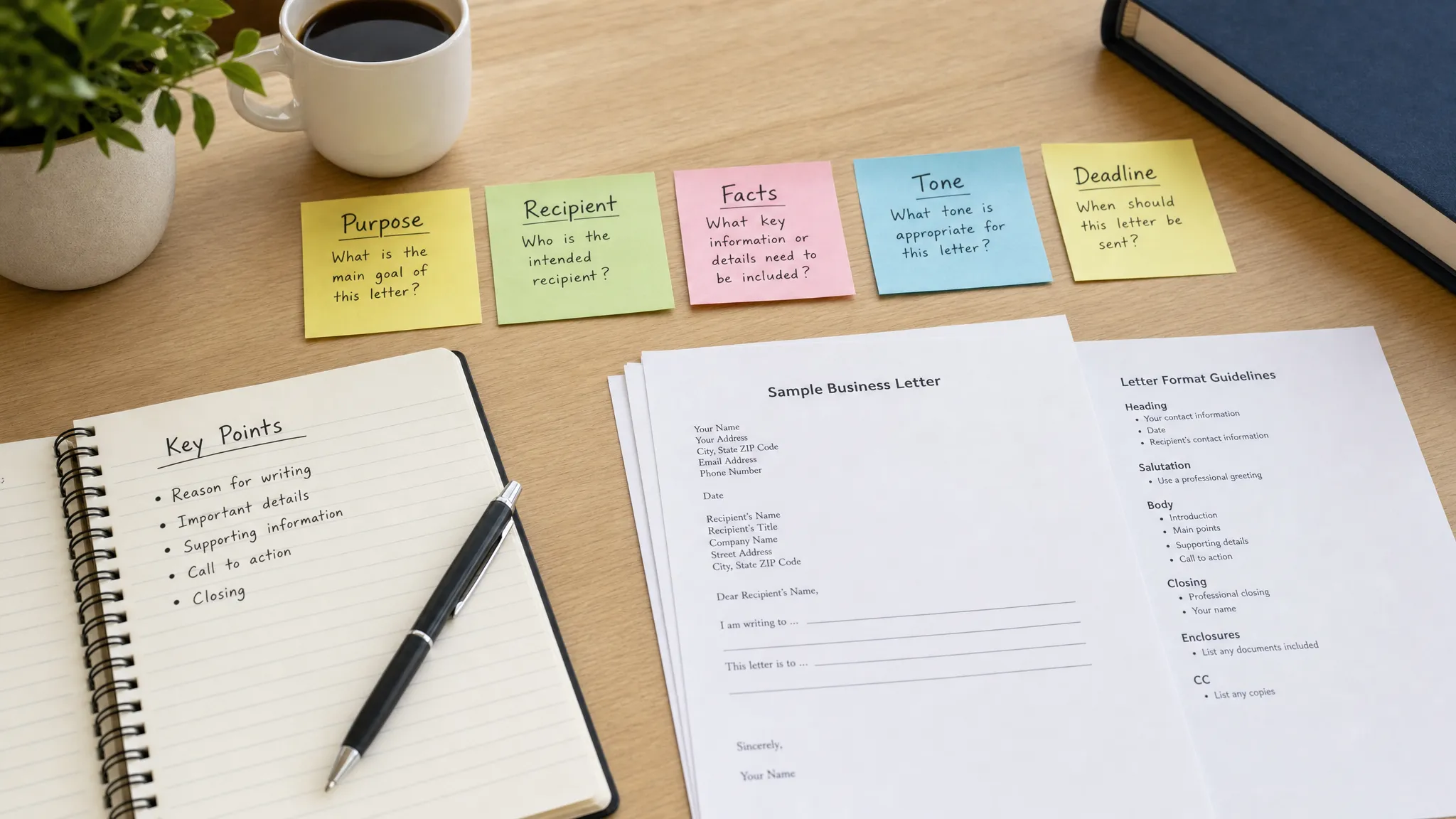
Before using an AI letter generator, prepare this short input:
Letter type: [complaint, request, resignation, cover letter, appeal, etc.]
Recipient: [name, company, department, or role]
Purpose: [what the letter should accomplish]
Key facts: [dates, events, amounts, names, reference numbers]
Tone: [professional, firm, warm, apologetic, persuasive, concise]
Desired outcome: [what you want the reader to do]
Deadline: [if any]
Attachments: [if any]
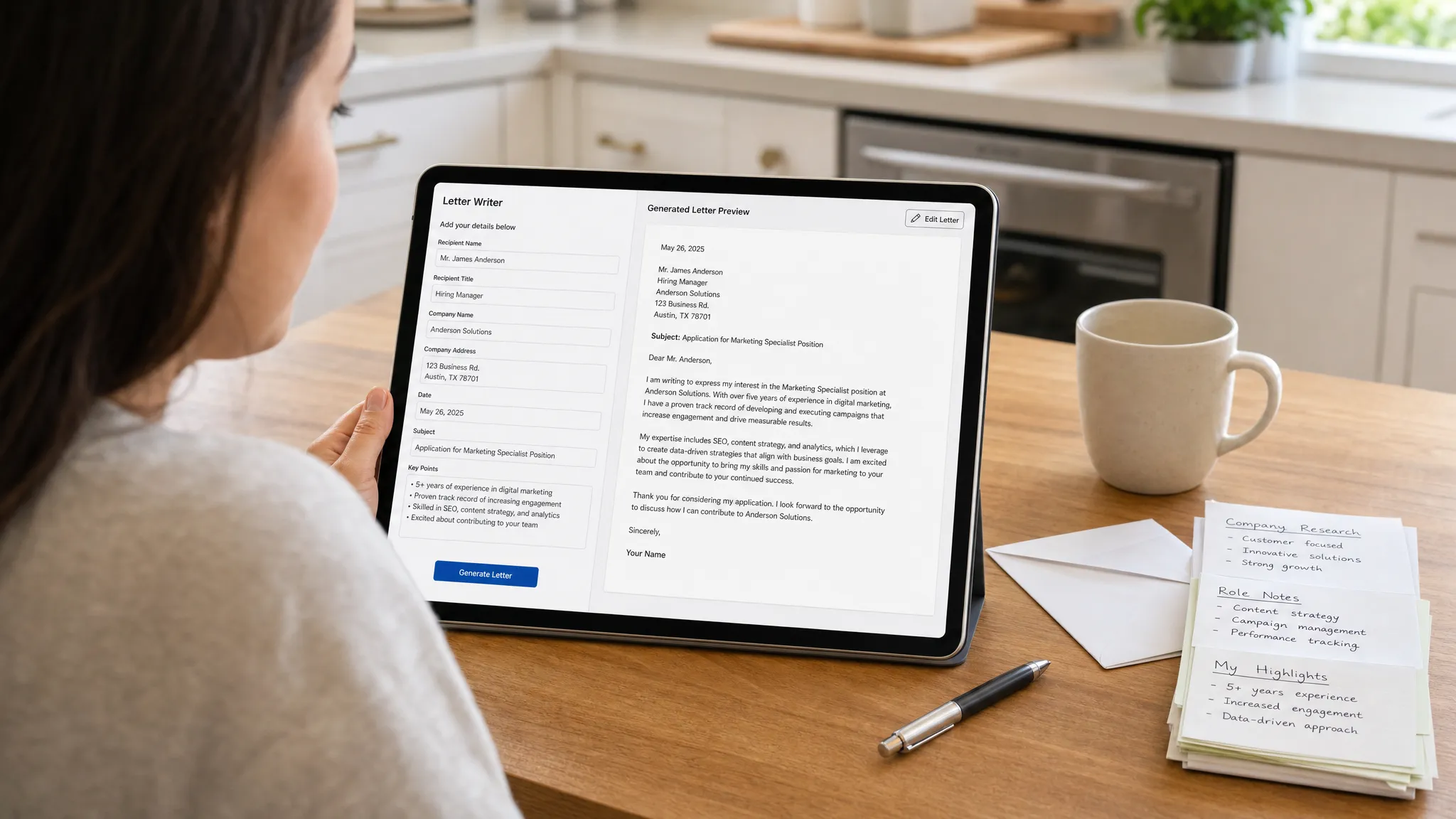
With LetterCraft AI, you can turn those details into a polished letter quickly across 65+ letter types, adjust the tone, copy the result, export it as a PDF, and keep track of letter history. The important part is still your input. The better your pre-draft notes, the stronger and more personalized the final letter will be.
Quick final review before you send
Before sending, take two minutes to check the essentials. Confirm the recipient’s name, your contact information, dates, amounts, and any attached files. Read the request sentence out loud. If it is not clear what you want, revise it.
Also check the tone. A letter written under pressure can accidentally sound harsher than intended. Replace emotional phrases with factual ones. Change “This is unacceptable and nobody has helped me” to “I have contacted support twice and have not yet received a resolution.”
Finally, make sure the closing gives the reader a clear next step. A strong final sentence might be, “Please confirm receipt of this request and let me know if you need any additional documentation.”
Frequently Asked Questions
What should I include if I need a letter fast? Include the letter type, recipient, purpose, key facts, dates, desired outcome, deadline, contact information, and any relevant attachments. These details help you create a clear draft quickly.
How long should a professional letter be? Most professional letters should be one page or less. A short letter with a clear purpose, necessary context, and a specific request is usually more effective than a long letter.
Can I use the same structure for different letter types? Yes. Most letters can follow a simple structure: opening, context, request, and close. You should adjust the tone and details based on whether the letter is for employment, resignation, complaint, request, appeal, or support.
What tone should I use for an urgent letter? Use a professional, direct tone. Urgency does not require pressure or emotion. Explain the deadline, state why timing matters, and make the requested next step clear.
Is it okay to use AI to draft a formal letter? Yes, as long as you review the draft carefully and provide accurate details. AI can save time, but you should verify names, dates, facts, tone, and attachments before sending.
Get your letter drafted in minutes
When you need a letter quickly, do not start with a blank page. Start with the facts: purpose, recipient, context, request, deadline, and tone. Once those are clear, drafting becomes much faster.
If you want help turning your notes into a polished letter, LetterCraft AI can generate professional, personalized letters in under 30 seconds. Choose the letter type, add your details, select the tone, and create a ready-to-edit draft without starting from scratch.