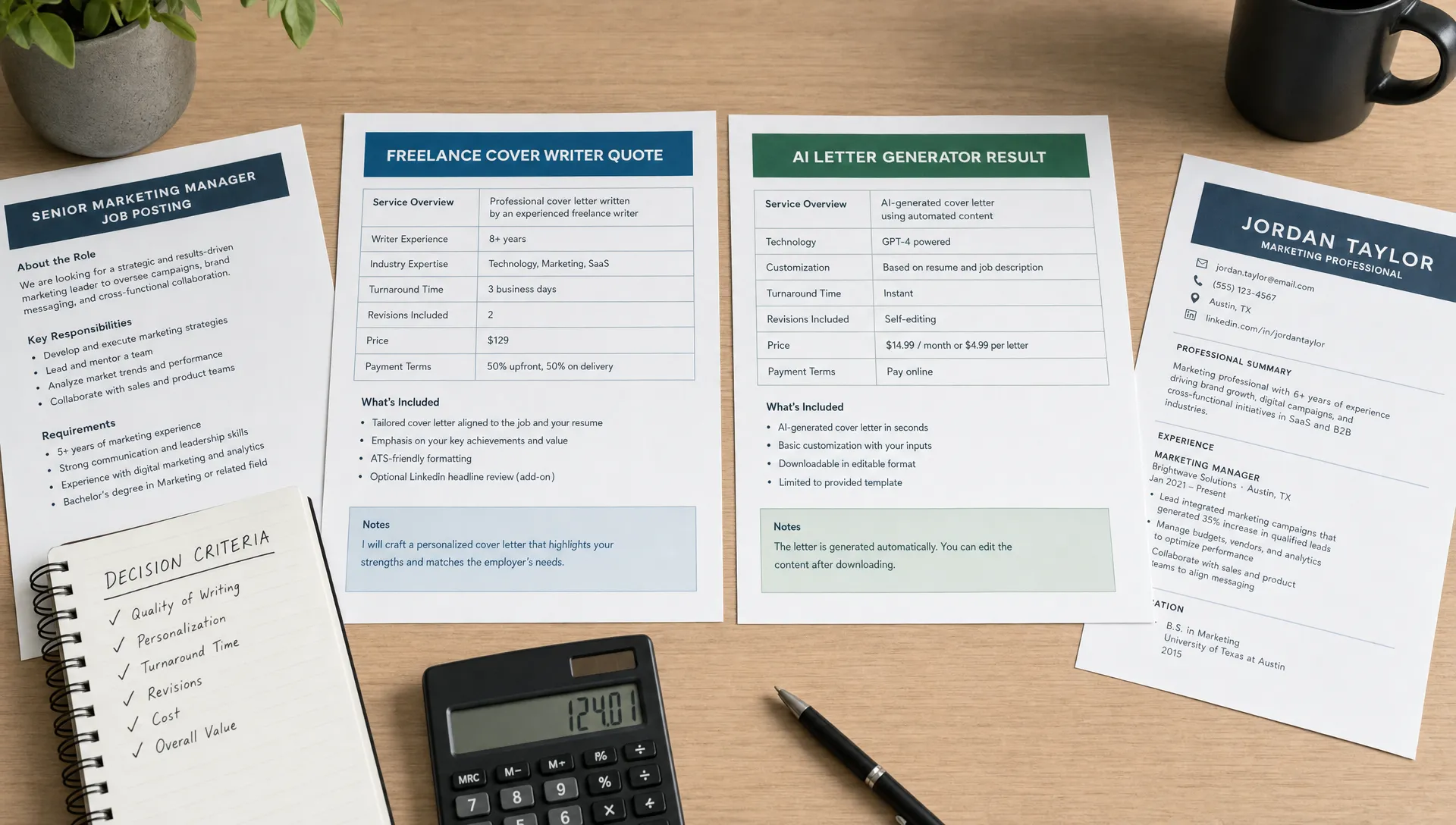
How to Choose a Cover Writer Without Overpaying
Learn how to choose a cover writer, compare options, spot overpricing, and get a polished cover letter without wasting money.
Write your cover letter — not a blank template
Generate a finished cover letter with your details, tone, and language in ~30 seconds. Free first letter, no credit card — beats copy-pasting and filling the blanks yourself.
Choosing a cover writer for a job application can feel riskier than it should. Prices vary widely, every service claims to be professional, and it is hard to know whether you are paying for real strategy or just a polished version of information you already had.
The smartest approach is not to look for the cheapest cover writer. It is to match the level of help to the problem you actually need solved. A recent graduate applying to similar entry-level roles does not need the same support as a senior manager making a career pivot. Someone who needs one urgent letter does not need the same workflow as someone applying to 30 roles this month.
This guide will help you compare human writers, AI tools, templates, and coaching-style services without overspending. By the end, you should know what is worth paying for, what is not, and how to get a strong cover letter at the lowest sensible cost.
Start by defining what you mean by cover writer
A cover writer can mean several different things. Some people use the term for a freelance writer who writes cover letters from scratch. Others mean a career coach, a resume-writing agency, a general AI chatbot, or a specialized AI cover letter generator.
That distinction matters because each option solves a different problem. If your issue is grammar, you may only need editing. If your issue is positioning, you may need someone who understands your target industry. If your issue is speed, an AI tool may give you a usable draft faster than a human writer can schedule an intake call.
According to CareerOneStop, a good cover letter should be tailored to the job and explain why you are a strong match. That means the value of a cover writer is not just writing nice sentences. The real value is helping you connect your experience to a specific role in a clear, credible way.
Before comparing prices, identify your main bottleneck:
| Your situation | Best-value type of help | Why this controls cost |
|---|---|---|
| You have a resume and a clear target role | Specialized AI cover letter generator or template-based draft | You mainly need structure, tone, and speed |
| You write well but sound too generic | Editor or AI-assisted rewrite | You need sharper wording, not full career strategy |
| You are changing careers | Human cover writer or career coach | You need help translating experience into a new context |
| You are applying to many similar roles | AI-first workflow with manual review | You need repeatable tailoring without paying per letter every time |
| You are applying for executive or highly specialized roles | Niche human writer with industry experience | The stakes and complexity may justify deeper support |
This first step prevents the most common mistake: buying a premium package when your actual problem is simple.
Compare cover writer options by total value, not just price
A low-cost option is not always cheap if it produces a letter you cannot send. A premium option is not always expensive if it helps you create a reusable positioning strategy for multiple high-value applications.
The fairest way to compare options is to ask what you receive, how much tailoring is included, and how many usable applications the work supports.
| Option | Best for | Main limitation | When it becomes overpriced |
|---|---|---|---|
| Free cover letter template | Simple applications where you know what to say | Often generic and easy to misuse | When you spend hours editing it and still sound vague |
| General AI chatbot | Fast brainstorming and first drafts | Requires careful prompting and fact-checking | When you rely on it without tailoring or editing |
| Specialized AI cover writer | Quick personalized drafts based on your details | Still needs your accurate input and review | When you expect it to replace complex career coaching |
| Freelance cover writer | One-off help with wording, structure, or storytelling | Quality varies by writer | When the writer uses the same style for everyone |
| Career coach or agency | Career pivots, senior roles, confidence issues, broader job-search strategy | More expensive and slower | When you only need a single straightforward letter |
If you are specifically comparing digital options, the LetterCraft AI guide to choosing the right cover letter writer tool in 2026 explains how templates, writing assistants, general AI, and specialized generators differ. That comparison can help you avoid paying human-writer rates for work that a tool can handle well.
Know what is actually worth paying for
A cover writer is worth paying for when they improve the substance of your application, not just the surface. Grammar, formatting, and polite wording are basic requirements. They matter, but they are not usually worth a premium on their own.
The higher-value work is strategic. A good writer should help you decide which achievements to emphasize, how to handle gaps or pivots, and how to make your experience relevant to the employer’s needs.
Pay more only when you are getting help with work like this:
- Clarifying your fit for a specific role or industry.
- Turning responsibilities into evidence-backed achievements.
- Explaining a career change without sounding defensive.
- Matching the tone of the company and role level.
- Creating a reusable framework you can adapt for future applications.
If a service only promises professional wording, be cautious. Professional wording is useful, but it is not the same as a persuasive application strategy.
Watch for red flags that inflate the price
Overpaying often starts with urgency. You need to apply quickly, you feel unsure about your writing, and a service promises to fix everything. That is exactly when you should slow down and check what is actually included.
Some cover letter providers use vague package names, interview guarantees, or fear-based messaging to make a basic service look more valuable than it is. The Federal Trade Commission warns job seekers to be careful with anyone who guarantees job outcomes or asks for money in suspicious employment-related situations. A cover writer cannot guarantee that an employer will interview you, no matter how strong the letter is.
Use this table to spot inflated pricing before you pay:
| Red flag | Why it can cost you more | Better alternative |
|---|---|---|
| Guarantees interviews or job offers | No writer controls employer decisions | Look for clear deliverables, not outcome promises |
| Uses one letter for every role | Generic letters weaken your application | Ask for job-specific tailoring |
| No intake questions | The writer cannot personalize without context | Expect questions about your resume, target role, and achievements |
| No revision policy | You may pay again to fix mismatches | Confirm whether at least one revision is included |
| Vague package description | You do not know what you are buying | Ask for exact deliverables and turnaround time |
| Heavy pressure to upgrade | Fear replaces value | Compare options calmly before paying |
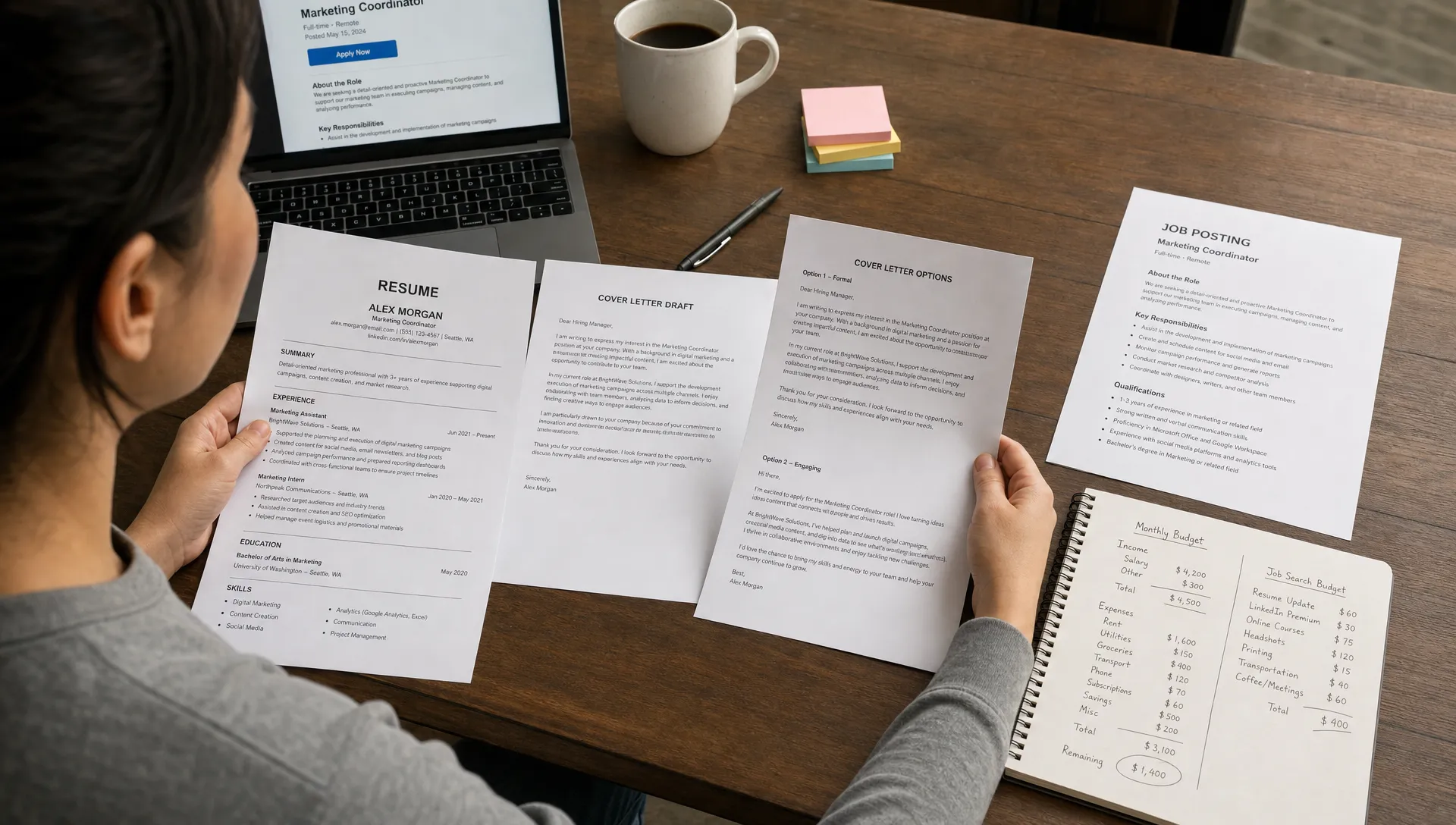
Ask these questions before choosing a cover writer
The best way to avoid overpaying is to ask practical questions before you buy. You do not need a long consultation, but you do need enough information to understand whether the provider can deliver what you need.
Ask these questions before hiring a human writer or paying for a service:
- What information do you need from me before writing?
- Will the letter be tailored to one specific job posting?
- Do you include revisions, and if so, how many?
- Will I receive an editable version as well as a final file?
- How do you make sure the letter still sounds like me?
- Can I reuse the structure for similar roles?
- What is the turnaround time, and are rush fees included?
The answers reveal whether the cover writer has a real process. A strong provider should ask for details about the role, your resume, achievements, and tone preferences. If they can produce a finished letter without asking anything meaningful, the result may be generic.
Evaluate samples without being fooled by polished language
Many cover letter samples sound impressive at first glance. They use confident phrases, smooth transitions, and formal language. But polished language can hide weak substance.
When reviewing a sample, ignore whether it sounds fancy. Instead, ask whether it sounds specific, honest, and relevant to the role. A strong cover letter should make it easy for the hiring manager to understand why this candidate fits this job.
| Quality signal | Good sign | Overpriced or weak sign |
|---|---|---|
| Specificity | Mentions relevant skills, achievements, or role requirements | Could apply to almost any candidate |
| Evidence | Connects claims to examples or outcomes | Uses broad claims like hardworking or passionate without proof |
| Brevity | Gets to the point quickly | Adds long paragraphs to appear more substantial |
| Voice | Sounds professional but still human | Sounds overly formal, robotic, or unlike the applicant |
| Alignment | Reflects the job posting and company context | Talks mostly about the candidate without connecting to employer needs |
| Honesty | Frames experience accurately | Exaggerates qualifications or invents impact |
This is especially important if you are hiring someone online. A sample may not reflect the letter you will receive unless the writer has a consistent intake and revision process.
When an AI cover writer is enough
You do not always need a human writer. If you already understand the role, have a solid resume, and can provide accurate details, an AI cover writer can be the most cost-effective choice.
AI is especially useful when you need a fast first draft, multiple versions for similar roles, or help adjusting tone. A specialized tool can also reduce the blank-page problem by turning a few inputs into a structured letter you can review and personalize.
For example, LetterCraft AI helps generate professional, personalized letters in under 30 seconds across 65+ letter types. For cover letters, features such as tone options, PDF export, copy to clipboard, letter history tracking, and support for five languages can make it easier to create and manage drafts without starting from scratch each time. It is also free to try with no credit card required, which lowers the risk of testing whether AI fits your workflow.
AI-first support is usually enough when:
- The role is similar to your current or previous experience.
- You can clearly explain your achievements.
- You need to tailor letters for several related postings.
- You want a polished draft but can review it yourself.
- You are trying to avoid ongoing subscription costs or per-letter fees.
A human cover writer may still be worth it when your situation is complicated. Examples include major career changes, senior leadership applications, academic or highly technical roles, or cases where you do not know how to position your background.
If you are still unsure whether paying for a service makes sense at all, this breakdown of whether a cover letter writing service is worth paying for can help you decide when the added cost is justified.
Use a simple budget ladder
The easiest way to avoid overpaying is to start with the least expensive option that can realistically solve your problem. Then upgrade only if that option fails for a specific reason.
| Budget level | What to try | Stop here if | Upgrade if |
|---|---|---|---|
| Lowest cost | Template or AI-generated draft | You can personalize it confidently | The letter sounds generic or misses your positioning |
| Moderate cost | AI draft plus editing or peer review | You only need refinement | You cannot explain your fit clearly |
| Higher cost | Freelance cover writer | You need one strong application package | You need broader job-search strategy |
| Premium cost | Career coach or specialized agency | The role is high-stakes or complex | You only need a basic letter |
This ladder keeps you from buying more support than you need. It also gives you a clear test: if the cheaper option produces a letter you would confidently send, you do not need to keep spending.
A practical rule for deciding what to spend
Think in terms of cost per usable application, not cost per document. A $150 letter that only works for one job may be expensive if you are applying broadly. A lower-cost tool that helps you create ten tailored drafts may be better value, even if each draft needs a few minutes of review.
Before paying, ask yourself three questions:
- Will this help me create a better letter than I can produce alone?
- Will I learn or receive a structure I can reuse?
- Is the cost reasonable compared with the role’s importance and my current job-search urgency?
If the answer is yes to all three, the expense may be justified. If the answer is no, start with a cheaper option and upgrade only if needed.
Frequently Asked Questions
What is a cover writer? A cover writer is a person, service, or tool that helps create cover letters for job applications. This can include freelance writers, career coaches, agencies, templates, or AI cover letter generators.
How much should I pay for a cover writer? There is no single correct amount because the right price depends on the complexity of your situation. Pay less for straightforward drafting or editing, and consider paying more only when you need strategy, career-change positioning, or senior-level support.
Is a human cover writer always better than AI? Not always. A human writer can be better for complex or high-stakes situations, but AI can be more cost-effective for fast drafts, role-specific tailoring, and multiple similar applications.
Can I use the same cover letter for every job? You can reuse the structure, but you should tailor the content. A strong cover letter connects your experience to the specific role, company, and requirements.
What should I prepare before hiring a cover writer? Prepare your resume, the job posting, a few relevant achievements, your preferred tone, and any details the employer should understand about your background. Better input usually leads to a better letter.
Get a polished cover letter without overpaying
If you want a strong cover letter but do not want to pay for a full writing service, start with a lower-risk option. LetterCraft AI can help you create a personalized, professional draft quickly, then you can review, edit, export, and reuse it for your job search.
Try LetterCraft AI when you need a polished cover letter in minutes without committing to an expensive service or subscription.
Write your cover letter — not a blank template
Generate a finished cover letter with your details, tone, and language in ~30 seconds. Free first letter, no credit card — beats copy-pasting and filling the blanks yourself.