
Employee Cover Letter Examples for Internal Job Moves
Employee cover letter examples for internal job moves, with templates, tips, and wording to help you apply for promotions or transfers confidently.
Write your cover letter — not a blank template
Generate a finished cover letter with your details, tone, and language in ~30 seconds. Free first letter, no credit card — beats copy-pasting and filling the blanks yourself.
Applying for a role inside your own company can feel deceptively simple. You already know the systems, the culture, and the people. But that familiarity can also make the application harder, because you need to show why this move makes business sense, not just why you personally want it.
A strong employee cover letter for an internal job move does three things quickly: it connects your current performance to the new role, explains your motivation without sounding restless, and reassures the hiring team that your transition will be smooth.
Whether you are applying for a promotion, a lateral move, a department transfer, or a role in another location, the examples below will help you write a clear, confident internal cover letter that sounds professional and specific.
What Makes an Internal Employee Cover Letter Different?
An internal cover letter is not just a regular cover letter with your company name added. The hiring team may already have access to your performance history, manager feedback, and internal reputation. That means vague claims like “I am a strong communicator” or “I am passionate about this company” are not enough.
Instead, your letter should answer a more specific question: Why are you the right internal candidate for this next role right now?
| External cover letter | Internal employee cover letter |
|---|---|
| Introduces you to a new company | Repositions you within a company that already knows you |
| Explains why you want to join | Explains why you want to grow, transfer, or contribute in a new way |
| Proves you understand the company | Proves you understand internal goals, teams, and priorities |
| Focuses on transferable experience | Connects current achievements to the target role |
| Rarely discusses transition | Should mention continuity, handoff, or collaboration |
The advantage is that you can use company-specific context. You might reference a cross-functional project, a process you improved, a product launch you supported, or a customer problem you helped solve. The risk is assuming your work “speaks for itself.” It rarely does. Your cover letter should make the case clearly.
If you want broader guidance before focusing on internal moves, read our guide on how to write a cover letter that gets interviews.
What to Include Before You Start Writing
Before you draft your employee cover letter, gather details that prove fit. Internal applications are strongest when they feel grounded in real company experience rather than generic ambition.
Use this quick planning table:
| Detail to gather | Why it matters | Example |
|---|---|---|
| Current role and team | Shows your internal context | “Customer Success Specialist, Enterprise Accounts” |
| Target role | Keeps the letter focused | “Customer Success Team Lead” |
| Relevant achievement | Proves readiness | “Improved renewal tracking and helped lift retention by 8%” |
| Internal collaboration | Shows company-wide credibility | “Worked with Sales and Product on onboarding feedback” |
| Reason for move | Explains motivation | “I want to lead process improvements at a broader team level” |
| Transition plan | Reassures your current and future managers | “I can document account history and train a replacement over two weeks” |
Your goal is not to summarize your entire time at the company. It is to select the evidence that best supports the move you want.
The Best Structure for an Internal Cover Letter
For most internal job moves, keep your letter to about 250 to 400 words. One page is enough. Hiring managers are busy, and internal recruiters often review multiple candidates who already know the organization.
A reliable structure looks like this:
1. Open with the role and your internal connection
Start by naming the role you are applying for and your current position. Avoid a generic opening like “I am excited to apply.” Instead, make your internal experience relevant immediately.
Example: “I am writing to apply for the Senior Operations Coordinator role after two years supporting the East Region fulfillment team, where I have helped improve scheduling accuracy and cross-team communication.”
2. Prove readiness with one or two achievements
Choose achievements that connect directly to the new role. Use numbers if you have them, but do not force metrics where they do not belong. Strong proof can include process improvements, customer outcomes, project leadership, training, documentation, stakeholder management, or successful stretch assignments.
3. Explain why this move makes sense
This is where internal candidates often sound too casual. Do not simply say you are “ready for a new challenge.” Explain why this specific team, function, or promotion fits your skills and the company’s needs.
4. Close with confidence and continuity
End by expressing interest in discussing the role and, if appropriate, noting that you will support a smooth transition from your current responsibilities.
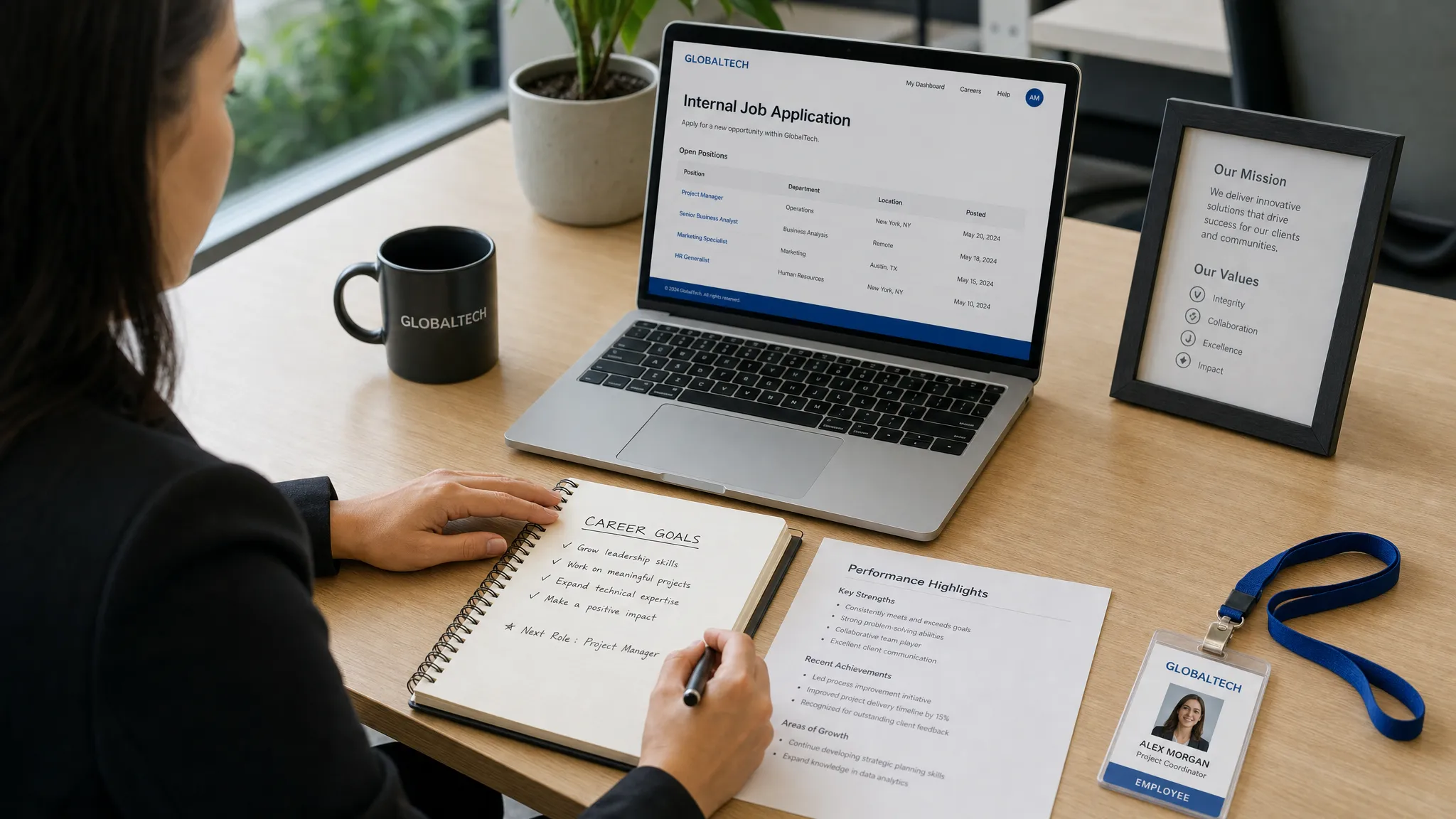
Employee Cover Letter Examples for Internal Job Moves
The following examples are written for common internal move scenarios. Treat them as models, not scripts. Replace the details with your actual role, achievements, team names, and target position.
Example 1: Internal promotion from specialist to team lead
Use this version when you are applying for a higher-level role in the same department.
Dear Hiring Committee,
I am writing to apply for the Customer Success Team Lead position. Over the past three years as a Customer Success Specialist on the Enterprise Accounts team, I have built a strong understanding of our customer lifecycle, internal workflows, and the coaching support our team needs as we continue to grow.
In my current role, I manage a portfolio of high-value accounts and have consistently met or exceeded renewal targets. Last year, I created a renewal-risk tracker that helped our team identify at-risk accounts earlier and improve follow-up consistency. I have also onboarded four new specialists, documented account handoff procedures, and partnered with Sales and Product to share customer feedback more effectively.
This role interests me because it combines the work I already enjoy, customer problem-solving, process improvement, and team development, at a broader leadership level. I understand the expectations of the position and believe my experience supporting both customers and colleagues gives me the foundation to contribute quickly.
I would welcome the opportunity to discuss how my performance, company knowledge, and interest in coaching can support the Customer Success team in this next stage. I am also committed to making any transition from my current portfolio smooth and well documented.
Sincerely,
[Your Name]
This example works because it does not rely on tenure alone. It shows evidence of leadership before the title, including onboarding, documentation, and cross-functional communication.
Example 2: Lateral move to a different department
Use this when the new role is not a promotion but gives you a better fit, broader skills, or a new functional path.
Dear [Hiring Manager Name],
I am writing to express my interest in the Communications Specialist opening on the Corporate Communications team. I currently serve as a Marketing Coordinator in the Growth Marketing department, where I support campaign planning, content updates, and internal launch communications.
During my time in Marketing, I have developed strong writing, coordination, and stakeholder management skills. I helped prepare messaging for three product campaigns, coordinated review timelines across Design and Sales, and drafted internal updates that improved visibility into campaign deadlines. These projects gave me a clear appreciation for how effective communication supports alignment across the company.
I am especially interested in this internal move because the Communications Specialist role closely matches the work I want to deepen: translating business updates into clear, useful messages for employees and customers. My current role has given me a practical understanding of our brand voice, approval process, and cross-functional rhythm, which I believe would help me contribute quickly.
Thank you for considering my application. I would be grateful for the opportunity to discuss how my marketing experience and internal knowledge can support the Communications team’s goals.
Best regards,
[Your Name]
This employee cover letter example is effective because it frames the move as strategic, not random. It shows how current responsibilities naturally connect to the new department.
Example 3: Moving from operations into project coordination
Use this when you are changing functions but can prove you have already done parts of the new job.
Dear [Hiring Manager Name],
I am applying for the Project Coordinator position within the Business Operations team. In my current role as an Operations Associate, I have worked closely with scheduling, vendor communication, reporting, and issue tracking, all of which have strengthened my interest in formal project coordination.
Over the past 18 months, I have helped streamline our weekly operations reporting process, reducing manual follow-up and improving deadline visibility for regional managers. I also supported the rollout of our updated inventory tracking process by gathering feedback, documenting recurring issues, and coordinating status updates between the warehouse, finance, and IT teams.
These experiences have shown me that I am most effective when I am organizing moving pieces, clarifying next steps, and helping teams stay aligned. The Project Coordinator role would allow me to contribute these strengths in a more focused way while continuing to support the operational priorities I already understand.
I would appreciate the opportunity to discuss how my hands-on operations experience, attention to detail, and familiarity with our internal systems could benefit the Business Operations team. If selected, I would work closely with my current manager to ensure a smooth handoff of my responsibilities.
Sincerely,
[Your Name]
This example is useful for career path shifts. It does not apologize for lacking the exact title. Instead, it highlights project-related work already performed.
Example 4: Internal transfer to another office or location
Use this for a move to a different branch, office, territory, or regional team.
Dear [Hiring Manager Name],
I am writing to apply for the Account Manager opening in the Dallas office. I currently work as an Account Associate in the Chicago office, where I support client onboarding, renewal preparation, and day-to-day account coordination for mid-market customers.
In my current role, I have built strong knowledge of our account management process and customer expectations. I regularly prepare renewal summaries, coordinate internal follow-ups, and help resolve client questions by working with Support, Billing, and Implementation. This experience has helped me develop the communication and ownership skills needed to manage accounts more independently.
I am interested in transferring to the Dallas team because I plan to relocate later this year and would like to continue growing within the company. I value our approach to customer relationships and believe my familiarity with our systems, service standards, and internal processes would help me contribute without the ramp-up time of an external hire.
Thank you for considering my application. I would welcome the chance to discuss how my current experience can support the Dallas office’s account management goals and how I can help make the transition smooth for both teams.
Kind regards,
[Your Name]
This letter handles relocation professionally. It explains the personal reason briefly but keeps the focus on business continuity and contribution.
Example 5: Internal move after a stretch assignment
Use this when you have temporarily supported a team and now want to join it permanently.
Dear [Hiring Manager Name],
I am excited to apply for the Product Operations Analyst role. For the past six months, I have supported the Product Operations team on a stretch assignment while continuing my responsibilities as a Data Analyst on the Customer Insights team.
During this assignment, I helped build a customer feedback tracker, summarized recurring themes from support tickets, and prepared weekly reporting for the product launch review meeting. This work gave me direct exposure to the team’s priorities and confirmed that my analytical background can help improve how feedback is organized, interpreted, and shared with product stakeholders.
In my current analytics role, I have developed strong reporting habits, attention to data quality, and experience translating raw information into practical recommendations. I believe those strengths align well with the Product Operations Analyst position, especially as the team continues to improve feedback loops between customers, Support, and Product.
I would be grateful for the opportunity to discuss this role in more detail. I appreciate the chance I have already had to contribute to the team and would be excited to bring that same ownership to the position full time.
Sincerely,
[Your Name]
This example works because it uses the stretch assignment as proof. The candidate is not just interested in the team, they have already contributed to it.
Copy-Ready Internal Employee Cover Letter Template
If you want a flexible starting point, use this template and replace the bracketed sections with your details.
Dear [Hiring Manager Name],
I am writing to apply for the [Target Role] position. I currently work as a [Current Role] on the [Current Team], where I have developed experience in [Skill or Responsibility 1], [Skill or Responsibility 2], and [Skill or Responsibility 3].
In my current role, I have [Brief Achievement or Contribution]. I have also [Second Relevant Achievement, Project, or Collaboration]. These experiences have prepared me to contribute to the [Target Team] by [Specific Way You Can Help].
I am interested in this internal move because [Clear Reason Connected to the Role or Company Need]. My knowledge of [Company Process, Customer Base, Product, Team, or System] would allow me to ramp up quickly while bringing a fresh perspective from my current team.
Thank you for considering my application. I would welcome the opportunity to discuss how my experience and internal knowledge can support the goals of the [Target Team]. I am committed to helping ensure a smooth transition from my current responsibilities if selected.
Sincerely,
[Your Name]
For more ready-to-adapt wording, you can also review these free cover letter templates for every industry.
How to Customize Your Internal Cover Letter by Scenario
Different internal moves require different emphasis. A promotion letter should show leadership readiness. A lateral transfer should show strong reasoning. A department change should show transferable skills.
| Internal move type | What to emphasize | What to avoid |
|---|---|---|
| Promotion | Leadership, ownership, results, mentoring | “I deserve this because I have been here a long time” |
| Lateral move | Skill fit, career focus, company value | Sounding bored with your current role |
| Department transfer | Transferable projects and cross-functional work | Ignoring gaps between your current and target role |
| Location transfer | Continuity, relocation timeline, company knowledge | Making the letter mostly about personal logistics |
| Stretch assignment to permanent role | Work already completed with the team | Assuming the assignment guarantees the job |
| Move after conflict or burnout | Professional motivation and future contribution | Criticizing your manager, team, or workload |
The most persuasive internal letters are honest but diplomatic. You can want growth, change, or a better fit without making your current role sound like a problem.
Common Mistakes to Avoid
Internal applicants often have strong experience but weaken their cover letters with avoidable mistakes.
- Assuming everyone knows your work: The hiring manager may know your name but not your results. Include proof.
- Sounding entitled: Avoid language like “I have earned this” or “I should be next in line.” Show readiness instead.
- Criticizing your current team: Even if you are frustrated, keep the letter positive and forward-looking.
- Being too casual: Internal does not mean informal. Use a polished tone.
- Skipping the transition question: A short line about handoff can reassure both teams.
- Repeating your resume: The cover letter should explain the story behind your move, not list every responsibility.
A good test is simple: if your letter could be sent to any company, it is not specific enough for an internal move.
Should You Tell Your Current Manager Before Applying?
This depends on your company culture and internal hiring policy. Some organizations require manager notification before applying. Others keep early applications confidential until later in the process.
Before submitting, check the internal mobility policy, job posting notes, or HR guidance. If you have a strong relationship with your manager, a brief conversation can protect trust and give you a chance to explain your goals professionally.
A simple message can work: “I wanted to let you know I am applying for the [Role] opening. I am grateful for what I have learned on this team, and I see this as a growth opportunity that aligns with the work I want to continue developing.”
Keep that conversation separate from your cover letter. Your letter should focus on the hiring team, the role, and your qualifications.
Frequently Asked Questions
Do I need an employee cover letter for an internal job application? Yes, if the application asks for one or gives you space to add supporting materials. Even when optional, a short internal cover letter can help explain your motivation, connect your current achievements to the new role, and make your application feel more intentional.
How long should an internal cover letter be? Aim for 250 to 400 words. Internal hiring teams usually do not need a long introduction to the company. Focus on the role, your proof of readiness, your reason for applying, and your transition mindset.
Can I mention that I know the hiring manager? Yes, but keep it professional. You can reference past collaboration if it supports your fit for the role. Avoid relying on personal familiarity as the main reason you should be selected.
Should I explain why I want to leave my current role? Explain why you want the new role, not why you want to escape the old one. Keep your tone positive and growth-focused. If there is a practical reason, such as relocation, mention it briefly and return to your qualifications.
Is an internal cover letter different from a letter of intent? Yes. A cover letter usually responds to a specific job opening, while a letter of intent can express broader interest in future opportunities. If you are exploring roles before there is a formal opening, see our guide to a letter of intent for a job.
Can I use AI to write an internal cover letter? Yes, but the best results come when you provide real details: your current role, target role, internal projects, achievements, and reason for moving. Always review the draft so it sounds like you and follows your company’s internal application norms.
Create Your Internal Cover Letter Faster
If you are staring at a blank page, you do not have to start from scratch. LetterCraft AI helps you generate professional, personalized letters in under 30 seconds, including cover letters for internal job moves, promotions, transfers, and more.
Choose the letter type, add a few details about your current role and target position, select the tone you want, and get a polished draft you can edit, copy, or export. LetterCraft AI supports 65+ letter types, multiple tone options, PDF export, letter history tracking, and 5 languages. No credit card is required to try it.
Use the examples above for direction, then create a tailored internal employee cover letter that makes your next move easier to explain and harder to ignore.
Write your cover letter — not a blank template
Generate a finished cover letter with your details, tone, and language in ~30 seconds. Free first letter, no credit card — beats copy-pasting and filling the blanks yourself.