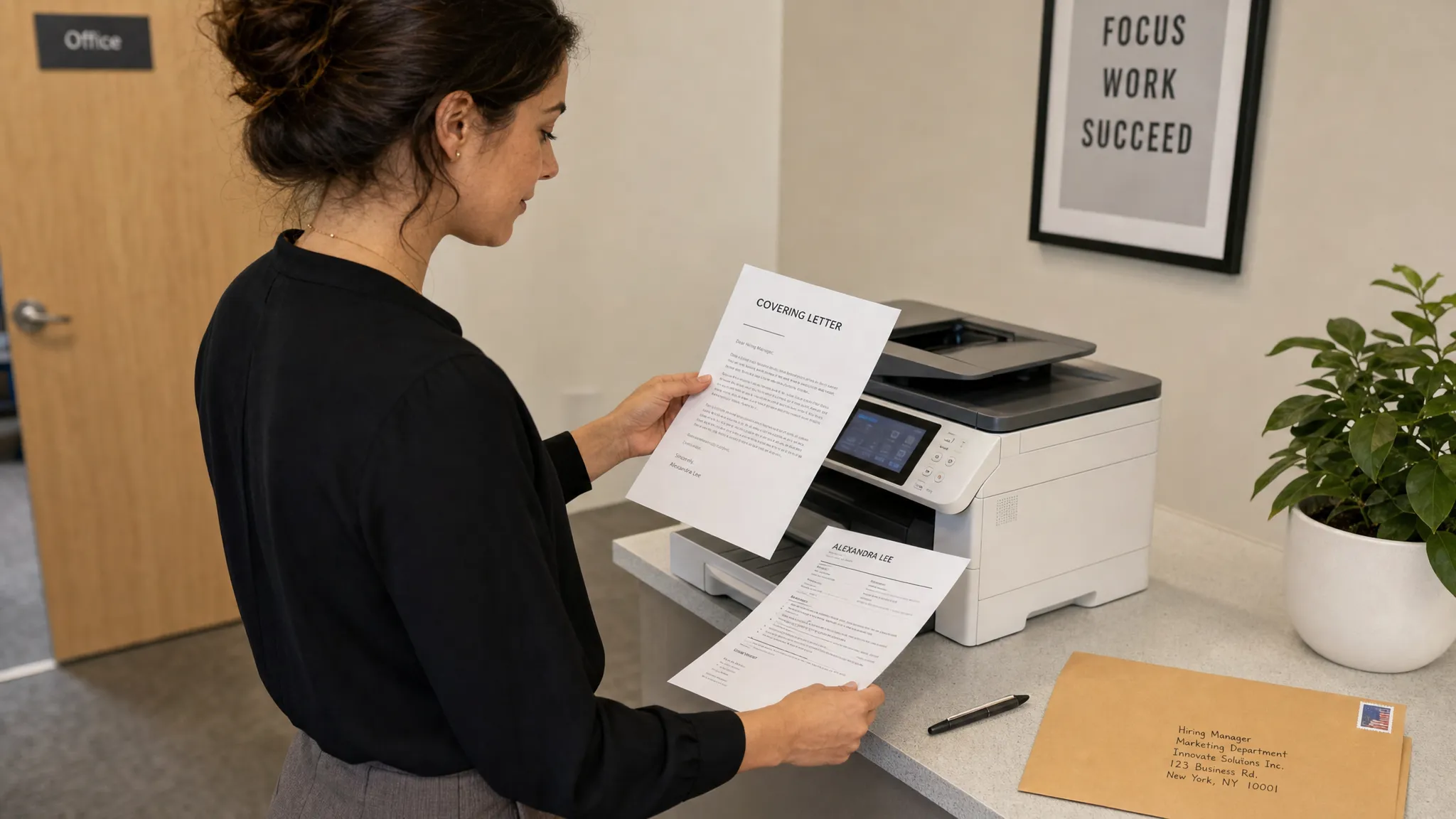
Basic Covering Letter Example for Any Job
Use this basic covering letter example for any job, with a copy-ready sample, email version, customization tips, and mistakes to avoid.
A basic covering letter should do one simple job: help the employer understand why your resume is worth reading closely. It does not need to be long, overly creative, or packed with buzzwords. For most job applications, the best version is clear, specific, and easy to scan.
Below, you’ll find a copy-ready basic covering letter example for any job, followed by a short breakdown of why it works, how to customize it in minutes, and a few variations for common situations.
What Is a Basic Covering Letter?
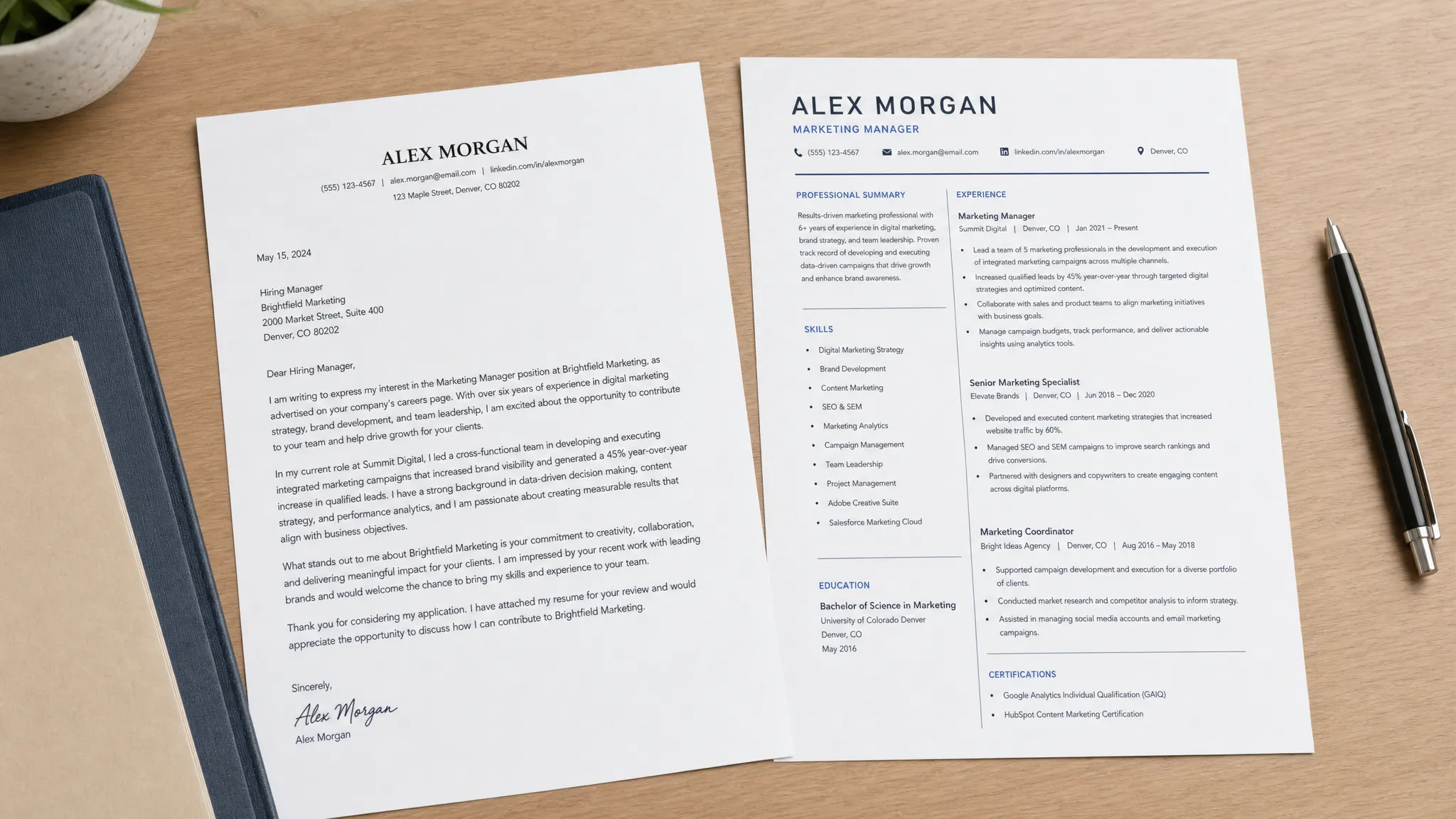
A basic covering letter, often called a cover letter in the U.S., is a short professional letter sent with your resume or job application. It introduces you, explains your interest in the role, and highlights one or two reasons you are a strong fit.
According to CareerOneStop, sponsored by the U.S. Department of Labor, a cover letter should connect your skills and experience to the employer’s needs. That is exactly what a simple covering letter should do, without repeating your full resume.
For most roles, aim for 200 to 300 words. If the job is senior, highly competitive, or asks for detailed selection criteria, you can go slightly longer. But for a general application, short and relevant is usually stronger than long and generic.
Basic Covering Letter Example for Any Job
Use this example as a starting point. Replace the bracketed details with your own information, then adjust the middle paragraph so it matches the job description.
[Your Name]
[Your Phone Number]
[Your Email Address]
[Your City, State]
[Date]

[Hiring Manager’s Name]
[Company Name]
[Company Address]

Dear [Hiring Manager’s Name],

I am writing to apply for the [Job Title] position at [Company Name]. With experience in [your field, skill area, or relevant background], I am confident I can contribute to your team and support the goals of this role.

In my previous role as [Previous Job Title] at [Previous Company], I developed strong skills in [Skill 1], [Skill 2], and [Skill 3]. One achievement I am especially proud of is [brief achievement, result, or responsibility]. This experience helped me build the reliability, communication, and problem-solving abilities needed to succeed in the [Job Title] position.

I am particularly interested in this opportunity because [mention one reason related to the company, role, industry, or mission]. I would welcome the chance to bring my experience and positive work ethic to [Company Name].

Thank you for considering my application. I have attached my resume for your review and would be pleased to discuss how my background matches your needs. I look forward to hearing from you.

Sincerely,
[Your Name]
Finished Basic Covering Letter Sample
Here is what the same structure looks like when completed for a customer service job. You can adapt the wording for almost any industry by changing the role, skills, and achievement.
Jordan Lee
(555) 014-7284
jordan.lee@email.com
Austin, TX
June 1, 2026

Hiring Manager
Brightline Retail Group
Austin, TX

Dear Hiring Manager,

I am writing to apply for the Customer Service Associate position at Brightline Retail Group. With experience in customer support, problem-solving, and fast-paced retail environments, I am confident I can contribute to your team and help create a positive experience for your customers.

In my previous role as a Sales Assistant at Northview Market, I developed strong skills in handling customer questions, processing transactions, and resolving issues calmly. One achievement I am especially proud of is helping reduce repeat customer complaints by keeping clearer notes and following up with customers before the end of each shift. This experience helped me build the reliability, communication, and patience needed to succeed in the Customer Service Associate position.

I am particularly interested in this opportunity because Brightline Retail Group is known for its helpful in-store service and strong local reputation. I would welcome the chance to bring my experience and positive work ethic to your team.

Thank you for considering my application. I have attached my resume for your review and would be pleased to discuss how my background matches your needs. I look forward to hearing from you.

Sincerely,
Jordan Lee
Why This Basic Covering Letter Works
This example is simple, but it avoids the biggest problem with most entry-level or general covering letters: it does not sound empty. It gives the employer enough context to understand who the applicant is, what they can do, and why they are applying.
| Section | Purpose | What to Include |
|---|---|---|
| Opening | States the job and introduces your fit | Job title, company name, relevant background |
| Middle | Proves you can do the work | Skills, experience, one achievement or example |
| Company fit | Shows the letter is not generic | One reason you want this role or company |
| Closing | Ends professionally | Resume mention, interview interest, thanks |
The strongest part of the sample is the specific achievement. Even a small result, such as reducing complaints, improving organization, training a teammate, meeting a deadline, or supporting customers, makes the letter more credible.
If you do not have formal work experience yet, use a class project, volunteer role, internship, freelance task, campus position, or personal responsibility that shows transferable skills.
How to Customize This Covering Letter for Any Job
The key to making a basic covering letter work for any job is not rewriting everything. It is changing the right details.
Before you send it, look at the job posting and identify the top three things the employer wants. These are often repeated in the requirements section, responsibilities section, or first few lines of the description.
Then adjust these parts of the letter:
- Job title and company name: Use the exact title from the job posting.
- Relevant background: Mention your closest match, such as customer service, administration, sales, healthcare, education, operations, or technical support.
- Top skills: Choose skills the employer actually requested.
- One proof point: Add a result, responsibility, project, or example.
- Reason for applying: Include one company-specific detail, even if brief.
A basic covering letter becomes much stronger when it feels like it was written for that specific employer. You do not need to overdo this. One accurate company detail is enough.
For example, instead of writing:
I am interested in your company because it seems like a great place to work.
Write:
I am interested in this opportunity because your team emphasizes quick, friendly support, which matches the customer service standards I have developed in my previous role.
The second version sounds more thoughtful because it connects your skills to the employer’s needs.
Short Basic Covering Letter for Email Applications
If you are applying by email and attaching your resume, you can use a shorter version. This works well for part-time roles, internships, local jobs, and straightforward applications.
Subject: Application for [Job Title] Position

Dear [Hiring Manager’s Name],

I am writing to apply for the [Job Title] position at [Company Name]. I have experience in [relevant area] and strong skills in [Skill 1], [Skill 2], and [Skill 3], which I believe would help me contribute effectively to your team.

In my previous role as [Previous Job Title], I [brief example of relevant responsibility or achievement]. This helped me develop the communication, organization, and problem-solving skills needed for this position.

I have attached my resume for your review. Thank you for considering my application, and I would be happy to discuss my suitability for the role in more detail.

Sincerely,
[Your Name]
[Phone Number]
Keep the email version easy to read on a phone. Use short paragraphs, a clear subject line, and a professional email address.
Basic Covering Letter Lines You Can Reuse
If you are struggling with wording, these lines can help you adapt the example quickly.
For the opening:
I am writing to apply for the [Job Title] position at [Company Name]. My background in [field or skill area] has prepared me to contribute effectively in this role.
For the proof paragraph:
In my previous role, I gained hands-on experience in [task or responsibility], which strengthened my ability to [important skill from job posting].
For limited experience:
Although I am at the beginning of my career, I have developed relevant skills through [coursework, volunteering, internship, project, or part-time work].
For a career change:
While my background is in [previous field], I have built transferable skills in [Skill 1], [Skill 2], and [Skill 3] that align closely with this position.
For the closing:
Thank you for considering my application. I would welcome the opportunity to discuss how my experience and enthusiasm can support your team.
These lines are intentionally simple. The goal is not to sound impressive for its own sake. The goal is to sound clear, professional, and relevant.
What to Avoid in a Basic Covering Letter
A basic covering letter should be polished, but it should not feel robotic. Avoid using the same vague phrases that appear in thousands of applications.
Common mistakes include:
- Repeating your resume word for word: The letter should explain your fit, not list every job.
- Starting with “I am a hardworking individual”: Show work ethic through an example instead.
- Making it all about what you want: Focus on how you can help the employer.
- Using one letter for every job: Change at least the role, skills, and company detail.
- Writing too much: A basic covering letter should usually fit on one page.
Also avoid overexplaining personal circumstances unless they are directly relevant. If you have a gap, layoff, relocation, or career change, mention it briefly only when it helps clarify your application. Then return quickly to your qualifications.
For more structure, you can also review this guide to cover letter outlines that keep you focused.
Basic Covering Letter Format
Use a clean business-letter format if you are uploading the letter as a document. If you are pasting it into an email, remove the full address block and start with the greeting.
A simple format should include:
- Your name and contact details
- The date
- Employer or hiring manager details, if known
- Professional greeting
- Three short paragraphs
- Professional sign-off
- Your name
For fonts, use a readable option such as Arial, Calibri, Times New Roman, or Georgia. Keep the font size around 10.5 to 12 points, use normal margins, and save the file as a PDF unless the employer asks for another format.
A good file name also helps you look organized. Use something like:
Jordan-Lee-Covering-Letter-Customer-Service.pdf
Quick Checklist Before You Send
Before submitting your application, read your covering letter once for content and once for errors. A simple final review can prevent mistakes that weaken an otherwise good application.
Check that your letter:
- Names the correct job and company
- Includes one relevant achievement or example
- Uses the same tone as the role requires
- Matches the key skills in the job posting
- Fits on one page
- Has no spelling errors in names, titles, or company details
- Uses the correct attachment and file name
If you are applying to several jobs, slow down before sending each one. Many applicants accidentally submit a letter with the wrong company name, which is one of the easiest mistakes to avoid.
Frequently Asked Questions
Is a covering letter the same as a cover letter? Yes, in most job application contexts, “covering letter” and “cover letter” mean the same thing. “Covering letter” is more common in some countries, while “cover letter” is more common in the U.S.
How long should a basic covering letter be? A basic covering letter should usually be 200 to 300 words. It should be long enough to explain your fit, but short enough for a hiring manager to scan quickly.
Can I use the same basic covering letter for every job? You can use the same structure, but you should customize the job title, company name, skills, and proof point for each application. A fully generic letter is much less effective.
What if I do not know the hiring manager’s name? Use “Dear Hiring Manager” or “Dear [Department] Team.” Avoid outdated greetings like “To Whom It May Concern” unless there is no better option.
Should I attach my covering letter or put it in the email body? Follow the employer’s instructions first. If they ask for attachments, send a PDF. If you are emailing directly and no instructions are given, you can put a shorter version in the email body and attach your resume.
Create a Polished Covering Letter Faster
A basic example is a great starting point, but the best covering letter is still tailored to your role, experience, and tone. If you want a personalized draft without starting from a blank page, LetterCraft AI can generate professional letters in under 30 seconds.
Choose your letter type, add a few details, select the tone you want, and get a ready-to-edit draft you can copy, export as a PDF, or save in your letter history. LetterCraft AI supports 65+ letter types and 5 languages, so you can create cover letters, resignation letters, complaint letters, and more from one simple tool.
Try it free, no credit card required, and turn your basic covering letter into a polished application today.