Application Letter With Work Experience: Best Structure
Learn the best structure for an application letter with work experience, with section tips, proof examples, a template, and mistakes to avoid.
Write your job application — not a blank template
Generate a finished job application with your details, tone, and language in ~30 seconds. Free first letter, no credit card — beats copy-pasting and filling the blanks yourself.
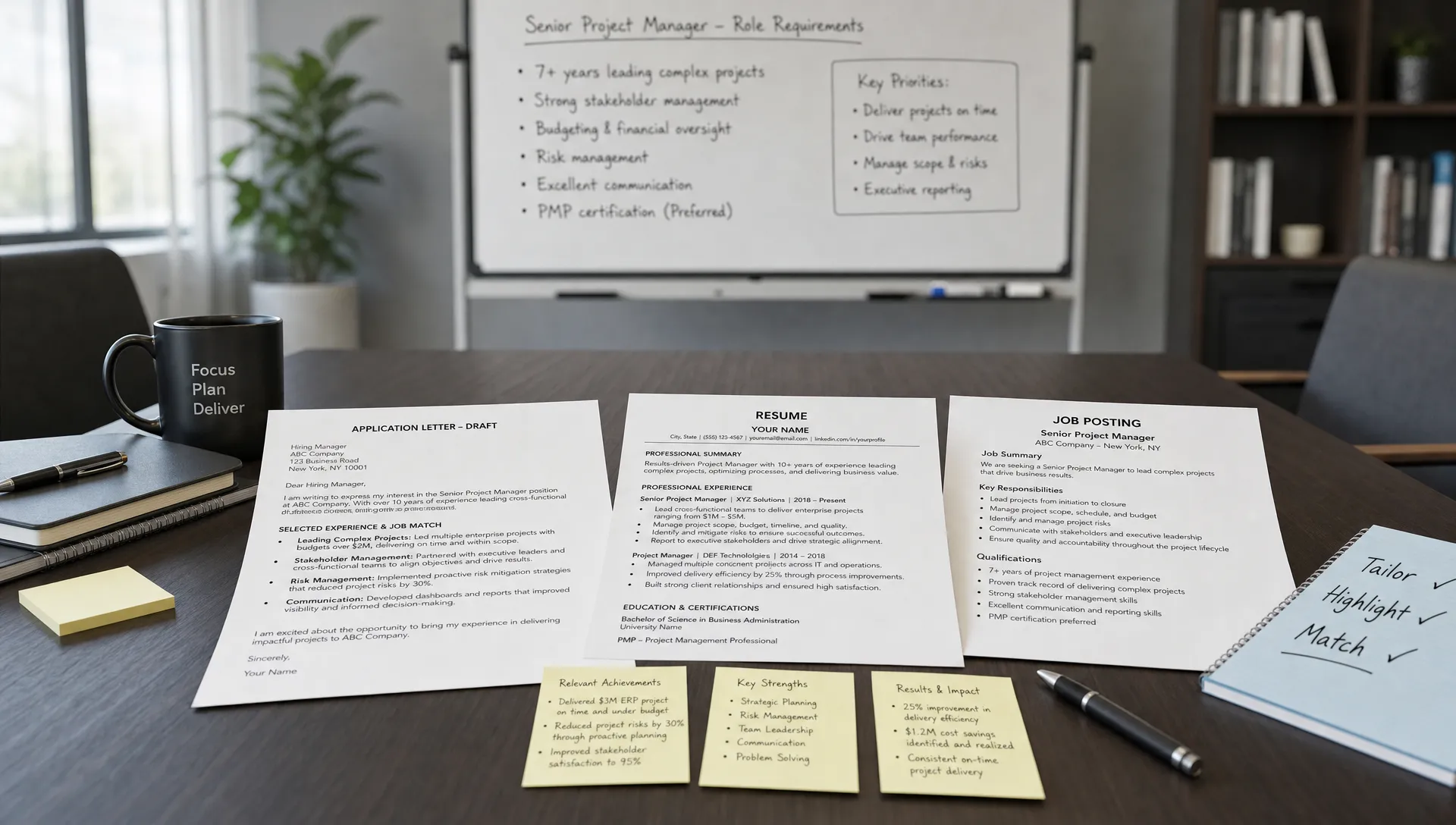
An application letter with work experience has a different job than an entry-level letter. You are not trying to prove you are eager enough to learn. You are trying to show that your past work makes you a low-risk, high-value hire for this specific role.
That does not mean writing a long career summary. In fact, the best experienced-candidate application letters are selective. They choose the most relevant parts of your background, connect them to the employer’s needs, and make the hiring manager want to read your resume with interest.
Below is a practical structure you can use to write a focused, professional application letter that highlights your experience without sounding generic or overloaded.
What makes an experienced application letter different?
When you already have work experience, your letter should answer one central question: Why does your previous experience make you a strong match for this job now?
A resume lists your roles, dates, and achievements. Your application letter explains the thread between them. It gives context, highlights judgment, and shows why you are applying to this employer rather than sending the same letter everywhere.
For experienced applicants, hiring managers usually look for four things:
- Relevance between your previous responsibilities and the job requirements
- Evidence that you delivered results, not just completed tasks
- Professional maturity, including communication and judgment
- A clear reason for your interest in the role or organization
If you are still building the basics of your job letter, this broader guide to an application letter for job application can help you understand the overall purpose before you refine the structure for an experienced profile.
The best structure for an application letter with work experience
A strong application letter should be easy to scan. Most hiring managers do not read every word at first. They look for the role you want, the experience you bring, and whether your message feels tailored.
Use this structure as your foundation:
| Section | Purpose | Recommended length |
|---|---|---|
| Header or contact details | Make your letter professional and easy to identify | 3 to 6 lines, or omitted in short email format |
| Greeting | Address the reader respectfully | 1 line |
| Opening paragraph | State the role and your strongest experience-based fit | 2 to 4 sentences |
| Experience paragraph | Prove your value with relevant achievements | 4 to 6 sentences |
| Fit and motivation paragraph | Connect your background to the company or team | 3 to 5 sentences |
| Closing paragraph | Request the next step and thank the reader | 2 to 3 sentences |
| Sign-off | End professionally | 1 to 2 lines |
This structure works because it follows the way hiring decisions are made. First, the reader needs to understand what you are applying for. Then they need proof that you can do the work. Finally, they need a reason to believe you are genuinely interested and ready to discuss the role.
Section 1: Header, contact details, and greeting
If you are uploading a formal letter, include your name, phone number, email address, city and state, the date, and the employer’s details if available. If you are sending the letter in the body of an email, you can keep this shorter because your email account already provides part of the contact context.
A formal header may look like this:
Your Name
City, State
Phone Number
Email Address

Date

Hiring Manager Name
Company Name
Company Address
For the greeting, use the hiring manager’s name if you have it. If not, choose a professional general greeting such as “Dear Hiring Manager” or “Dear [Department] Hiring Team.” Avoid outdated or overly broad greetings such as “To Whom It May Concern” unless you have no better option.
Section 2: Opening paragraph, lead with your strongest match
Your opening should not begin with a vague statement like “I am writing to apply for the position.” That sentence is not wrong, but it wastes your most valuable space.
A better opening combines three things: the role, your relevant experience, and a reason you are a credible match.
Here is a simple formula:
I am applying for the [Job Title] position at [Company]. With [number] years of experience in [field or function], including [specific relevant skill or responsibility], I am confident I can contribute to [specific team goal or role requirement].
Example:
I am applying for the Customer Success Manager position at BrightPath Software. With six years of experience supporting B2B SaaS clients, reducing churn risk, and leading onboarding improvements, I am confident I can help your team strengthen customer retention and long-term account value.
Notice how the example does not try to summarize an entire career. It immediately frames the applicant’s experience around the employer’s likely priorities.
Section 3: Experience paragraph, prove value with specifics
This is the core of an application letter with work experience. Your goal is to turn your background into evidence.
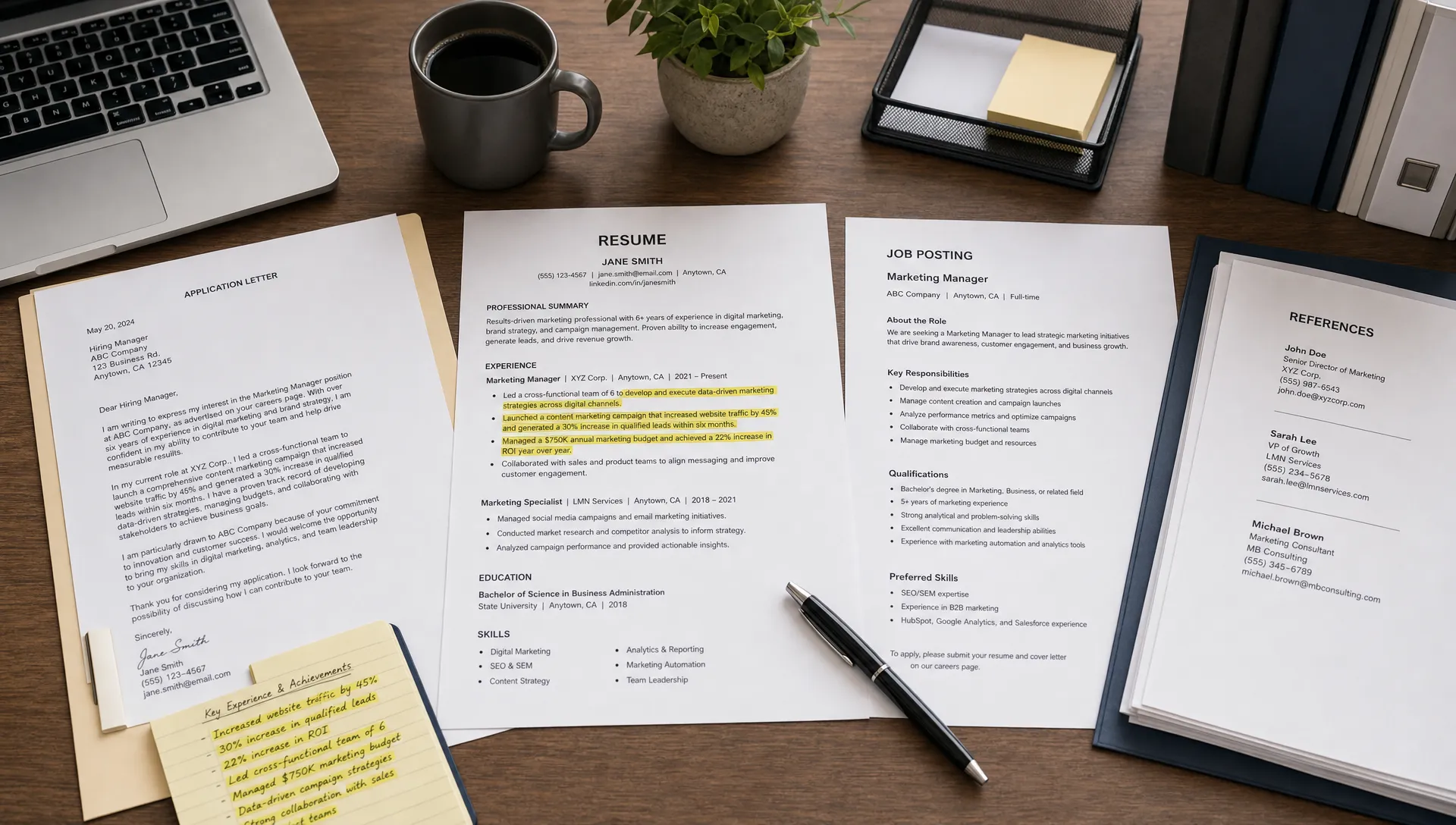
Many applicants make the mistake of copying resume bullets into paragraph form. That usually sounds flat. Instead, choose one or two examples that show scope, impact, or skill.
A strong experience paragraph usually includes:
- A role or situation that matches the job you want
- A responsibility that shows you understand the work
- A result, metric, or concrete outcome
- A skill or strength the employer will care about
You do not always need numbers, but numbers help when they are accurate and relevant. Revenue growth, cost savings, customer satisfaction, project timelines, error reduction, team size, caseload, and productivity improvements can all make your experience easier to evaluate.
Compare the difference:
| Weak wording | Stronger wording |
|---|---|
| I have experience managing projects. | In my current role, I manage cross-functional projects involving product, sales, and support teams, keeping launches on schedule and improving handoff clarity. |
| I am good at customer service. | As a client support lead, I handled complex escalations and helped improve first-response consistency across a team of eight representatives. |
| I worked in administration for several years. | Over four years in office administration, I coordinated scheduling, vendor communication, and document control for a 40-person department. |
The stronger versions work because they show context. They help the hiring manager picture the applicant doing similar work in the new role.
Section 4: Fit paragraph, connect your experience to the employer
Once you have shown that you can do the work, explain why your experience fits this specific opportunity. This is where you move beyond “I am qualified” and show “I understand what this role needs.”
You can connect your experience to the employer in several ways:
- Mention a relevant part of the job description
- Refer to the company’s industry, customer base, mission, or growth stage
- Explain how your previous work prepared you for the challenges of the role
- Highlight a transferable strength that matters in the position
Keep this paragraph sincere and concise. You do not need to overpraise the company. A grounded sentence is stronger than a generic compliment.
Example:
What interests me most about this role is the opportunity to support a growing operations team where accuracy, communication, and process improvement are equally important. My background in coordinating high-volume administrative workflows has prepared me to contribute quickly while continuing to improve systems as the team scales.
This kind of paragraph shows alignment. It also makes your letter feel tailored without becoming overly long.
Section 5: Closing paragraph, make the next step easy
Your closing should be confident, polite, and action-oriented. Thank the reader, restate your interest, and invite a conversation.
A good closing might say:
I would welcome the opportunity to discuss how my experience in [relevant area] can support [Company] in this role. Thank you for your time and consideration. I look forward to the possibility of speaking with you.
Avoid endings that sound uncertain, such as “I hope you will consider me if you think I might be suitable.” You do not need to be aggressive, but you should sound ready for the next step.
A copy-ready structure you can adapt
Use this template as a starting point, then replace the placeholders with details that match your actual experience.
Dear [Hiring Manager Name],

I am applying for the [Job Title] position at [Company Name]. With [number] years of experience in [field, industry, or function], including [specific experience related to the job], I am confident I can contribute to [specific responsibility or goal from the job posting].

In my current or previous role as [Your Job Title] at [Company], I [describe a responsibility that matches the new role]. I also [describe a second relevant responsibility or achievement]. Through this work, I developed strong skills in [skill 1], [skill 2], and [skill 3], while achieving [specific result, improvement, or outcome if available].

I am especially interested in this opportunity because [specific reason connected to the company, role, or team]. My experience with [relevant process, customer type, tool, responsibility, or challenge] has prepared me to step into this position with a practical understanding of what success requires.

I would welcome the opportunity to discuss how my background and skills can support your team. Thank you for your time and consideration. I look forward to hearing from you.

Sincerely,
[Your Name]
If you want to compare this structure with more complete samples, these work experience cover letter examples show how experienced applicants can sound specific without sounding stiff.
How to choose which work experience to include
The biggest challenge for experienced candidates is not having too little to say. It is having too much.
Your application letter should not cover every job you have held. It should highlight the experience that best predicts success in the role you want next.
A useful method is to read the job posting and identify the top three requirements. Then choose one example from your background for each requirement. You may not use all three in the letter, but this exercise helps you avoid irrelevant details.
| If the job emphasizes... | Highlight experience that shows... |
|---|---|
| Leadership | Team coordination, mentoring, delegation, decision-making |
| Customer service | Escalation handling, retention, communication, satisfaction improvement |
| Operations | Process improvement, scheduling, compliance, accuracy, workflow management |
| Sales | Pipeline management, revenue growth, account development, negotiation |
| Administration | Organization, document control, communication, calendar or vendor management |
| Technical skill | Tools used, projects completed, systems improved, problems solved |
If you are changing industries, focus on transferable experience. For example, a retail supervisor applying for an office coordinator role might emphasize scheduling, vendor communication, inventory accuracy, and team leadership rather than only store sales.
If you are applying for a more senior role, focus less on daily tasks and more on scope. Mention team size, budget responsibility, strategic projects, cross-functional work, or measurable improvements where accurate.
Best paragraph style for experienced applicants
Experienced applicants often write sentences that are too dense. They try to fit ten years of work into one paragraph, and the result becomes hard to read.
Aim for clear, direct sentences. One paragraph should usually make one main point. If a sentence has too many commas, job titles, tools, and achievements, split it.
For example, instead of this:
During my time at my previous company, where I handled many duties across operations, customer management, reporting, team support, training, and vendor coordination, I gained the skills needed for this role.
Write this:
In my previous role, I supported daily operations, customer communication, and vendor coordination for a regional service team. That experience strengthened my ability to manage competing priorities while keeping internal and external stakeholders informed.
The second version sounds more controlled. It also shows communication and prioritization, which are valuable in many roles.
Common mistakes to avoid
Even experienced professionals can weaken their application letter by including too much information or using language that feels copied from a template.
| Mistake | Why it hurts your letter | Better approach |
|---|---|---|
| Repeating your resume line by line | The letter adds no new value | Explain why selected experience matters for this role |
| Listing every past job | The reader loses the main point | Focus on the most relevant roles or achievements |
| Using generic claims | Anyone can say they are hardworking | Provide context, examples, or outcomes |
| Writing more than one page | Busy hiring teams may not read it fully | Keep it concise and focused |
| Ignoring the job description | The letter feels untargeted | Mirror the role’s key priorities naturally |
| Overexplaining career history | Important strengths get buried | Choose a clear narrative and leave details for the resume |
A good test is to ask: “Could this same letter be sent to ten different employers?” If the answer is yes, it needs more specific connection to the role.
How long should it be?
For most experienced applicants, the ideal application letter is 250 to 400 words. That is usually enough room for an opening, one strong experience paragraph, one fit paragraph, and a closing.
Senior applicants may need slightly more space, especially when applying for leadership roles. Still, one page is usually the limit. The purpose of the letter is to earn attention, not to document your entire career.
Email application letters can be shorter, often 150 to 250 words, especially if your resume is attached. In that case, keep the structure but compress each section.
Frequently Asked Questions
Is an application letter with work experience the same as a cover letter? In many job search contexts, yes. Employers may use “application letter” and “cover letter” to describe the same document: a professional letter that introduces your application, highlights relevant experience, and explains your fit for the role.
Should I mention all my previous jobs in the letter? No. Mention only the experience that supports your application. Your resume can show your full work history, while your letter should focus on the most relevant evidence.
How do I write an application letter if my experience is in a different industry? Focus on transferable skills and similar responsibilities. For example, leadership, customer communication, reporting, scheduling, compliance, sales, and problem-solving can apply across many industries.
Should I include numbers and achievements? Yes, if they are accurate and relevant. Metrics such as revenue, retention, cost savings, response time, project completion, team size, or process improvements make your experience more concrete.
Can I use the same structure for every job application? You can use the same structure, but not the exact same content. Tailor the opening, experience examples, and fit paragraph to each role.
Build a polished experienced-candidate letter faster
The best application letter with work experience is selective, specific, and easy to read. It does not repeat your resume. It gives your most relevant achievements a clear narrative and connects them to the job you want.
If you want to create a polished version quickly, LetterCraft AI can help you generate a professional, personalized letter in under 30 seconds. Choose from 65+ letter types, adjust the tone, copy your draft, or export it as a PDF, with no credit card required to try it.
Write your job application — not a blank template
Generate a finished job application with your details, tone, and language in ~30 seconds. Free first letter, no credit card — beats copy-pasting and filling the blanks yourself.