A Simple Letter Structure Template for Any Situation
Use a simple letter structure template for any situation, with a copy-ready format, section-by-section guidance, tone tips, and examples.
A strong letter does not need complicated wording. In most situations, the real difference between a clear letter and a confusing one is structure: what you say first, what details you include, and how you guide the reader toward the next step.
That is why a reusable letter structure template is so useful. Whether you are writing a complaint, request, resignation, application, apology, thank-you note, or follow-up, the same basic framework can help you sound organized, respectful, and purposeful.
Below is a simple structure you can copy, adapt, and use almost anywhere.
The universal letter structure at a glance
Most effective letters follow a predictable path:
- Identify who the letter is from and who it is for. This removes confusion and makes the message easy to file or respond to.
- State the purpose early. The reader should understand why you are writing within the first few lines.
- Give only the necessary context. Include the facts, dates, references, or background details that help the reader act.
- Make a clear request or conclusion. Tell the reader what you want, what you are confirming, or what will happen next.
- Close politely. A professional ending leaves the door open, even when the subject is difficult.
This flow works because it respects the reader’s time. PlainLanguage.gov gives similar guidance for clear communication: put the most important information first and make it easy for people to act on what they read.
A simple letter structure template you can copy
Use this as your starting point for almost any formal or semi-formal letter. You can remove sections that do not apply, especially for email.
[Your Name]
[Your Address, optional]
[Your Email Address]
[Your Phone Number, optional]

[Date]

[Recipient Name]
[Recipient Title, if known]
[Company or Organization Name, if applicable]
[Recipient Address, optional]

Subject: [Short, clear summary of the letter]

Dear [Recipient Name or Appropriate Greeting],

I am writing to [state your main purpose in one sentence].

[Provide the key context the reader needs. Include relevant dates, names, reference numbers, decisions, events, or background information. Keep this section focused and factual.]

[Explain what you are requesting, confirming, offering, or asking the reader to do next. If needed, mention a deadline or preferred response method.]

Thank you for your time and consideration. I would appreciate [a response, confirmation, review, update, or other next step] by [date, if relevant].

Sincerely,

[Your Name]
If you are sending the letter by email, you can usually shorten the top section. For example, your name and contact details can go in your email signature, and the subject line becomes the email subject.
What each section should do
The best letters are not long. They are complete. Each section should have a job, and if a sentence does not support that job, it probably does not need to be there.
| Section | Purpose | Best practice |
|---|---|---|
| Sender details | Shows who the letter is from | Include name, email, and phone if a reply is needed |
| Date | Creates a record | Use the date you send the letter |
| Recipient details | Directs the letter to the right person | Use a specific name when possible |
| Subject line | Summarizes the topic | Keep it short and specific |
| Greeting | Sets the tone | Use “Dear” for formal letters and “Hello” for less formal emails |
| Opening sentence | States the reason for writing | Be direct, not vague |
| Context paragraph | Gives supporting details | Include only relevant facts |
| Request or next step | Tells the reader what to do | Make the action clear and realistic |
| Closing | Ends politely | Thank the reader and include your name |
Think of this structure as a container. The topic changes, but the order stays mostly the same.
How to adapt the template for different situations
The universal structure works because every letter has the same basic challenge: the reader needs to know what happened, why it matters, and what should happen next. Still, the emphasis changes depending on the situation.
| Situation | What to emphasize | Example purpose sentence |
|---|---|---|
| Complaint letter | Problem, evidence, desired resolution | “I am writing to request a resolution for an issue with my recent order.” |
| Resignation letter | Final working date, gratitude, transition support | “I am writing to formally resign from my position, effective [date].” |
| Cover letter | Role, fit, proof of value | “I am writing to express my interest in the [job title] position.” |
| Formal request | Clear ask, reason, deadline | “I am writing to request approval for [specific request].” |
| Apology letter | Responsibility, impact, next steps | “I am writing to sincerely apologize for [specific issue].” |
| Thank-you letter | Appreciation, specific reason, continued goodwill | “I am writing to thank you for [specific action or opportunity].” |
For job applications, the structure needs to become more persuasive. If you are writing to a hiring manager, this 3-paragraph cover letter framework can help you turn the basic format into a stronger application.
For approvals, permissions, refunds, records, or workplace requests, it often helps to use a more specific formal request letter format so your ask is easy to understand and act on.
The three sentences that make any letter clearer
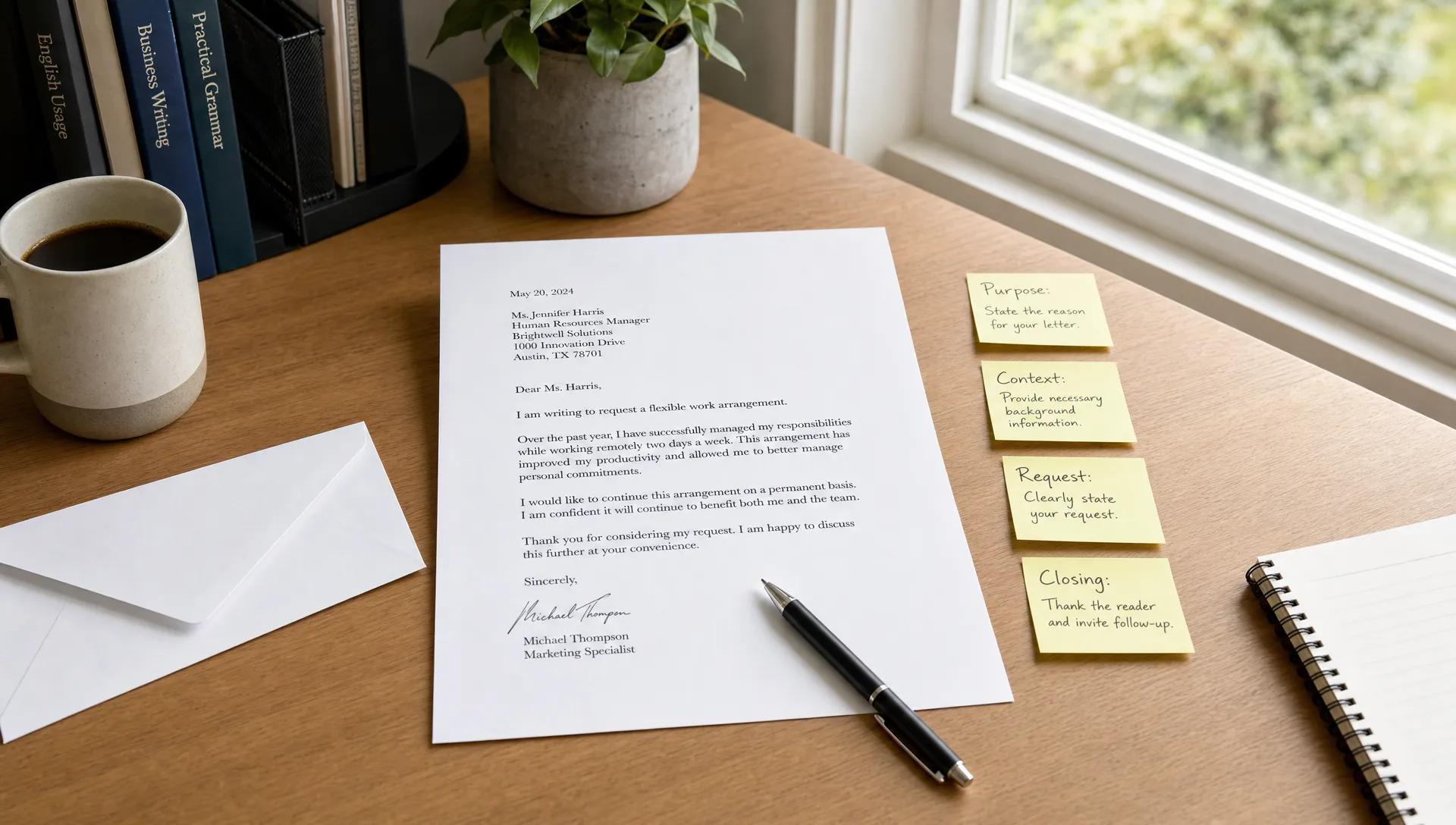
If you only remember one part of this guide, remember these three sentence types. They form the backbone of nearly every effective letter.
Purpose sentence: “I am writing to [main reason].”
This sentence belongs near the beginning. Avoid opening with a long explanation before the reader knows what the letter is about.
Context sentence: “This relates to [event, date, account, job, order, conversation, or decision].”
This gives the reader the facts they need to understand the situation. If the letter involves a reference number, deadline, prior conversation, or specific document, mention it here.
Action sentence: “I would appreciate [specific next step] by [date, if relevant].”
This prevents the letter from ending vaguely. Instead of hoping the reader understands what you want, you tell them politely and clearly.
Here is how those three sentences might look together:
I am writing to request an update on my application for the Operations Coordinator role. This relates to my interview with your team on June 18 and the follow-up documents I submitted on June 20. I would appreciate any update you can provide by the end of next week.
That short version already contains purpose, context, and action. You can expand it when needed, but the core is complete.
Choosing the right tone
The same structure can sound warm, firm, formal, or neutral depending on your wording. Before you write, decide what tone fits the relationship and situation.
A formal tone is best when writing to government offices, legal contacts, executives, schools, landlords, or companies you do not know well. Use complete sentences, avoid slang, and keep your request precise.
A professional but friendly tone works well for colleagues, recruiters, clients, vendors, and community organizations. You can still be polite and structured without sounding stiff.
A firm tone is appropriate for complaints, disputes, refund requests, or boundary-setting letters. Firm does not mean rude. It means clear, factual, and specific about what you expect next.
A warm tone fits thank-you notes, congratulations, apologies, and personal references. Even then, structure matters. Warm letters can still be organized.
Common mistakes to avoid
A letter often becomes weaker when it tries to do too much. The goal is not to include every possible detail. The goal is to include the details that help the reader understand and respond.
Avoid these common problems:
- Starting too slowly: Do not make the reader search for your main point.
- Using emotional language instead of facts: This is especially important in complaints or workplace letters.
- Making multiple unrelated requests: If you need three different outcomes, consider whether they belong in separate letters.
- Forgetting the next step: A letter should usually end with a request, confirmation, deadline, or clear conclusion.
- Sounding too casual for the situation: Even a short letter should feel respectful and intentional.
One useful test is to read only the first sentence and the final paragraph. If those two parts do not clearly show why you are writing and what should happen next, revise before sending.
A quick editing checklist before you send
Before you submit, print, or email your letter, review it from the reader’s perspective. Ask yourself whether the person receiving it can understand the situation quickly and respond without needing to guess.
Use this checklist:
- Is the purpose clear in the opening paragraph?
- Did I include the necessary names, dates, amounts, reference numbers, or documents?
- Is my request specific and reasonable?
- Have I removed details that do not help the reader act?
- Does the tone fit the situation?
- Did I proofread names, dates, and contact information?
- Is the closing polite and complete?
If the letter is important, step away for a few minutes and reread it once more. You will often catch unclear wording, repeated points, or missing details after a short break.
Short example using the template
Here is a simple example of the structure in action:
Subject: Request for Billing Correction

Dear Customer Support Team,

I am writing to request a correction to my most recent billing statement.

My account was charged $85 on June 28, but my monthly plan is listed as $65. I have reviewed my account details and did not find any additional services or fees that would explain the difference.

Please review the charge and let me know whether the statement can be corrected. I would appreciate an update by July 12 if possible.

Thank you for your time and assistance.

Sincerely,

Jordan Lee
Notice that the letter is brief, but it includes everything needed: the purpose, the problem, the relevant details, the requested action, and a polite close.
Frequently Asked Questions
What is the best structure for a letter? The best general structure is sender details, date, recipient details, subject line, greeting, purpose, context, request or next step, and closing. For email, you can shorten the header and use your email subject line instead.
Can I use the same letter structure template for personal and professional letters? Yes. The structure works for both, but the tone should change. A professional letter should be more direct and formal, while a personal letter can be warmer and more conversational.
How long should a letter be? Most everyday letters should be one page or less. A short email may only need three paragraphs: why you are writing, the key context, and the next step.
Do I always need a subject line? For business letters and emails, a subject line is strongly recommended because it helps the reader understand and organize the message. For personal handwritten letters, it is usually optional.
What should I do if I do not know the recipient’s name? Use a respectful general greeting such as “Dear Hiring Manager,” “Dear Customer Support Team,” or “To Whom It May Concern.” If possible, choose a department or role instead of a generic greeting.
Write the right letter faster
A good structure gives you a reliable starting point, but customizing the letter still takes time. If you want a polished letter without building it from scratch, LetterCraft AI can generate personalized letters for 65+ situations in under 30 seconds, with tone options, copy-to-clipboard, PDF export, and no credit card required to try.
Use the template above when you want to write manually, or use AI when you need a professional draft quickly. Either way, the goal is the same: a clear letter that helps the reader understand your message and take the right next step.