Cover Letter Free Template: A Modern Draft You Can Reuse
Copy this cover letter free template and learn how to tailor it in 10 minutes with proof points, modern structure, and ATS-friendly formatting.
Job postings move fast in 2026, and most applicants do not struggle because they lack experience. They struggle because they are staring at a blank page.
If you are searching for a cover letter free template that does not sound outdated (or like it was copied from the internet), the best approach is a modern draft you can reuse, with a few high-impact lines you swap each time.
Below is a reusable cover letter draft, plus a quick personalization method that helps you sound specific and human in under 10 minutes.
What “modern” cover letters look like in 2026
Hiring teams skim. ATS systems parse. Recruiters want evidence. A modern cover letter is not a biography, it is a short argument for fit.
In practice, “modern” usually means:
- Short: 150 to 300 words is often enough for most roles.
- Role-specific: mirrors the job posting’s priorities.
- Evidence-based: 1 to 3 achievements, with numbers when possible.
- Company-aware: one detail that proves you did research.
- Easy to scan: clean formatting, no fancy layout tricks.
If you only implement one change, make it this: stop “telling,” start proving.
Gather these inputs before you edit any template
Templates fail when you try to customize them while you are still figuring out what to say. First, collect your raw material.
Aim to have:
- The role title and the team name (if listed)
- Two key requirements from the job post (the real priorities)
- Two proof points from your experience (results, projects, outcomes)
- One company-specific detail (product launch, mission, recent news, business model)
- Your “why this role” sentence (one clear motivation that is not generic)
- Logistics (location, work authorization, start date, referral name if applicable)
If you are applying in a regulated or detail-heavy field, the “company-specific detail” can be a credible reference point that shows you understand the market. For example, if you are applying to an insurance role in the UAE, referencing how customers compare coverage online through platforms like InsuranceHub can signal practical awareness of how the industry sells and serves today.
Cover letter free template: a modern draft you can reuse
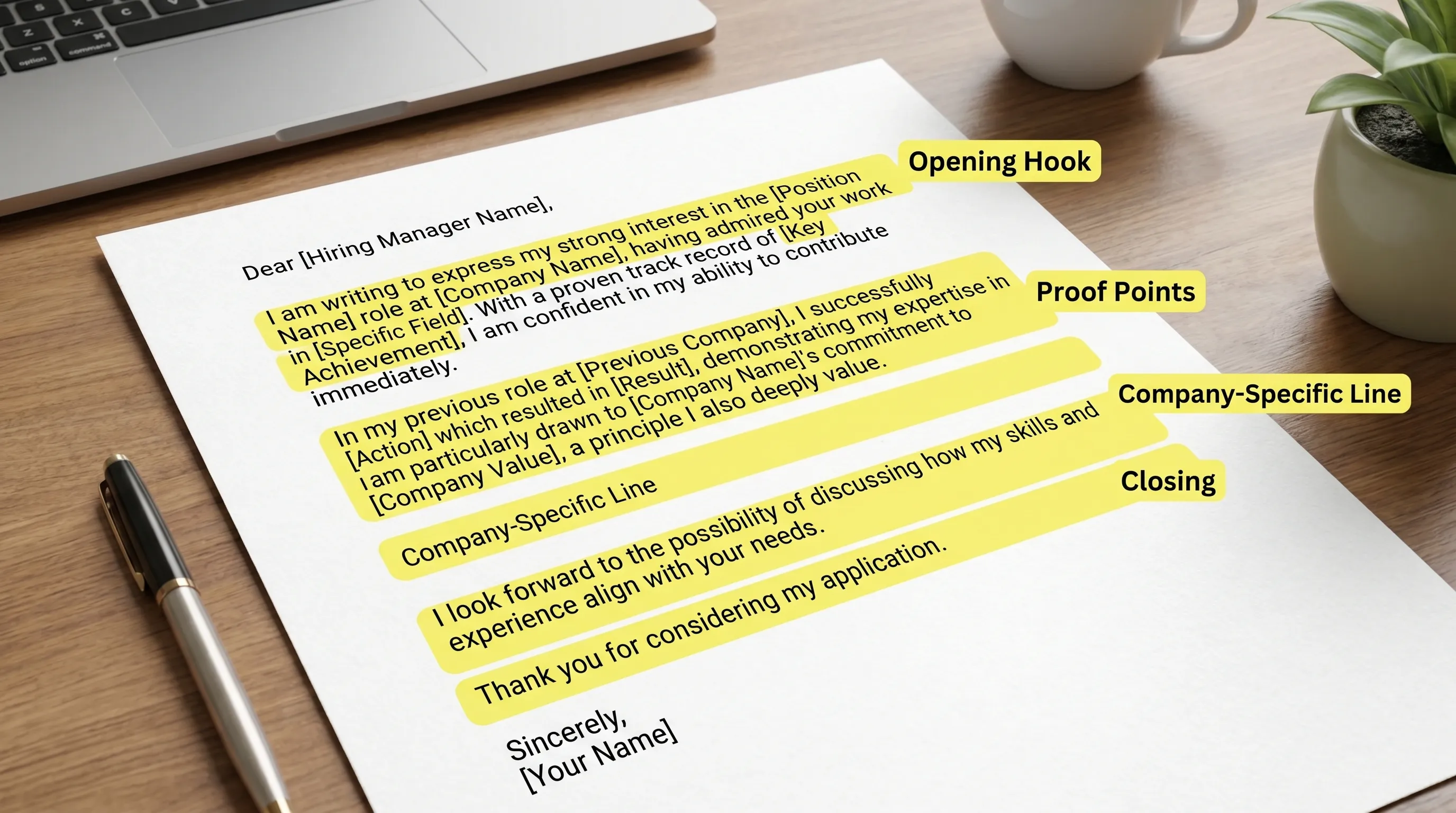
Use this as your base draft. Keep the structure the same, only swap the bracketed sections.
[Your Name]
[Phone] | [Email] | [LinkedIn or Portfolio] | [City, State]

[Date]

[Hiring Manager Name]
[Company Name]

Dear [Hiring Manager Name],

I’m applying for the [Role Title] position at [Company Name]. Based on my experience in [relevant area], I can help your team [deliver outcome tied to the role], especially through [skill #1] and [skill #2].

In my recent role at [Company/Org], I [did action] which led to [measurable result]. I also [did action] to [solve problem], resulting in [measurable result or clear outcome]. These outcomes are relevant to [Company Name] because [connect your proof to the job’s top priority].

What stands out to me about [Company Name] is [specific detail from research]. I’m excited about this role because [your “why” in one sentence], and I’d welcome the chance to bring my experience in [relevant strengths] to your team.

Thank you for your time and consideration. If it’s helpful, I can share [portfolio/work sample/brief plan] related to [role-relevant topic].

Sincerely,
[Your Name]
A faster “short version” template (when you need to be ultra concise)
Dear [Hiring Manager Name],

I’m applying for [Role Title]. I’ve delivered [proof #1 with metric] and [proof #2 with metric], and I’m confident I can help [Company Name] [outcome tied to the job].

I’m especially interested in this role because [company-specific detail]. I’d love to discuss how my experience in [skill] and [skill] can support your team.

Sincerely,
[Your Name]
What to customize (and what to leave alone)
Reusability is the point. You should not rewrite everything for every application. Instead, “lock” the parts that work and only customize the parts that get you relevance.
| Section | Keep stable | Customize every time | What “good” looks like |
|---|---|---|---|
| Opening | Structure and length | Role title, outcome, skills | Sounds like you read the posting |
| Proof | 2-paragraph format | Achievements, metrics, tools | Evidence maps to job priorities |
| Company detail | One sentence | The detail itself | Specific, not flattering |
| Closing | Polite and direct | Optional work sample offer | Clear next step, not desperate |
How to tailor this template in 10 minutes
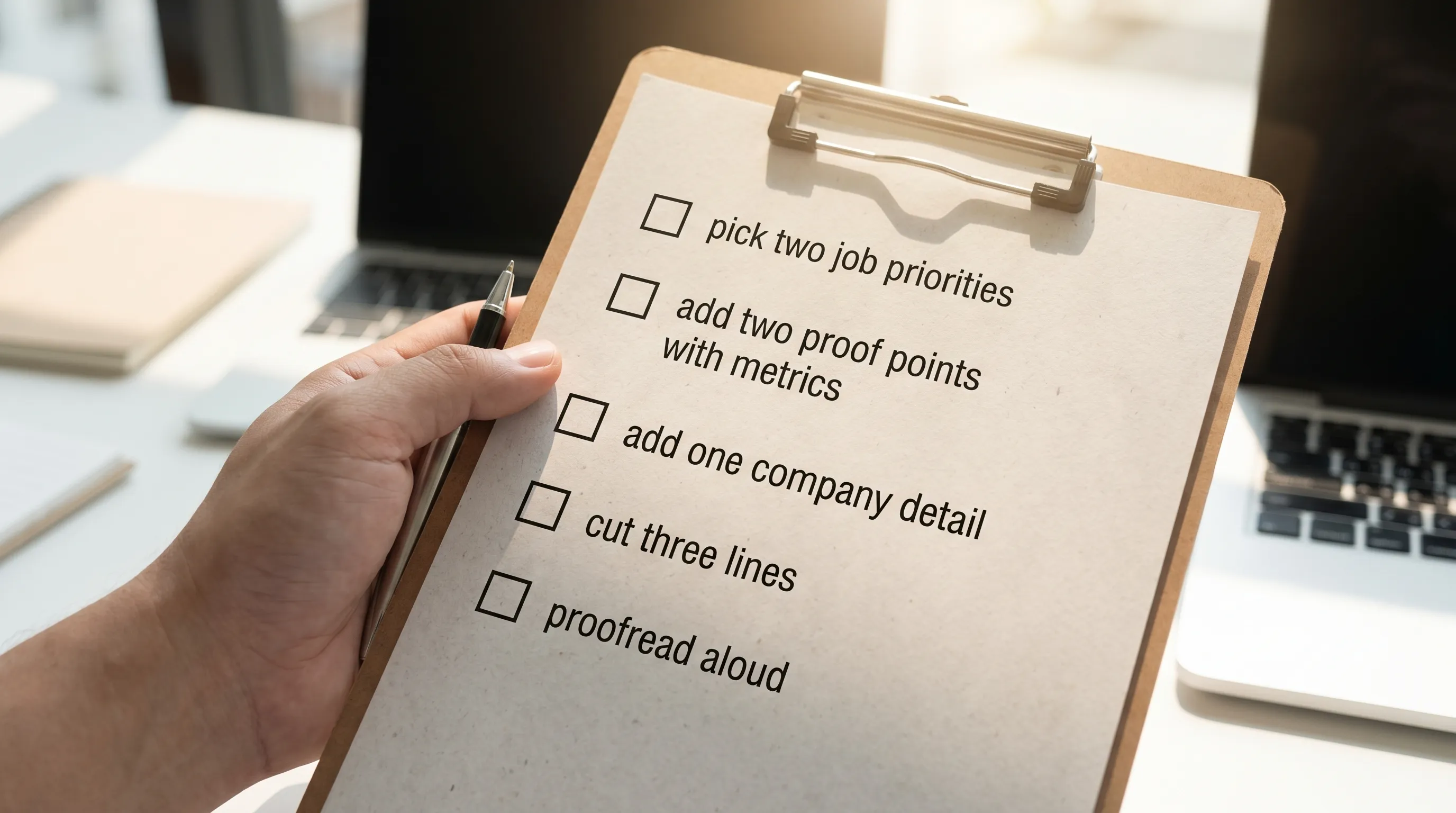
Minute 1: Match your first line to the job post
Replace vague openers with a direct fit statement.
Less effective:
- “I am writing to express my interest in…”
More effective:
- “I’m applying for the [Role] position, and I can help you [priority] through [two strengths].”
Minutes 2 to 6: Choose two proof points that “cover” the role
Pick proof points that match what the job actually needs.
A simple mapping:
- If the job emphasizes growth, lead with revenue, pipeline, conversion, acquisition.
- If it emphasizes operations, lead with cycle time, accuracy, SLA, cost reduction.
- If it emphasizes product/engineering, lead with performance, reliability, launches, adoption.
- If it emphasizes customer, lead with NPS/CSAT, retention, response time, deflection.
If you do not have a perfect metric, use a concrete scope:
- “owned onboarding for 30+ enterprise customers”
- “supported 12 stakeholders across Sales, Product, and Support”
- “shipped 5 releases in one quarter”
Minutes 7 to 8: Add one company-specific detail
This is the line that prevents your letter from feeling mass-produced.
Good company details include:
- A product feature you actually used
- A specific strategy mentioned in the job post
- A recent announcement (and why it matters for the role)
- A customer segment the company serves
Avoid:
- Generic praise (“innovative,” “world-class,” “fast-growing”)
- Copying the company mission statement with no commentary
Minutes 9 to 10: Cut 2 to 3 lines
Most cover letters get stronger when they get shorter.
Cut:
- Adverbs (“very,” “really,” “extremely”)
- Soft filler (“I believe I would be a great fit”)
- Anything that simply repeats your resume bullet points
Plug-and-play lines you can swap without sounding generic
Use these as interchangeable parts, but rewrite them into your own voice.
Opening hook options
- “I’m applying for [Role]. I’ve spent the last [X] years improving [process/outcome], and I’d love to bring that experience to [Company] as you [company priority].”
- “Your posting for [Role] stood out because it focuses on [priority]. That is exactly where I’ve delivered results, including [short proof].”
Proof options (achievement framing)
- “I [action] which reduced [problem] by [metric] over [timeframe].”
- “I led [project] across [teams] and delivered [outcome], measured by [metric].”
Motivation options (without sounding cheesy)
- “I’m interested in this role because it combines [skill] and [skill] in a way that directly supports [mission/product/customer].”
- “I’m applying because I want to focus my work on [domain], and your team’s approach to [specific detail] aligns with how I like to operate.”
Closing options
- “If helpful, I can share a brief work sample related to [topic].”
- “I’d welcome the chance to discuss how I can help you [priority] in the first 60 to 90 days.”
Common template mistakes (and how to fix them fast)
Mistake: Your letter is a resume rewrite.
Fix: keep only achievements that match the posting’s top two needs. If a sentence does not support those needs, delete it.
Mistake: You sound confident, but not credible.
Fix: add one measurable outcome, even a small one. Credibility usually comes from specificity.
Mistake: You used a template, but forgot to personalize the “why here” line.
Fix: add one company detail, then explain why it matters for the role.
Mistake: You are trying to be “professional” and you sound robotic.
Fix: replace one stiff sentence with how you would say it out loud, while staying respectful.
Formatting reminders (ATS-friendly and hiring-manager friendly)
A solid draft can get weakened by formatting. Keep it simple:
- Use a readable font (common system fonts are fine).
- Keep the layout left-aligned.
- Do not use columns, text boxes, icons, or heavy design.
- Save as PDF unless the application specifically requests .docx.
If you want a deeper walkthrough of layout and sections, you can also reference LetterCraft AI’s guides on cover letter format and the 3-paragraph structure.
Frequently Asked Questions
Can I reuse the same cover letter for every job? You can reuse the same structure, but you should customize at least the opening, two proof points, and one company-specific line for each application.
How long should a cover letter be in 2026? For most roles, 150 to 300 words is a strong range. If a job explicitly asks for more detail, you can go longer, but keep it skimmable.
Should I include my full address on a cover letter? In most cases, city and state are enough. Many applicants include a LinkedIn profile and email instead of a full street address.
Is it okay to use AI to draft a cover letter? Yes, as long as you edit for accuracy, add proof points that are true, and make the voice sound like you. Treat AI as a drafting assistant, not a replacement for judgment.
What if I do not know the hiring manager’s name? Use “Dear Hiring Manager,” or “Dear [Team Name] Hiring Team,” and focus on tailoring the content rather than over-optimizing the greeting.
Turn this template into a tailored letter in 30 seconds
If you like the structure above but want a faster first draft, you can use LetterCraft AI to generate a personalized cover letter in under 30 seconds. Choose from 65+ letter types, adjust tone, export to PDF, and keep drafts organized with letter history tracking. It’s free to try, no credit card required, and pricing is one-time (no subscriptions).