
How to Write a Professional Application Letter
Learn how to write a professional application letter with a clear structure, template, examples, and tips to stand out with confidence.
Write your job application — not a blank template
Generate a finished job application with your details, tone, and language in ~30 seconds. Free first letter, no credit card — beats copy-pasting and filling the blanks yourself.
A professional application letter has one job: make the reader believe your application deserves a closer look. It should not repeat your resume line by line, sound like a generic template, or bury your strongest qualification in paragraph four. It should quickly answer three questions: what are you applying for, why are you a strong fit, and what should happen next.
That sounds simple, but the blank page can make even experienced professionals overthink every sentence. The good news is that most strong application letters follow a reliable structure. Once you understand that structure, you can adapt it for jobs, internships, academic programs, scholarships, internal transfers, volunteer roles, or professional opportunities.
In this guide, you will learn how to write a professional application letter from start to finish, including what to include, what to leave out, how to format it, and how to make it feel specific without spending hours on every draft.
New to application letters? This guide focuses on the professional polish. For the fundamentals — the application letter meaning, the standard format, and a complete example — start with our complete application letter guide.
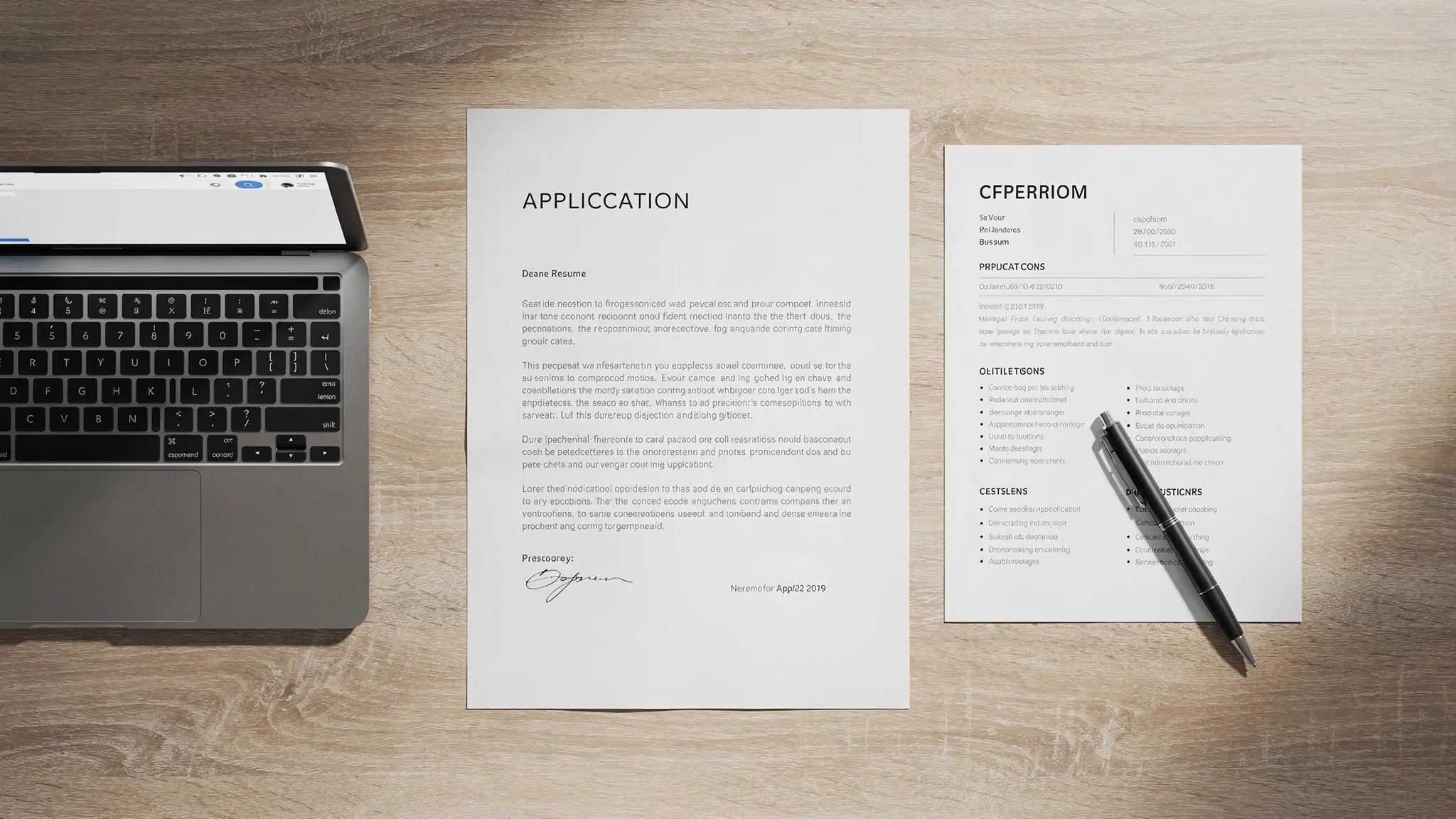
What makes an application letter professional?
A professional application letter is clear, focused, polite, and tailored to the opportunity. It uses formal business writing, but it still sounds like a real person. The best letters are not stiff. They are direct, evidence-based, and easy to scan.
A strong application letter usually includes:
-
The specific role, program, or opportunity you are applying for
-
A brief reason you are interested
-
Two or three relevant qualifications or achievements
-
Evidence that connects your background to the recipient's needs
-
A courteous closing with a clear next step
The U.S. Department of Labor sponsored CareerOneStop cover letter guidance emphasizes that a cover letter should introduce you, explain your interest, and highlight why you are qualified. A professional application letter follows the same principle, but it may be used in a wider range of formal application situations.
Wondering how an application letter differs from a cover letter? See the full application letter vs cover letter breakdown — in short: if a posting asks for an “application letter,” write a formal, tailored letter; if it asks for a “cover letter,” the structure is very similar and this guide still applies.
Before you write, gather the right details
A professional letter starts before the first sentence. If you write without reading the job description or opportunity requirements carefully, your letter will sound generic. Take a few minutes to collect the details that will make your letter specific.
Gather these inputs first:
-
The exact title of the role, program, or opportunity
-
The recipient's name, if available
-
Two or three required skills or selection criteria
-
One or two measurable achievements from your background
-
A reason you are genuinely interested in the organization
-
Any submission instructions, deadlines, file naming rules, or requested attachments
For company research, look for one detail that shows you understand what the organization does. This does not need to be dramatic. It can be a service, audience, mission, recent project, or business priority. For example, if you were applying to a transportation, hospitality, or client service company, you might reference a relevant service detail such as Grand Limousine's nationwide luxury transportation and airport transfer services to show that you understand the customer experience the company is known for.
The key is relevance. Do not mention a company fact just to prove you did research. Mention it only if it helps connect your skills to the organization's needs.
Professional application letter format
Use a simple business letter layout. Hiring managers, admissions teams, and administrators should be able to find your contact information, purpose, proof, and closing without effort.
| Section | What to include | Professional tip |
|---|---|---|
| Header | Your name, phone, email, city and state, and optional LinkedIn or portfolio | Use the same name and contact details as your resume |
| Date | The date you send the letter | Use the current date, not the date you started drafting |
| Recipient details | Recipient name, title, organization, and address if known | If unknown, skip the full address for email submissions |
| Salutation | Dear [Name] or Dear Hiring Manager | Avoid To Whom It May Concern when possible |
| Opening paragraph | State what you are applying for and your strongest fit | Lead with relevance, not a generic introduction |
| Body paragraph | Prove your fit with examples, skills, and results | Use evidence instead of broad claims |
| Closing paragraph | Reaffirm interest, thank the reader, and request next step | Keep it confident and courteous |
| Signature | Sincerely, Best regards, or Respectfully, plus your name | Match the formality of the opportunity |
For most professional application letters, aim for 250 to 400 words. If you are applying by email, your message can be slightly shorter, often 150 to 250 words, as long as it still includes a clear opening, proof of fit, and a polite close.
How to write each part of a professional application letter
Start with a direct, specific opening
Your first paragraph should tell the reader exactly why you are writing. Avoid vague openings like I am writing to express my interest in the position. That sentence is not wrong, but it wastes your most valuable space.
A stronger opening combines the opportunity, your fit, and a reason to keep reading.
Weak opening:
I am writing to apply for the Administrative Assistant position at your company. I believe I would be a good fit for this role.
Stronger opening:
I am applying for the Administrative Assistant position at Northview Medical Group because my three years of experience managing scheduling, patient communication, and office documentation align closely with the support your front office team needs.
The stronger version is still simple, but it gives the reader context immediately. It identifies the role, names relevant experience, and connects that experience to the organization's needs.
Use the body to prove fit, not repeat your resume
The middle of the letter should give the reader a reason to believe you can succeed. Do not summarize every job you have held. Choose the most relevant proof.
Good proof can include:
-
A measurable result, such as reducing processing time, increasing customer satisfaction, or supporting a larger workload
-
A relevant responsibility, such as managing client communication, coordinating events, analyzing data, or training team members
-
A transferable skill, especially if you are changing careers or applying as a student
-
A specific project that relates to the opportunity
Instead of saying you are hardworking, show what that looked like. Instead of saying you have communication skills, give an example of how your communication helped a team, customer, client, student, or stakeholder.
For example:
In my current role, I coordinate schedules for a team of 18 staff members and handle an average of 40 client inquiries per day. By creating a shared tracking system, I helped reduce missed follow-ups and improved response consistency across the office.
This is more persuasive than I have excellent organizational and communication skills because it gives the reader evidence.
Connect your motivation to the organization
A professional application letter should not sound like it could be sent to 50 organizations with only the name changed. Add one sentence that explains why this specific opportunity makes sense.
You can mention:
-
The organization's mission
-
The type of clients, customers, or community it serves
-
The responsibilities listed in the posting
-
A product, service, or program you understand
-
A professional value you share with the organization
Keep this part honest. If your reason is practical, that is okay. You do not need to claim a lifelong passion for every role. You simply need to show that your interest is thoughtful and relevant.
Example:
I am especially interested in this role because it combines client-facing communication with operational support, two areas where I have consistently delivered strong results.
Close with confidence and courtesy
Your closing paragraph should thank the reader and point toward the next step. Avoid sounding desperate, overly casual, or passive.
Weak closing:
I hope you will consider me. Please let me know if you need anything else.
Stronger closing:
Thank you for considering my application. I would welcome the opportunity to discuss how my administrative experience and attention to detail can support your team.
This closing is polite, confident, and focused on value.
Copy-ready professional application letter template
Use this template as a starting point. Replace every bracketed section with specific details from your background and the opportunity.
[Your Name]
[Your Phone Number]
[Your Email Address]
[City, State]
[Date]

[Recipient Name]
[Recipient Title]
[Organization Name]
[Organization Address]

Dear [Recipient Name or Hiring Manager],

I am applying for the [role, program, or opportunity name] at [organization name]. With experience in [relevant skill or field] and a background in [second relevant strength], I am confident I can contribute to [specific need, team, program, or goal].

In my previous role as [your role or relevant experience], I [describe a responsibility or achievement]. For example, [give a specific result, project, or example that proves your fit]. This experience strengthened my ability to [skill from the posting] while also helping me develop [another relevant skill or quality].

I am particularly interested in [organization name] because [specific reason related to the organization or opportunity]. The focus on [specific service, mission, audience, or responsibility] aligns with my experience in [your relevant background] and my goal of [professional or academic goal].

Thank you for considering my application. I would welcome the opportunity to discuss how my skills and experience can support [organization name]. I look forward to hearing from you.

Sincerely,
[Your Name]
Professional application letter example
Here is a sample for a job applicant. Notice that it is concise, specific, and focused on the employer's needs.
Jordan Lee
jordan.lee@email.com
(555) 014-8273
Austin, TX
May 14, 2026

Dear Hiring Manager,

I am applying for the Customer Operations Coordinator position at Brightline Home Services. With four years of experience supporting customer service teams and improving scheduling workflows, I am confident I can help your operations team deliver timely, organized, and professional support.

In my current role as a Client Support Specialist, I manage daily communication with customers, coordinate technician schedules, and maintain service records across multiple platforms. Last year, I helped introduce a shared follow-up tracker that reduced missed customer callbacks and improved team visibility into open service requests. This experience has strengthened my ability to manage details, communicate clearly, and solve problems under time pressure.

I am especially interested in this position because it combines customer communication with process improvement. Your posting's emphasis on accurate scheduling, cross-team coordination, and responsive service aligns closely with the work I have done successfully in my current role.

Thank you for considering my application. I would welcome the opportunity to discuss how my customer operations experience can support Brightline Home Services.

Sincerely,
Jordan Lee
This letter works because it does not try to cover everything. It selects the most relevant experience, includes a concrete improvement, and connects the applicant's background to the role.
How to sound professional without sounding robotic
A common mistake is thinking professional means complicated. It does not. Professional writing is clear, respectful, and controlled. You can use natural language while still sounding polished.
Use phrases like:
| Instead of | Write this |
|---|---|
| I think I would maybe be a good fit | I am confident my experience aligns with this role |
| I really need this opportunity | I would welcome the opportunity to contribute to your team |
| I have always dreamed of working here | I am drawn to this opportunity because of [specific reason] |
| I did many tasks in my last job | My responsibilities included [specific relevant tasks] |
| I am a hard worker | I have demonstrated this through [specific example] |
Also watch your tone. A professional application letter should be positive, but not exaggerated. Avoid claims like perfect candidate, uniquely qualified, or guaranteed results unless you can support them. Strong letters feel confident because the evidence is strong, not because the adjectives are intense.
For additional writing discipline, Purdue OWL's job search letter resources are useful for understanding how to keep professional letters focused, reader-centered, and properly formatted.
Common mistakes that make application letters look unprofessional
Small errors can weaken an otherwise strong application. Before you submit, check for the issues that hiring teams notice quickly.
| Mistake | Why it hurts | Better approach |
|---|---|---|
| Using a generic letter for every application | It signals low effort and weak interest | Customize the opening and one body sentence for each opportunity |
| Repeating the resume | It wastes space and adds no new value | Highlight one or two examples that prove fit |
| Writing too much | Long letters are harder to scan | Keep it to one page, usually 250 to 400 words |
| Focusing only on what you want | The reader cares about their needs | Show how your skills solve a problem or support a goal |
| Using vague claims | Claims without proof are forgettable | Add numbers, examples, projects, or outcomes |
| Forgetting instructions | It can suggest poor attention to detail | Follow all file, format, deadline, and attachment rules |
| Skipping proofreading | Errors can reduce credibility | Read aloud and check names, dates, and contact details |
One of the fastest ways to improve a letter is to remove anything that could apply to almost any applicant. If a sentence is generic, either make it specific or delete it.
Quick pre-send checklist
Before sending your professional application letter, review it once for strategy and once for errors. A polished letter should pass these checks:
-
The first paragraph names the exact opportunity
-
The letter includes at least one specific achievement or example
-
The body connects your experience to the recipient's needs
-
The tone is professional, confident, and respectful
-
The letter is no longer than one page
-
The recipient's name and organization are spelled correctly
-
Your phone number, email, and attachments are correct
-
The file name is clear, such as Jordan-Lee-Application-Letter.pdf
If you are submitting by email, write a short subject line that identifies the purpose clearly. For example: Application for Customer Operations Coordinator, Jordan Lee.
Frequently Asked Questions
How long should a professional application letter be? Most application letters should be 250 to 400 words. For email applications, 150 to 250 words can work if the message is specific and complete.
Should I address the letter to a specific person? Yes, if you can find the correct name. If not, use Dear Hiring Manager, Dear Selection Committee, or Dear Admissions Committee, depending on the situation.
Can I use the same application letter for multiple opportunities? You can reuse the structure, but you should customize the opening, proof points, and organization-specific sentence for every application.
What should I include if I do not have much experience? Focus on coursework, volunteer work, internships, projects, leadership roles, certifications, or transferable skills. Use specific examples that show responsibility, learning ability, communication, or problem-solving.
Is it okay to use AI to write an application letter? Yes, as long as you review, personalize, and proofread the result. AI can help with structure and wording, but your best examples, achievements, and motivation should come from you.
Create a polished application letter faster
Writing a professional application letter is easier when you start with the right structure. You need a clear opening, relevant proof, a specific reason for applying, and a confident close.
If you want to skip the blank page, LetterCraft AI can help you generate a personalized application letter in under 30 seconds. Choose from 65+ letter types, add a few details, select your tone, and create a ready-to-edit draft you can copy, export as a PDF, or save in your letter history. It is free to try and does not require a credit card.
Write your job application — not a blank template
Generate a finished job application with your details, tone, and language in ~30 seconds. Free first letter, no credit card — beats copy-pasting and filling the blanks yourself.