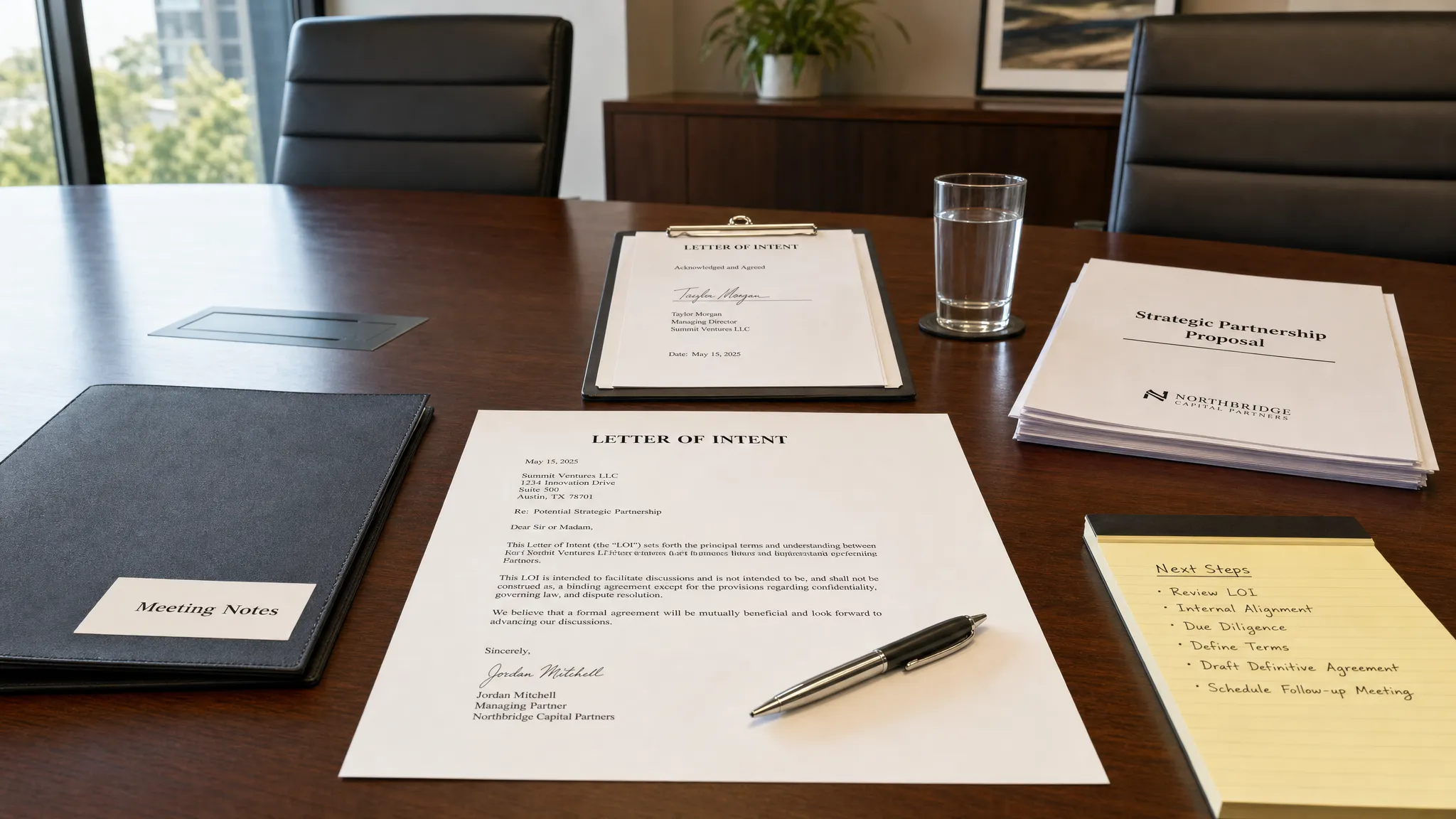
How to Write a Formal Intent Letter With Clear Purpose
Learn how to write a formal intent letter with clear purpose, polished structure, examples, and wording tips for professional results.
A formal intent letter is a professional document that states what you plan to do, why you are writing, and what you want the recipient to consider next. It may be used for job opportunities, business partnerships, school programs, vendor discussions, real estate matters, grants, internal proposals, or other situations where you need to express serious interest without sounding casual or vague.
The best intent letters are not long, dramatic, or overloaded with background. They are focused. A reader should understand your purpose within the first few lines, see why your request or interest is credible, and know what action you expect after reading.
This guide walks you through how to write a formal intent letter with clear purpose, including structure, tone, example wording, and common mistakes to avoid.
What Is a Formal Intent Letter?
A formal intent letter, often called a letter of intent or LOI, is a written statement of interest, intention, or preliminary agreement. It is usually sent before a final application, contract, negotiation, or decision.
Unlike a casual inquiry, it carries a professional tone and a specific objective. Unlike a binding contract, it typically does not finalize every detail, unless certain terms are explicitly stated as binding. If the letter relates to legal, financial, real estate, or contractual obligations, it is wise to have a qualified professional review it before sending.
A formal intent letter may be used to:
- Express interest in a role, program, partnership, purchase, lease, or opportunity
- Confirm the purpose of a discussion or proposal
- Outline preliminary terms before a formal agreement
- Introduce your qualifications or organization
- Request a meeting, review, approval, or next step
If your letter is specifically for employment, you may also find it helpful to review this guide on writing a letter of intent when applying for a job, since job-related LOIs have their own expectations.
Start With One Clear Purpose
Before you write a single sentence, answer this question: What should the recipient understand or do after reading this letter?
That answer becomes the center of the letter. Many intent letters fail because they try to do too much at once. The writer explains their background, asks for consideration, mentions unrelated goals, includes too many details, and ends with a weak closing. The reader is left unsure whether the letter is a request, proposal, introduction, application, or negotiation.
A clear formal intent letter usually has one primary purpose, such as:
- To express intent to apply for a program
- To propose a business collaboration
- To confirm interest in purchasing an asset
- To outline preliminary terms for a partnership
- To request consideration for a position or opportunity
- To declare interest in continuing negotiations
For example, “I am writing to express my intent to partner with your organization on a regional training initiative” is much clearer than “I wanted to reach out regarding some possible opportunities that may be a good fit.”
Clear purpose does not mean you must sound stiff. It means your letter respects the reader’s time.
Know the Difference Between Intent, Interest, and Commitment
A formal intent letter often sits between an informal expression of interest and a final commitment. That makes wording important.
If you are only exploring an opportunity, avoid language that sounds like a final promise. If you are ready to proceed subject to certain conditions, say that clearly. If your letter includes proposed terms, specify whether they are preliminary and non-binding, if that is accurate for your situation.
Here is a simple comparison:
| Type of statement | What it communicates | Example wording |
|---|---|---|
| Interest | You want to learn more or be considered | “I am writing to express my interest in discussing a potential partnership.” |
| Intent | You have a defined purpose and serious direction | “I am writing to state my intent to submit a proposal for the upcoming project.” |
| Commitment | You are agreeing to a specific action or obligation | “I confirm our agreement to proceed under the terms outlined below.” |
For many professional situations, “intent” is strong enough to show seriousness but flexible enough to allow discussion.
Use a Professional Letter Structure
A formal intent letter should look and read like a business document. You do not need complex formatting, but you do need a logical order.
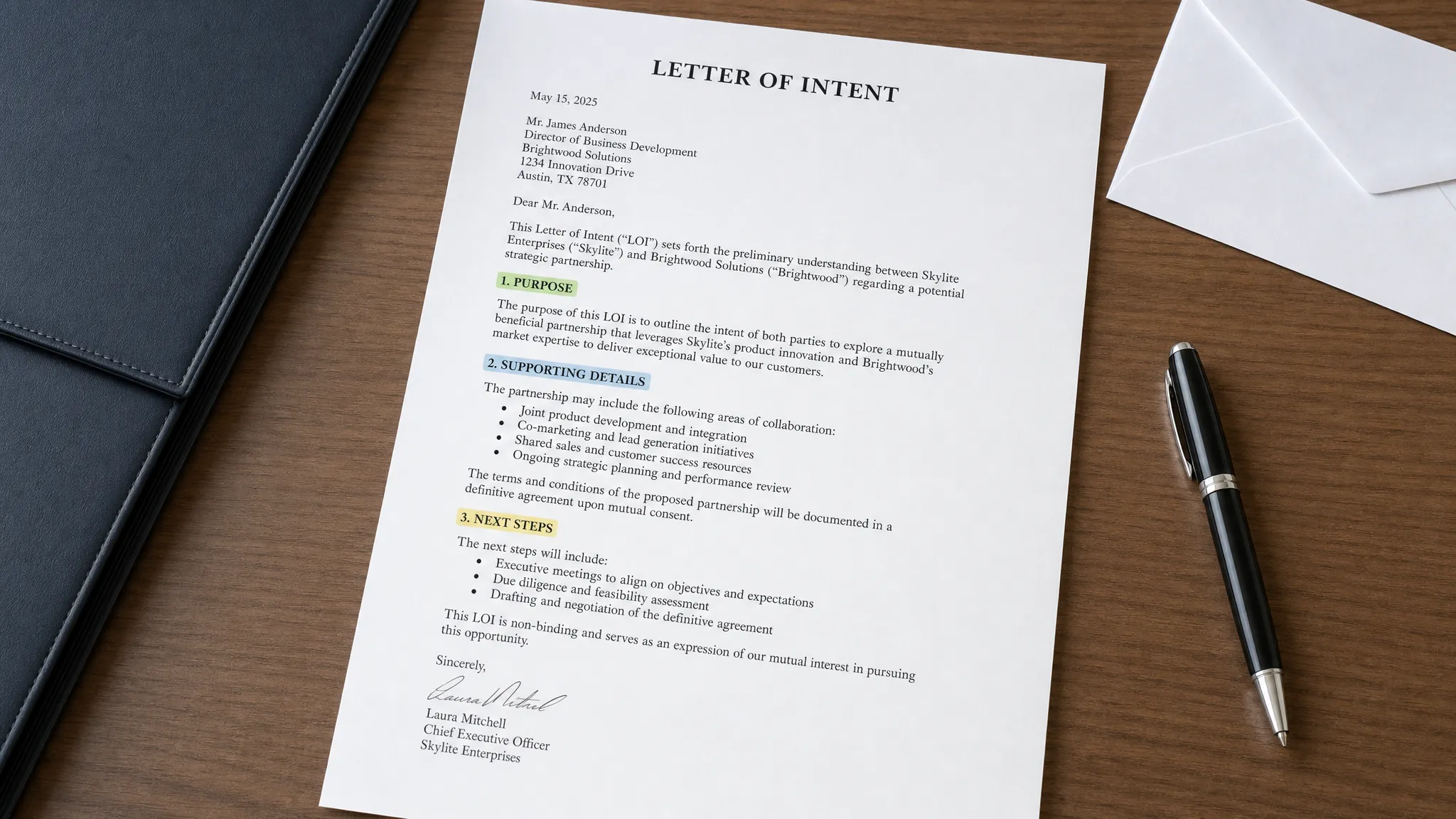
A strong structure usually includes:
- Sender details and date
- Recipient details
- Subject line
- Professional greeting
- Opening statement of intent
- Context or reason for writing
- Relevant qualifications, background, or proposed terms
- Clear next step
- Professional closing
If you need a broader business-letter layout for requests, approvals, or formal communication, this free letter format template for formal requests can help you format the document correctly.
The key is sequence. Do not begin with five paragraphs of background before saying why you are writing. Put the purpose near the top, then support it.
Write a Direct Opening Paragraph
The first paragraph should answer three questions: who you are, why you are writing, and what the letter concerns.
A good opening is specific but not overloaded. It should feel confident, not pushy.
Here are example openings for different situations:
| Situation | Strong opening example |
|---|---|
| Business partnership | “I am writing on behalf of Northline Training Group to express our intent to explore a partnership with your organization for workforce development programs in the Midwest region.” |
| Academic program | “I am writing to formally state my intent to apply for the Master of Public Health program for the Fall 2027 intake.” |
| Purchase discussion | “This letter confirms my intent to enter preliminary discussions regarding the potential purchase of the commercial property located at 218 Market Street.” |
| Internal proposal | “I am writing to express my intent to lead the development of a cross-functional onboarding initiative for new client success hires.” |
| Vendor or technology evaluation | “I am writing to confirm our intent to evaluate your platform for potential use in our creative operations workflow.” |
Notice that each version avoids vague phrases like “just reaching out,” “wanted to touch base,” or “seeing what might be possible.” Formal intent writing benefits from clarity.
Add Context Without Overexplaining
After your opening, give the reader enough context to understand why the intent matters. This is where you briefly explain the opportunity, need, timeline, relationship, or background.
The goal is relevance. Include details that support your purpose, not everything you know.
For instance, if your company is seeking a technology partner, you might mention the specific operational challenge. A team evaluating tools for high-volume creative work might refer to the need for governed AI production workflows across teams, models, and outputs. That context helps the recipient understand the seriousness and scope of the discussion.
If your letter is for a job or position, the context might focus on your relevant experience and alignment with the organization. For a deeper employment-specific structure, this article on the best structure for a letter of intent for a position breaks down how to organize credibility, alignment, and future contribution.
A useful rule: if a detail does not help the reader evaluate your intent, remove it.
Support Your Intent With Evidence
A formal intent letter should not simply announce what you want. It should explain why your intent is reasonable, credible, or worth considering.
Depending on the situation, evidence may include:
- Relevant experience
- Organizational capabilities
- Previous results
- Shared objectives
- Available resources
- Proposed timeline
- Understanding of the recipient’s needs
For example, instead of writing, “I believe I would be a strong partner for this project,” write, “Our team has delivered three regional training programs for healthcare employers in the past two years, each involving curriculum design, facilitator coordination, and post-program reporting.”
The second version gives the reader something concrete to evaluate.
Evidence does not need to be lengthy. One or two strong proof points are usually better than a long list of claims.
Keep the Tone Formal, Human, and Specific
Formal does not mean cold. A strong intent letter sounds professional, respectful, and direct. It avoids slang, emotional exaggeration, and unnecessary filler.
Compare these examples:
| Weak wording | Stronger wording |
|---|---|
| “I think this could maybe be a great opportunity for both of us.” | “I believe this opportunity aligns with both organizations’ goals and merits further discussion.” |
| “I really, really want to be considered.” | “I respectfully request consideration for the opportunity described above.” |
| “Let me know what you think.” | “I would welcome the opportunity to discuss next steps at your convenience.” |
| “I am the perfect fit.” | “My background in client operations and process improvement aligns closely with the needs outlined for this initiative.” |
Specificity makes formal writing stronger. Avoid broad claims like “excellent communication skills,” “great track record,” or “strong business experience” unless you connect them to examples.
Include the Right Level of Detail
The right amount of detail depends on the purpose of the letter. A job-related intent letter may need a concise summary of qualifications. A business intent letter may need proposed scope, timeline, or objectives. A purchase-related letter may need property details, conditions, and next steps.
However, most formal intent letters should not attempt to replace a full proposal, resume, contract, or application. Think of the letter as a polished bridge to the next stage.
Use this table to decide what to include:
| Letter purpose | Details to include | Details to avoid |
|---|---|---|
| Job or position | Role interest, relevant experience, contribution, availability | Full resume history, unrelated personal story |
| Business partnership | Shared goal, proposed collaboration area, credibility, next meeting | Full contract terms, vague promises, excessive company history |
| Academic or program intent | Program name, motivation, qualifications, goals | Generic praise, unrelated achievements |
| Purchase or lease intent | Asset or property, preliminary terms, conditions, timeline | Final legal commitments without review |
| Internal proposal | Business need, intended action, expected benefit, resources needed | Complaints, unsupported assumptions, overly broad scope |
If you are unsure, err on the side of clarity and brevity. A reader can always ask for more details if your letter creates interest.
Make the Next Step Obvious
The closing section should not fade out. It should tell the recipient what you would like to happen next.
Depending on the situation, your next step might be:
- A meeting
- A phone call
- A review of attached materials
- A written response
- Permission to submit a full proposal
- Confirmation of preliminary terms
- Consideration by a committee or hiring manager
A strong closing might say:
“Thank you for reviewing this letter of intent. I would welcome the opportunity to discuss the proposed partnership in a 30-minute call next week and determine whether a formal proposal would be appropriate.”
Or:
“Please consider this letter a formal statement of my intent to apply. I would appreciate confirmation of any additional documents required before the submission deadline.”
The best closing is polite, specific, and easy to respond to.
Formal Intent Letter Template
Use this template as a starting point. Adjust it based on your situation, and avoid copying it word for word if your context requires specific details.
[Your Name]
[Your Address or Organization]
[City, State ZIP]
[Email Address]
[Phone Number]
[Date]
[Recipient Name]
[Recipient Title]
[Organization Name]
[Address]
[City, State ZIP]
Subject: Letter of Intent Regarding [Purpose]
Dear [Recipient Name],
I am writing to formally express my intent to [state your purpose clearly]. This letter concerns [briefly identify the opportunity, position, program, proposal, property, partnership, or matter].
My interest is based on [brief context or reason]. Given [relevant background, need, qualification, or shared objective], I believe this matter is worth further consideration.
[Add one concise paragraph with supporting details. This may include experience, proposed terms, organizational capability, timeline, or why your intent is a strong fit for the recipient’s needs.]
At this stage, I would like to [state the next step]. I am available to [meet, provide documents, discuss details, submit a proposal, or answer questions] at your convenience.
Thank you for your time and consideration. I look forward to your response.
Sincerely,
[Your Name]
Example of a Formal Intent Letter
Here is a general example for a business partnership context.
Sarah Mitchell
Mitchell Learning Solutions
Portland, OR 97205
sarah@mitchelllearning.com
June 28, 2026
Daniel Reeves
Director of Community Programs
Northwest Workforce Alliance
Portland, OR 97209
Subject: Letter of Intent Regarding Workforce Training Partnership
Dear Mr. Reeves,
I am writing on behalf of Mitchell Learning Solutions to formally express our intent to explore a workforce training partnership with Northwest Workforce Alliance. This letter concerns a potential collaboration focused on practical job-readiness workshops for adults transitioning into administrative and client support roles.
Our interest is based on the alignment between your organization’s community employment programs and our experience designing applied training for early-career professionals. Over the past three years, our team has developed and delivered instructor-led programs for nonprofit partners, including courses in workplace communication, digital organization, and customer service fundamentals.
We believe a pilot workshop series could provide measurable value to your participants while allowing both organizations to evaluate long-term collaboration. A preliminary pilot could include four weekly sessions, participant feedback forms, and a short outcomes summary after completion.
At this stage, we would welcome the opportunity to discuss your program goals and determine whether a formal proposal would be useful. I am available next week for a brief call and would be glad to provide sample curriculum materials in advance.
Thank you for your time and consideration. I look forward to the possibility of speaking with you.
Sincerely,
Sarah Mitchell
Common Mistakes to Avoid
Even experienced professionals can weaken a formal intent letter by making it too vague, too long, or too self-focused.
One common mistake is burying the purpose. If the reader has to reach the third paragraph to understand why you are writing, revise the opening.
Another mistake is using generic praise. Sentences like “Your company is a leader in the industry” do not add much unless you connect them to a specific reason for your intent.
Writers also sometimes overstate commitment. If you are not entering a binding agreement, avoid language that could be interpreted as final acceptance of terms. Use phrases such as “preliminary,” “subject to review,” or “for discussion purposes” when appropriate.
Finally, do not send the letter without proofreading names, titles, dates, addresses, and attachments. A formal letter with a misspelled recipient name immediately loses credibility.
Quick Final Review Checklist
Before sending your formal intent letter, review it against these questions:
- Is the purpose clear in the first paragraph?
- Does the subject line accurately describe the matter?
- Is the tone professional and respectful?
- Have you included only relevant context?
- Does the letter provide evidence or reasoning to support your intent?
- Is the requested next step specific?
- Are names, dates, titles, and details correct?
- Have you removed vague filler and repeated points?
- If legal or financial terms are involved, has the letter been reviewed appropriately?
A clear letter usually becomes stronger after one round of cutting. Remove anything that distracts from the purpose.
Frequently Asked Questions
What is the main purpose of a formal intent letter? The main purpose is to clearly state your intention regarding a professional opportunity, proposal, application, purchase, partnership, or discussion. It helps the recipient understand what you want and what should happen next.
How long should a formal intent letter be? Most formal intent letters should fit on one page, usually around 300 to 600 words. Complex business, real estate, or partnership situations may require more detail, but clarity is more important than length.
Is a formal intent letter legally binding? It depends on the wording and context. Many letters of intent are non-binding, but certain clauses or commitments may carry legal significance. For contracts, purchases, leases, or financial matters, consult a qualified professional before sending.
What tone should I use in a formal intent letter? Use a tone that is professional, respectful, and direct. Avoid casual language, exaggeration, and vague phrases. The reader should feel that your intent is serious and well considered.
Can I use AI to write a formal intent letter? Yes, AI can help you create a polished first draft quickly, especially when you provide accurate details about your purpose, recipient, tone, and desired next step. Always review and personalize the final version before sending.
Write a Clear Formal Intent Letter Faster
A strong formal intent letter does not need to be complicated. It needs a clear purpose, relevant support, professional tone, and a specific next step.
If you want help turning your details into a polished letter, LetterCraft AI can generate personalized professional letters in under 30 seconds. You can choose from 65+ letter types, adjust tone options, export to PDF, and start without a credit card.