How LOR Writers Build Strong Recommendation Letters
Learn how LOR writers build strong recommendation letters with evidence, structure, tone, and personalization that help candidates stand out.
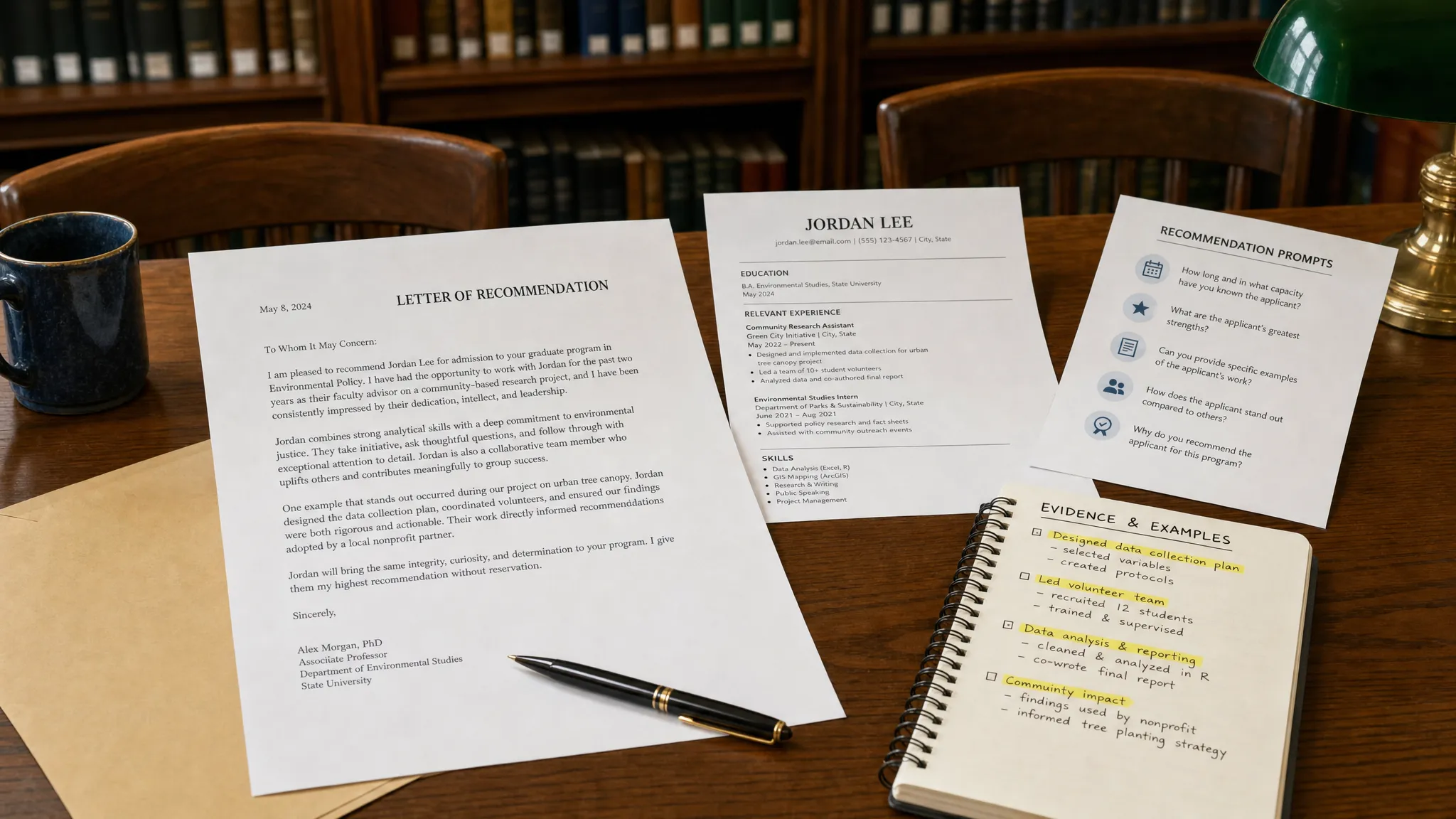
Write your letter of recommendation for student — not a blank template
Generate a finished letter of recommendation for student with your details, tone, and language in ~30 seconds. Free first letter, no credit card — beats copy-pasting and filling the blanks yourself.
A recommendation letter carries borrowed trust. Admissions committees, hiring managers, scholarship panels, and review boards use it to learn what a resume cannot prove: how a person thinks, works, leads, improves, and behaves when no one is prompting them.
That is why strong LOR writers do more than assemble nice phrases. They translate real experience into credible evidence. Whether the writer is a professor, manager, mentor, colleague, or professional editor helping a recommender shape a draft, the goal is the same: build a letter that is truthful, specific, and clearly aligned with the opportunity.
The best recommendation letters feel effortless to read, but they are rarely written casually. They follow a deliberate process.
What strong LOR writers actually do
LOR writers are not just grammar fixers. They act as interviewers, strategists, and editors at the same time. Their first job is to understand the opportunity, the candidate, and the recommender relationship. Their second job is to decide which facts deserve space. Their third job is to make the letter sound like a real person who can confidently vouch for the candidate.
A weak recommendation letter says the candidate is hardworking, reliable, and impressive. A strong one shows when the candidate worked hard, what made the work difficult, how the person responded, and why that example matters for the next role or program.
If you need the standard format, examples, and ready-to-use templates, CraftMyLetter has a detailed guide on how to write a letter of recommendation. This article focuses on the behind-the-scenes choices strong LOR writers make before, during, and after drafting.
They start with a clear recommendation thesis
Before writing a single paragraph, experienced LOR writers define the main argument of the letter. A recommendation is not a biography. It is a focused case for why the candidate deserves serious consideration.
A good recommendation thesis answers one question: why is this person a strong fit for this specific opportunity?
For example, the thesis for a graduate school letter may be that the applicant is ready for advanced research because they combine analytical discipline with intellectual independence. For a job promotion, the thesis may be that the employee is prepared for leadership because they consistently improve team outcomes and mentor others.
Strong LOR writers usually clarify these points before drafting:
- What is the candidate applying for, and what does the decision-maker care about most?
- Which 2 or 3 qualities can the recommender verify from direct experience?
- What examples prove those qualities better than a resume could?
- What should the reader remember after finishing the letter?
This thesis keeps the letter from becoming a list of compliments. Every paragraph should support the central recommendation.
They gather source material before writing
The biggest difference between generic LOR writers and strong ones is the quality of their input. If the writer only has a resume and a deadline, the letter often sounds vague. If they have context, examples, and the recommender's perspective, the letter becomes specific.
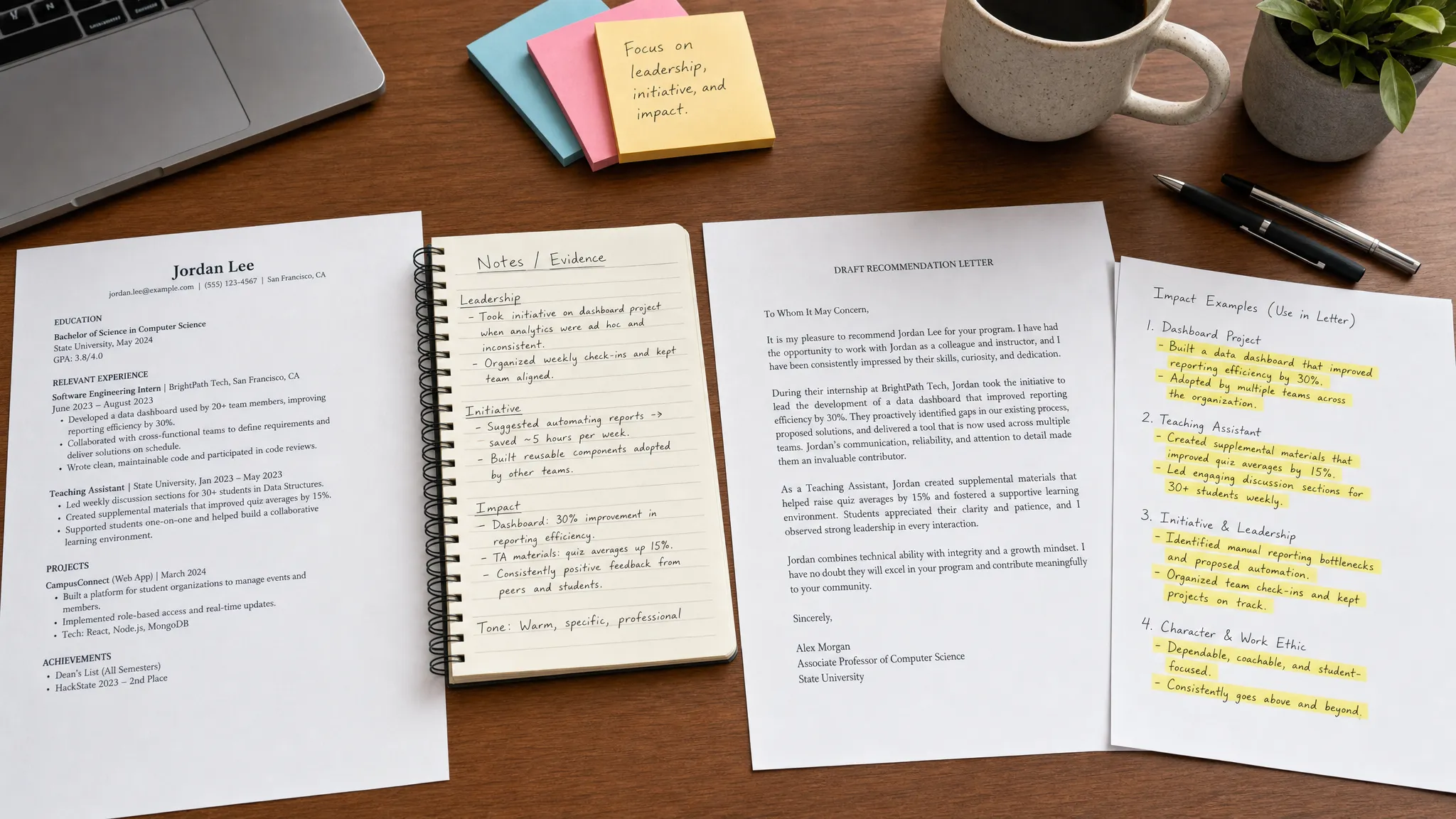
Professional LOR writers often create a short intake brief. This can be completed by the candidate, the recommender, or both. The goal is not to let the candidate invent the recommendation. The goal is to help the recommender remember accurate details and choose the strongest evidence.
| Source material | Why it matters | Example of useful detail |
|---|---|---|
| Target program, role, or award | Helps the letter match the reader's criteria | The scholarship values community leadership and academic persistence |
| Recommender relationship | Establishes credibility | I supervised the candidate for 18 months on a client operations team |
| Specific achievements | Prevents vague praise | Improved reporting accuracy by identifying a recurring data issue |
| Behavioral examples | Shows character in action | Stayed late to help two new team members prepare for a launch |
| Candidate goals | Connects past performance to future fit | Plans to pursue public health research focused on rural access |
| Deadlines and submission rules | Avoids administrative mistakes | Upload required through a portal by 11:59 p.m. Eastern Time |
This preparation stage also protects the recommender's integrity. If there is not enough direct experience to write a strong letter, the ethical choice may be to decline or write a narrower recommendation. A credible letter is always better than an inflated one.
They choose evidence over adjectives
Strong recommendation letters are built on evidence. Words like exceptional, motivated, and talented can help, but only when they are supported by proof. Without proof, they become filler.
The University of Wisconsin-Madison Writing Across the Curriculum program emphasizes the value of specific examples in recommendation letters because examples help readers understand the basis for the writer's judgment. That principle applies across academic, professional, and personal recommendation letters.
A useful method is to turn each major trait into a short evidence story. Instead of writing that a candidate has leadership potential, the LOR writer explains a moment when the candidate led. Instead of saying the applicant is intellectually curious, the writer describes a question the applicant pursued beyond the required assignment.
Consider the difference:
| Generic statement | Stronger evidence-based version |
|---|---|
| Maya is a strong leader. | Maya led a 6-person volunteer team during a weekend food distribution event, reorganizing roles when two volunteers canceled and keeping the event on schedule. |
| Daniel is very analytical. | Daniel noticed a pattern in customer complaints that others had missed, traced it to a documentation gap, and proposed a fix that reduced repeat questions. |
| Priya is hardworking. | Priya revised her capstone project three times after feedback, each time narrowing the research question and strengthening the data analysis. |
The stronger versions do not just praise the candidate. They let the reader see the candidate at work.
They build a structure that is easy to scan
Decision-makers often read many letters in a short period of time. Strong LOR writers respect that reality by using a clean structure, clear transitions, and short paragraphs.
A strong letter usually opens with the recommender's relationship to the candidate and the level of endorsement. The body then develops 2 or 3 strengths with evidence. The closing restates the recommendation and, when appropriate, offers availability for follow-up.
| Letter section | What strong LOR writers include | What they avoid |
|---|---|---|
| Opening | Relationship, context, and clear endorsement | A long introduction about the recommender |
| First body paragraph | The candidate's most relevant strength | A general personality summary |
| Second body paragraph | A concrete example that proves the strength | Repeating the resume |
| Fit paragraph | Why the candidate matches the opportunity | Generic lines that could apply to anyone |
| Closing | Confident recommendation and contact offer | Overly dramatic or exaggerated claims |
The structure should be invisible to the reader. It should feel natural, not formulaic. Good LOR writers use structure to create clarity, then use details to create trust.
They tailor the letter to the decision being made
A strong recommendation letter is not one-size-fits-all. LOR writers adjust emphasis based on the context. The same candidate may need different evidence for a master's program, a fellowship, a scholarship, a promotion, or a volunteer leadership role.
For academic opportunities, readers often care about intellectual curiosity, research habits, writing ability, and persistence. For employment, they may care more about judgment, collaboration, reliability, and measurable results. For scholarships, the strongest angle may combine achievement with purpose, values, and impact.
| LOR context | What to emphasize | Evidence that usually works well |
|---|---|---|
| College or graduate admission | Academic ability, curiosity, readiness for rigorous study | Research projects, class performance, original questions, growth after feedback |
| Scholarship | Merit, values, service, resilience, future contribution | Community work, leadership, obstacles overcome, mission alignment |
| Job or promotion | Performance, collaboration, leadership, problem-solving | Projects completed, team impact, measurable improvements, reliability under pressure |
| Internship | Potential, learning speed, professionalism | Coursework, early work examples, initiative, coachability |
| Character reference | Integrity, responsibility, personal judgment | Long-term relationship, consistent behavior, service, trustworthiness |
This is also where writers distinguish recommendation letters from adjacent documents. If the purpose is to support an application or request without formally evaluating a person, a supporting letter may be the more appropriate format.
They manage tone carefully
Tone is one of the hardest parts of LOR writing. Too flat, and the letter feels unenthusiastic. Too intense, and it may feel exaggerated. The best LOR writers sound warm, confident, and grounded.
A strong tone usually has three qualities. First, it is direct. The writer clearly states support instead of hiding behind cautious language. Second, it is measured. Claims are proportional to what the recommender has actually seen. Third, it is personal. The letter sounds like it came from a real mentor or supervisor, not a template.
This matters because decision-makers are good at spotting generic praise. Phrases such as one of the best students I have taught can be powerful, but only when the recommender can justify the comparison. If the writer cannot support that level of praise, a more precise statement is safer and often more credible.
Strong LOR writers also know when to include nuance. A thoughtful note about growth can make a candidate seem more real. For example, mentioning that a student initially struggled with public speaking but became a confident discussion leader after consistent practice can be stronger than pretending the student was perfect from day one.
They protect credibility and ethics
Recommendation letters are high-trust documents. LOR writers must protect the trust of the recommender, the candidate, and the reader.
If a candidate drafts material for a recommender, the recommender should review, revise, and approve the final version. The letter should reflect the recommender's genuine experience and judgment. A candidate should never impersonate a recommender, invent accomplishments, or submit a letter without permission.
Ethical LOR writers also avoid confidential or sensitive information unless it is relevant and appropriate to share. Health details, family circumstances, immigration matters, disciplinary issues, and personal hardships should be handled carefully. When in doubt, the writer should focus on observable behavior and verified achievements.
Credibility also means avoiding claims the recommender cannot defend. A letter does not need to say everything. It needs to say the right things with honesty.
They revise for specificity, flow, and human voice
The first draft of a recommendation letter is rarely the strongest version. Experienced LOR writers revise with the reader in mind. They remove repeated compliments, replace vague statements with examples, and check that every paragraph supports the recommendation thesis.
A useful editing pass asks these questions: can the reader understand who the recommender is, what the candidate did, why it mattered, and why the candidate fits the next opportunity? If any answer is unclear, the letter needs revision.
Strong editors also remove language that feels automated. Repeated superlatives, generic personality traits, and polished but empty phrases can make the letter weaker. Human-sounding writing includes small but meaningful details: the candidate's role in a project, the type of feedback they received, the way they handled a constraint, or the moment the recommender's opinion of them changed.
How applicants can help LOR writers do better work
Applicants often think their only job is to ask for the letter. In reality, the quality of the request affects the quality of the final recommendation. A rushed request with no context forces the writer to guess. A thoughtful request makes it easier to write something specific and useful.
Applicants should provide a concise packet that includes the opportunity description, resume, deadline, submission instructions, and a few reminders of shared work. The most helpful reminders are not just awards or grades. They are moments the recommender personally witnessed.
A strong request packet may include:
- A short explanation of why the opportunity matters
- The exact name of the program, role, award, or organization
- The submission deadline and delivery method
- A resume or activity list
- Two or three examples of work the recommender observed
- Any required prompts or evaluation criteria
- A polite note giving the recommender room to decline if they cannot write a strong letter
Give the recommender room to decline if they cannot describe the applicant's work with confidence. That keeps the request honest and avoids putting the writer under pressure to invent praise.
Where AI fits into the LOR writing process
AI can help LOR writers move from scattered notes to a polished first draft faster, but it should not replace the recommender's judgment. The strongest use of AI is as a drafting assistant: organize source material, suggest structure, refine tone, and create a clear version that the recommender can review.
CraftMyLetter is built for this kind of practical letter drafting. Choose a recommendation type, enter details you can verify, and review the draft before signing it. For recommendation letters, the quality still depends on the details you provide. The more specific the input, the stronger and more credible the draft can become.
Think of AI as the starting point, not the signature. The final letter should always be checked for accuracy, edited for personal voice, and approved by the actual recommender.
Frequently Asked Questions
What does LOR mean? LOR stands for letter of recommendation. It is a formal letter written by someone who can evaluate a candidate's skills, character, achievements, or potential for a program, job, scholarship, or other opportunity.
Who can be an LOR writer? An LOR writer can be a professor, teacher, manager, supervisor, mentor, advisor, colleague, or another person with direct knowledge of the candidate. A professional editor or AI tool may help draft or polish the letter, but the recommender should own and approve the final content.
What makes a recommendation letter strong? A strong recommendation letter has a clear endorsement, a credible recommender, specific examples, relevant evidence, and a tone that feels honest. It should explain not only that the candidate is impressive, but why the candidate is a strong fit for the opportunity.
How long should a letter of recommendation be? Check the destination's instructions for any length limit. Include enough detail to explain the relationship, evidence, and recommendation, then remove repeated praise.
Can applicants write their own recommendation letters? Follow the destination's instructions about authorship. If you provide notes or a draft, the recommender should review it and approve only descriptions they can verify from their own experience with you.
Can AI help write a LOR? Yes. AI can help organize details, create a draft, adjust tone, and save time. However, the recommender should verify every detail, personalize the language, and make sure the letter reflects their genuine judgment.
Build a stronger recommendation letter faster
Strong LOR writers do not rely on fancy language. They rely on preparation, evidence, structure, and honesty. When the right details are in place, the letter becomes more than a formality. It becomes a persuasive, credible case for the candidate's next step.
If you need a polished draft quickly, try CraftMyLetter. Add a few key details, choose the tone that fits, and generate a professional recommendation letter draft you can review, personalize, and send with confidence.
A sample based on specific observations
This fictional example shows the structure. Replace the observations with things the recommender actually witnessed; do not copy its claims about the student.
October 3, 2026
Dear Admissions Committee,
I am pleased to recommend Maya Chen for your graduate program. I taught Maya in my research methods seminar and supervised her final project on neighbourhood access to libraries.
When her first survey returned incomplete answers, Maya explained the limitation rather than hiding it. She revised the questionnaire, documented the change, and made sure her final conclusions reflected what the responses could support. Her presentation helped classmates understand both the result and its limits.
Maya also made time to explain her analysis to a classmate who was struggling with the same method. I saw her listen carefully, work through an example, and encourage the classmate to check the answer independently.
Based on this work, I believe Maya would contribute careful reasoning and a collaborative approach to your program. I recommend her with confidence.
Sincerely, Dr. Alex Rivera
Draft a student recommendation using your own observations, or start with the student recommendation template.
Write your letter of recommendation for student — not a blank template
Generate a finished letter of recommendation for student with your details, tone, and language in ~30 seconds. Free first letter, no credit card — beats copy-pasting and filling the blanks yourself.
Related Posts
AI Letter Generator: How to Write Any Professional Letter in 30 Seconds
Use an AI letter generator to write cover letters, complaints, resignations, and 70+ professional letter types in seconds. Free to try.
March 7, 2026
5 Resignation Letter Mistakes That Burn Bridges
The lines that quietly cost you a reference — and what to write instead. Five resignation letter mistakes, with fixes.
February 28, 2026