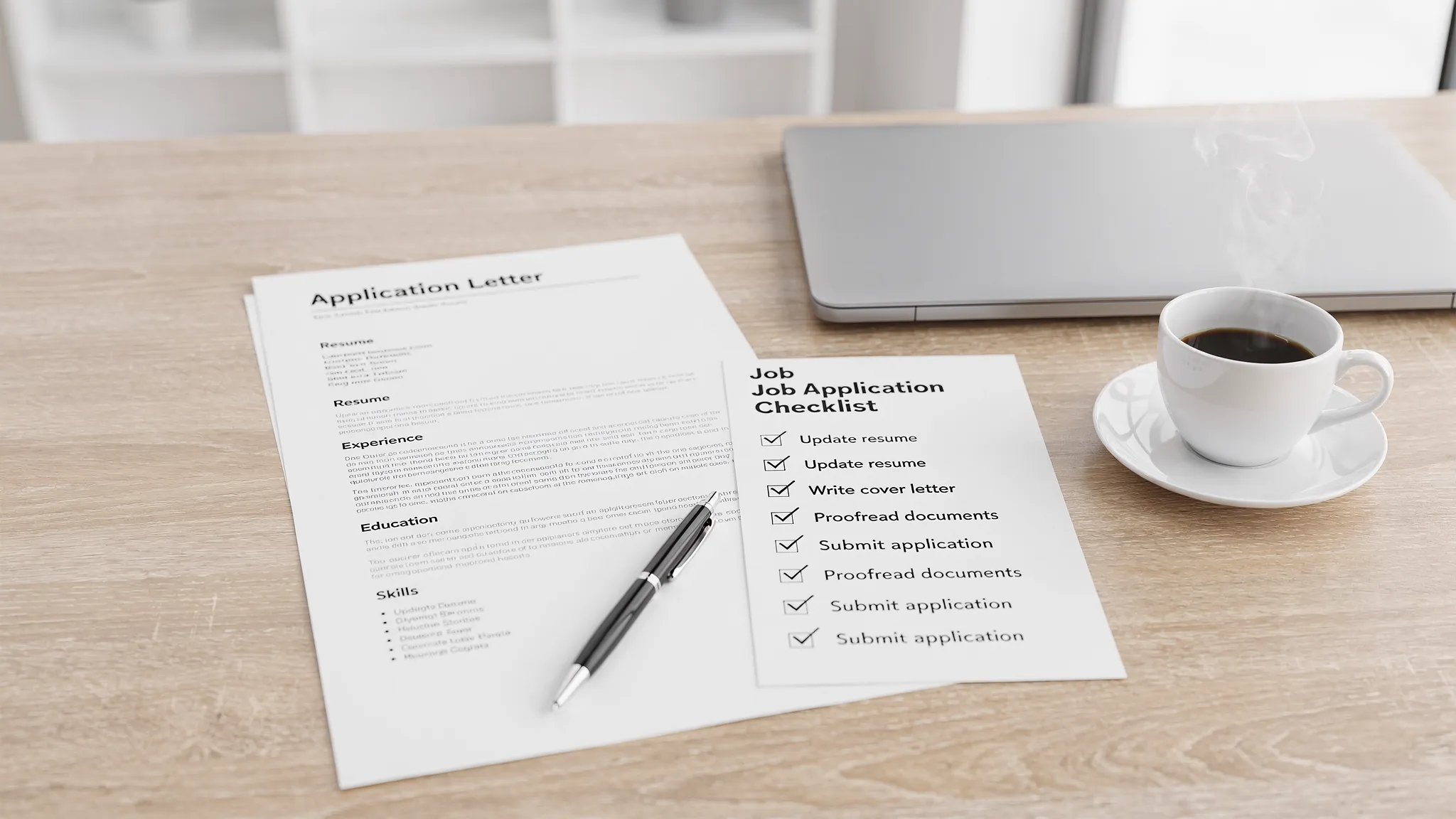
Application Letter Guide: Meaning, Format & AI Draft
Application letter meaning, format, and examples: what an application letter is, how it differs from a cover letter, and how to write one step by step.
Write your cover letter — not a blank template
Generate a finished cover letter with your details, tone, and language in ~30 seconds. Free first letter, no credit card — beats copy-pasting and filling the blanks yourself.
An application letter is a formal letter that introduces you and makes your case for a job, internship, scholarship, or program — the document that explains, in your own words, why you are the right fit. When an employer asks for one, they are usually looking for the one thing your resume cannot do by itself: a clear, written explanation of why you are a strong fit, in professional letter form.
This guide explains what an application letter is, how it differs from similar documents, and the situations where using one gives you a real advantage.
What is an application letter?
An application letter is a formal letter you submit to be considered for an opportunity, most commonly a job, internship, scholarship, program, or internal role. It introduces you, specifies what you are applying for, and makes a short case for why the organization should move you forward.
In practice, “application letter” is sometimes used interchangeably with “cover letter,” but many employers (and many government or academic processes) use “application letter” to mean a slightly more formal, standalone letter. It often reads more like business correspondence than a marketing page.
If you want a widely accepted baseline for professional letter expectations (format, tone, clarity), Purdue’s writing guidance is a solid reference point: Purdue OWL’s cover letter resources.
Application letter vs cover letter vs letter of interest
These documents overlap, but they are not identical. The easiest way to choose the right one is to look at whether you are responding to a specific opening, and how formal the requested document is.
| Document | What it’s for | Usually attached to | Typical tone | Best used when |
|---|---|---|---|---|
| Application letter | A formal written application that can stand on its own | Resume, forms, supporting documents | Formal, business letter style | The posting or process explicitly asks for an “application letter,” especially in academic, government, or international contexts |
| Cover letter | A tailored pitch that complements a resume | Resume, portfolio, application | Professional but more sales oriented | You are applying to a specific role and want to connect your experience to the job description |
| Letter of interest (prospecting letter) | Expresses interest when there is no listed opening | Resume (optional) | Professional, exploratory | You want to start a conversation, request consideration, or ask about upcoming roles |
If the employer uses the phrase “application letter,” follow that instruction. Matching requested materials is a small signal of professionalism that can matter when hiring teams are screening quickly. For a deeper side-by-side comparison, read our full breakdown of the application letter vs cover letter difference.
When should you use an application letter?
An application letter is most useful when the process values formal documentation, when competition is high, or when context matters.
1) When the posting explicitly requests it
This is the most straightforward case. If an employer asks for an “application letter,” treat it as required, even if there is also an optional “cover letter” field.
Common phrasing includes:
-
“Submit a resume and application letter.”
-
“Attach an application letter describing your qualifications.”
-
“Include an application letter addressing the selection criteria.”
In these cases, your letter is not only about persuasion. It is also about compliance and clarity.
2) When you need to address selection criteria (especially in public sector or academia)
Some roles require you to respond directly to defined criteria (skills, competencies, experience areas). An application letter is the cleanest way to:
-
Mirror their criteria headings in your own wording
-
Provide short proof (outcomes, metrics, scope)
-
Keep your resume from becoming overly long or repetitive
This is also where a more formal letter style tends to be expected.
3) When you are applying by email (or a portal that expects a letter upload)
If you are emailing a hiring manager or HR contact, an application letter can act as your professional “front page.” You can either:
-
Attach it as a PDF, and keep your email brief, or
-
Use the letter content as the body of the email (if they prefer no attachments)
If a portal asks for “letter” upload, a dedicated application letter is the safest choice.
4) When your situation needs brief context
An application letter is especially valuable when the reader may otherwise make assumptions. For example:
-
You are changing industries
-
You have a gap you want to frame confidently
-
You are relocating
-
Your title does not obviously match the job level
You do not need to overexplain. One or two sentences of context, followed by evidence of fit, is usually enough.
For job specific guidance, you can also read: How to Write a Job Application Letter That Actually Gets You Hired.
5) When the opportunity is competitive and “optional” materials are actually differentiators
Some applications list letters as optional. In competitive pools, “optional” often means “helpful if it adds substance.” A strong application letter can:
-
Prove you researched the organization
-
Highlight one or two relevant wins with numbers
-
Connect your motivation to the role (not just “I’m a hard worker”)
If you are unsure whether it is worth writing, this is a practical read: Are Cover Letters Dead in 2026? Here’s What the Data Actually Says.
Application letter format and structure
Every strong application letter follows the same seven-part skeleton. If you can fill in each part, the letter is effectively written:
-
Header — your name, phone, email, and city, matching your resume. In an email application, this moves to your signature.
-
Date and recipient details — the submission date, plus the recipient’s name, title, and organization when you know them.
-
Salutation — “Dear [Name],” beats “Dear Hiring Manager,” which beats “To Whom It May Concern.”
-
Opening paragraph — name the exact role or program and give a one-sentence case for your fit.
-
Body paragraphs — one or two paragraphs of evidence: scope, actions, and measurable results that match the stated requirements.
-
Closing paragraph — restate interest, thank the reader, and ask for the next step.
-
Signature — “Sincerely” or “Best regards,” plus your name.
Keep the finished letter to 200–400 words on a single page, in a readable font, and send it as a PDF unless the employer requests another format.
What an effective application letter includes
A good application letter is short, specific, and easy to scan. In most professional contexts, aim for three to five short paragraphs.
Professional header and clear subject line
If you are uploading a document, use a standard business header (your name, phone, email, city/state). If you are emailing, use a subject line that makes routing easy, for example: “Application: Marketing Coordinator, Job ID 1842, Taylor Nguyen.”
A direct opening that names what you want
In the first two lines, include:
-
The opportunity (role, program, or posting reference)
-
A one sentence positioning statement (who you are and why you fit)
This is not the place for a long story. Clarity beats cleverness.
One core section that proves fit with evidence
Instead of listing skills, connect them to outcomes. Strong proof usually looks like:
-
Scope (team size, budget, volume)
-
Action (what you did)
-
Result (measurable impact)
If you are writing for roles that value concise persuasion, you may also like: How to Write a Cover Letter That Gets Interviews in 2026.
A close that makes next steps easy
End with:
-
A polite call to action (request an interview, express interest in discussing)
-
A note about attached documents
-
A professional sign off
Formatting and length: what works in 2026
Even when a letter is “formal,” modern readers still prefer brevity.
-
Length: Often 200 to 400 words is enough for most roles. If you must address multiple selection criteria, you can go longer, but keep paragraphs short.
-
Font and spacing: Use a readable font and generous spacing. If it looks dense, it feels harder to read.
-
File format: PDF is usually safest for preserving formatting. If a portal requests DOCX, follow that.

A complete application letter example
Here is a realistic example for a customer operations role. Notice how it names the role, proves fit with one concrete result, and closes with a clear next step — all in under 250 words:
Jordan Lee
jordan.lee@email.com
(555) 014-8273
Austin, TX
May 14, 2026Dear Hiring Manager,
I am applying for the Customer Operations Coordinator position at Brightline Home Services. With four years of experience supporting customer service teams and improving scheduling workflows, I am confident I can help your operations team deliver timely, organized, and professional support.
In my current role as a Client Support Specialist, I manage daily communication with customers, coordinate technician schedules, and maintain service records across multiple platforms. Last year, I introduced a shared follow-up tracker that reduced missed customer callbacks and improved team visibility into open service requests. That experience strengthened my ability to manage details, communicate clearly, and solve problems under time pressure.
I am especially interested in this position because it combines customer communication with process improvement. Your posting’s emphasis on accurate scheduling, cross-team coordination, and responsive service aligns closely with the work I do today.
Thank you for considering my application. I would welcome the opportunity to discuss how my customer operations experience can support Brightline Home Services.
Sincerely,
Jordan Lee
Why this works: it does not try to cover everything. It picks the most relevant experience, includes one concrete improvement, and connects the applicant’s background to the specific role.
How to write an application letter, step by step
You can produce a solid application letter in about 20 minutes. Work through these steps in order:
-
Read the posting and mark the top three requirements. These are the criteria your letter has to answer.
-
Gather your inputs. The exact role title, the recipient’s name if you can find it, and one or two achievements that prove you meet the requirements.
-
Write a direct opening. Name the role and position yourself in one sentence — skip “I am writing to express my interest.”
-
Prove fit with evidence. One or two short paragraphs covering scope, action, and result. Numbers help, but a specific project or outcome works too.
-
Add one line of genuine motivation. Reference something real about the organization — a product, mission, or current priority.
-
Close with a confident ask. Thank the reader and request an interview or the next step in the process.
-
Proofread names, titles, and details, then save the file with a clear name such as “Jordan-Lee-Application-Letter.pdf.”
If you would rather skip the blank page, you can generate an application letter from your details in about 30 seconds and then personalize the proof points before sending.
Common mistakes that weaken an application letter
Repeating the resume instead of interpreting it
If your letter restates job duties, it adds no value. Your letter should translate experience into relevance for this specific opportunity.
Being generic about the company
Hiring teams can spot “copy and paste” language quickly. One concrete detail, such as a product line, mission, or recent initiative, signals that you are intentional.
Overexplaining or apologizing
Context is fine. Apologies are not. Keep explanations factual and brief, then pivot to strengths.
Using the wrong level of formality
Application letters tend to be more formal than casual emails, but they should still sound human. Avoid stiff, outdated phrasing if it does not match the industry.
Types of application letters
The fundamentals above apply everywhere, but the emphasis shifts with the opportunity. These are the three most common types of application letter, each with its own dedicated guide:
Job application letter. The most common type: a formal letter sent with your resume for a specific opening, focused on matching the job’s requirements with evidence from your work history. See the full guide to writing a job application letter that gets you hired, or generate one from your details.
Application letter for students. Students and recent graduates lean on coursework, projects, internships, and leadership roles instead of a long work history, and admissions-style letters follow their own conventions. Our guide to college application letters covers the structure, tone, and a template.
Scholarship application letter. Scholarship committees look for a clear link between your goals, your record, and their award criteria, so this letter reads closer to a persuasive essay in letter form. See how to write a scholarship application letter.A faster way to draft an application letter (without sounding generic)
A faster way to draft an application letter (without sounding generic)
If you struggle to start from a blank page, using a structured generator can help you get a solid draft quickly, then you can personalize it.
With CraftMyLetter's application letter generator, you can generate an application letter from your details in about 30 seconds: enter a few details, choose a tone, and get a polished draft. From there, add the details that make it yours (a specific achievement, a company reference, one line of motivation), then export to PDF or copy and paste where needed.
If you are also considering a more traditional cover letter format, you can compare approaches with: Free Cover Letter Templates for Every Industry (2026).
Write your cover letter — not a blank template
Generate a finished cover letter with your details, tone, and language in ~30 seconds. Free first letter, no credit card — beats copy-pasting and filling the blanks yourself.