
Cover Letter Writing Service: Is It Worth Paying For?
Is a cover letter writing service worth paying for? Compare benefits, risks, and alternatives, plus how to draft tailored letters in 30 seconds.
Paying for a cover letter writing service can feel like a shortcut, or like an unnecessary expense for something you “should” be able to do yourself. In 2026, the real question is less about whether cover letters matter (they often do), and more about whether a paid service reliably produces something better than you can create with the right process.
This guide breaks down what you actually get when you pay, when it’s worth it, what to watch out for, and a practical alternative that gets you 80 percent of the way there in minutes.
What a cover letter writing service really is (and isn’t)
A cover letter writing service typically falls into one of these categories:
- Template-based “personalization” services: you answer a questionnaire, they swap in details, and you get a polished but often generic letter.
- Professional resume/cover letter writers: a writer interviews you, reviews your resume and target roles, then drafts a tailored letter.
- Career coaches: you get strategy plus writing help, sometimes including interview prep.
- Recruiter-style editing: less “writing from scratch,” more tightening and positioning.
The key point: you’re not only buying grammar and formatting. You’re buying positioning (what to emphasize, what to leave out, and how to tell a coherent story for that specific role).
What a service usually does not do well by default:
- Deep company research for every application (unless you’re paying for a very high-touch package)
- Truth-checking your achievements
- Guaranteeing interviews (anyone implying this is a red flag)
Why people pay, the 5 real benefits
A good service can absolutely be worth it, but only in situations where the service is solving a painful problem.
1) You’re stuck and losing time
If you’re staring at a blank page, the biggest value is momentum. A solid first draft can turn “I’ll apply tomorrow” into “submitted today.”
2) You need stronger positioning (not just nicer wording)
Cover letters work best when they connect your experience to the employer’s needs. Many candidates default to:
- repeating their resume
- listing skills without proof
- writing generic motivation
A strong writer can help you build a clear narrative: “Here’s what I did, here’s the measurable outcome, here’s why that maps to your role.”
3) Career change, gaps, layoffs, or a non-traditional path
When your resume raises questions, the cover letter’s job is to reduce uncertainty quickly.
If you’ve been laid off, for example, you often want a neutral, brief framing and then a fast pivot to results and fit. (If you want a proven structure, see LetterCraft’s guide to a simple framework: Hook, Evidence, Close.)
4) English is not your first language
A service can help you sound natural and confident, especially in industries with strong expectations around tone.
5) You’re targeting high-stakes roles
For executive, leadership, government, or highly competitive positions, it can make sense to invest more in the written narrative because the upside is higher.
The downside, when paying is a waste (or risky)
Not all services are equal, and some are actively harmful.
Generic letters can lower your response rate
If the letter reads like it could be sent to any company, it’s often worse than sending nothing. Hiring teams have seen thousands of formulaic intros.
Voice mismatch is real
If your cover letter sounds nothing like you, it can create friction later, especially in interviews. You want help, not a costume.
Privacy and scam risks
Many services ask for sensitive info (address, phone number, employment history). Be careful where that data goes.
The U.S. Federal Trade Commission has repeatedly warned jobseekers about job scams and the misuse of personal information during the hiring process. It’s worth skimming their guidance before sharing details with any vendor: FTC job scam resources.
A simple “is it worth it?” decision test
Ask yourself two questions:
1) Is this a high-leverage application?
High leverage usually means:
- the role is a major step up in pay, scope, or stability
- you have a referral or an internal path
- the company is a top target (you would genuinely take the job)
If you’re applying to 80 roles in a week with minimal customization, paying per letter rarely makes sense.
2) Is your bottleneck strategy or execution?
- If your bottleneck is execution (you can write, you just don’t have time), a faster drafting method may be enough.
- If your bottleneck is strategy (you don’t know what angle to take, or your story feels messy), a human can be worth paying for.
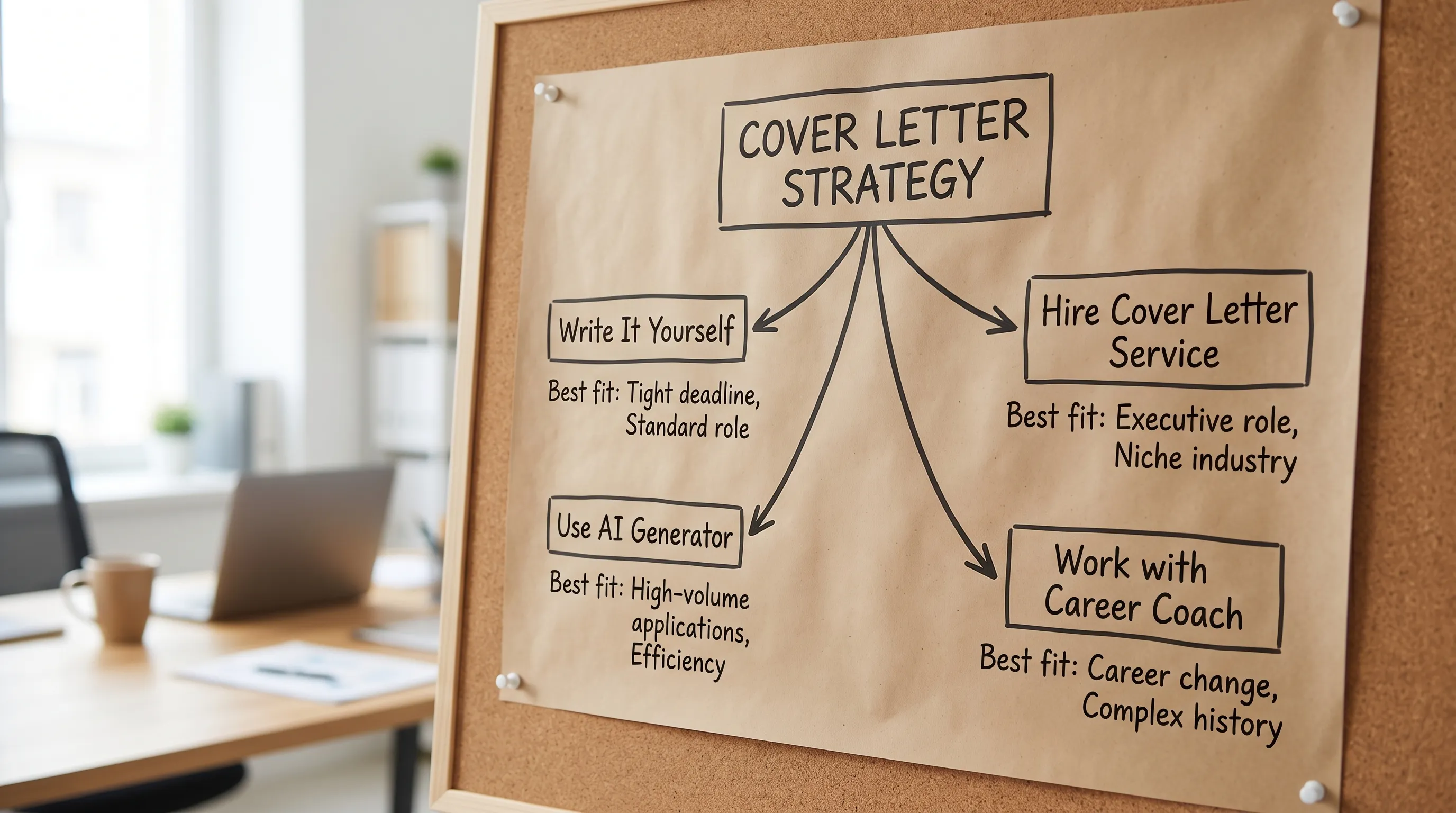
What you should expect from a quality cover letter writing service
Before paying, you should be able to clearly understand the process. A credible service typically offers:
- A short intake interview or questionnaire that asks about the target job, achievements, and constraints
- A focus on proof (numbers, scope, outcomes), not just adjectives
- A draft that matches your voice (direct, friendly, formal, confident)
- At least one revision cycle
- Clarity on turnaround time
- Clear policies on confidentiality and data handling
If you’re applying for specialized roles, you also want someone who understands your domain language. For instance, marketing candidates should be able to speak to outcomes like pipeline contribution, CAC, ROAS, conversion rates, and experimentation. If you need help translating your work into business impact, a strategy-focused consultant can be useful alongside writing support, for example a digital strategy and marketing services consultant who can help you articulate results in a way leadership teams recognize.
Red flags to avoid
These are common warning signs that you’re about to pay for a generic letter:
- Promises like “guaranteed interviews” or “ATS certified cover letter”
- No questions about the job posting
- They refuse to show anonymized samples
- The service pushes you to buy a bundle without understanding your goal
- Overly inflated claims about “secret recruiter formulas”
The realistic alternatives (often better than paying per letter)
For most jobseekers, the best results come from a hybrid approach: fast drafting plus smart customization.
Here’s how the common options stack up:
| Option | Best for | Upside | Tradeoff |
|---|---|---|---|
| DIY from scratch | Writers who have time | Full control and authentic voice | Slow, easy to overthink |
| Templates | Entry-level and routine roles | Fast, simple | Can sound generic if not adapted |
| AI letter generator | High-volume or tight deadlines | Speed plus structure | Needs human editing to sound like you |
| Professional writing service | High-stakes roles, messy narratives | Strong positioning and polish | Quality varies, can be expensive |
| Career coach | Career pivots, senior roles | Strategy plus accountability | Highest time and cost investment |
A practical middle path: draft with AI, then personalize like a human
If your main challenge is speed (not strategy), an AI-first workflow often beats paying for a one-off letter.
With LetterCraft AI, you can generate a tailored draft in about 30 seconds by entering a few details, then refine it to match your voice. It’s designed specifically for professional letters (not generic chat), and supports multiple tones, PDF export, and letter history so you can reuse what works.
A simple workflow that stays authentic:
Step 1: Feed the tool better inputs
The output quality depends on what you provide. Include:
- the exact job title and a few keywords from the posting
- 2 to 3 achievements with metrics (revenue, time saved, volume, quality scores)
- a real reason you want this company (product, mission, team, market)
Step 2: Add one “only I would say this” detail
This is the fastest way to avoid a generic feel:
- a specific project you’re proud of
- a challenge you solved that maps to the role
- a short, true reason you’re excited (not flattery)
Step 3: Tighten and remove “AI-sounding” filler
Delete vague lines like “I am confident I would be a great fit” and replace them with proof.
If you’re worried about AI detection, focus on authenticity, specificity, and sentence variety. (LetterCraft also covers this topic in detail: Will your AI cover letter get flagged?)
So, is a cover letter writing service worth paying for?
It’s worth paying for a cover letter writing service when:
- the role is high leverage (you will genuinely take it)
- your story needs strategy (career change, senior scope, gaps)
- you need a strong narrative quickly and you can’t afford trial-and-error
It’s usually not worth paying when:
- you’re applying at high volume with low customization
- the service can’t explain their process or show samples
- you mainly need a first draft, not deep positioning
In practice, many jobseekers get the best ROI by using a purpose-built generator to produce a structured draft, then spending their time where it counts: adding specifics and aligning proof to the role.
Frequently Asked Questions
How much does a cover letter writing service cost? Prices vary widely depending on whether you’re getting a template edit, a custom writer, or coaching. Expect anything from relatively low-cost edits to premium, interview-based writing.
Can hiring managers tell if I paid for a cover letter? They can’t “detect” payment, but they can spot generic language or a voice mismatch. The goal is a letter that sounds like you and proves impact.
Is it ethical to use a cover letter writing service? Yes, as long as the content is truthful and based on your real experience. Think of it like editing support, not outsourcing your identity.
Is it better to pay for a service or use AI? If you need strategy and positioning, a strong human can help. If you need speed and structure, AI plus careful personalization is often enough.
How do I make sure the letter doesn’t sound generic? Add one company-specific detail, include at least one measurable achievement, and remove filler phrases that don’t add evidence.
What information should I never share with a writing service? Avoid sharing unnecessary sensitive data upfront (SSN, banking info). Share only what is needed to write the letter, and confirm their privacy practices.
Create a tailored cover letter in 30 seconds (then make it yours)
If you want a faster alternative to paying for a cover letter writing service, try LetterCraft AI. You can generate a personalized draft in under 30 seconds (no credit card required), choose a tone, export to PDF, and reuse past letters from your history, then spend your time on the final edits that actually get interviews.