
Application Letter Sample: Copy-and-Paste Example for 2026
Application letter sample for 2026: copy-paste template, email version, and quick customization tips to sound specific, confident, and human.
If you’re searching for an application letter sample you can copy, paste, and send in 2026, the biggest risk is also the most common: using a “nice” template that says nothing specific.
Hiring teams skim fast, ATS systems parse faster, and recruiters have read every generic sentence a thousand times. The good news is that a modern application letter is short, proof-based, and easy to customize if you start with the right structure.
Below you’ll find a ready-to-use sample (plus an email version), a quick “swap line” library, and a 10-minute customization method that keeps your letter sounding human.
What an application letter needs to do in 2026
An application letter is not your resume in paragraph form. In 2026, it’s a one-page argument that answers three questions quickly:
- Why this role? (You’re not mass applying.)
- Why you? (You can prove impact, not just claim skills.)
- Why this company? (You understand the context and priorities.)
A strong letter is usually 200 to 350 words, uses the job posting’s language naturally, and gives 1 to 2 proof blocks with measurable outcomes (speed, quality, revenue, cost, conversion, time saved, customer satisfaction, risk reduced).
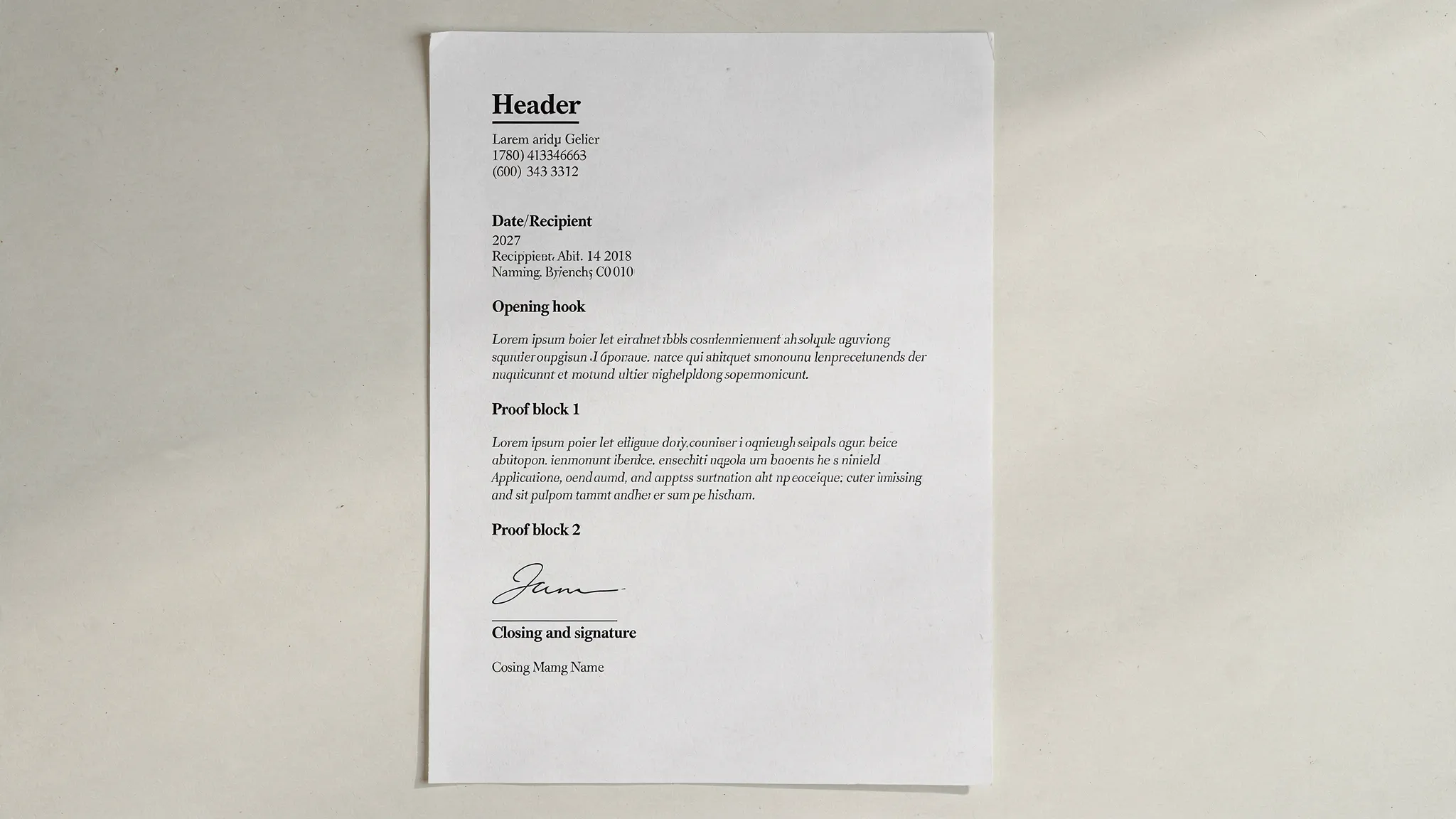
Application letter sample (copy and paste)
Use this as your base. Then replace every bracketed section with real details.
[Your Name]
[City, State] | [Phone] | [Email] | [LinkedIn or Portfolio]

[Date]

[Hiring Manager Name]
[Company Name]
[Company Address]

Dear [Hiring Manager Name],

I’m applying for the [Job Title] role at [Company Name]. I bring [X years / X months] of experience in [relevant function], and I’m confident I can help your team [deliver outcome tied to job post, for example “reduce cycle time,” “grow pipeline,” “improve customer retention,” or “ship reliable features”]. What drew me to [Company Name] is [specific company signal: product, mission, growth stage, recent launch, values, or team focus].

In my current/most recent role at [Current Company], I [achievement #1 with metric]. For example, I [what you did] by [how you did it], resulting in [measurable result]. This matters for your [Job Title] opening because the job description emphasizes [requirement from the posting], and I’ve already delivered that type of outcome in a real environment.

I can also contribute immediately to [second priority area]. Recently, I [achievement #2 with metric], collaborating with [cross-functional partners] and using [tools/methods] to [result]. If hired, I would apply the same approach to [Company Name] by focusing first on [first 30 to 60 day focus that is realistic and role-relevant].

I’d welcome the chance to discuss how my background in [skill area] can support [Company Name]’s goals in 2026. Thank you for your time and consideration.

Sincerely,
[Your Name]
When this sample works best
This format performs well when:
- The job post asks for an “application letter” or “cover letter”
- You’re applying through email, a referral, or a more formal process (education, government, compliance-heavy industries)
- You need to add context that’s not obvious from your resume (career change, gap, relocation)
If you want a deeper explanation of when to choose an application letter vs other formats, see our guide on what an application letter is and when to use it.
10-minute customization method (so you don’t sound generic)
The fastest way to personalize is to edit only the sections that hiring teams actually notice.
Step 1: Mirror the job post in one sentence
In your first paragraph, include:
- The exact job title
- 1 outcome the role owns
- 1 company-specific reason you care
Example:
I’m applying for the Customer Success Manager role at BrightDesk, and I’m confident I can help reduce churn for SMB accounts by strengthening onboarding and expansion playbooks.
Step 2: Add two proof blocks (each with a metric)
Your body should be two mini-stories:
- What you improved (and by how much)
- How you did it (tools, process, collaboration)
If you don’t have perfect metrics, use “credible approximations” that are still honest:
...cut average response time from about 18 hours to under 6 hours...
Step 3: Make the close specific, not polite
A strong closing references what you’ll discuss, not just “hope to hear from you.”
I’d love to discuss how I’d approach improving activation in the first 60 days.
For more structure help, this cover letter format guide is also useful, even when the employer calls it an application letter.
“Swap lines” you can plug in (by situation)
Use this table to quickly tailor your application letter sample without rewriting from scratch.
| Situation | Opening line you can paste | Proof line you can paste | Closing line you can paste |
|---|---|---|---|
| You have a referral | “I’m applying for [Job Title] at [Company] after speaking with [Name], who suggested my experience in [area] could help with [team priority].” | “In [context], I partnered with [team] to [action], which led to [result].” | “If helpful, I can share a brief plan for how I’d tackle [problem] in my first 30 days.” |
| Career change | “I’m applying for [Job Title] after transitioning from [old field] to [new field], where I’ve focused on [relevant skill].” | “Most relevant to this role, I’ve delivered [transferable outcome] by [transferable method].” | “I’d welcome the chance to explain how my background helps me perform strongly in [new role’s key requirement].” |
| Entry-level or recent grad | “I’m applying for [Job Title] and would bring strong foundations in [skills] plus hands-on experience from [project/internship].” | “In [project], I [did X], using [tools], and achieved [result].” | “I’m excited to bring a high-ownership approach to [team goal] and grow in the role.” |
| Remote-first role | “I’m applying for [Job Title] and have succeeded in remote teams by using clear writing, predictable updates, and measurable deliverables.” | “I improved [metric] while coordinating across [time zones/functions] via [tools].” | “I’m happy to walk through my async workflow and how I keep stakeholders aligned.” |
| Mission-driven organization | “I’m applying for [Job Title] because your work on [mission] aligns with my long-term focus on [impact area].” | “I’ve contributed to mission work by [action], resulting in [impact].” | “I’d value a conversation about how this role supports your 2026 priorities.” |
If you’re applying to a mission-driven organization, spend 3 minutes reading their “why” before you write. Even a quick scan of a movement’s mission, like the continuous direct democracy movement at JustSocial.io, gives you concrete language to reference (and helps your letter feel intentional, not templated).
Email application letter sample (short version)
When the employer expects your application letter in the email body, keep it tighter and treat attachments as optional unless requested.
Subject: Application for [Job Title] – [Your Name]

Hi [Hiring Manager Name],

I’m applying for the [Job Title] role at [Company]. I bring experience in [relevant area], including [one proof point with metric], and I’m excited about [company-specific reason].

In my recent role at [Company], I [achievement #1 with metric]. I also [achievement #2 with metric], working closely with [team] to deliver results in [area tied to job post].

If it’s helpful, I can share a quick outline of how I’d approach [priority] in my first 30 to 60 days. Thank you for your time.

Best regards,
[Your Name]
[Phone] | [LinkedIn/Portfolio]

Attachment: Resume (PDF)
Common mistakes that get application letters ignored
Too much “I” and not enough outcomes. Confidence is good, but hiring teams want evidence. Make each paragraph earn its space.
Repeating your resume bullets. Your letter should explain the “so what” behind your strongest bullet points.
Trying to cover everything. Two proof blocks are usually enough. A third can dilute your best story.
Sounding AI-written. AI is fine for drafting, but final text should include at least one detail that only you would know (a project constraint, a tradeoff you made, a specific stakeholder, a lesson learned).
Need a faster draft? Use LetterCraft AI (then personalize)
If you like the structure above but don’t want to start from a blank page, you can draft an application letter in under 30 seconds with LetterCraft AI. It supports 65+ letter types, multiple tone options, PDF export, letter history, and 5 languages, and it’s free to try with no credit card.
A good workflow is:
- Generate a first draft with your role, 2 achievements, and the job post keywords
- Replace placeholders with 2 company-specific details
- Read it aloud once and trim anything that sounds like “template language”
Frequently Asked Questions
What is the best length for an application letter in 2026? Most strong application letters are 200 to 350 words (about half to three-quarters of a page). Aim to be scannable and proof-based.
Can I use the same application letter sample for every job? Use the same structure, yes. Reuse the same exact text, no. Update the opening (company signal) and the two proof blocks (requirements and metrics) for each role.
Should an application letter be formal? Match the company’s culture and the posting. For government, education, and compliance-heavy roles, more formal is safer. For startups, concise and direct often works best.
Is an application letter the same as a cover letter? Many employers use the terms interchangeably, but “application letter” can imply a slightly more formal tone and a clearer statement of purpose. When in doubt, keep it professional and specific.
How do I write an application letter if I don’t have metrics? Use measurable proxies (time saved, volume handled, error reduction, turnaround time) or credible ranges. You can also quantify scope (users served, tickets handled, budget managed) without exaggerating.
Create a personalized application letter in 30 seconds
Want this sample tailored to your exact role, experience, and tone? Try LetterCraft AI to generate a polished, ready-to-send application letter quickly, then customize it with your details so it reads like you, not a template.