
Cover Letter for Job Application Template That Gets Interviews
Cover letter for job application template you can copy fast, customize with proof, and use to get interviews, plus an email version and FAQs.
Most cover letters fail for one simple reason: they sound like they could have been sent to any company.
A strong cover letter for job application template solves that by giving you a structure that forces specifics: the role you want, the problem you can help solve, and proof you have done it before. Below is a copy-ready template designed to be scanned quickly and still feel personal, plus practical examples for customizing it so it actually leads to interviews.
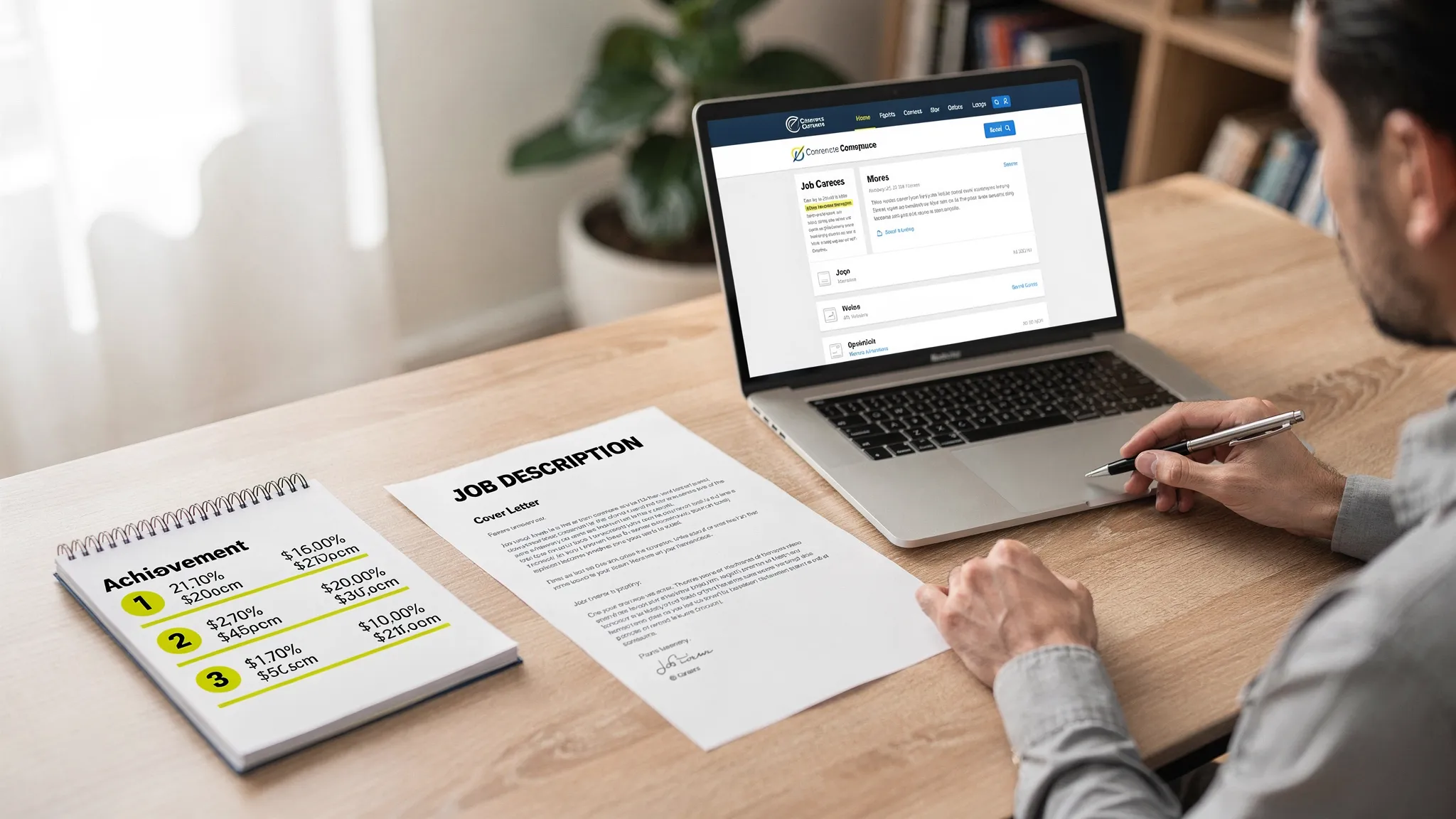
What an interview-winning cover letter does (in under 45 seconds)
Hiring teams do not open a cover letter hoping to read your life story. They are looking for fast signals:
- Role fit: you understand what the job requires (not just the title).
- Proof: you have results that map to their needs.
- Motivation: a believable reason you want this job at this company.
- Clarity: the letter is easy to skim and feels confident, not desperate.
A template is useful only if it helps you deliver those four signals quickly.
Gather these details first (this is where most “templates” go wrong)
Before you paste any template, spend 6 minutes collecting:
- The exact job title as posted
- 2 responsibilities the role is clearly hiring for (from the job description)
- 1 company fact you can reference (product launch, recent news, mission, customer segment)
- 2 achievements you can prove with numbers (even small ones)
- The name of the hiring manager (if you can find it)
- One line that connects your background to the role (especially important for career changes)
If you cannot find the hiring manager, “Hiring Manager” is better than “To whom it may concern.”
Cover letter for job application template (copy, paste, customize)
Use this for a PDF attachment or an application portal. Keep it to about 250 to 400 words.
[Your Name]
[City, State] | [Phone] | [Email] | [LinkedIn or Portfolio]

[Date]

[Hiring Manager Name]
[Company Name]

Dear [Hiring Manager Name],

I’m applying for the [Job Title] role at [Company Name]. In my current/most recent role as [Your Current Role] at [Current Company], I [top relevant outcome with metric], which aligns with your need for [responsibility/problem from job description]. I’m excited about [Company Name] because [specific reason tied to team/product/mission].

Here are two examples of the impact I would bring to this role:

- [Proof Point #1: action you took + measurable result + context].
- [Proof Point #2: action you took + measurable result + context].

What makes me a strong fit for your team is my ability to [skill #1 tied to posting] and [skill #2 tied to posting] while staying focused on [business outcome that matters in this role]. If helpful, I can share a brief 30/60/90-day outline for how I would approach [priority area in the job].

Thank you for your time and consideration. I’d welcome the chance to discuss how my experience in [relevant area] can help [Company Name] achieve [specific goal].

Sincerely,
[Your Name]
Email version (when there is no upload field)
Subject: [Job Title] application, [Your Name]

Hi [Hiring Manager Name],

I’m applying for the [Job Title] role. In my recent work as [Your Current Role] at [Company], I [top relevant outcome with metric]. I’m particularly interested in [Company Name] because [specific reason].

Two relevant examples:
- [Proof Point #1 in one sentence].
- [Proof Point #2 in one sentence].

If it’s useful, I can share a short 30/60/90-day plan for [priority area].

Thanks for your time,
[Your Name]
[Phone] | [LinkedIn/Portfolio]
How to customize this template so it does not sound generic
Customizing is not “changing a few adjectives.” It is swapping in information that proves the letter could only belong to you.
1) Replace the first sentence with a credible outcome
Avoid: “I’m excited to apply for…”
Use outcomes that match the job:
- “In the last 12 months, I reduced onboarding time by 28% by rebuilding our enablement materials and training flow.”
- “I managed a 30-account book of business and improved renewal rate from 86% to 92% by tightening QBR cadence and risk tracking.”
If you do not have metrics, use scope:
- “I supported 40+ weekly customer tickets across billing, product, and integrations, consistently meeting SLA targets.”
2) Add one company-specific line that shows real intent
One good line beats a paragraph of flattery:
- “I noticed you’re hiring this role as you expand into mid-market healthcare, and I’ve worked directly with compliance-heavy buyers and longer sales cycles.”
Where to pull this from:
- The company’s blog or newsroom
- The team’s product page
- The job description itself (often it hints at a new initiative)
3) Choose proof points that match the job’s priorities
A common mistake is picking your “biggest” wins instead of your most relevant wins.
Use this quick matching approach:
| If the job emphasizes… | Choose proof that shows… | Example angle |
|---|---|---|
| Speed and execution | shipped outcomes fast | “delivered X in Y weeks” |
| Customer impact | retention, NPS, resolution time | “reduced churn by…” |
| Revenue | pipeline, conversion, deal size | “increased qualified leads by…” |
| Operations | cost, errors, cycle time | “cut processing time by…” |
| Collaboration | cross-functional work | “aligned Sales and Product to…” |
4) Keep your “proof” sentences tight
A strong proof sentence usually follows this pattern:
Action + Result + Context
Example:
- “Built a weekly reporting workflow that reduced manual spreadsheet work by 6 hours per week for the finance team.”
That is clearer than:
- “Responsible for building reports and supporting finance stakeholders.”
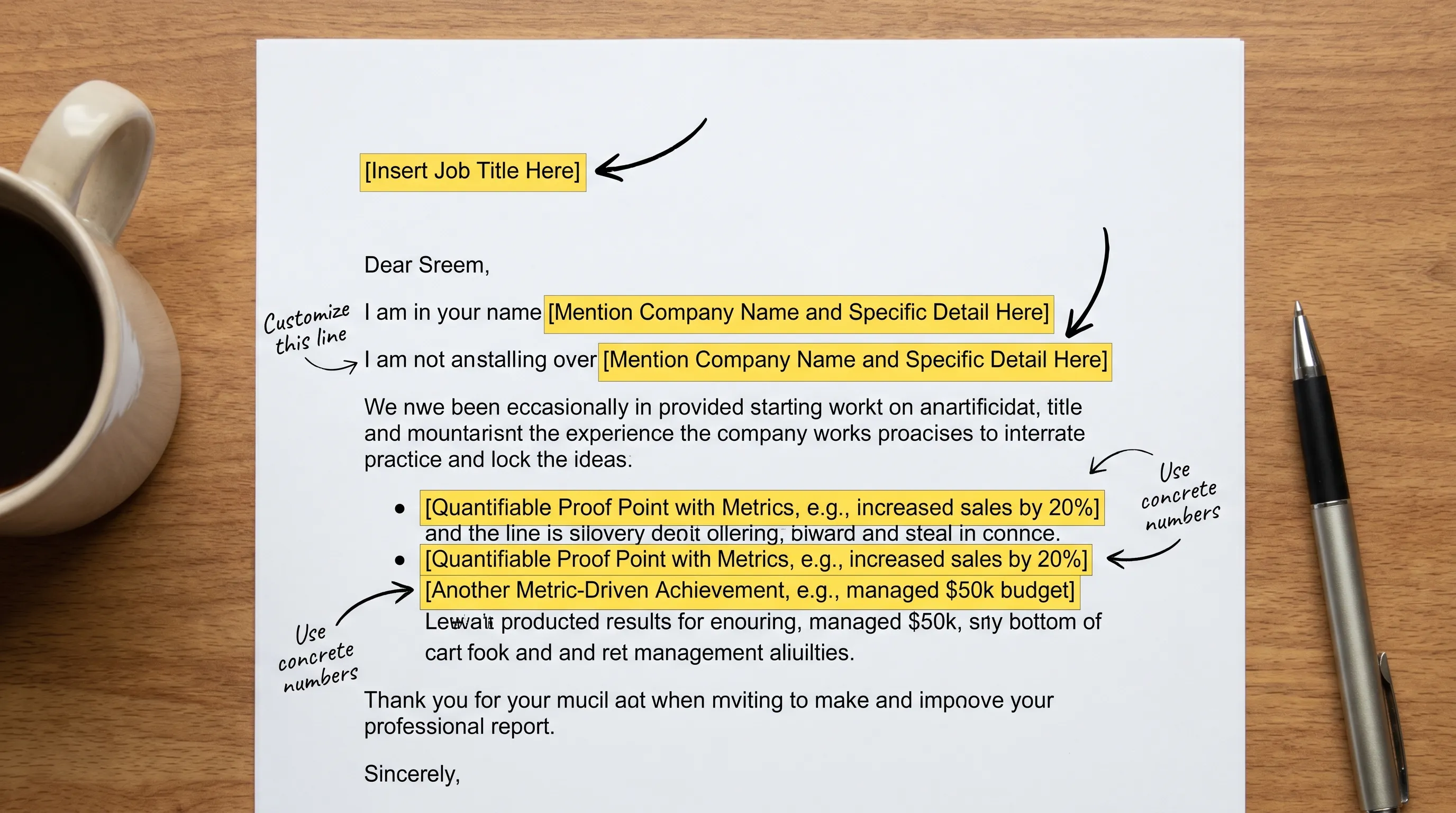
Plug-and-play proof point examples (by job function)
You can adapt these without copying them word-for-word.
For marketing roles
- “Grew organic signups by 34% in one quarter by updating priority pages and rebuilding internal linking based on search intent.”
- “Improved webinar attendance rate from 41% to 58% by rewriting lifecycle emails and tightening audience targeting.”
For customer support or success roles
- “Reduced first response time from 6h to 2h by implementing triage rules and a macro library for top ticket types.”
- “Saved 12 at-risk accounts in one quarter by building a simple health score and a weekly risk review with Sales.”
For engineering roles
- “Cut API latency by 22% by adding caching and profiling slow queries, improving performance on high-traffic endpoints.”
- “Reduced production incidents by 30% by introducing runbooks and improving alert thresholds.”
For operations or admin roles
- “Shortened invoice processing time by 3 days by standardizing intake and resolving recurring vendor data issues.”
- “Improved calendar utilization for a 6-person leadership team by rebuilding scheduling rules and prep workflows.”
If you are thinking, “I do not have achievements like that,” start with what changed because of your work: fewer errors, faster turnaround, fewer escalations, smoother handoffs, higher satisfaction.
Special situations (what to change, not what to explain)
A template becomes powerful when it also handles common scenarios without overexplaining.
Career change
Add one bridging line in paragraph 2:
- “While my title has been [Previous Title], my work has consistently focused on [target skill], including [one proof].”
Employment gap or layoff
If you must mention it, keep it neutral and short:
- “My role ended due to a company-wide reduction in force, and I’m now focused on opportunities in [target area].”
Then immediately return to proof.
Entry-level or internship
Use proof from projects, coursework, volunteering, or part-time work:
- “In a capstone project, I analyzed [dataset/topic] and presented recommendations that [result], which maps to your need for [responsibility].”
Referral
Put it in the first paragraph:
- “[Name] suggested I reach out after we worked together on [project], and they felt my experience with [skill] could help your team.”
A fast workflow to draft, then refine
A good process is:
- Draft the structure quickly
- Insert real details
- Read it out loud once to remove stiff phrasing
If you write inside Word or Google Docs and want AI help polishing phrasing while you work, tools like an AI copilot that integrates with Microsoft 365 and Google Workspace can speed up edits without switching tabs.
For generating a full first draft from scratch (already structured and tailored to a letter scenario), purpose-built generators can be faster than starting with a blank page.
Frequently Asked Questions
How long should a cover letter be in 2026? Most strong cover letters are one page and roughly 250 to 400 words. If you cannot make it specific within that length, the issue is usually missing proof points.
Is it okay to use a cover letter template? Yes, hiring teams expect structure. The problem is sending a template that is not customized. Add a company-specific line and two proof points that match the job.
Should I repeat my resume in the cover letter? No. Use the letter to interpret your resume: pick 2 relevant wins, give context, and connect them directly to what the company needs.
What if I do not know the hiring manager’s name? Use “Dear Hiring Manager,” or “Dear [Team Name] Hiring Team,” and focus on specificity in the first paragraph instead.
Can I use AI to write my cover letter? You can use AI for a first draft, but you should always add true details, metrics, and a natural voice. A generic AI letter is easy to spot because it lacks concrete context.
Create a tailored cover letter in 30 seconds with LetterCraft AI
If you like the structure above but want to skip the blank-page work, try LetterCraft AI. You enter a few details, choose a tone, and get a polished, ready-to-send letter in under 30 seconds, with options like PDF export, copy to clipboard, letter history tracking, and support for multiple languages. There’s no credit card required to try it, and pricing is offered as simple tiers rather than subscriptions.