
Cover Letter for Application: Examples That Don’t Sound Generic
Cover letter for application examples that sound specific, not generic. Steal strong openings, proof paragraphs, and closings, plus a quick edit checklist.
Most cover letters fail for one simple reason: they read like they could have been sent to any company, for any role, by anyone. Hiring managers can spot that in the first two lines.
Below are cover letter for application examples that sound specific, credible, and human, plus the “why it works” behind each one so you can adapt them fast.
What “generic” actually sounds like (and why it gets ignored)
Generic cover letters usually have three tells:
- No proof: they claim strengths (“hardworking,” “detail-oriented”) without evidence.
- No target: they don’t reference the team’s goals, customers, or tools.
- No voice: they rely on filler phrases (“I’m excited to apply,” “fast-paced environment”).
A hiring manager scanning 100+ applications is looking for signals, not adjectives: relevant scope, outcomes, and a clear reason you picked this role.
The “Specificity Stack”: a simple formula that fixes 80% of bland letters
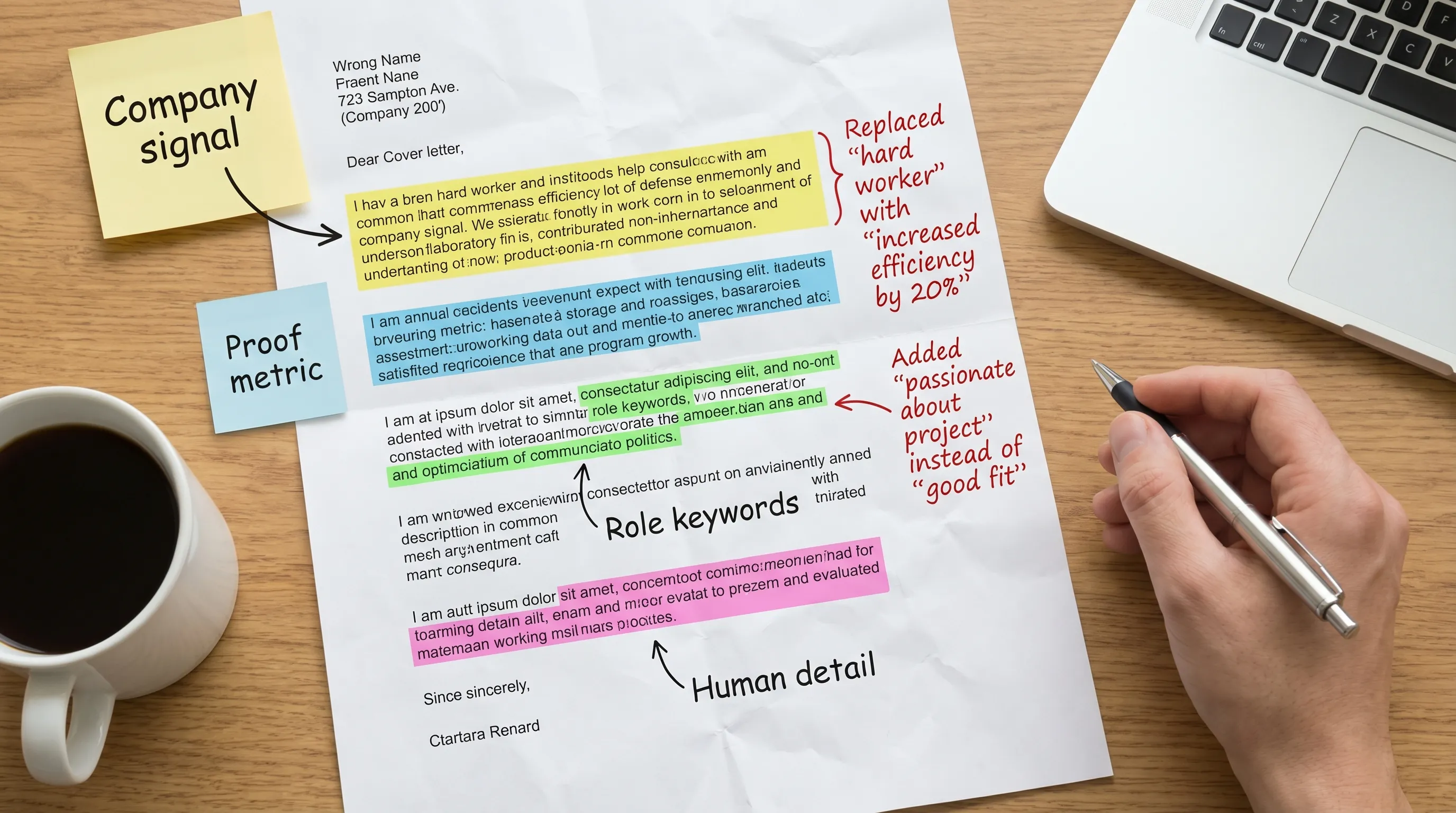
When you write (or edit) a cover letter for an application, aim to include at least three of these four elements in every paragraph:
- Role signal: the exact job you’re applying for and the problems it owns.
- Company signal: a detail that proves you didn’t mass-apply (product line, recent launch, customer segment, tech stack, mission, market).
- Proof: a measurable result, concrete example, or portfolio artifact.
- Personal logic: a short, believable “why me, why this, why now” that is not a life story.
If you stack those elements, your letter stops sounding like a template even if you start from one.
Opening paragraph examples (that don’t start with filler)
Example 1: Operations role (process improvement)
Stronger opening
I’m applying for the Operations Coordinator role because you’re scaling from regional fulfillment to multi-site operations, and that transition is where I do my best work. In my current role, I rebuilt our inbound workflow (receiving to stocking), cutting order prep time by 18% while improving inventory accuracy.
Why it works: It signals the company’s stage (scaling), names a relevant challenge (multi-site ops), and immediately proves capability.
Example 2: Customer support role (high empathy, high metrics)
Stronger opening
Your job post mentions reducing first response time while maintaining a high CSAT, and that balance is exactly what I’ve been measured on. Over the last year, I handled 50 to 70 tickets per day across email and chat, helped lift CSAT from 4.5 to 4.7, and documented 22 macros that reduced repeat questions.
Why it works: It mirrors the job’s priorities and includes credible numbers without sounding like a brag.
Example 3: Entry-level marketing (no “years of experience” to lean on)
Stronger opening
I’m applying for the Marketing Assistant role with a portfolio built around one question: “Can I turn attention into action?” In my capstone project, I ran a four-week content test (two channels, three messaging angles) and increased newsletter sign-ups by 31% by rewriting the landing page around one primary objection.
Why it works: It uses a mini-story, shows thinking, and replaces “I’m a quick learner” with evidence.
Example 4: Career change (connects the dots clearly)
Stronger opening
I’m transitioning from retail management into HR coordination, and the through-line is people operations. I’ve hired and trained 40+ part-time employees, built onboarding checklists that reduced early churn, and handled sensitive issues (scheduling conflicts, performance coaching) with clear documentation.
Why it works: It doesn’t apologize for the change, it reframes experience into relevant HR tasks.
Body paragraph examples: “proof blocks” you can copy and customize
Most applicants waste the middle of the letter restating their resume. Instead, use one to two proof blocks that show outcomes, how you got them, and how that maps to the new role.
Proof block template (plain English)
One problem you’re hiring for is [problem from job post]. I solved a similar problem at [company/project] by [what you did], which resulted in [metric/outcome]. The approach I’d bring to your team is [one sentence method], especially as you [company context].
Example 1: Data analyst (from “responsible for reporting” to “changed decisions”)
One problem you’re hiring for is turning messy, cross-team data into reporting leaders will actually use. In my last role, I consolidated three spreadsheets and two dashboards into one weekly KPI view, then partnered with Sales Ops to standardize definitions. The result was fewer “numbers meetings” and faster decisions on pipeline gaps, because everyone trusted the same source.
Example 2: Software engineer (specific impact, not a tech stack dump)
Your posting emphasizes performance and reliability. Recently I led an API refactor that reduced p95 latency and cut error rates during peak traffic by adding caching and tightening query patterns. I’d bring that same habit of measuring before optimizing, then documenting tradeoffs so the team can move quickly without accumulating fragile fixes.
Example 3: Project manager (scope, coordination, and outcomes)
You’re looking for someone who can keep delivery predictable across multiple stakeholders. I ran a weekly risk review and shipped a phased rollout plan for a customer-facing feature, which reduced last-minute scope changes and improved on-time delivery. The biggest difference was making dependencies visible early, not “working harder” late.
Closing paragraph examples (confident, not pushy)
A non-generic close does three things: it reinforces fit, it makes the next step easy, and it stays brief.
Example close (general)
If it’s helpful, I can share a 1-page summary of the two projects I referenced above and walk through what I’d prioritize in the first 30 days. Thanks for your time, I’d welcome the chance to interview for the role.
Example close (when you have a portfolio)
I’ve included links to two relevant samples (a short case study and a before/after rewrite) and can talk through the decisions behind them. If you’re still interviewing next week, I’d love to discuss how I can contribute on day one.
A quick “de-generic” rewrite table (use this during editing)
| Generic line | Why it falls flat | Stronger alternative (pattern) |
|---|---|---|
| “I’m excited to apply for…” | Says nothing unique | “I’m applying because [company signal] and I’ve done similar work when [proof].” |
| “I’m a hard worker and quick learner.” | Unprovable traits | “In [context], I learned [tool/process] and delivered [result] in [time].” |
| “I thrive in fast-paced environments.” | Overused and vague | “In a high-volume week (X requests/day), I prioritized by [method] and improved [metric].” |
| “I’m a great fit for your team.” | Unsupported conclusion | “The role needs [A, B]. My background shows [A proof] and [B proof].” |
The 10-minute customization checklist (so your letter sounds written for them)
Before you hit submit, make sure your cover letter for application includes:
- One sentence that mirrors the job post (a priority, metric, or constraint)
- Two proof points (numbers if possible, otherwise concrete outcomes)
- One company-specific detail (product, customer, mission, tool, or recent initiative)
- One “how I work” line (your method, not your personality)
If you can’t find company specifics, read the About page, a recent press release, a product update, or the job post’s “What you’ll do” section and pick one detail to reflect.
Using AI to draft without sounding robotic
AI can speed up structure and phrasing, but the final letter should still sound like you. The best workflow is:
- Draft quickly, then add two details only you would know (a real project constraint, a tradeoff you made, a lesson you learned).
- Replace inflated verbs (“spearheaded,” “revolutionized”) with clear actions.
- Read it out loud once, if it feels like LinkedIn filler, it probably is.
If you’re applying to roles where AI adoption is part of the job (ops, product, analytics, engineering), it also helps to understand how organizations actually implement AI through audits, automation, and integrations. Skimming what an AI agency like Impulse Lab delivers can help you speak more concretely about real-world AI use cases in your cover letter and interviews.
Frequently Asked Questions
How long should a cover letter for an application be in 2026? Aim for 250 to 400 words, usually 3 short paragraphs. If you can’t keep it under one page, you’re probably repeating your resume.
Do hiring managers still read cover letters? Many skim, but a tailored letter can be a strong differentiator when the role is competitive, when you’re changing careers, or when your resume needs context.
Is it okay to use AI to write my cover letter? Yes, if you treat it like a first draft. Personalize with real proof and company details, then edit for clarity and voice.
What if I don’t have metrics? Use concrete outcomes: “reduced back-and-forth,” “standardized process,” “trained new hires,” “resolved escalations,” “shipped on schedule.” Specific beats numerical.
Should I address the cover letter to a person? If you can find the hiring manager or recruiter confidently, use their name. If not, “Dear Hiring Manager” is acceptable.
Generate a tailored cover letter in under 30 seconds
If you want the speed of a template without the generic tone, try LetterCraft AI. Fill in a few job-specific details and get a personalized draft fast, with multiple tone options, PDF export, letter history, and support for multiple languages. Then use the examples above to add your final “human details” before you send.