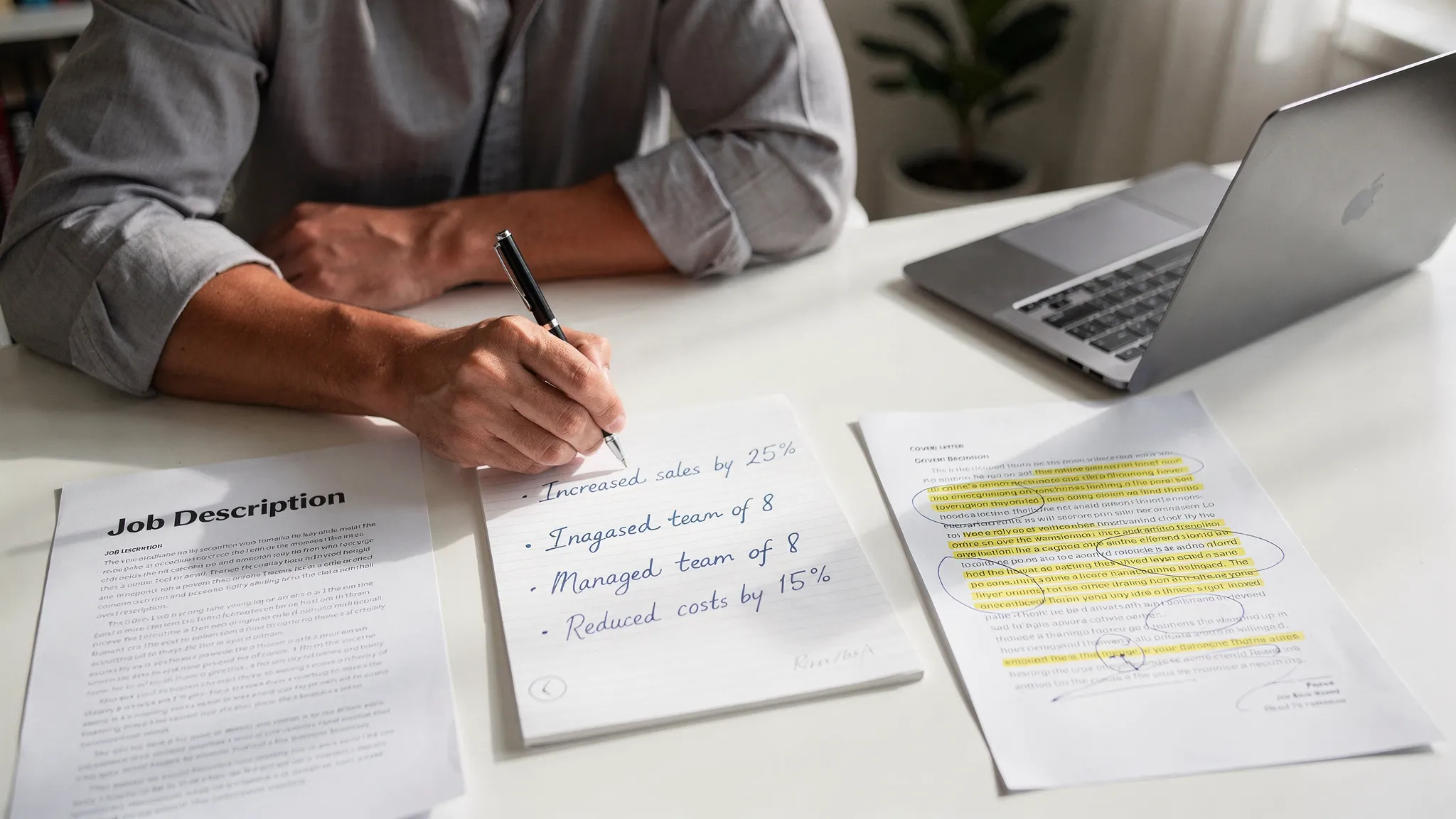
ChatGPT Cover Letter Prompts That Actually Sound Human
ChatGPT cover letter prompts that sound human. Copy proven prompts, avoid clichés, add metrics and stories, and edit fast with an authenticity checklist.
Most “AI-written” cover letters sound fake for the same reason most “AI-written” anything sounds fake: the prompt is vague.
When you ask ChatGPT, “Write me a cover letter for this job,” it fills the empty space with corporate wallpaper: enthusiastic, polished, and strangely nobody. The fix is not “use better adjectives.” The fix is to give the model the same ingredients a human would use: a specific moment, a measurable outcome, and a real reason you care about that company.
Below is a prompt framework and a library of ChatGPT cover letter prompts that actually sound human, plus editing prompts that help you keep your voice without spending hours rewriting.
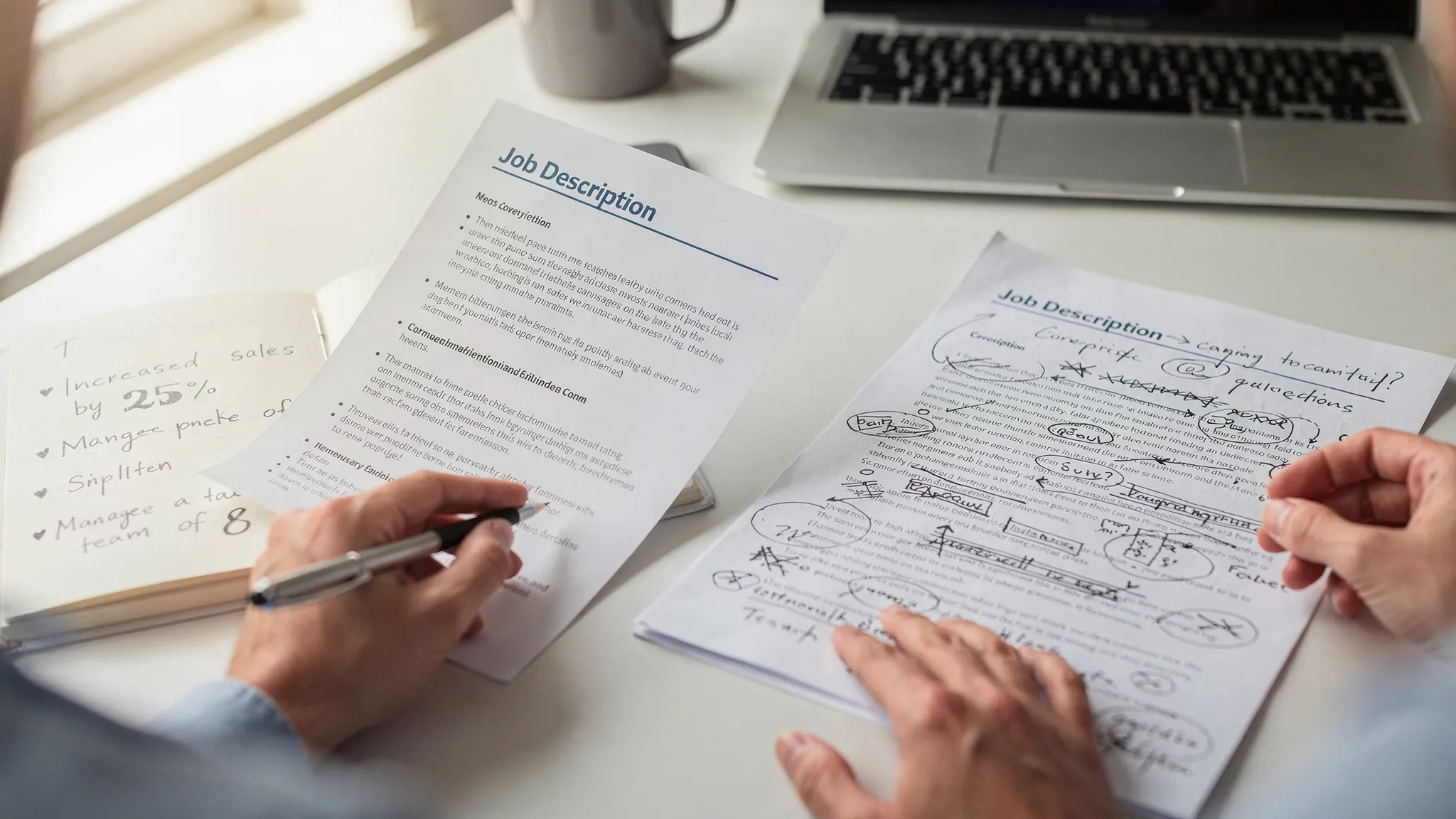
Why ChatGPT cover letters often sound robotic
Even strong writers can end up with bland results from ChatGPT because the model defaults to safe patterns when it lacks context. The most common causes:
- No proof points: If you do not feed it achievements with numbers, it invents generic “results-driven” language.
- No personal “why”: If you do not give a real motivation, it substitutes “I admire your commitment to innovation.”
- No voice constraints: If you do not tell it how you sound, it produces formal, symmetrical sentences that read like marketing copy.
- No guardrails: If you do not set length, structure, and what to avoid, it repeats your resume and adds fluff.
The goal is not to make ChatGPT “more human.” The goal is to make your prompt “more you.”
The human-sounding prompt formula (copy and reuse)
Before you use any prompt from the library, collect five inputs. This takes 5 to 10 minutes and saves you an hour of editing.
| Input you provide | What it looks like (example) | Why it makes it sound human |
|---|---|---|
| The role target | “Customer Success Manager, Mid-Market” | Anchors tone and priorities |
| 2 to 3 proof points | “Reduced churn from 6.2% to 4.8% in 2 quarters” | Forces specificity and credibility |
| One micro-story | “A customer escalated, I mapped blockers, led a reset call, kept the account” | Adds narrative, not slogans |
| One company-specific detail | “Your job post mentions onboarding time-to-value and SMB expansion” | Shows real attention |
| Voice constraints | “Warm, direct, slightly informal. No buzzwords. 220 to 260 words.” | Prevents generic corporate language |
If you want a quick reality check on your job-search tooling (ATS scanners, AI writers, portfolio builders), a curated resource like Online Tool Guides can help you compare options without drowning in hype.
Master prompt: “Write a cover letter that sounds like me”
Paste this into ChatGPT and fill in the brackets.
You are my cover-letter writing assistant.

Task: Draft a cover letter for the role below that sounds human and specific, not corporate.

Constraints:
- Length: 220–260 words
- Tone: [warm/direct/confident/etc.]
- Style: short sentences mixed with a few longer ones, no buzzwords, no clichés (avoid: “fast-paced,” “results-driven,” “synergy,” “passionate,” “I’m excited to”).
- Do not repeat my resume. Use only the proof points I give.
- Use plain language and concrete details.

Role:
- Job title: [title]
- Company: [company]
- Job post excerpt (paste 5–10 lines): [excerpt]

My background (3–5 lines):
[summary]

My proof points (choose 2–3 and weave them in):
1) [proof point with metric]
2) [proof point with metric]
3) [proof point with metric]

One short story (3–5 sentences, real situation):
[story]

Company-specific hook:
- I’m applying because: [specific reason tied to company/product/mission]

Output format:
- 3 short paragraphs.
- End with a clear, non-needy call to action for an interview.

Before writing, list 5 missing details you would ask me for to improve accuracy. Then write the draft using what you have.
Why this works: it forces ChatGPT to behave like an editor, not a content generator. The “missing details” step also reveals what you forgot to include.
Prompt library: openers that do not feel scripted
A robotic opening is the fastest way to get mentally filtered out. Use one of these prompts to generate options, then pick the one that matches your personality.
Prompt: 10 specific opening lines (no “I’m excited”)
Generate 10 opening lines for my cover letter.
Rules:
- No clichés and no “I’m excited to apply.”
- Each line must reference one specific detail from the job post or company.
- Each line must hint at one proof point (metric) without listing a full achievement yet.

Job post excerpt:
[paste]

Company detail I want to reference:
[detail]

My proof points:
[paste 2–3]
Prompt: “Start with a mini-story” opener
Write 3 opening paragraphs (2–3 sentences each) that start with a quick, human moment from my work.
The moment must connect directly to the role’s top priority.

My moment:
[story in 3–5 sentences]

Role priority:
[paste from job post]
Prompt library: achievements that read like a person wrote them
The difference between “I improved retention” and a human-sounding claim is usually the shape of the sentence.
Prompt: convert metrics into natural language
Rewrite these achievements so they sound natural and specific.
Rules:
- Keep every metric accurate.
- Add context (what I did, why it mattered) in one sentence each.
- Avoid braggy language.

Achievements:
1) [achievement]
2) [achievement]
3) [achievement]
Prompt: choose one “proof paragraph” that fits the job
Pick the best 2 achievements for this job post and write one tight paragraph (3–5 sentences) connecting them to the role.
Rules:
- Mention the job’s needs explicitly.
- Use no more than 2 metrics.
- Explain the method briefly (how I got the result).

Job post excerpt:
[paste]

My achievements:
[paste 4–6]
Prompt library: company fit without sounding like flattery
Most AI drafts overdo praise because it is “safe.” Use prompts that force specificity.
Prompt: one genuine “why this company” sentence
Write 6 options for one sentence explaining why I’m applying.
Rules:
- Each option must reference a specific product, initiative, customer, or principle.
- No generic admiration. No “innovative,” “industry leader,” or “great culture.”

Company notes:
[paste what you found: product page notes, a recent announcement, a value, a team blog line]

Role focus:
[paste]
Prompt: align my experience to their language (without copying)
Extract 6 key themes from this job post (skills, outcomes, priorities).
Then rewrite 6 lines from my experience so they match the themes using similar language, but do not copy exact phrases.

Job post:
[paste]

My experience bullets:
[paste]
Prompt library: tricky situations (career change, gaps, layoffs)
The human approach is short and calm. You are not “confessing,” you are providing context and moving on.
Prompt: career change bridge paragraph
Write a short bridge paragraph for a cover letter.
Goal: explain a career change in a confident, forward-looking way.
Rules:
- 3–4 sentences.
- Do not sound apologetic.
- Connect 2 transferable strengths to the role.

Career change context:
[from X to Y]

Transferable proof points:
1) [proof]
2) [proof]

Job post excerpt:
[paste]
Prompt: address an employment gap in one sentence
Write 6 options for one sentence that addresses my employment gap.
Rules:
- Neutral tone.
- No personal oversharing.
- End by pivoting back to fit.

Gap context:
[length + simple reason]

What I did during the gap (optional):
[course/project/freelance]

Role:
[paste 2–3 lines]
Prompt library: email-style cover letters (short, high signal)
Some applications call for a cover letter in the email body, not a full document. Here is a prompt that keeps it tight.
Write a cover letter email body under 150 words.
Rules:
- 2 short paragraphs.
- Include 1 metric.
- Include 1 company-specific detail.
- End with a clear next step.

Job title + company:
[fill]

Job post excerpt:
[paste]

My top proof point:
[metric]

Company detail:
[detail]
Editing prompts: make the draft sound like you, not like AI
Treat ChatGPT as your editor after it produces a draft.
Prompt: remove “AI-isms” and tighten
Edit this cover letter draft.
Goals:
- Remove clichés, filler, and overly formal phrases.
- Vary sentence length.
- Make it sound like a real person who is confident and concise.
- Keep facts and metrics exactly the same.

Draft:
[paste]
Prompt: add one authentic detail (without getting personal)
Suggest 5 places where I can add a small authentic detail to this cover letter.
The detail should be work-related (a tool, workflow, customer type, or decision).
Do not add new facts. Ask me a question for each suggestion.

Draft:
[paste]
Prompt: “Call out what still sounds generic”
Highlight any sentence that could apply to 50 other candidates.
For each highlighted sentence, give 2 rewrite options and tell me what specific detail would make it credible.

Draft:
[paste]
A quick “human check” before you submit
Read your letter once and look for these signals:
- One clear hook: a specific reason you applied that is not interchangeable.
- Two proof points: ideally measurable, always concrete.
- One micro-story or method: a glimpse of how you work.
- No overclaiming: if it feels too perfect, hiring managers will feel it too.
- Skimmable structure: short paragraphs, no wall of text.
If you are using ChatGPT, do not paste sensitive personal data. For most cover letters, you do not need your full address, ID numbers, or anything you would not email.
Frequently Asked Questions
What are the best ChatGPT cover letter prompts? The best prompts include the job post excerpt, 2 to 3 quantified proof points, one short work story, voice constraints (tone, length, phrases to avoid), and a company-specific reason for applying.
How do I stop ChatGPT from using clichés in my cover letter? Add an explicit “avoid” list (for example: “results-driven,” “fast-paced,” “passionate”) and ask ChatGPT to highlight any sentence that could apply to 50 other candidates.
Should I paste the full job description into ChatGPT? You usually only need the most relevant 5 to 10 lines (responsibilities and requirements). Pasting the entire posting can dilute focus and create a longer, more generic draft.
How long should an AI-assisted cover letter be in 2026? In most cases, 200 to 300 words is plenty. Hiring teams want fast proof of fit, not a biography.
Can employers detect a ChatGPT cover letter? Some companies experiment with AI detection, but the bigger risk is sounding generic. Specific details, accurate metrics, and a real “why” matter more than whether AI helped.
Is it better to use ChatGPT or a dedicated cover letter generator? ChatGPT is flexible, but it requires strong prompting and editing. A dedicated generator can be faster because it is built around letter formats, tone controls, and common scenarios.
Want a cover letter draft in 30 seconds (that you can still personalize)?
If you like the control of good prompts but hate starting from a blank page, try LetterCraft AI. It generates professional, personalized letters for 65+ scenarios, lets you pick multiple tone options, and supports PDF export, copy to clipboard, letter history tracking, and 5 languages.
You can try it without a credit card, generate a clean first draft fast, then use the editing prompts above to make it unmistakably yours.