AI Cover Letter Generator: How to Get Better Output
Learn how to use an AI cover letter generator for sharper, more human output. Get better prompts, proof points, tone control, and edits that work.
Most people try an AI cover letter generator the same way they try a generic template: they paste a job link, dump their resume, and hope the AI “figures it out.” The result is usually polite, vague, and packed with filler.
Better output is not about finding a “smarter” model. It is about giving the model the same raw material a strong human writer would use: a target, proof, and a reason.
This guide shows exactly what to feed an AI cover letter generator (and what to fix after) so your letter reads specific, credible, and human.
Why AI cover letters often come out generic
AI is excellent at producing fluent text. It is not automatically great at choosing which details matter most for this role at this company.
Generic letters usually happen when the inputs are missing one of these:
- A clear target (what role, what team, what problems you would solve)
- Proof (measurable outcomes, tools, scope, constraints)
- Motivation (why this company, why now, why you)
- A realistic tone (your actual voice, seniority, and communication style)
If your input is “Here’s my resume, write a cover letter,” the AI will default to safe patterns: enthusiastic adjectives, responsibility lists, and broad claims.
Before you generate: collect the 8 details that drive quality
You can get dramatically better drafts in under 10 minutes if you gather the right facts first.
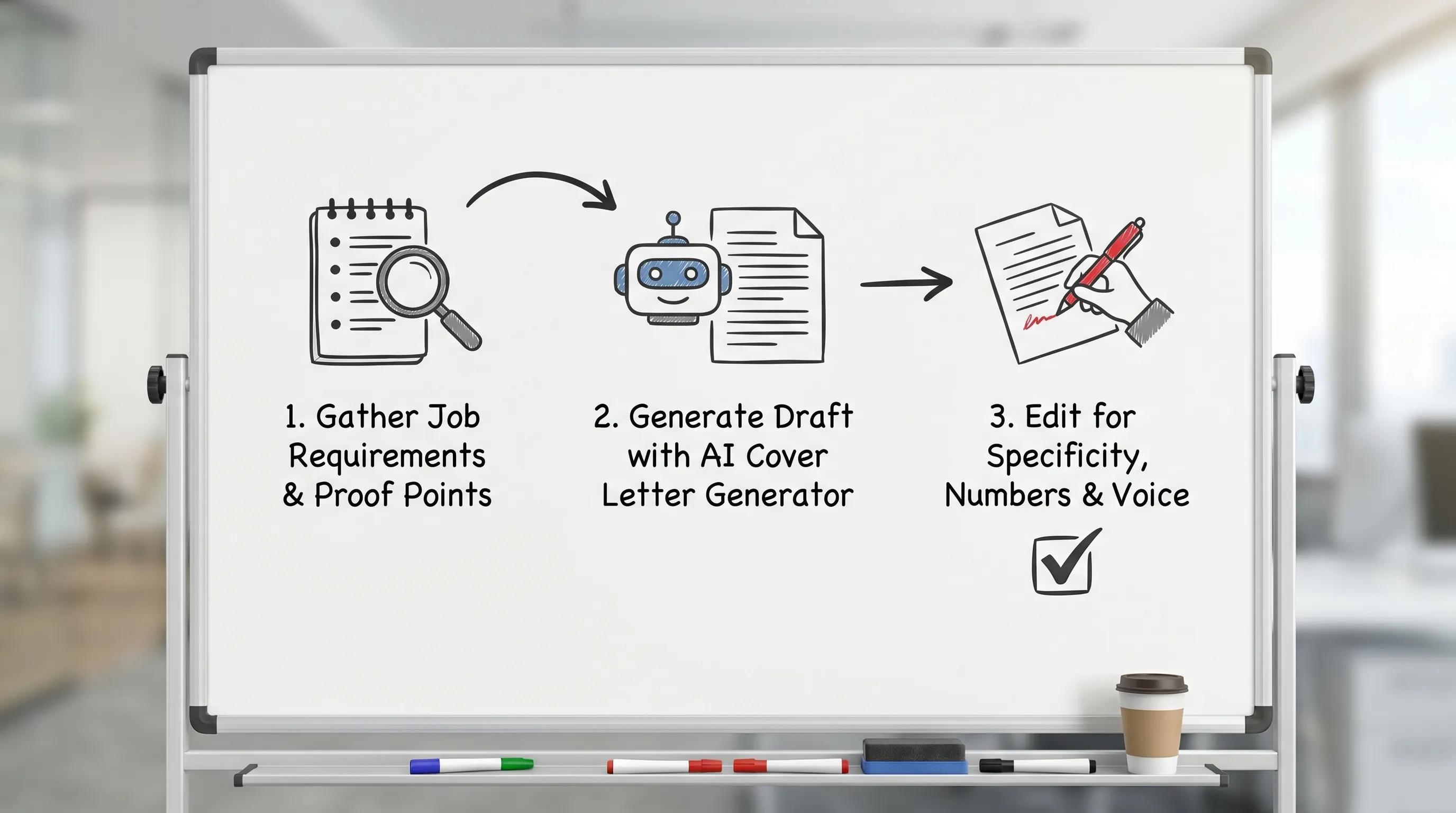
The fastest prep method: copy the job post into “requirements buckets”
Skim the posting and pull only the parts that matter:
- Top 3 responsibilities you will be judged on
- Top 3 skills or tools (the ones repeated, not the long wishlist)
- 1 business outcome implied by the role (growth, cost, reliability, patient experience, customer retention, etc.)
Then match each bucket to one proof point from your background.
Your “proof inventory” (do this once, reuse forever)
AI output improves when you stop describing tasks and start supplying evidence. Build a small library of proof points:
- 3 projects you are proud of (one line each)
- 3 metrics (time saved, revenue influenced, error reduction, volume handled)
- 3 moments of leadership (mentoring, cross functional alignment, ownership)
- 2 constraints you worked under (tight deadline, limited budget, legacy system)
You will reuse these in multiple applications.
What to input into an AI cover letter generator (with examples)
Think of the generator as a structured interview. The more specific your answers, the less “guessing” the AI has to do.
Use this table as a checklist.
| Input you provide | What “good” looks like | Example (short) |
|---|---|---|
| Target role | Exact title + level + focus | “Customer Success Manager, Mid Market, onboarding and retention” |
| Company context | One detail that proves you looked | “Your product recently expanded into healthcare compliance workflows” |
| Relevant experience | Only what maps to the posting | “Owned onboarding for 120+ SMB accounts, reduced time to value” |
| Proof metric | A number tied to an outcome | “Reduced churn from 5.2% to 3.9% over 2 quarters” |
| Tools or methods | The tools that match their stack | “Salesforce, Gainsight, SQL for account health” |
| One story | A mini challenge and outcome | “Escalation: rebuilt playbook, recovered 3 at risk accounts” |
| Tone | Choose a tone that fits role and culture | “Confident, direct, no buzzwords” |
| Constraints | Adds realism and credibility | “2 week deadline, cross team dependencies” |
If you do nothing else, include one metric and one specific company detail. Those two items are what most AI drafts are missing.
A prompt formula that consistently improves results
Even if your tool does not expose a “prompt box,” it still helps to think in terms of instructions.
Here is a copy friendly prompt you can adapt in any AI cover letter generator that allows additional guidance:
Prompt template (paste and fill):
Write a 180 to 250 word cover letter for the role of [JOB TITLE] at [COMPANY].
Must include:
- A specific opening that references [COMPANY DETAIL] and connects it to my experience.
- Two proof paragraphs, each centered on one measurable achievement.
- A simple close that asks for an interview and mentions one relevant strength.
My most relevant proof points:
- Proof #1: [what you did, for whom, metric, tools]
- Proof #2: [what you did, for whom, metric, tools]
Tone: [confident and plainspoken / warm and collaborative / formal].
Avoid:
- Generic phrases like “hardworking,” “team player,” “fast learner” unless tied to evidence.
- Repeating my resume line by line.
The “quality lever” most people miss: tell the AI what to leave out
AI tends to include everything you mention. If a past job is not relevant, do not feed it.
A strong cover letter is not your full history. It is a short argument for fit.
Use “evidence language,” not “responsibility language”
When you edit the draft, look for sentences that describe duties, then convert them to outcomes.
| Responsibility language (weak) | Evidence language (strong) |
|---|---|
| “I was responsible for managing projects.” | “I led a 6 person rollout across 3 teams and delivered 2 weeks early.” |
| “I have strong communication skills.” | “I aligned Product and Support on a new escalation path, cutting repeat tickets by 18%.” |
| “I’m passionate about customer success.” | “I built a renewal risk dashboard that helped the team prioritize outreach and improve retention.” |
You do not need huge numbers. Even small, honest metrics beat big vague claims.
Add one company specific sentence (without sounding creepy)
The goal is to show alignment, not to prove you memorized the website.
Good options:
- Reference a product line, customer segment, or business model
- Mention a value from the careers page and connect it to how you work
- Connect your experience to a public initiative (expansion, new category, new platform)
What to avoid:
- Overly personal references to employees
- Deep speculation about internal problems
- Generic praise (“innovative,” “industry leader”) without specifics
If you are applying in a space where messaging and positioning matter (for example, growth roles or e-commerce), it can help to study how other AI systems generate on brand copy and structure. An example is the Needle AI-powered marketing platform, which focuses on turning concrete business inputs into usable creative. The principle is the same for cover letters: better inputs create more convincing output.
Control tone like a professional (3 simple switches)
Tone is where many AI cover letters get exposed as “AI-ish.” Fixing it is usually easy.
Switch 1: seniority
Tell the generator your seniority and adjust sentence style:
- Entry level: curious, coachable, specific coursework or projects
- Mid level: ownership, collaboration, measurable delivery
- Senior: strategy, influence, scaling systems, mentoring
Switch 2: formality
Choose one and stick to it:
- Plainspoken and direct (often best for modern teams)
- Formal and traditional (some regulated industries)
- Warm and people focused (customer and community roles)
Switch 3: confidence level
Replace “I believe” and “I feel” with proof based confidence:
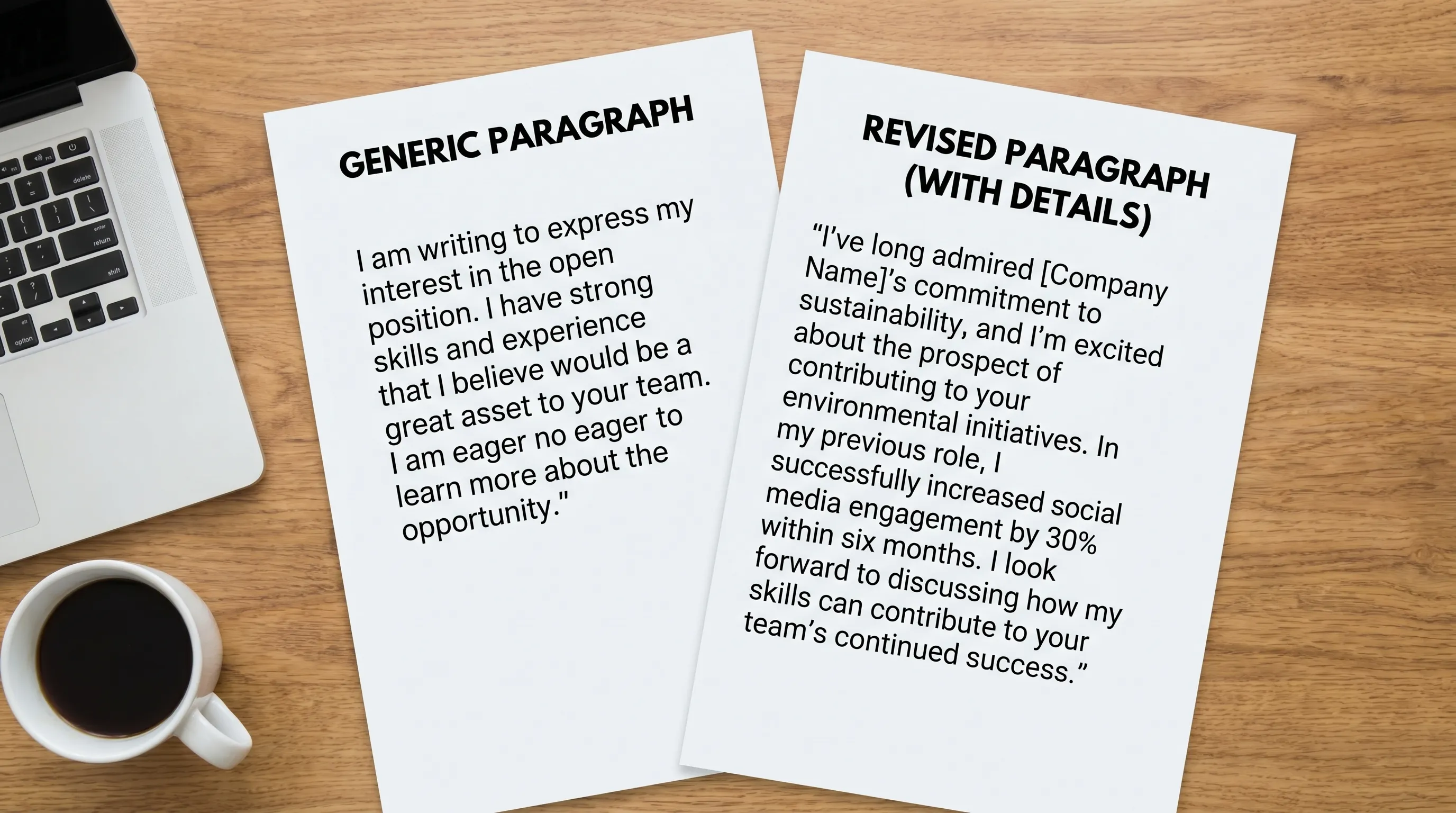
- Instead of “I believe I would be a great fit,” use “In my last role, I [proof], which matches your need for [requirement].”
The edit pass that turns a draft into a strong letter
Do a focused edit, not a rewrite.
Pass 1: delete filler
Remove these patterns wherever they appear:
- “I am excited to apply for…” (replace with a role specific hook)
- Lists of adjectives
- Repeated resume summaries
- Paragraphs that do not contain a skill, proof, or motivation
Pass 2: insert proof (at least two times)
Add:
- One metric in the first half
- One metric or scoped outcome in the second half
If you truly have no metrics, use scope instead (volume, size, frequency, stakeholders, timeline).
Pass 3: make it scannable
Hiring teams skim. Make your letter easy to read:
- 150 to 250 words for most roles
- 3 short paragraphs
- 1 to 2 sentences per paragraph that carry the main point
Pass 4: “voice test”
Read it out loud. If you would never say a phrase in real life, replace it.
A simple rule: if a sentence could be pasted into 500 other applications unchanged, it is not doing its job.
Common AI cover letter problems and quick fixes
“It repeats my resume”
Fix: Remove the job-by-job recap. Keep only the two achievements that map to the job’s top requirements.
“It sounds too enthusiastic or salesy”
Fix: Ask for a “calm, professional, plainspoken tone” and delete intensifiers (very, extremely, truly).
“It is too long”
Fix: Cap the word count and limit proof points to two.
“It is missing keywords for ATS”
Fix: Mirror the exact phrasing of 3 to 6 relevant terms from the posting, but only where true. Do not paste the entire keyword list.
“It feels fake”
Fix: Add one real constraint or tradeoff you handled. Specificity reads as honesty.
Using LetterCraft AI to get better output (without overcomplicating it)
If you want speed without a blank page, a purpose built tool helps because it starts from a letter structure, not a chat.
With LetterCraft AI, you can generate a tailored draft quickly by selecting the cover letter type, adding your role and company details, choosing a tone, and exporting a ready-to-send version (including PDF). Since it supports multiple tones and keeps letter history, it is easier to iterate: generate, edit, compare, and finalize.
The key is still the same: feed it your best proof points and a real company detail, then do a short edit pass.
Frequently Asked Questions
What should I paste into an AI cover letter generator to get better results? Paste the job requirements (top responsibilities and must-have skills), plus 2 to 3 proof points with metrics, and one company specific detail. This prevents generic filler.
How long should an AI generated cover letter be in 2026? For most roles, 150 to 250 words is enough. If a role explicitly asks for more detail (government, academia), you can go longer, but keep it scannable.
How do I keep my AI cover letter from sounding like everyone else’s? Give the AI unique inputs (a real achievement, a constraint you worked under, and a specific reason you want that company) and delete any sentence that could apply to any employer.
Is it okay to use the same AI cover letter for multiple jobs? Reuse your proof inventory, yes. Reuse the full letter, no. Swap the opening, match the two proof points to the job’s priorities, and update the company specific line each time.
Should I include keywords from the job description? Include a handful of relevant terms naturally, especially tools and role responsibilities, but only if they are true for you. Avoid copy-pasting keyword blocks.
Generate a better cover letter in 30 seconds (then personalize it)
If you are tired of generic drafts, start with a fast, structured first version and spend your time where it matters: proof and personalization. Try the cover letter flow on LetterCraft AI to generate a draft quickly, choose the right tone, and export a clean PDF when you are ready to submit.