
Make a Cover Letter That Matches the Job Description
Make a cover letter that matches the job description: extract requirements, map them to achievements, and use a quick checklist to submit with confidence.
Most cover letters fail for one simple reason: they talk about the candidate, not the job.
If you want to make a cover letter that matches the job description, your goal is not to “introduce yourself” in a generic way. Your goal is to help a hiring manager quickly connect three dots:
- You understand what the role actually needs.
- You have proof you can do those things.
- You can do them in their environment (industry, customers, tools, pace).
This guide gives you a practical method to translate any posting into a targeted, evidence-driven cover letter without copying the job ad line by line.
What “matches the job description” really means
A cover letter matches the job description when the same priorities show up in your letter, in the same order of importance, backed by your evidence.
Think of it as a short “requirements to results” argument. Hiring teams scan for:
- Role fit: Do you understand the responsibilities and constraints?
- Proof: Can you point to outcomes, not just skills?
- Relevance: Are your examples the closest match to what they asked for?
- Clarity: Can they see the fit in under 20 seconds of skimming?
Matching is less about stuffing keywords and more about choosing the right proof points.
Step 1: Turn the job description into a “skills map”
Before you write a single sentence, extract the job posting into a short map of what the employer is signaling.
Separate must-haves from nice-to-haves
Most job descriptions blend:
- Must-haves: core responsibilities and non-negotiable requirements (often repeated, listed early, or labeled “required”).
- Nice-to-haves: extra tools, preferred industry experience, bonus certifications.
- Performance signals: what success looks like (speed, accuracy, growth, customer satisfaction, compliance, uptime).
A strong cover letter mainly addresses must-haves and performance signals. Nice-to-haves are optional unless you have unusually strong evidence.
Find “proof hooks” you can answer with an achievement
Look for phrases like:
- “Own,” “lead,” “drive,” “manage,” “build,” “improve,” “reduce,” “partner with”
- “Responsible for,” “ensure,” “support,” “deliver,” “maintain”
Each one is an invitation to respond with a short, specific achievement.
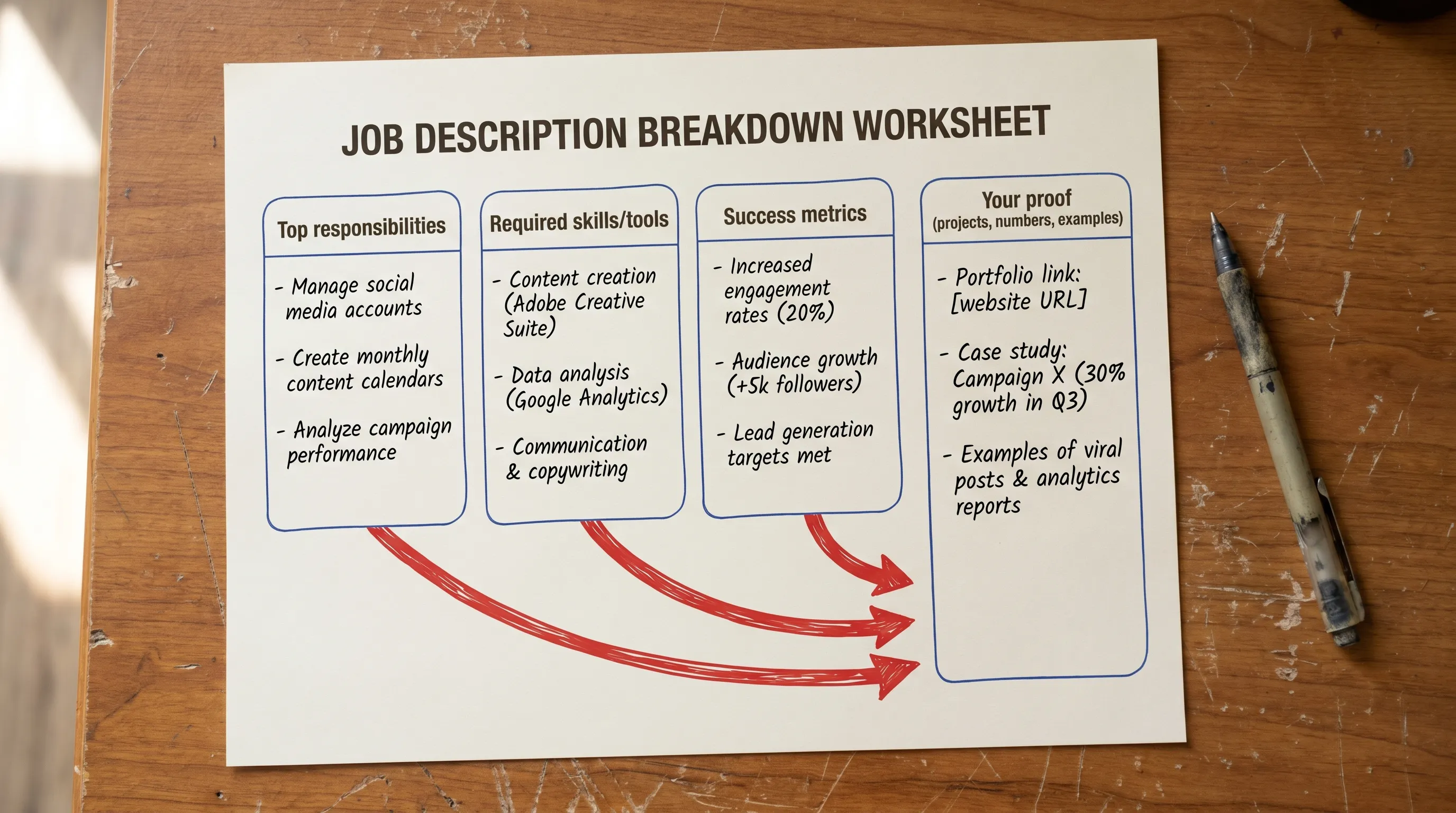
Step 2: Build a “requirements to evidence” table (10 minutes, huge payoff)
This is the fastest way to stop your letter from sounding generic.
Create a quick table with three columns:
| Job requirement (from posting) | Your most relevant evidence | How you’ll phrase it in the letter |
|---|---|---|
| Example: “Manage email campaigns and improve conversions” | Built lifecycle emails, improved CTR by X% | “I improved lifecycle email engagement by…” |
| Example: “Partner with cross-functional teams” | Worked with Product and Sales on launches | “I partnered with Product and Sales to…” |
| Example: “Strong customer communication” | Handled escalations, improved CSAT | “I resolved high-stakes customer issues by…” |
Rules that make this work:
- Use your closest matching evidence, not your most impressive unrelated project.
- Write one line of proof per requirement, then pick only the best two or three for the letter.
- Add a metric when it’s honest and meaningful (time saved, revenue impact, error reduction, volume handled).
This table becomes your outline.
Step 3: Choose 2 to 3 proof points, and write them like a mini case study
A cover letter is not a resume recap. It is a short argument.
Pick two or three achievements that directly support the top priorities in the posting.
A reliable structure for each proof point:
- Context: What was the situation and your responsibility?
- Action: What did you do (tools, approach, collaboration)?
- Result: What changed (numbers if possible)?
Example (generic vs matched):
Too generic: “I have strong project management skills and work well with teams.”
Matched to a posting that emphasizes deadlines and cross-functional work: “In my last role, I coordinated a 6-week launch across Design, Engineering, and Support, keeping delivery on schedule by rebuilding the project plan and running twice-weekly risk reviews.”
Notice what happened: the sentence mirrors what they care about (cross-functional delivery, schedule) and proves it.
Step 4: Mirror the employer’s language, but keep it human
Mirroring is useful when done lightly. It helps the reader see instant alignment.
Match these elements from the job description:
- Job title and team language: “Customer Success” vs “Account Management” matters.
- Tools that are central to the role: only mention tools you can actually use.
- Outcome language: “reduce churn,” “improve close rate,” “ensure compliance,” “increase efficiency.”
Avoid:
- Copying full phrases from the posting.
- Listing every keyword you can find.
- Writing like a policy document.
A good test: if your letter could be sent to five companies unchanged, it does not match the job description.
Step 5: Use a simple structure that makes the match obvious
You do not need a complicated format. You need a scannable one.
A clean structure:
Opening (2 to 3 sentences)
- Name the role.
- State your strongest, most relevant value.
- Optional: add a specific hook (referral, company initiative, product detail).
Example opening:
“I'm applying for the Marketing Coordinator role at [Company]. In my last position, I supported email and social campaigns that increased event registrations while improving on-time delivery across teams.”
Middle (1 to 2 short paragraphs)
- Prove fit with your two to three best examples.
- Use the same priority order as the job description.
Close (2 sentences)
- Confirm interest.
- Invite the next step.
If you want a layout-focused reference, follow a standard, hiring-manager-friendly format like the one explained in LetterCraft AI’s guide to cover letter format.
Step 6: Add one company-specific detail that proves this is not mass-applied
This is where most applicants either overdo it (flattery) or underdo it (nothing specific).
A strong company detail:
- Connects to the role.
- Shows you did light research.
- Sets up why your experience is relevant.
Good examples of company-specific details:
- A product launch or service line that relates to the role.
- A customer type you have worked with.
- A business model or quality standard you understand.
For instance, if you were applying to a skincare business, you might reference the importance of personalized service and consistent client experience across treatments and retail products. A quick look at a brand like Lumina Skin Sanctuary makes it clear how much trust and “personalization” matter in that space, which changes how you would position customer communication, scheduling accuracy, and follow-up.
Keep this section to one sentence. The point is specificity, not a company biography.
Step 7: Do a fast “match check” before you send
Use this quick quality bar. If you cannot confidently say “yes” to most of these, your letter is not aligned yet.
| Quick check | What “good” looks like |
|---|---|
| Top 2 priorities are addressed | Your middle paragraph clearly proves the most important requirements |
| Evidence beats adjectives | More outcomes and examples, fewer claims like “hardworking” |
| Keywords are natural | Job title, core tools, and outcomes appear without feeling stuffed |
| Company detail is present | One sentence that proves it is written for this role |
| Length is controlled | Generally one page, often 200 to 350 words for most roles |
| Final read sounds like you | No overly formal, robotic, or generic phrases |
Common reasons a “tailored” cover letter still gets ignored
Even when people try to match the job description, these mistakes weaken the signal:
- Repeating the resume: Hiring teams already have it. Use the letter to interpret your resume in the context of this job.
- Trying to cover everything: Address the top priorities, not the entire posting.
- Generic motivation: “I’m excited about the opportunity” is not a reason. Tie motivation to something real (the work, the customers, the pace, the mission).
- No proof: Skills without outcomes read like guesses.
- Wrong “level”: If the posting is senior, show ownership and strategy. If it is junior, show execution, reliability, and learning speed.
Frequently Asked Questions
How do I make a cover letter match the job description without copying it? Use the same priorities and similar keywords, but write in your own voice and support each key requirement with a specific achievement or project.
How many keywords should I include from the job posting? Include the job title, the most important tools or skills (only if true), and outcome language that reflects the role. If it feels forced, cut it.
What if I do not have experience in one required skill? Acknowledge it indirectly by emphasizing the closest transferable experience (similar tool, similar workflow, similar outcome) and show a track record of learning quickly.
Should I address every responsibility listed in the posting? No. Pick the top two or three requirements that appear most central (repeated, listed first, or tied to outcomes) and go deep with proof.
How long should a targeted cover letter be in 2026? For most roles, a concise one-page letter is expected. If it is taking more than a few minutes to skim, it is usually too long.
Write a job-matched cover letter in under 30 seconds with LetterCraft AI
If you already have the job description and a few details about your background, you can generate a polished first draft quickly and then personalize the proof points.
With LetterCraft AI, you can create a professional cover letter for 65+ scenarios, choose a tone, export to PDF, and keep your letter history, with no credit card required to try it. The best workflow is simple: paste the job description, add your real achievements, generate a draft, then edit the top 10 percent to make it unmistakably yours.