Write a Cover Letter in 15 Minutes (Without Overthinking)
Write a cover letter in 15 minutes with a simple structure, proof-first prompts, and a fast edit checklist. Stop overthinking and apply with confidence.
Overthinking a cover letter is easy because the stakes feel high and the “right” words seem invisible until you find them. The fix is not more inspiration, it is a timebox and a repeatable structure.
If you can commit to 15 focused minutes, you can write a cover letter that does what hiring teams actually need: confirm fit, prove value, and make it easy to say “let’s interview.”
What a cover letter must do (and what it can skip)
A modern cover letter is not your life story. It is a short argument.
Your letter must:
- Show you understand the role (use their keywords naturally)
- Back up 1 to 2 claims with evidence (numbers, outcomes, scope)
- Explain “why this company” in one clear line
- End with a confident, low-pressure close
Your letter can skip:
- A full recap of your resume
- Soft fluff (“hardworking,” “team player”) without proof
- Long intros about your passion since childhood
- More than 350 to 450 words in most cases
If you keep that boundary, 15 minutes is plenty.
The 15-minute cover letter plan (minute-by-minute)
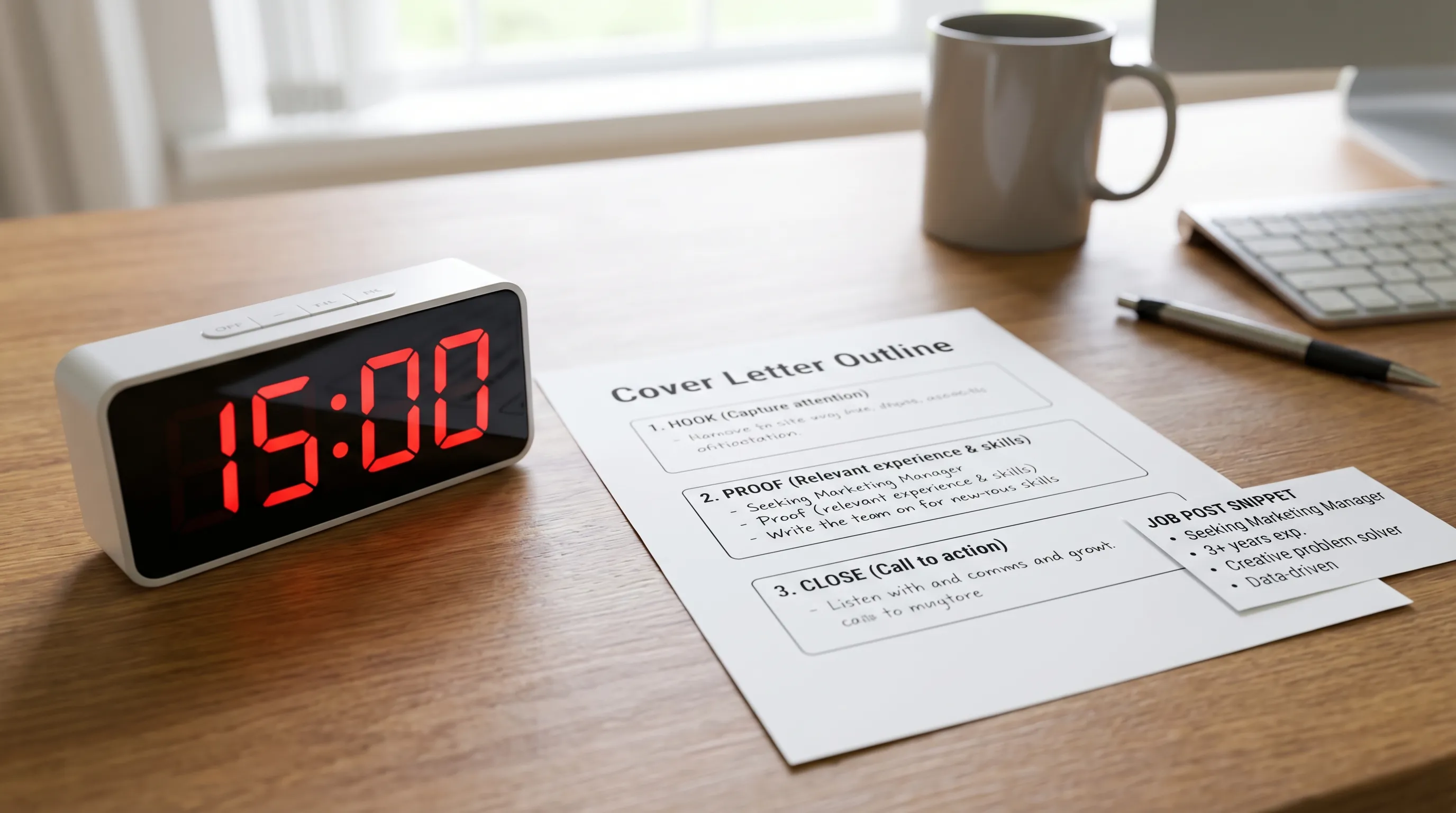
Use this as a sprint. Set a timer. Do not edit while drafting.
| Time | Goal | Output you should have by the end |
|---|---|---|
| 0:00 to 3:00 | Pull the job’s “must-prove” points | 3 role signals and 1 company signal |
| 3:00 to 6:00 | Pick your proof | 2 achievements with numbers or concrete outcomes |
| 6:00 to 12:00 | Draft 3 short paragraphs | A complete, slightly messy first draft |
| 12:00 to 15:00 | Tighten and de-generic | A clean, sendable letter |
Minute 0 to 3: Extract 3 role signals and 1 company signal
Open the job post and copy these into a scratch pad:
- Role signals (3): the top responsibilities or requirements they repeat (for example, “own reporting,” “manage stakeholders,” “reduce cycle time”)
- Company signal (1): a product, value, customer, or initiative you can reference (for example, “your expansion into mid-market,” “your focus on privacy,” “your new logistics hub”)
Rule: if you cannot find a real company signal in 60 seconds, use one of these safe options:
- A specific product or service line from their website
- A line from the job post about the team’s mission
- A public announcement (press page, LinkedIn update)
Minute 3 to 6: Choose 2 proof points (do not brainstorm 10)
Most cover letters fail because they claim too much and prove too little. Pick two proof points that match your role signals.
A strong proof point includes:
- What you did
- The scope (team size, budget, volume, region)
- The outcome (metric, speed, quality, cost, revenue, risk)
If you do not have perfect metrics, use credible approximations (for example, “reduced processing time by about a third”) and keep it honest.
Minute 6 to 12: Draft using the 3-paragraph “hook, proof, close” structure
Write fast. Use plain language. Keep the letter scannable.
Paragraph 1 (Hook): role + proof + company fit
Aim for 2 to 4 sentences.
Fill-in template:
I’m applying for the [role] position at [company]. In my recent work as [current or most relevant role], I [proof in 8 to 12 words, with a number if possible]. I’m especially interested in [company signal], and I’d love to bring my experience in [role signal #1] and [role signal #2] to your team.
Paragraph 2 (Proof): 2 compact evidence blocks
This is where you earn attention. Keep it tight.
Fill-in template:
In [context], I [action], which led to [measurable outcome]. This required [relevant skill/tool] and close coordination with [stakeholders].
More recently, I [second action] to solve [problem]. The result was [outcome], and I learned [relevant insight] that maps directly to [role signal].
Tip: If you only have time for one evidence block, make it the one that matches the most important requirement in the job post.
Paragraph 3 (Close): low-friction next step
Fill-in template:
If helpful, I can share examples of [work sample type] and walk through how I would approach [relevant challenge from the job] in the first 30 to 60 days. Thank you for your time, and I’d welcome the chance to talk.
Minute 12 to 15: Edit with a ruthless “de-generic” checklist
Do not rewrite everything. Only fix what makes it vague or risky.
- Replace 2 generic phrases with specifics (swap “strong communicator” for “wrote weekly exec updates for a 12-person cross-functional group”)
- Confirm names and details (company name, role title, spelling)
- Cut 2 lines that repeat your resume
- Add 1 number (even a small one: “trained 6 new hires,” “handled 40 to 60 tickets/day”)
- Make the first sentence concrete (no “I am excited to apply…” as the opener unless you add proof)
- Keep formatting simple (one page, readable font, no fancy columns)
A fast rewrite table (turn vague lines into hireable lines)
When you feel stuck, it is usually because your sentence is abstract. Here are swaps you can make in seconds.
| Vague line | Stronger version you can customize |
|---|---|
| “I’m a hardworking team player.” | “I coordinated with [team] to deliver [project] [on time/under budget], resulting in [outcome].” |
| “I have experience in customer service.” | “I handled [volume] customer requests per [day/week], maintaining [metric] while improving [process].” |
| “I’m passionate about marketing.” | “I grew [channel] from [A] to [B] in [timeframe] by [action].” |
| “I’m a quick learner.” | “I learned [tool/process] in [timeframe] and used it to [deliver outcome].” |
Special cases (quick add-ons that prevent overexplaining)
You can address a “non-standard” background without writing a defensive essay.
If you are changing careers
Use one bridging sentence in the proof paragraph:
While my background is in [previous field], the core work has been [shared skill] and [shared skill], and I’ve applied that to [relevant outcome].
If you have a gap or were laid off
Keep it neutral and brief:
After a [company-wide layoff / planned career break], I focused on [relevant project, certification, freelance work], and I’m ready to bring that momentum to [company].
If you are entry-level
Replace “years of experience” with proof of execution:
In [internship/class/project], I delivered [result] by [action], and I’m excited to apply that same ownership in a full-time role.
The “15-minute” mindset that keeps you from overthinking
Overthinking usually shows up as one of these traps:
- You try to sound impressive instead of clear.
- You keep adding skills instead of proving one.
- You edit too early and never finish.
A good cover letter is closer to a clean sales page than an essay. Use the structure, prove two things, reference one real company detail, and ship it.
If you like using systems to move faster, you have probably seen this in other kinds of work too. Creators often rely on ready-to-customize assets to avoid starting from zero, for example, using video templates for everyday projects to speed up production. The principle is the same for cover letters: start with a proven framework, then personalize where it matters.
Frequently Asked Questions
How long should a cover letter be in 2026? Most hiring teams prefer a single page. For many roles, 250 to 400 words is the sweet spot, enough to show fit and proof without repeating your resume.
Do I need to address the hiring manager by name? If you can find the correct name quickly (company site, LinkedIn, job post), use it. If not, “Dear Hiring Manager” is acceptable. Do not guess.
What if the application says the cover letter is optional? Optional often means “not required by the form,” not “ignored.” If you can write a tailored letter in 15 minutes, it can still differentiate you, especially for competitive roles or career changes.
Is it okay to use AI to write a cover letter? Yes, as long as you provide real inputs and edit the draft so it sounds like you. The risk is not “AI,” it is sending generic text that does not prove anything.
What are the biggest cover letter mistakes? Being generic, repeating the resume, writing too long, and making claims with no evidence. Fix those and you are ahead of most applicants.
Want a polished draft in under 30 seconds?
If you like the 15-minute structure but want to move even faster, LetterCraft AI can generate a professional, personalized cover letter from a few details in under 30 seconds. It supports 65+ letter types, multiple tones, PDF export, letter history tracking, and 5 languages, and you can try it with no credit card required.
Generate your cover letter at LetterCraft AI.