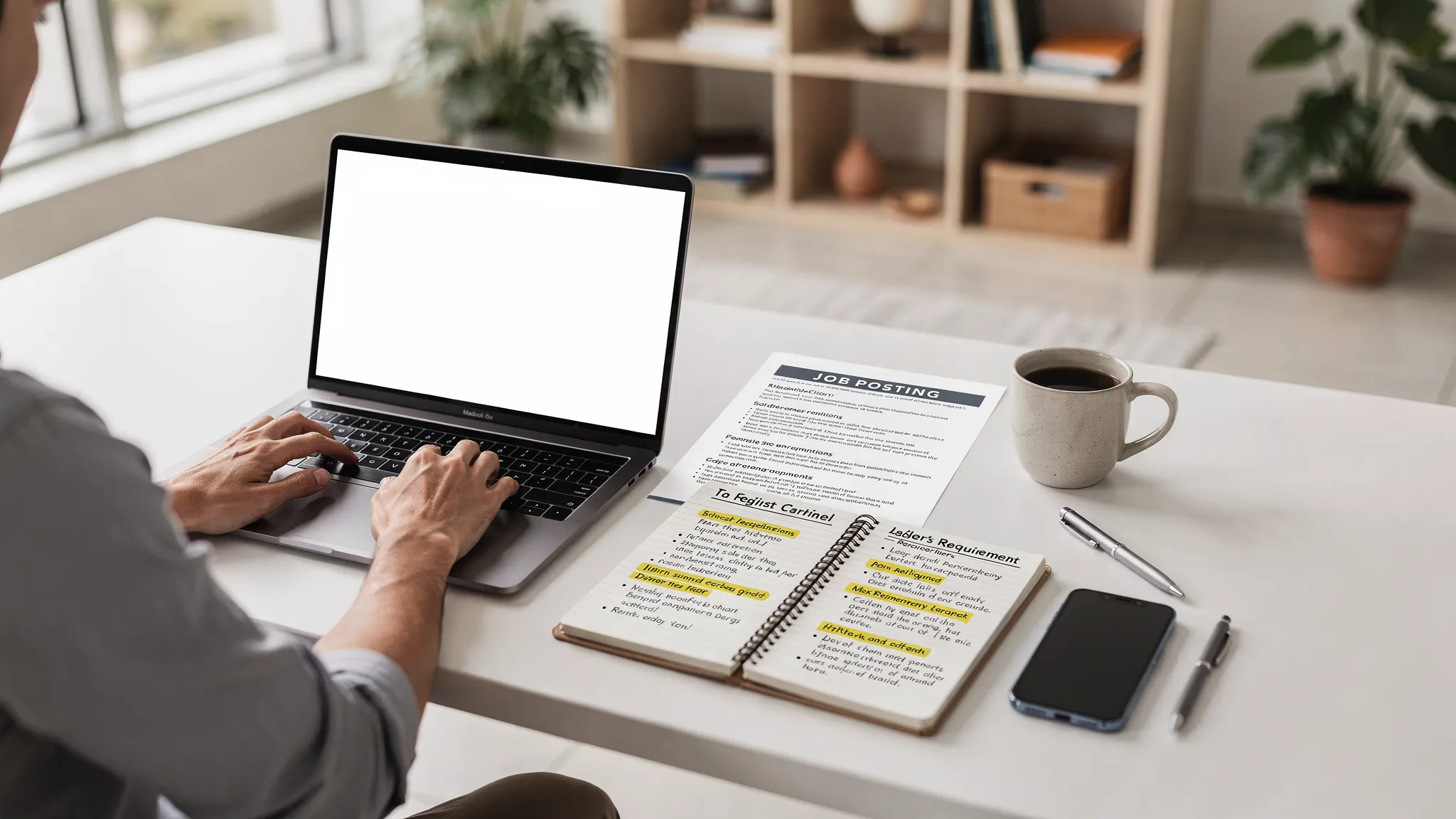
Application Letter Generator: How to Get a Polished Draft Fast
Application letter generator guide for 2026: gather the right details, generate a strong draft fast, and polish it into a ready-to-send letter.
Hiring moves fast in 2026. Sometimes you have a job posting on Monday, a deadline on Tuesday, and a blank page staring at you right now. That’s exactly where an application letter generator can help, not by replacing your judgment, but by getting you to a structured, professional draft in seconds so you can spend your time on what actually wins interviews: specificity, proof, and tone.
This guide walks you through a simple workflow to get a polished application letter draft fast, plus the exact details you should feed into any generator (including LetterCraft AI) to avoid sounding generic.
What “polished” actually means (and what it doesn’t)
A polished application letter is not the longest one, or the most “formal.” It is the one that makes it easy for a hiring manager to answer three questions quickly:
- Can you do the work?
- Have you done similar work before (with evidence)?
- Do you understand what this specific role and company needs?
A generator can give you structure and strong baseline phrasing, but polish comes from your inputs and your final edit. Think of the generator as a high-speed first draft assistant.
Before you generate: collect the inputs that create a non-generic letter
Most “bad AI letters” happen because the user provides vague inputs like “I’m hardworking and passionate.” Instead, spend 5 minutes gathering concrete details.
Here’s the minimum set of inputs that reliably produces a strong draft:
| Input you provide | Why it matters | Example (replace with yours) |
|---|---|---|
| Target job title + level | Sets the right seniority and language | “Operations Coordinator” |
| Company name + team (if known) | Prevents copy-paste vibe | “Acme Logistics, Fulfillment Team” |
| Top 3 requirements from the posting | Aligns the letter with what’s being screened | “Vendor coordination, Excel reporting, SLA tracking” |
| 2 measurable wins | Converts claims into proof | “Reduced shipping exceptions 18% in 90 days” |
| 1 tool/process you actually used | Adds credibility and ATS relevance | “Salesforce, Zendesk, Power BI” |
| One “why this company” detail | Signals intent and research | “Your expansion into same-day delivery” |
| Constraints or context (optional) | Helps explain non-linear paths briefly | “Career change from retail to ops” |
If you only do one thing before using an application letter generator, do this: pull three phrases directly from the job posting and paste them into your input (as long as they truthfully match your experience).
The fast workflow: draft in 30 seconds, polish in 10 minutes
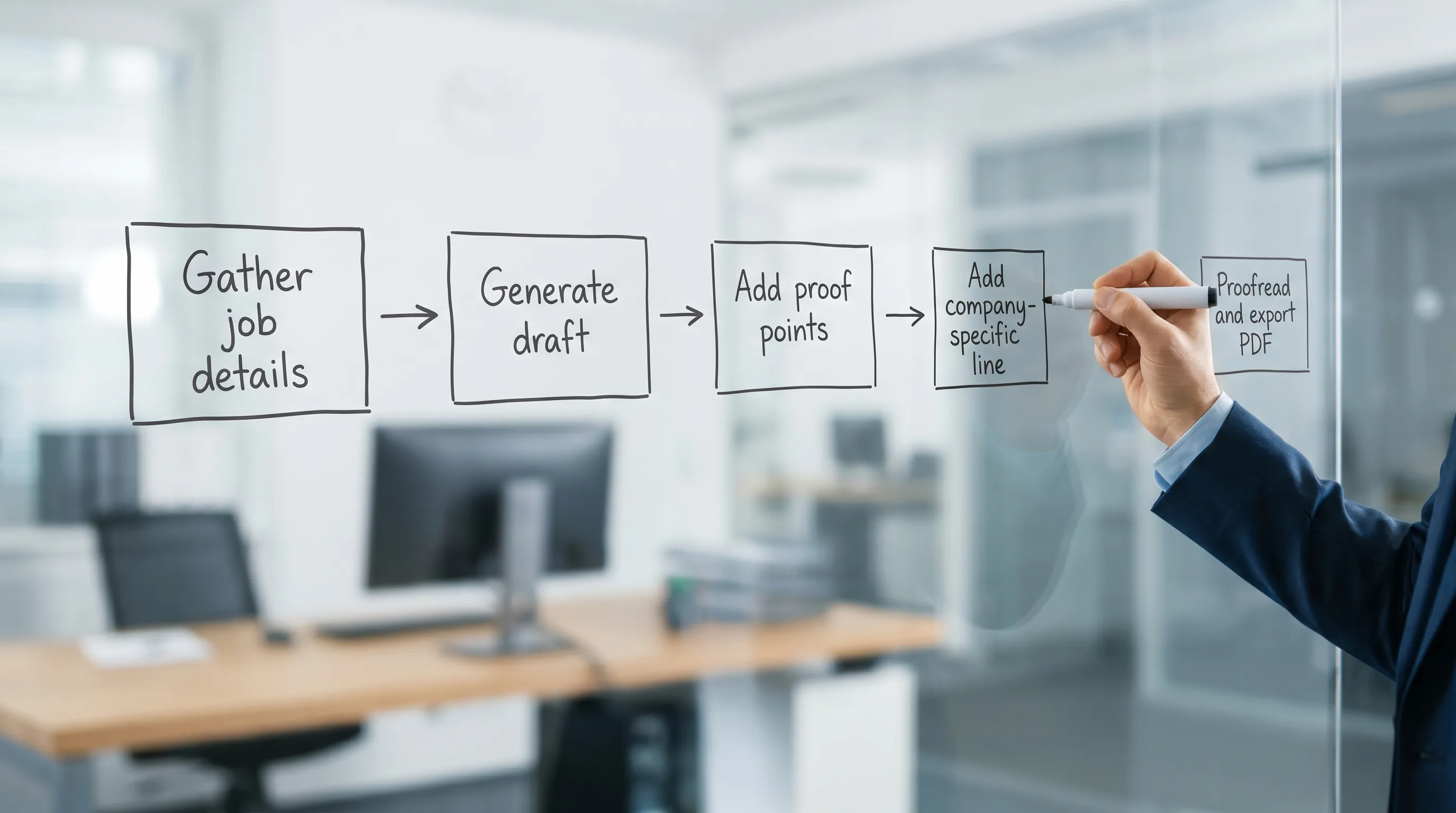
A generator’s real value is speed, but you still need a quick editing pass to make the result “send-ready.” Here’s a practical workflow you can repeat.
Step 1: Generate a draft from structured details
With LetterCraft AI, the process is designed to be simple: pick the letter type, fill in a few details, choose a tone, and generate a complete draft quickly.
LetterCraft AI supports:
- 65+ letter types
- Multiple tone options
- PDF export
- Letter history tracking
- Support for 5 languages
- Copy to clipboard
If you are using a different tool, the principle is the same: the more specific your inputs, the more “human” and targeted your draft will read.
Step 2: Replace “soft claims” with proof
Scan for sentences like:
- “I am a hard worker…”
- “I have strong communication skills…”
- “I am passionate about…”
These are not automatically wrong, they are just weak without evidence. Replace each with a short proof point:
- “I partnered with Sales and Support to cut response time from 28 hours to 9 hours by rebuilding the triage workflow.”
Aim for two proof points total in a short application letter. That is usually enough.
Step 3: Add one company-specific sentence
This is the highest ROI personalization you can do.
Add one sentence that ties your skills to something specific about the company:
- A product line
- A recent announcement
- A customer segment
- A value or operating principle
Keep it grounded. Do not invent details.
Step 4: Tighten length and readability
Most application letters perform best when they’re easy to scan. As a rule of thumb:
- Keep it to about 200 to 400 words unless the employer explicitly requests longer
- Use short paragraphs (2 to 4 sentences)
- Remove repeated ideas (especially repeated “I” sentences)
Step 5: Final formatting and delivery
Decide how you are submitting:
- Online portal: paste into the text field or upload a PDF
- Email: keep the email body short and attach the PDF if requested
If you export a PDF, give it a clean filename like FirstName_LastName_ApplicationLetter_Role.pdf.
A fill-in template you can paste into any application letter generator
If your generator accepts free-form input, this structure works well (and reduces generic output):
Role: [Job title] at [Company]
Job requirements I want to highlight (from the posting):
- [Requirement 1]
- [Requirement 2]
- [Requirement 3]
My matching proof (real results):
- [Win 1 with metric, timeframe, and your action]
- [Win 2 with metric, timeframe, and your action]
Tools/processes I used: [Tools]
Why this company: [1 specific reason]
Tone: [Confident / Warm / Direct / Formal]
Constraints or context to address (optional): [Career change, gap, relocation, etc.]
This input forces the draft to be evidence-based, which is what most hiring teams respond to.
The “polish checklist” (use this before you hit submit)
Use this quick checklist to turn a decent draft into a strong one.
| Check | What you’re looking for | Quick fix |
|---|---|---|
| Specific opening | Mentions the exact role and a relevant hook | Add one line: a result, domain strength, or referral |
| Proof in the body | At least 2 concrete wins | Add metrics, timeframe, and what you did |
| No resume rehash | Not repeating job duties line-by-line | Replace duties with outcomes and scope |
| Company alignment | One sentence about why them | Add a product, team, value, or initiative |
| Clear close | Asks for next step | “I’d welcome the chance to discuss…” |
| Clean tone | No negativity, no desperation | Remove apologies and emotional language |
| Error-free | No name mistakes, no tense issues | Read aloud once, then run spellcheck |
If you want a fast reality check, read the letter and underline every sentence that could apply to any company. If you underline more than two sentences, personalize again.
Common mistakes with application letter generators (and how to fix them)
Mistake 1: The letter sounds impressive but says nothing
You’ll see phrases like “results-driven professional” and “dynamic self-starter.”
Fix: replace one buzzword sentence with one concrete result.
Mistake 2: It over-explains your story
Generators sometimes add unnecessary background.
Fix: keep context lines to one sentence. For example: “After a 2025 layoff affecting my team, I focused on X and am now targeting Y roles.” Then move on.
Mistake 3: The tone is slightly “too perfect”
Polish is good, but you still want your voice.
Fix: add one sentence that sounds like you, using simple language. If you want examples of grounded, plainspoken writing from real life experience, browse a few first-person reflections like those on Raw Life Thoughts and notice how concrete details make writing feel authentic.
Mistake 4: It includes claims you can’t defend
AI can sometimes “upgrade” your experience.
Fix: if you cannot support it in an interview, delete it. Always.
When an application letter generator is the right choice (and when it isn’t)
A generator is a great fit when:
- You have a tight deadline
- You struggle with structure or getting started
- You’re applying across similar roles and need fast tailoring
- English is not your first language and you want professional phrasing
Consider writing manually (or getting human review) when:
- The role requires highly regulated statements (some government, legal, or compliance scenarios)
- You must include strict selection criteria responses, and the employer has a precise format
- You are handling sensitive personal data and you are not comfortable sharing details in a tool
You can still use a generator safely in many cases by minimizing sensitive information and focusing on job-relevant facts.
Getting a polished draft fast with LetterCraft AI
If your goal is speed plus a professional baseline, LetterCraft AI is built specifically for letters, not general writing.
A practical way to use it for an application letter:
- Go to craftmyletter.com
- Select the application letter type
- Paste the job requirements (3 bullets) and your 2 proof points
- Pick a tone that matches the company culture
- Generate, then apply the 10-minute polish steps above
- Export to PDF or copy to your application
The key is not generating more text, it’s generating the right structure fast so you can personalize efficiently.
Frequently Asked Questions
What is the difference between an application letter generator and a cover letter generator? An application letter generator typically creates a formal job application letter (often similar to a cover letter), tailored to the role and company. The best approach is to match what the employer requested and keep the letter focused on fit and proof.
How long should an application letter be in 2026? For most roles, a concise letter is more effective, often around 200 to 400 words, unless the posting asks for a longer statement or specific criteria responses.
Will employers know I used an application letter generator? Not reliably. What hiring teams usually notice is generic language, lack of specifics, or mismatched tone. If you add real proof points and one company-specific detail, your letter will read like a human wrote it.
What details should I never include in an AI-generated letter? Avoid unnecessary sensitive data (full ID numbers, passwords, medical details, or anything unrelated to the job). Keep inputs job-relevant and truthful.
How do I make a generated letter sound like me? Keep the structure, but rewrite a few lines in your natural voice, add one specific story or result, and remove overly formal phrases you would not say out loud.
Generate your application letter draft in under 30 seconds
If you want a fast, professional starting point, try LetterCraft AI at craftmyletter.com. Pick an application letter, add a few details, choose your tone, and get a ready-to-edit draft quickly, no credit card required.