Application Letter for Employment: How to Write One Fast
Learn how to write an application letter for employment fast with a proven 3-paragraph structure, copy-ready template, and quick editing checklist.
Hiring teams move fast, and so do application deadlines. If you are staring at a blank page, your goal is not to write a “perfect” letter, it is to write a clear, role-specific application letter for employment that proves you can do the job in a few scannable paragraphs.
This guide gives you a fast workflow, a copy-ready template, and a short example you can adapt in minutes.
What a hiring manager wants to learn in 20 seconds
Most application letters get skimmed before they get read. Hiring managers typically look for three signals:
- Fit: Do you understand the role and company, or is this generic?
- Proof: Can you show measurable results, not just responsibilities?
- Professionalism: Is the letter easy to scan, well structured, and free of red flags?
If your letter delivers those three signals quickly, you are already ahead of most applicants.
The fastest structure that still works: 3 short paragraphs
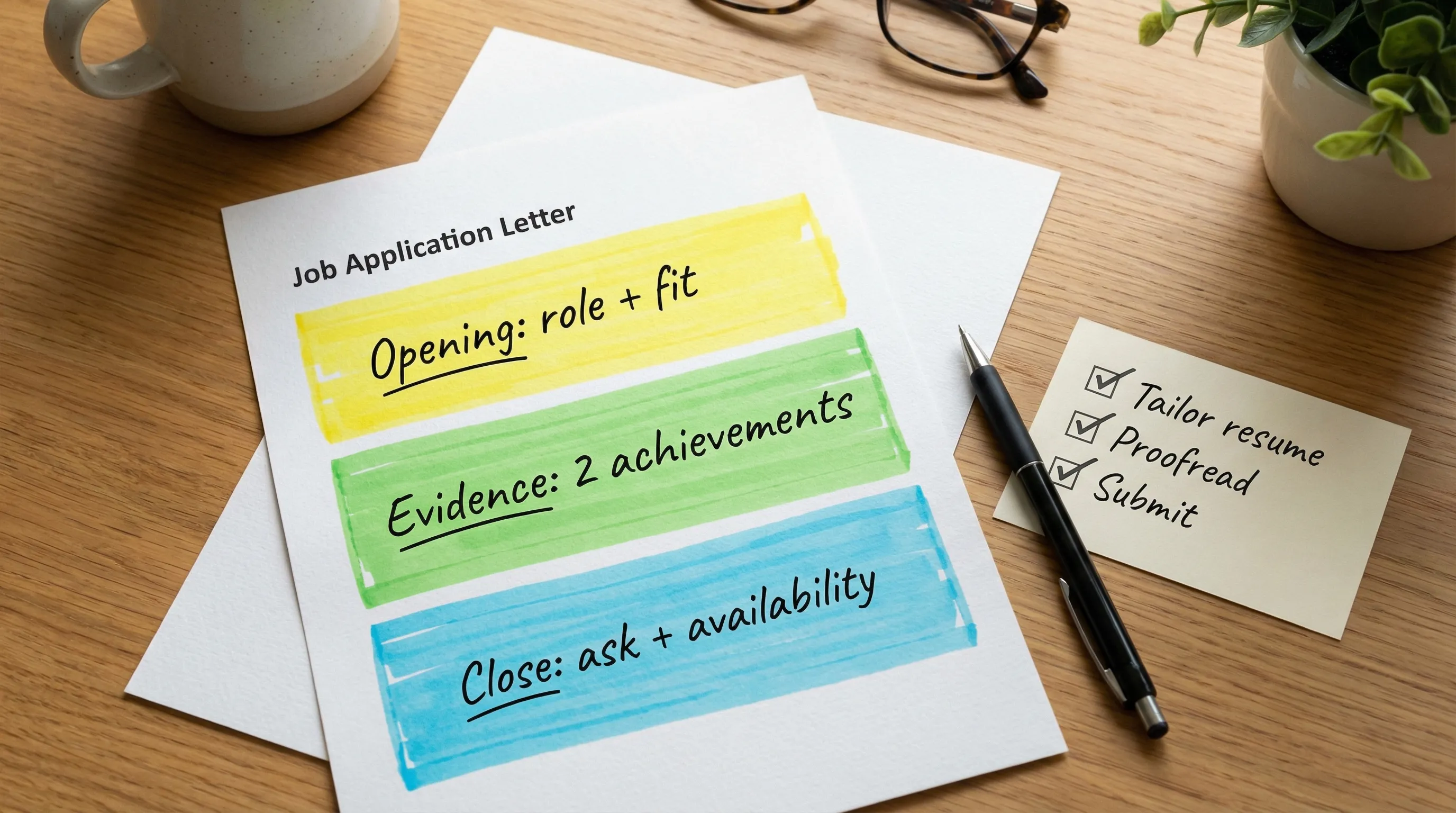
A long letter slows you down and usually lowers your odds. A fast, effective application letter is typically 200 to 350 words and follows a simple structure.
| Paragraph | What to say | What to avoid | Target length |
|---|---|---|---|
| 1. Hook | Role, where you found it, and a specific reason you fit this company | “I am writing to apply…” with no substance | 2 to 4 sentences |
| 2. Evidence | 2 proof points that match the job requirements (with numbers if possible) | Rewriting your resume line-by-line | 4 to 6 sentences |
| 3. Close | Confidence, logistics (availability), and a clear ask | Desperation, vague endings, or salary demands here | 2 to 4 sentences |
This format is fast because it forces focus. You only need a few inputs to write it.
The 15-minute method to write an application letter for employment
Minute 1 to 5: Gather only the inputs that matter
Open the job post and capture what you need to tailor the letter. Do not research for an hour.
- Job title and top 3 requirements (pull the exact wording from the posting)
- Company detail you can mention truthfully (product, mission, team, recent news, or value)
- Two achievements that map to the requirements
- One “why this role now” line (a real reason that connects your background to the next step)
If you cannot find a company detail in 2 minutes, use something safe and specific, like the team’s focus (“your customer retention goals”) or the product category.
Minute 6 to 12: Draft the letter using plug-in sentences
Instead of “writing,” assemble.
Paragraph 1 (Hook)
Use this formula:
- “I am applying for [Role] at [Company].”
- “I can help you [deliver outcome] because I have [relevant experience] and have achieved [proof].”
- “I am especially interested in [specific company detail].”
Paragraph 2 (Evidence)
Pick two proof points. For each proof point:
- Start with the skill they asked for.
- Add the situation.
- End with a measurable result.
Example pattern:
- “In my current role as [Role], I [action] which resulted in [metric].”
If you do not have metrics, use credible specifics: volume, frequency, tools, scope, stakeholders, or constraints.
Paragraph 3 (Close)
Close with confidence and a clear next step:
- “I would welcome the chance to discuss how I can help you [goal].”
- “I am available for an interview [time window] and can start [timing].”
- “Thank you for your time and consideration.”
Minute 13 to 15: Quick edit for clarity and credibility
Do three fast passes:
- Cut fluff: remove filler phrases (“hardworking,” “fast learner,” “team player”) unless you prove them.
- Add one concrete detail: a tool, process, customer type, or metric.
- Match job language: mirror the job post’s keywords naturally (especially the role title and core responsibilities).
A useful rule: if a sentence could be true for 500 other applicants, rewrite it.
Copy-and-paste template (fast and professional)
Paste this into your doc and replace the brackets.
[Your Name]
[City, State] | [Phone] | [Email] | [LinkedIn or Portfolio]

[Date]

[Hiring Manager Name]
[Company Name]
[Company Address] (optional)

Dear [Hiring Manager Name],

I am applying for the [Job Title] position at [Company Name]. With [X years / X months] of experience in [relevant field], I have delivered [relevant outcome] by [relevant strength]. I am particularly interested in [specific company detail], and I would love to bring my background in [skill area] to your team.

In my role at [Current/Most Recent Company], I [achievement #1 action] resulting in [metric/result]. I also [achievement #2 action], which led to [metric/result or specific impact]. These experiences align well with your need for [job requirement #1] and [job requirement #2], and I am confident I can contribute quickly.

I would welcome the opportunity to discuss how I can help [Company Name] [goal tied to role]. I am available for an interview [dates/times], and I can start [start date or notice period]. Thank you for your time and consideration.

Sincerely,
[Your Name]
Fast example (you can adapt in minutes)
Here is a short example for a posting that emphasizes customer support, tickets, and retention.
Jordan Lee
Austin, TX | (555) 012-3456 | jordan.lee@email.com | linkedin.com/in/jordanlee

April 7, 2026

Taylor Morgan
BrightDesk

Dear Taylor Morgan,

I am applying for the Customer Support Specialist position at BrightDesk. I have 3 years of experience supporting SaaS customers and resolving high-volume ticket queues while maintaining a calm, customer-first tone. I am especially interested in BrightDesk’s focus on reducing time-to-resolution without sacrificing quality.

In my current role at HexaTools, I manage a daily queue of 40 to 60 tickets across email and chat, consistently meeting SLA targets and improving first-contact resolution through better triage and macros. I also partnered with Product to report recurring bugs and confusing UX flows, helping reduce repeat tickets for one feature area by creating clearer help-center steps and internal troubleshooting notes.

I would welcome the chance to discuss how I can help BrightDesk deliver faster, more consistent support. I am available to interview this week and can start two weeks after an offer. Thank you for your time and consideration.

Sincerely,
Jordan Lee
Notice what makes it “fast but strong”: it is specific, it shows scope, and it avoids repeating the resume.
Common speed traps (and what to do instead)
Writing quickly should not mean writing carelessly. These are the mistakes that cost the most interviews.
Trap 1: Starting with a generic opener
“I am writing to apply for…” is not a deal-breaker, but it wastes your most valuable space.
A faster, stronger alternative is to combine role + proof in the first two lines.
Trap 2: Listing responsibilities instead of results
Hiring managers already know what the job includes. They want to know if you can deliver.
If you are tempted to write “I was responsible for…”, switch to:
- “I did [action], which improved [result].”
Trap 3: Over-explaining your entire story
Your letter is not a memoir. If you have something that needs context (career change, gap, layoff), address it in one neutral line, then return to proof.
Trap 4: Forgetting the logistics
A surprising number of letters never clearly state availability. A simple “I can start [date]” helps employers move faster.
Using AI to write it fast (without sounding robotic)
AI can speed up drafting, but the best results happen when you give it real inputs and then edit like a human.
Here is a simple approach that keeps your voice and credibility:
- Feed the AI only your best raw material: the job post highlights, your two achievements, and one company-specific detail.
- Choose a tone that matches the company: friendly, formal, confident, or direct.
- Edit for truth and specificity: keep what is accurate, remove anything you cannot defend in an interview.
If you are worried about AI-generated writing sounding “too AI,” focus on personalization first (real metrics, real tools, real context). For a broader overview of AI detection and editing resources, you can also explore AI detection and humanizing tools to understand what readers and detectors tend to react to, then prioritize authenticity over “gaming” anything.
If you want a shortcut, LetterCraft AI is designed for this exact use case. You fill in a few job and background details, pick a tone, and generate a ready-to-send letter quickly. It also supports 65+ letter types, PDF export, letter history tracking, and 5 languages, so you can reuse strong inputs and iterate faster.
Final 60-second checklist before you send
Use this to catch the mistakes that slip through when you are moving fast.
| Check | What “good” looks like |
|---|---|
| Tailored first paragraph | Mentions the role and one specific company detail |
| Proof included | At least 2 specific achievements, ideally with metrics |
| Scannable length | Roughly 200 to 350 words |
| No resume reprint | Adds context and value, does not duplicate bullets |
| Clean formatting | Easy-to-read paragraphs, consistent font, no dense blocks |
| Correct recipient | Hiring manager name if available, otherwise “Dear Hiring Manager” |
| Clear close | Polite ask for an interview plus availability |
When you can check most of these boxes, you are done. Send it, track it, and move to the next application.
If you want to go from blank page to polished draft even faster, generate your application letter for employment in under 30 seconds with LetterCraft AI, then spend your saved time tailoring the two proof points that actually win interviews.