Job Letter vs Cover Letter: What’s the Difference?
Job letter vs cover letter explained: definitions, key differences, when to use each, and how to choose the right format for your next application.
Hiring posts, career sites, and recruiters often use “job letter” and “cover letter” as if they mean the same thing. Sometimes they do. Other times, “job letter” is a broader label for several different employment letters, and sending the wrong format can make you look inattentive even if your experience is strong.
This guide breaks down what each term usually means, how employers use them in 2026, and how to choose the right document (without overthinking it).
The quick definition
A cover letter is a short, targeted pitch that supports your resume for a specific role.
A job letter is an umbrella term that can refer to any letter related to employment. In job-search contexts, it most often means a job application letter (also called a “letter of application”), which can be slightly more formal and sometimes more detailed than a standard cover letter.
Because “job letter” is ambiguous, your safest move is to interpret it based on the context of the job posting.
What is a cover letter?
A cover letter is a one-page (often 250 to 400 words) document that answers three questions clearly:
- Why this role?
- Why you?
- Why this company, specifically?
It is not a second resume. The best cover letters do two things well:
- Connect your most relevant achievements to the employer’s needs.
- Add human context a resume cannot (motivation, rationale for transitions, fit, a brief story, or a proof point).
Typical use: private-sector roles, applications through job boards, referrals, or when the posting explicitly asks for a cover letter.
What is a job letter?
“Job letter” is not a single standardized document. Employers may use it to mean:
- Job application letter (common meaning in recruiting): a formal letter applying for a position, sometimes used as the email body.
- Letter of interest (when no job is posted): outreach that introduces you and asks about potential openings.
- Employment letters after hiring: offer acceptance letters, resignation letters, promotion requests, transfer requests, and more.
So, when someone says “send a job letter,” your first task is to figure out whether they mean:
- “Send a cover letter,” casually phrased, or
- “Send a letter of application,” with a more formal structure or selection-criteria style.
Job letter vs cover letter: the real differences
Both documents aim to persuade, but the intent and format cues differ.
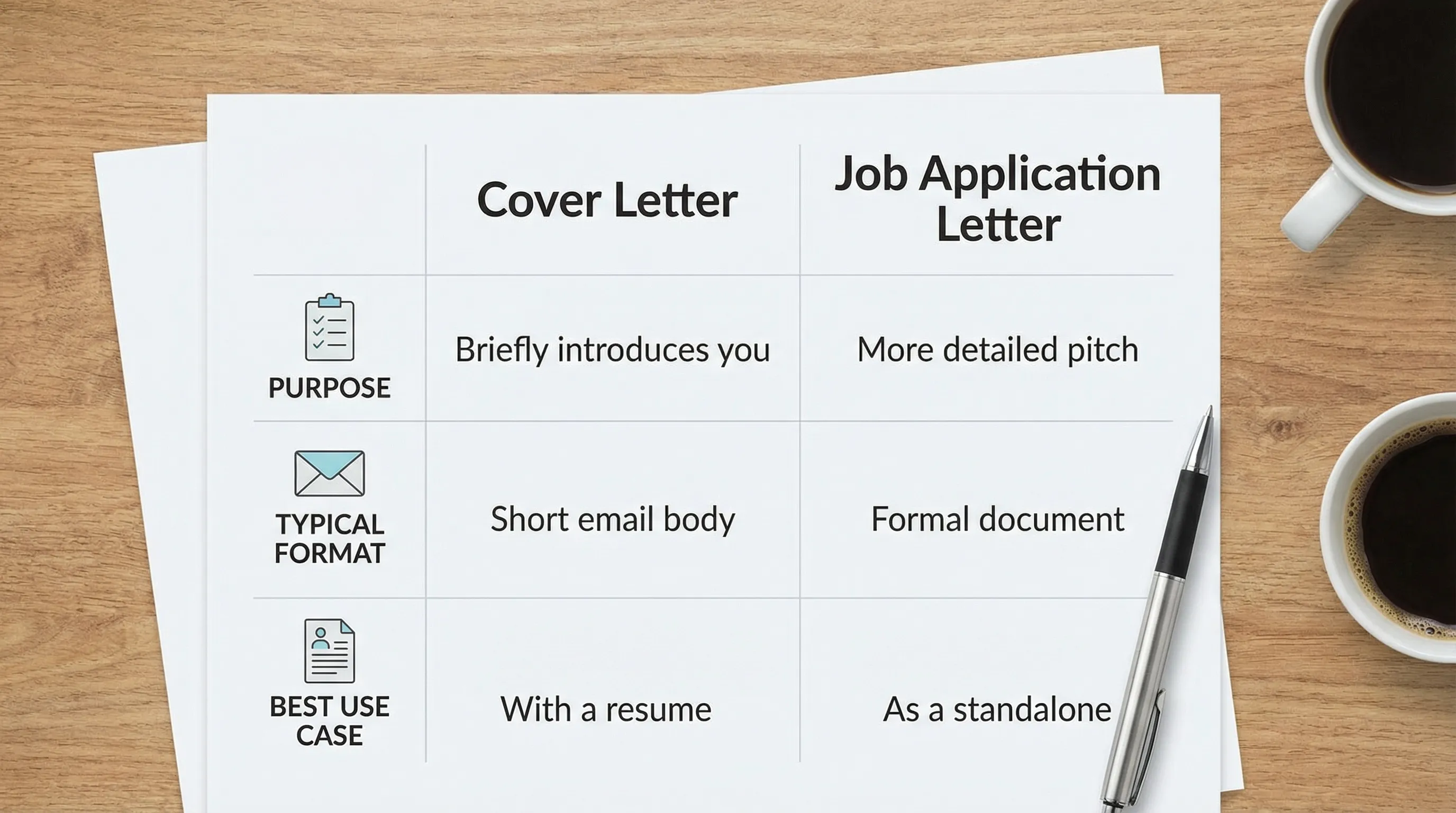
| Element | Cover letter | Job letter (often: application letter) |
|---|---|---|
| Primary purpose | Complement a resume with a tailored pitch | Formally apply and present fit, sometimes as the main narrative |
| Common context | Job boards, corporate portals, referrals | Email applications, government roles, roles with explicit selection criteria |
| Tone | Professional, concise, slightly conversational (role-dependent) | Often more formal and structured |
| Structure | Hook, evidence, close | More “letter-like”: opening, qualifications, alignment, closing |
| Length | Usually shorter, scannable | Can be similar length, sometimes a bit longer when criteria must be addressed |
| What it references | Resume highlights plus company-specific motivation | Resume highlights plus explicit job requirements and context |
Key takeaway: A cover letter is usually the expected attachment. A “job letter” might be the same thing, or it might be a more formal application letter that stands on its own.
How to tell what the employer actually wants
The job posting usually gives away the answer. Look for these signals.
If the posting says “cover letter”
Send a cover letter, even if someone else called it a “job letter.” Follow the instructions on:
- File type (PDF vs DOCX)
- Naming convention
- Where to upload it
If the posting says “job letter” or “application letter”
Scan for phrases like:
- “Address the selection criteria”
- “Explain how you meet the requirements”
- “Include a letter of application”
These are signs they want a job application letter format, typically with clearer mapping between your experience and their criteria.
If the posting says “email your application”
This often means:
- Your job application letter goes in the email body, and
- Your resume is attached (and sometimes a separate cover letter is optional).
In these cases, the “job letter” is essentially your formal email letter.
If you are unsure
When it is not explicit, you can:
- Check the application form fields (is there a “cover letter” upload slot?).
- Look at the organization type (government, education, and healthcare organizations more often use “application letter” language).
- Reply with a clarifying question if you have a real contact (this is common for internal roles or recruiter-led processes).
Structure: cover letter vs job application letter
You can think of these as two presentation styles of the same underlying content.
A modern cover letter structure (fast to read)
A strong cover letter is easy to skim:
- Opening: role, hook, and one proof point
- Evidence: 2 to 3 achievements tied to the job needs
- Close: motivation, logistics, and call to action
This is especially effective when hiring teams are reading quickly.
A job application letter structure (more formal)
A job application letter often reads more like traditional correspondence:
- Opening: the position, where you found it, and your intent to apply
- Fit paragraph: your background and the most relevant match
- Requirements paragraph: direct alignment to key criteria (especially if requested)
- Closing: enthusiasm, availability, and polite sign-off
If the employer expects a “letter,” this format feels familiar and compliant.
Examples of when each one is the better choice
Choose a cover letter when
You are applying through a portal, you are in a competitive field, and you need a clean, persuasive snapshot that complements your resume.
A cover letter is also a good choice when you need to frame something delicately, such as:
- a career change
- a gap
- a layoff
- a relocation
(You keep it brief and neutral, then pivot to outcomes.)
Choose a job application letter when
You are applying by email or to an organization that expects more formal writing, especially when the posting emphasizes requirements or criteria.
Common examples:
- Government or public-sector roles that expect criteria alignment
- Roles where you must show compliance items (certifications, clearance, licenses)
- Smaller organizations that want a formal letter in the email body
“Job letter” can also mean letters beyond the application
This is where candidates get tripped up. If someone says “job letter” outside a job application flow, they might mean an employment letter like:
- resignation letter
- acceptance letter
- salary negotiation letter
- internal transfer request
- work-from-home request
If you are dealing with a workplace situation rather than applying for a role, it is almost certainly not a cover letter.
How to reuse one document for the other (without rewriting from scratch)
If you already wrote a cover letter and now realize they want a job application letter, you can convert it in minutes:
- Add a formal opening line (position title, requisition number if available, and where you found it).
- Make the “evidence” section more explicit by mirroring 2 to 4 job requirements.
- Adjust the sign-off to a more traditional close (still warm, just more formal).
- Move attachments into the closing sentence if applying by email (“Resume attached for your review”).
The substance stays the same. The formatting and signaling changes.
A practical note: outreach messages are not cover letters
Many candidates use LinkedIn DMs or email intros to get noticed. These messages are useful, but they are not a replacement for the requested document.
If you are doing high-volume outreach (recruiting, business development, or even candidate networking), tools like Kakiyo’s AI for personalized LinkedIn conversations exist specifically to scale unique, human-like messaging and handle replies. For job applicants, though, keep your outreach message short and treat your cover letter or job application letter as the formal artifact that will be reviewed and saved.
Make either letter stronger with the same checklist
Regardless of which format you use, strong letters share the same foundations:
- Specificity: company name, role title, and a reason that is not generic
- Evidence: numbers, outcomes, scope, or concrete examples
- Relevance: only the experience that maps to the job
- Professional tone: confident, plain language, no exaggeration
- Clean formatting: easy to skim, no dense blocks of text
If you can only improve one thing, improve the evidence. A single quantified achievement often does more than five enthusiastic adjectives.
Drafting faster without sounding generic
If you are staring at a blank page, a structured first draft helps. Tools like LetterCraft AI generate personalized letters for 65+ scenarios (including job-focused letters) in under 30 seconds, with multiple tone options, PDF export, and letter history tracking. If you use an AI draft, the highest-impact edits are:
- Add one role-specific accomplishment (with numbers if possible)
- Name a real reason you want that company (product, mission, market, team)
- Remove filler lines that could apply to any employer
That combination keeps the speed benefits while making the result feel genuinely yours.
Bottom line
If the employer asks for a cover letter, send a cover letter.
If the employer asks for a job letter, treat it as a request for a job application letter, unless the context clearly indicates they are using the term loosely. When in doubt, follow the posting’s instructions, mirror their language, and make your qualifications easy to verify at a glance.