Application Letter for Job: A Clear Template to Follow
Use this application letter for job template with examples, section-by-section tips, and an email version to write a polished letter fast and get interviews.
Most hiring managers do not want a “life story.” They want a short, specific application letter that answers three questions quickly:
- Why this role?
- Why you?
- What should we do next?
If you have been staring at a blank page, use the template below as your default. Then customize only the parts that matter.
What an application letter for job should do (in 30 seconds of reading)
A strong application letter for job is a one page argument for fit. It is not a repeat of your resume. Think of it as your “highlight reel,” written in complete sentences, with just enough context to make your best evidence believable.
In 2026, most hiring teams skim. Your letter should be easy to scan, measurable where possible, and clearly tailored to the specific job.
Before you write, gather these details (you will write faster)
Collecting inputs first prevents generic filler.
- Job title and job posting URL (or a pasted snippet)
- Company name, team name (if available), and location
- Hiring manager name (optional, but helpful)
- Your top 2 relevant achievements (metrics, outcomes, scope)
- A short “why them” reason (product, mission, customers, news)
- Your availability and best contact details
If you only do one thing: pick two achievements that match the role’s priorities, and write the letter around those.
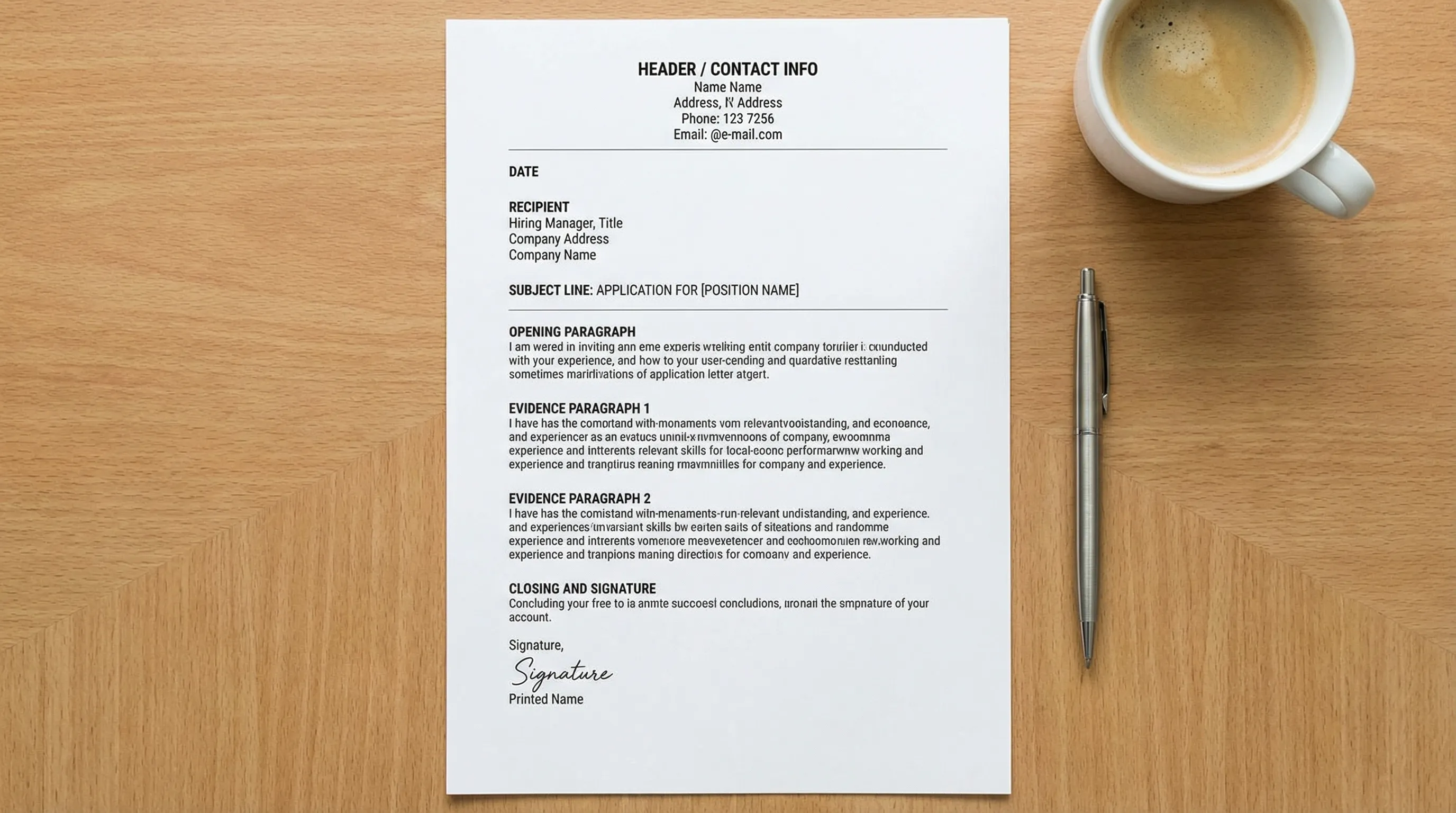
Application letter for job template (copy and paste)
Replace the bracketed fields. Keep the final letter roughly 200 to 400 words unless the employer explicitly asks for something longer.
[Your Name]
[City, State] | [Phone] | [Email] | [LinkedIn or Portfolio URL]

[Date]

[Hiring Manager Name]
[Company Name]
[Company Address Line 1]
[City, State ZIP]

Re: Application for [Job Title]

Dear [Hiring Manager Name],

I’m applying for the [Job Title] role at [Company Name]. With [X years / X type of experience] in [relevant area], I have delivered [outcome or specialty], including [achievement #1 with metric]. I’m excited about [Company Name] because [specific reason tied to the role or company].

In my recent role at [Current/Most Recent Company], I [achievement #1 in 1–2 lines: action + scope + measurable result]. This maps directly to your need for [requirement from posting], especially around [keyword or responsibility].

Previously, I [achievement #2 in 1–2 lines: action + scope + measurable result]. This experience strengthened my ability to [skill the job needs], and I’d bring the same approach to [Company Name] to help [team goal or business outcome].

I would welcome the opportunity to discuss how I can contribute as your next [Job Title]. Thank you for your time and consideration.

Sincerely,
[Your Name]
If you do not have a hiring manager name, use “Dear Hiring Manager,” or “Dear [Team Name] Hiring Team,” (avoid “To whom it may concern”).
What to write in each section (with examples)
Use this table to keep your draft focused and scannable.
| Section | Purpose | What “good” looks like | Example snippet |
|---|---|---|---|
| Opening | State the role, your value, and your motivation | Direct, specific, confident | “I’m applying for the Senior Analyst role. I’ve led forecasting and pricing work that improved gross margin by 2.1 points.” |
| Why this company | Prove you did minimal research | One concrete detail, not flattery | “I’m especially interested in your expansion into mid-market healthcare providers.” |
| Evidence #1 | Show you can do the core job | Action + scope + metric | “Reduced onboarding time from 14 days to 9 by redesigning SOPs and training.” |
| Evidence #2 | Show depth or a second priority | Different skill area, still relevant | “Built a dashboard used weekly by Sales and Support to flag churn risk.” |
| Close | Ask for next step | Polite, clear, not desperate | “I’d welcome a conversation to discuss how I can help the team hit [goal].” |
Email version (when you are not attaching a formal letter)
Some applications happen entirely in an email body (especially referrals, small companies, and cold outreach). In that case, keep it shorter.
Subject: Application for [Job Title] – [Your Name]

Hi [Hiring Manager Name],

I’m applying for the [Job Title] role. In [current/most recent role], I [achievement with metric]. I’m interested in [Company Name] because [specific reason].

A quick highlight that maps to your posting: I [second achievement with metric or scope].

If helpful, I can share examples of [portfolio/work] and walk through how I’d approach [relevant challenge].

Thanks,
[Your Name]
[Phone] | [LinkedIn/Portfolio]
Tip: if you attach a PDF, your email body can be a 2 to 4 sentence “cover note” that points the reader to the attachment.
How to tailor the template without overthinking it
Customization is about precision, not length. These small changes do most of the work:
Replace vague claims with proof
Instead of “I’m a hardworking team player,” write one line of evidence.
- Vague: “I improved processes.”
- Specific: “I cut ticket backlog by 38% in 6 weeks by triaging, rewriting macros, and setting SLAs.”
Mirror the job’s priority language (lightly)
If the posting emphasizes “stakeholder management,” use that phrase once, then prove it.
Add one company specific detail
Good sources include the company blog, product pages, a recent press release, or a talk by the hiring lead. Keep it factual.
Use one sentence to connect your past to their future
A strong connector line sounds like:
“I’d apply the same approach at [Company Name] to help [team] achieve [goal].”
Keep “why you’re leaving” out unless required
Do not volunteer negativity. If you must address a change (layoff, relocation, career shift), do it in one neutral sentence, then pivot to fit.
Common mistakes that make an application letter easy to ignore
Repeating your resume
If a line can be found in your resume verbatim, it is probably wasted space. Add context, outcomes, or motivation instead.
Writing a generic opening
Hiring teams see “I am writing to express my interest” all day. Start with role + value.
Overexplaining
Long letters do not sound more qualified, they sound less certain.
Using weak, passive asks
Avoid: “I hope to hear from you.”
Prefer: “I would welcome the chance to discuss…”
A quick process tip if you are testing job application emails (for builders)
If you are building an automated job application workflow, QA testing an HR inbox, or using AI agents to verify that confirmation emails arrive as expected, a programmable disposable inbox can save time. Tools like Mailhook’s programmable temp inboxes let you create test inboxes via API and receive emails as structured JSON, which is useful for automation and verification.
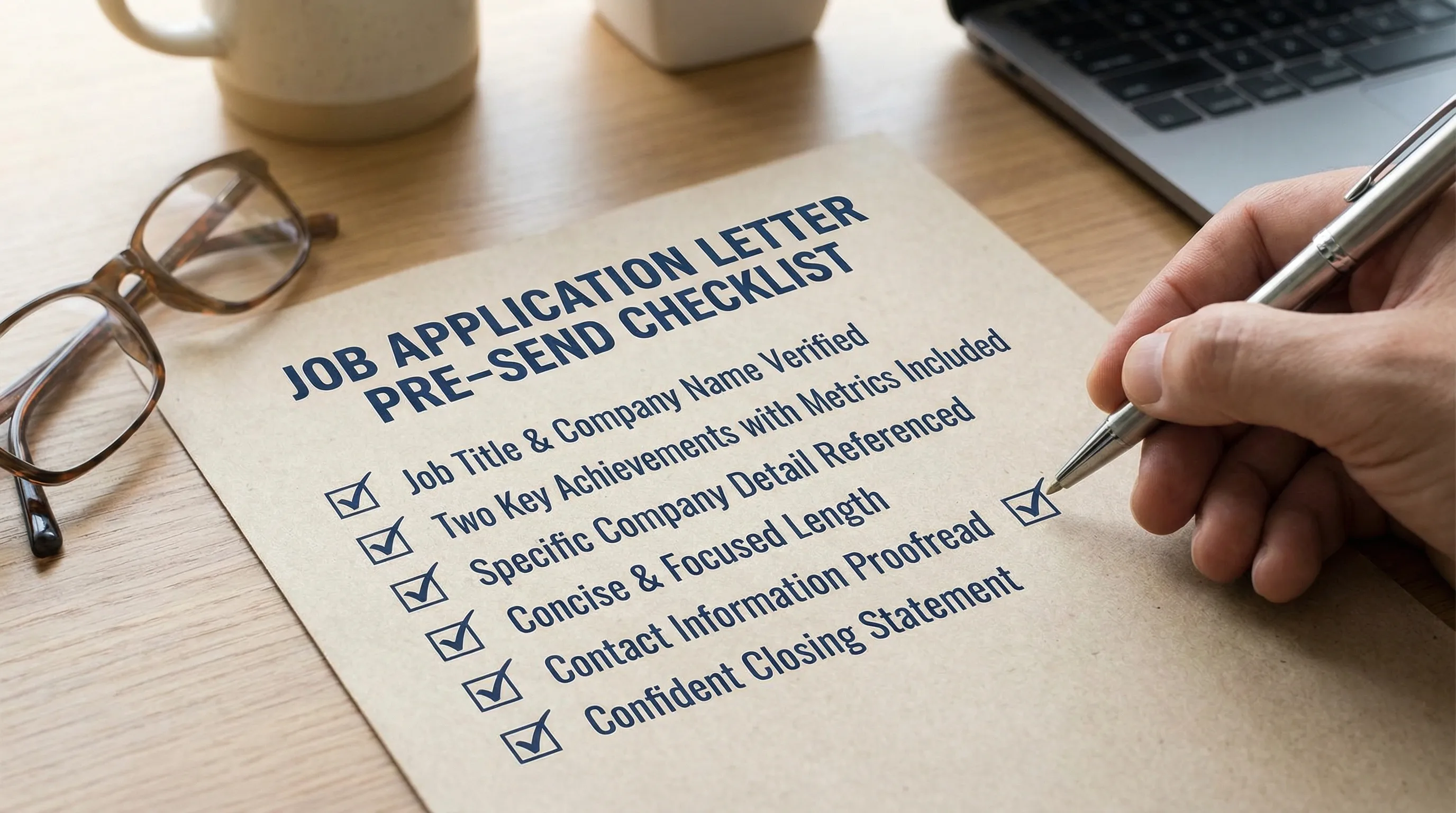
Final checklist before you hit send
Aim for “polished and human,” not “perfect.”
- Does the first paragraph mention the exact job title and company?
- Did you include 2 proof points with outcomes (numbers if possible)?
- Did you show one specific reason you want this role at this company?
- Is the letter one page and easy to skim?
- Did you remove filler phrases (very, really, various, helped with)?
- Did you confirm names, dates, and spelling?
Frequently Asked Questions
How long should an application letter for job be? Most strong letters are 200 to 400 words, or about three to five short paragraphs. Only go longer if the employer requests detailed selection criteria.
What is the difference between an application letter and a cover letter? In practice, employers often use the terms interchangeably. When a posting says “application letter,” it may mean a more formal letter format (with addresses and date) or a response to specific criteria.
Should I include my full address in 2026? Usually no. City and state are enough for most roles, unless the employer specifically requests your full mailing address.
Is it okay to use AI to write my application letter? Yes, as long as you verify every detail, add job-specific evidence, and revise the tone so it reflects how you actually communicate.
Can I use the same template for every job? Use the same structure, but swap in new proof points and a new company-specific reason each time. A template is a starting frame, not a reusable final draft.
Write a tailored application letter in 30 seconds with LetterCraft AI
If you want a fast first draft that still sounds professional, you can generate an application letter (and 65+ other letter types) with LetterCraft AI. Add a few details, pick a tone, and get a ready-to-send letter in under 30 seconds, with options like PDF export, letter history tracking, copy to clipboard, and support for 5 languages. No credit card required, free to try, and one-time pricing (no subscriptions).